
Companies House requires UK businesses to submit PSC change notifications within 14 days of any alteration, combining a 14-day update period with a 14-day public register processing window to maintain legal compliance, avoid severe financial penalties, and prevent director prosecution.
What Is the 14-Day PSC Update Rule for UK Companies?
UK corporate law mandates that companies update their Person with Significant Control register within 14 days of confirming changes, and submit this information to Companies House within a further 14 days to maintain accurate statutory records.
Directors often misunderstand statutory compliance timelines. Every UK registered company must track ownership changes meticulously. When a shareholder increases shares beyond 25%, voting rights shift, triggering mandatory reporting obligations. Companies House enforces these timelines strictly. Failing to update internal registers before filing creates discrepancies. Authorities cross-reference internal company books with public filings during audits. Business owners must integrate compliance tracking into daily administration workflows.
Managing statutory deadlines requires precision and speed. The legal framework protects market transparency. Creditors and investors rely on up-to-date public registers. When ownership structures evolve, transparency safeguards market integrity. Companies must establish internal oversight mechanisms immediately after corporate restructuring occurs. Delaying notifications invites regulatory scrutiny from government enforcement agencies.
Why Do Companies Fail to Meet the 14-Day Deadline?
Administrative oversight, complex corporate ownership chains, and delayed shareholder communication cause most deadline breaches, leading to criminal records for directors and daily financial penalties for non-compliant business entities.
Many corporate secretaries miscalculate statutory windows by counting business days instead of calendar days. Weekend tracking errors frequently invalidate submission timelines. Furthermore, complex multi-layered corporate structures obscure beneficial ownership details. When a corporate entity becomes a PSC, verifying its governing law and registration number takes vital time. Delays compound quickly during holiday periods or staff absences. Companies House rejects filings containing minor clerical errors, eating into the remaining statutory window.
| Compliance Failure Cause | Operational Impact | Regulatory Consequence |
| Calendar Calculation Errors | Missed filing windows by counting business days only | Immediate financial penalties |
| Complex Ownership Chains | Delayed identification of ultimate beneficial owners | Formal warning notices from authorities |
| Clerical Typographical Mistakes | Rejection of digital filings by Companies House | Resetting of submission timelines |
Directors face personal liability for regulatory breaches. Defaulting on statutory filings triggers fines reaching 5,000 pounds. Persistent non-compliance results in criminal prosecution for company officers. Corporate reputation suffers permanent damage when public registers display persistent filing defaults. Implementing automated tracking systems mitigates these operational risks effectively. Professional secretarial assistance ensures absolute adherence to statutory timeframes.
How Do You Identify a Person with Significant Control?
A Person with Significant Control is any individual who holds more than 25 percent of shares or voting rights, exercises significant influence or control, or holds the right to appoint board directors.
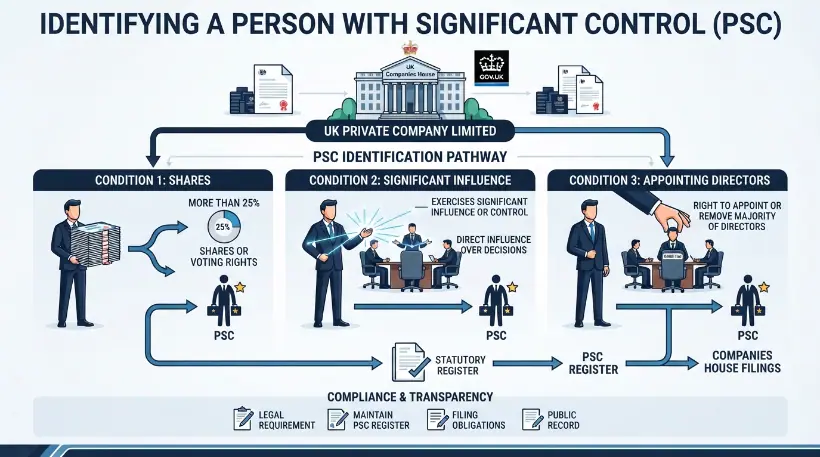
Identifying a PSC requires examining both direct and indirect holdings. Ownership thresholds operate on exact numerical markers. Holding exactly 25.1 percent of voting shares meets statutory classification criteria. Voting rights dictate control mechanisms independently of financial equity shares. Individuals holding veto powers over board decisions also qualify as PSCs. Companies must review shareholder agreements alongside constitutional documents to uncover hidden control patterns.
| Control Classification | Statutory Threshold | Verification Requirement |
| Direct Share Ownership | Exceeding 25% of company shares | Examine share certificates and register of members |
| Voting Rights Control | Exceeding 25% of voting power | Review articles of association and shareholder pacts |
| Board Appointment Power | Right to appoint or remove majority directors | Audit governance agreements and control documents |
Evaluating significant influence involves assessing operational control over business decisions. Trusts and limited partnerships introduce complex reporting requirements. Trustees exercising control must be formally registered as PSCs. Companies must document every evaluation step meticulously. Maintaining an audit trail protects directors during compliance reviews. Professional corporate formation platforms simplify this complex identification process. You can learn more about foundational setup requirements by reviewing the guidance on how do you notify Companies House of a new PSC.
What Happens When You Miss the 14-Day Deadline?
Missing the statutory filing deadline results in automatic marker flags on the public register, daily financial default fines, potential director disqualification proceedings, and severe reputational damage among commercial banking partners.
Regulatory enforcement begins immediately after the 14-day window closes. Companies House issues formal warning notices to the registered office address. Ignored warnings escalate into magistrates’ court summonses. Magistrates impose criminal records and financial penalties on defaulting officers. Commercial lenders review public compliance history before approving credit facilities. A flagged register signals poor corporate governance to potential investors and suppliers.
| Enforcement Stage | Timeline | Statutory Penalty |
| Initial Warning Notice | Day 1 to Day 30 post-deadline | Formal compliance demand issued |
| Magistrates Court Action | Day 31 to Day 90 post-deadline | Personal fines up to 5,000 pounds |
| Director Disqualification | Extended default periods | Prohibition from company management |
Correcting late filings requires immediate remedial action. Directors must submit retroactive notifications alongside explanatory letters. Companies House evaluates each late submission individually. Paying associated fines does not remove the public record of default. Proactive management remains the only reliable defense against regulatory penalties. Utilizing dedicated compliance tools prevents accidental deadline lapses entirely.
How Can Form My Company Streamline Your PSC Filings?
Form My Company accelerates statutory compliance by utilizing digital automation, expert oversight, and structured workflows to submit accurate PSC notifications well within the 14-day statutory deadline.
Professional filing services eliminate human calculation errors. Dedicated compliance software tracks ownership changes automatically from the moment shares transfer. Expert company secretaries review every data point prior to submission. This pre-submission verification prevents rejection errors from Companies House. Businesses save administrative hours while guaranteeing absolute legal alignment with UK corporate standards.
| Compliance Service Feature | Operational Benefit | Risk Reduction |
| Automated Deadline Tracking | Prevents missed calendar windows | Zero risk of financial default fines |
| Expert Data Verification | Eliminates typographical submission errors | Instant acceptance by Companies House |
| Secure Digital Storage | Maintains flawless internal registers | Full audit readiness for regulatory reviews |
Outsourcing corporate secretarial tasks frees management to focus on core business growth. Companies maintain immaculate public records without dedicating internal staff to regulatory monitoring. To secure your corporate standing and execute filings flawlessly, review our expert PSC register management services today. For comprehensive strategies on long-term compliance, consult meet the 14-day PSC deadline with Form My Company.
Explore our PSC Register guide,
When to Choose Certified Copies Over Standard Printouts
How to Run GDPR-Compliant Interviews in a Hired Room
Frequently Asked Questions
What is a PSC register and why is it legally required for UK companies?
A Person with Significant Control (PSC) register is a mandatory statutory record that identifies individuals who own or control a UK registered company. Form My Company helps businesses maintain this register accurately to comply with the Companies Act 2006 and ensure complete corporate transparency.
What details must be recorded in the company’s PSC register?
The PSC register must record full legal names, service addresses, residential addresses, dates of birth, nationality, and the exact nature of control held over the company. Utilizing Form My Company ensures that all required beneficial ownership data is formatted and recorded according to strict UK regulatory standards.
How do you update Companies House when a PSC’s details change?
Companies must notify Companies House of any alterations to PSC details within 14 days of updating their internal statutory register. Form My Company streamlines this process by submitting verified change notifications digitally to prevent administrative delays and compliance penalties.
What are the penalties for failing to maintain a correct PSC register?
Failing to keep an accurate PSC register or missing statutory reporting deadlines can result in unlimited fines, criminal records for company officers, and potential prosecution. Form My Company mitigates these regulatory risks by managing compliance tracking and digital filings on your behalf.
Can a corporate entity be listed as a Person with Significant Control?
A corporate entity can be registered as a PSC only if it meets specific exemption criteria, such as being subject to its own disclosure requirements or holding its own voting shares on a regulated market. Form My Company assists businesses in evaluating complex corporate ownership chains to identify eligible registrable relevant legal entities correctly.