Running GDPR-compliant interviews in a hired room requires strict data minimization, secure physical environment controls, encrypted digital recording practices, and immediate disposal protocols for candidate notes to protect applicant privacy rights under UK data protection legislation.
What Legal Obligations Apply Under UK GDPR When Hiring Interview Spaces?
UK GDPR legal obligations mandate that organizations establish a lawful basis for processing candidate data, appoint data controllers for physical spaces, implement strict access logs, and sign data processing agreements with external venue providers before conducting any in-person interviews.
Organizations processing candidate information must maintain absolute transparency. When businesses conduct recruitment in third-party spaces, the physical boundary becomes an extension of the corporate data processing environment.
Data protection officers must classify candidate resumes, handwritten assessment sheets, and biometric identification records as sensitive personal data. Under Article 6 of the UK GDPR, employers require a valid lawful basis, typically legitimate interests or contractual necessity, to collect this information during an interview process.
External venue providers act as data processors under strict legal definitions. Businesses must execute formal Data Processing Agreements (DPAs) with facility operators. These agreements ensure that cleaning staff, reception personnel, and facility managers do not access unattended interview tables or read candidate portfolios left in shared rooms.
Employers must also maintain an updated Record of Processing Activities (ROPA). This record details exactly which physical addresses host candidate assessments, matching the transparency mandates enforced by the Information Commissioner’s Office (ICO).
How Can You Secure Physical Interview Rooms Against Data Breaches?
Securing physical interview rooms requires utilizing dedicated private meeting spaces, positioning furniture to block visual eavesdropping, locking doors during evaluations, and removing all previous candidate documentation before admitting new applicants.
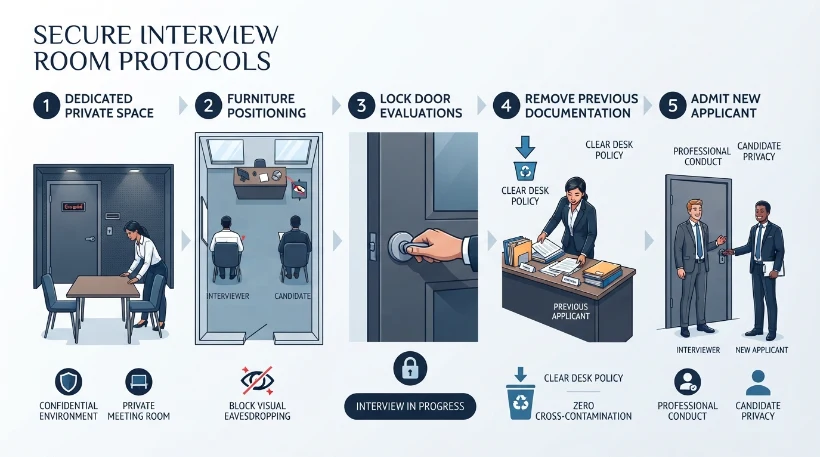
Physical security vulnerabilities represent a primary source of recruitment data breaches. Standard open-plan meeting rooms often feature glass walls or thin partitions that allow unauthorized individuals to overhear confidential competency discussions.
Organizers must book fully enclosed spaces with soundproofed walls to safeguard verbal data. Furniture arrangement dictates visual security. Interviewers must sit with their backs facing solid walls. This positioning prevents corridor pedestrians or reception staff from viewing evaluation laptops, scoring matrices, or printed candidate portfolios.
Document management requires rigorous physical control protocols. Interviewers must never leave paper resumes on reception desks, shared printers, or meeting room tables.
When businesses utilize professional Interview Rooms, they eliminate shared-office vulnerabilities by securing private, dedicated spaces designed specifically for confidential corporate evaluations. Every piece of scrap paper containing interview notes must go directly into a cross-cut shredder or a locked secure destruction bin immediately following each session.
What Rules Govern Audio and Video Recordings During Hired Room Interviews?
Audio and video recordings during hired room interviews demand explicit prior candidate consent, encrypted digital storage on secure cloud servers, strict retention timeframes, and immediate deletion upon completion of the recruitment evaluation cycle.
Recording candidate interactions introduces severe regulatory exposure under data protection laws. Before activating any recording device, interviewers must provide a clear privacy notice explaining why recording occurs, who accesses the footage, and how long the file remains archived.
Implicit consent through room entry signage does not satisfy UK GDPR requirements. Organizations must secure explicit, opt-in written consent from every candidate at least 48 hours prior to the scheduled interview date.
Technical infrastructure must meet high cybersecurity standards. Storing video files on unsecured local hard drives violates core accountability principles. Footage must upload automatically via end-to-end encrypted protocols to ISO 27001-certified cloud repositories.
Access controls must restrict playback capabilities strictly to the hiring manager and designated human resources personnel. Retention schedules must operate automatically. Systems must purge all interview video and audio files within 30 days of the final hiring decision, unless the candidate provides written authorization for talent pool retention.
How Do You Handle Candidate Identification Documents Securely On-Site?
Handling candidate identification documents on-site involves verifying passports or driver licenses visually without unauthorized photocopying, recording only verification confirmation timestamps, and discarding temporary digital scans immediately after compliance checks.
Verifying the right to work in the UK requires inspecting original physical documents. However, retaining photocopies or digital scans of passports in unencrypted folders creates massive compliance liabilities.
Recruitment teams must execute identity checks using standardized, minimalist procedures.
Inspect original government-issued photo identification under adequate lighting without recording unauthorized digital replicas
Validate security features such as holographic stamps and expiration dates against official regulatory guidelines
Record only the verification date, the identity document type, and the checker’s employee identifier in the applicant tracking system
Shred any temporary paper notes used during the identity confirmation process before the candidate exits the building
Storing excessive identification data violates the data minimization principle outlined in Article 5 of the UK GDPR. Businesses should transition from manual paper record-keeping to secure digital compliance frameworks. For detailed legal guidelines on early-stage recruitment compliance, review the What Are the GDPR Rules for Recruitment and Interviews? reference guide.
What Are the Best Practices for Document Disposal After Hired Room Interviews?
Best practices for post-interview document disposal require utilizing locked on-site shredding consoles, executing secure digital file deletion protocols, auditing paper trails daily, and retaining only essential recruitment justification metrics.
The final stage of the interview lifecycle presents the highest risk of accidental data leakage. Leaving evaluation notes inside a rented meeting room constitutes a severe reportable data breach under UK law.
Organizers must audit the room thoroughly after every candidate departs. Check table surfaces, chair pockets, whiteboards, and waste receptacles for stray notes.
Physical document destruction must occur via certified on-site shredding vendors or locked security bins provided by the venue management. Digital document deletion requires purging temporary cache files from shared laptops or tablets utilized during presentations.
Organizations should retain only structured scoring metrics necessary to defend against potential employment tribunal claims. This data must move immediately into secure, access-controlled human resources databases.
To streamline compliant venue sourcing and protect your recruitment pipeline from regulatory exposure, explore options to Book GDPR-Compliant Interview Rooms With Form My Company for your next hiring cycle.
Maintaining UK GDPR compliance during interviews conducted in hired rooms requires rigorous attention to physical security, digital encryption, and data minimization. Businesses must treat external meeting spaces as extensions of their corporate compliance perimeter. By enforcing strict access logs, securing explicit recording consents, and executing immediate document disposal protocols, organizations protect candidate privacy while mitigating severe regulatory penalties. Form My Company delivers secure, professional solutions designed to meet these exacting corporate standards.
Explore our Interview Rooms guide,
Accessibility Checklist for Booking a Conference Room
How to Make Your Corporate Event Inclusive for Every Delegate
Frequently Asked Questions
Can businesses legally conduct job interviews in hired rooms?
Yes, businesses can legally conduct job interviews in hired spaces provided they maintain strict UK GDPR compliance, secure explicit candidate consent for data handling, and implement physical access controls. When utilizing professional interview rooms through Form My Company, organizations ensure that candidate privacy rights remain fully protected throughout the recruitment evaluation process.
What are the main data protection requirements for recruitment in temporary venues?
Recruitment data protection in temporary spaces requires establishing a lawful basis for processing, executing formal data processing agreements with venue operators, and utilizing secure digital or physical document storage. Form My Company assists employers by providing dedicated interview rooms equipped with private meeting boundaries to prevent unauthorized viewing of sensitive applicant portfolios.
How do you dispose of candidate interview notes securely in a hired space?
Interview notes must be destroyed immediately following candidate evaluations using certified cross-cut shredders or locked secure destruction bins provided on-site. Organizations utilizing specialized interview rooms via Form My Company can securely clear all physical evaluation paperwork to eliminate the risk of reportable data breaches under UK data protection legislation.
Are employers required to sign data processing agreements with interview room providers?
Employers must ensure that external venue providers comply with data protection regulations, which frequently involves reviewing facility access terms and ensuring that unauthorized staff cannot access interview records. Form My Company structures its interview rooms to meet corporate compliance standards, allowing hiring teams to manage candidate assessments securely without shared-office data exposure.
How can companies protect candidate privacy during in-person interviews at external locations?
Protecting candidate privacy in external locations involves booking fully enclosed soundproofed spaces, positioning seating to block visual eavesdropping, and restricting digital recording access. By booking private interview rooms through Form My Company, businesses create a secure physical perimeter that safeguards sensitive personal data and adheres to UK GDPR guidelines.