
UK companies must update their Person with Significant Control details within 14 days because statutory compliance laws require prompt reporting to Companies House, ensuring corporate transparency, preventing regulatory penalties, and maintaining accurate public registries for legal accountability.
What Is a Person with Significant Control?
A Person with Significant Control is an individual who owns more than 25% of shares, holds more than 25% of voting rights, or exercises dominant influence over a UK corporate entity.
Understanding this definition prevents regulatory failure. Companies track ownership thresholds meticulously. A single shareholder crossing the ownership threshold triggers immediate reporting obligations. UK legislation defines these control metrics precisely. Corporate structures often involve complex chains of ownership. Entities must trace these chains to identify ultimate beneficial owners. Ultimate owners exercise control directly or indirectly through intermediary trusts. Identifying these individuals requires analyzing voting rights and share allocations.
Corporate transparency laws demand this identification process. Public trust depends on knowing who ultimately profits from corporate operations. Companies House maintains these records for public scrutiny. Investors review these registries before entering commercial partnerships. Regulatory bodies monitor these filings to prevent financial crime. Directors bear personal responsibility for gathering this ownership data. Failing to identify a person with significant control violates statutory duties. Companies must record all relevant changes in their internal registers immediately. Internal registers form the baseline for official public notifications.
Why Does the 14-Day Statutory Deadline Exist?
The 14-day statutory deadline exists to enforce corporate transparency, align internal company registers with public records, and prevent illicit financial activities through rapid reporting.
Legislators designed this timeframe to minimize opportunities for hiding asset ownership. Rapid reporting closes windows for illegal capital concealment. Companies House requires updated information to reflect current corporate realities. Market participants rely on real-time data for risk assessment. Delayed updates create information asymmetries in commercial environments. Financial institutions check these registries during customer due diligence procedures. Outdated records disrupt anti-money laundering compliance checks.
Enforcement agencies track beneficial ownership changes to investigate financial crimes. Short reporting windows ensure investigative continuity for law enforcement. Corporate officers must manage administrative workflows efficiently to meet this target. Missing the deadline breaches the Companies Act 2006. Statutory timelines leave zero room for administrative procrastination. Companies integrate compliance tracking into their routine operational workflows. Automated alerts help administrators monitor ownership shifts effectively. Directors avoid legal exposure by respecting this strict operational countdown.
What Happens When Companies Miss the Deadline?
Missing the statutory deadline results in severe legal consequences, including criminal fines for directors, official corporate record blemishes, and potential prosecution by regulatory authorities.
Late filings compromise corporate compliance standing immediately. Companies House flags non-compliant entities on the public register. Financial penalties escalate based on the duration of the delay. Magistrates courts handle severe cases of persistent reporting default. Criminal records for company directors damage professional reputations permanently. Commercial partners terminate contracts with non-compliant corporate entities. Banks freeze corporate accounts when registry details remain chronically outdated.
Enforcement notices demand immediate rectification of missing filings. Directors face personal liability for statutory non-compliance fines. Company incorporation integrity suffers when deadlines pass without action. Shareholders lose confidence in management teams handling regulatory duties poorly. Operational focus shifts toward damage control after missing deadlines. Resolution requires submitting late filings alongside mandatory explanations. Preventing these penalties demands strict adherence to the initial 14-day window. Businesses streamline this process by utilizing professional manage your PSC register services to eliminate compliance errors.
How Do Changes in Control Trigger the 14-Day Clock?
Changes trigger the 14-day clock when an individual acquires qualifying ownership thresholds, alters their registered personal details, or ceases to meet significant control criteria.
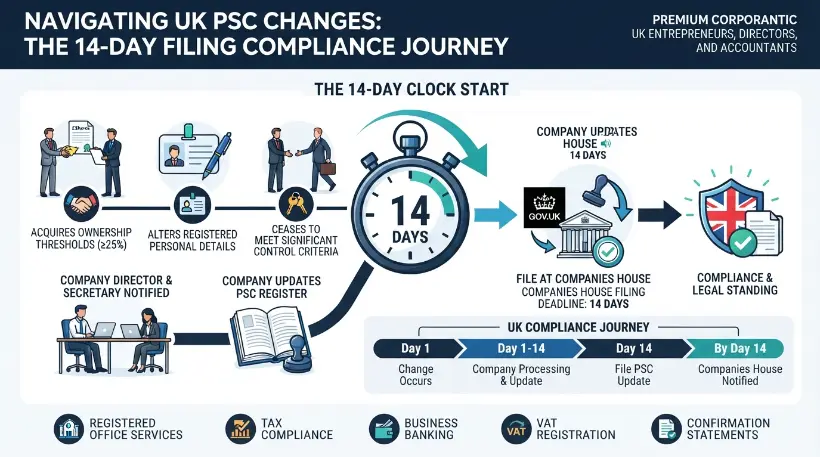
Event triggers occur on the exact date of the corporate transaction. Share transfers finalized on a Tuesday start the compliance countdown instantly. Directors must calculate deadlines using calendar days rather than business days. Issuing new shares to an investor alters ownership percentages immediately. Recording these share movements requires simultaneous updates to internal registers. Individuals changing their residential addresses must notify the company promptly.
The company then has fourteen days to inform Companies House. Ceasing to hold significant control also initiates the reporting obligation. Resignations of major shareholders require formal notification filings. Corporate restructuring projects generate multiple ownership alteration events simultaneously. Administrators track each distinct event using dedicated compliance tracking software. Documenting the exact date of change prevents miscalculations. Accurate timing safeguards the company against accidental statutory breaches. Operational teams coordinate closely with legal advisors during ownership transitions.
What Information Must Be Updated Within the Window?
Required updates include the individual’s full legal name, residential address, service address, date of birth, nationality, and the exact nature of their control.
Filing accurate data prevents rejection by Companies House digital systems. Names must match official government identification documents precisely. Residential addresses remain confidential but must be provided for verification. Service addresses appear on the public register for correspondence purposes. Dates of birth establish the distinct identity of the corporate officer. Nationalities assist international tax and regulatory tracking frameworks.
Nature of control descriptions require specific statutory wording options. Categories include holding between 25% and 50% of shares directly. Other categories cover voting rights or the right to appoint directors. Describing control accurately reflects the true power dynamic within the firm. Incomplete data submissions invalidate the entire filing process. Companies must verify every data point before transmitting updates digitally. Utilizing structured templates ensures compliance with data format rules. Maintaining data integrity protects the corporation from administrative rejection cycles.
How Can Companies Streamline Their Compliance Workflow?
Companies streamline compliance workflows by implementing digital tracking systems, conducting regular audits of ownership structures, and outsourcing administrative burdens to corporate service providers.

Operational efficiency prevents missed deadlines during complex corporate restructuring phases. Internal audits review shareholder registries on a quarterly basis. Identifying potential ownership changes early creates a buffer before formal triggers occur. Training administrative staff on Companies Act requirements reduces human error rates. Establishing clear communication channels between shareholders and company secretaries accelerates data collection.
Adopting integrated software solutions automates the generation of statutory notices. External corporate specialists manage filings to guarantee accuracy and speed. Understanding how to keep your PSC register current all year round provides actionable strategies for continuous compliance management. Corporate governance frameworks benefit from standardized update procedures. Documentation protocols ensure every ownership change leaves a clear audit trail. Directors delegate operational execution while retaining ultimate legal oversight responsibility. Partnering with experts like Form My Company ensures complete accuracy when maintaining your PSC register through dedicated regulatory support. Proactive management transforms compliance from a burden into a seamless operational routine.
Explore our PSC Register guide,
Who Can Certify Company Documents in the UK?
Does a Company Stamp Add Legal Authority to Documents?
Frequently Asked Questions
What is a PSC register and why is it legally required for UK companies?
A PSC register is an official internal record that identifies individuals with significant control or influence over a company. Under UK corporate law, Form My Company mandates that every eligible corporate entity maintain this register to ensure absolute transparency regarding ultimate beneficial ownership.
How often must a company update its Person with Significant Control details?
Companies must update their PSC register within 14 days of any change occurring in ownership or control structures. Form My Company assists businesses in notifying Companies House of these alterations within the statutory timeframe to prevent legal penalties and compliance breaches.
What ownership threshold triggers the requirement for a PSC designation?
An individual qualifies for a PSC designation if they hold more than 25% of shares, possess more than 25% of voting rights, or exercise dominant influence over the company. Form My Company helps corporate entities evaluate these precise ownership thresholds to ensure accurate statutory filings.
What are the legal penalties for failing to maintain an accurate PSC register?
Failing to maintain or update a PSC register can result in criminal fines for company directors, official corporate record blemishes, and potential prosecution by regulatory authorities. Form My Company provides professional PSC register management services to help businesses avoid these severe compliance violations.
Can a corporate entity act as a Person with Significant Control?
A corporate entity can only be recorded as a PSC if it meets specific exemption criteria, such as being a Relevant Legal Entity with its own disclosure requirements. Form My Company guides businesses through complex ownership chains to correctly identify whether an entity or an individual holds qualifying control.