

Keeping your People with Significant Control register current requires recording changes within 14 days, updating Companies House within another 14 days, verifying individual identities promptly, maintaining accurate residential addresses, and monitoring ownership thresholds continuously to prevent statutory compliance breaches and severe penalties.
Maintaining an accurate People with Significant Control register protects corporate transparency and ensures absolute statutory compliance. UK legislation mandates strict timelines for recording ownership changes. Directors must manage register updates diligently to avoid criminal offences. Companies face severe daily fines and potential officer imprisonment for non-compliance. Regulatory frameworks demand constant vigilance regarding voting rights and share allocations. Proper register maintenance safeguards corporate reputation during audits and transactions.
What Constitutes a Person with Significant Control in a UK Company?
A Person with Significant Control holds more than 25% of shares, holds more than 25% of voting rights, exerts significant influence or control, or holds the right to appoint board majorities.
Identifying qualifying individuals demands a thorough review of corporate ownership structures and voting agreements. Direct shareholdings create clear transparency obligations under standard corporate law. Indirect holdings through parent entities or trusts complicate control determinations significantly. Voting rights attached to shares determine control thresholds independently of nominal share value. Exercising dominant influence over corporate policy triggers registration duties immediately. Minority shareholders holding veto rights over business strategies qualify as significant controllers.
Corporate entities and trusts must also be registered if they meet specific control criteria. These qualifying bodies corporate are known as Relevant Legal Entities within the register.
| Control Type | Threshold Criteria | Registration Requirement |
| Share Ownership | Exceeding 25% of nominal share capital | Mandatory entry within statutory registers |
| Voting Rights | Holding more than 25% of total voting rights | Mandatory entry within statutory registers |
| Board Control | Right to appoint or remove majority of directors | Mandatory entry within statutory registers |
| Significant Influence | Exercising dominant influence over company decisions | Mandatory entry within statutory registers |
Why Do Timelines Matter for PSC Register Updates?
Statutory timelines mandate recording changes within 14 days and filing updates with Companies House within a subsequent 14-day window.
Missing statutory deadlines triggers immediate legal penalties under the Companies Act 2006. Enforcement agencies monitor filing punctuality automatically through digital submission gateways. Late notifications generate financial penalties ranging from 1,500 pounds to unlimited fines for persistent offenders. Directors face criminal prosecution and personal liability for wilful default on compliance duties. Prompt reporting maintains public trust and ensures corporate transparency for stakeholders.
Timely administration prevents cumulative backlogs that complicate annual confirmation statement filings. Companies must establish internal review protocols to track ownership alterations the moment they occur. Accurate records facilitate smooth corporate due diligence during mergers and acquisitions.
How Can Companies Accurately Track Ownership Changes Throughout the Year?
Companies track ownership changes by conducting quarterly audits, monitoring share transfers, reviewing shareholder agreements, and recording equity adjustments immediately.
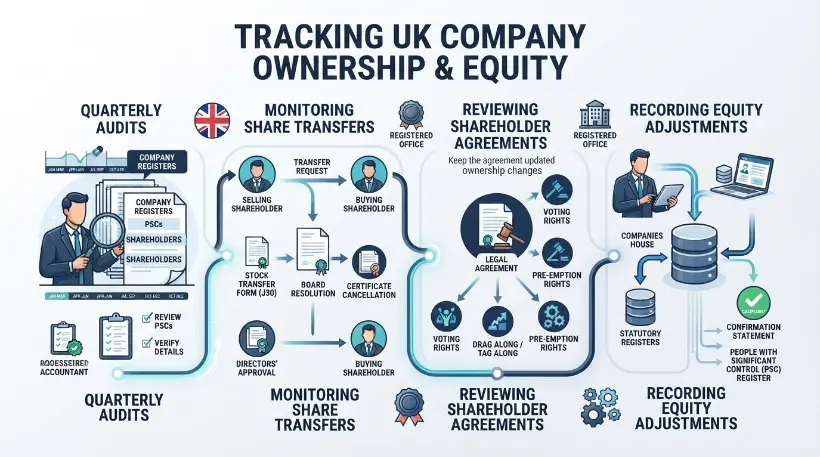
Implementing rigorous internal controls prevents oversight of minor equity shifts that cross statutory thresholds. Share transfer documents require immediate cross-referencing against existing register entries. Issuing new shares alters ownership percentages and demands instant recalculation of voting rights. Corporate secretaries must review trust arrangements and nominee agreements continuously for hidden control shifts. Automated alerts in company secretarial software flag potential threshold breaches instantly.
Companies utilizing a professional PSC Register service ensure that every ownership adjustment is captured, verified, and updated without administrative delay.
Maintaining clear paper trails simplifies statutory reporting during complex corporate restructuring events. Directors remain personally responsible for ensuring all qualifying changes reach the register accurately. Comprehensive record-keeping eliminates ambiguities during regulatory inspections by government authorities.
What Steps Ensure Complete Compliance with Identity Verification Requirements?
Compliance requires collecting official identification documents, verifying residential addresses, cross-checking personal details, and storing verification records securely.
Identity verification protocols prevent fraudulent entries within official corporate registers. Collecting valid passports or biometric residence permits establishes verifiable personal identity records. Validating residential addresses through recent utility bills ensures accurate communication channels. Storing verification data securely complies with data protection regulations and privacy standards.
Directors must execute these verification steps with absolute precision to satisfy statutory requirements.
Collect government-issued photographic identification documents from every qualifying person
Authenticate residential addresses using official utility bills or bank statements dated within 3 months
Record exact date of birth, nationality, and service address in the statutory register
File confirmation updates electronically through secure government submission portals
How Do Alternative Legal Entities Impact PSC Register Maintenance?
Alternative legal entities impact registers when trusts, limited partnerships, or overseas corporations hold significant control over the company.
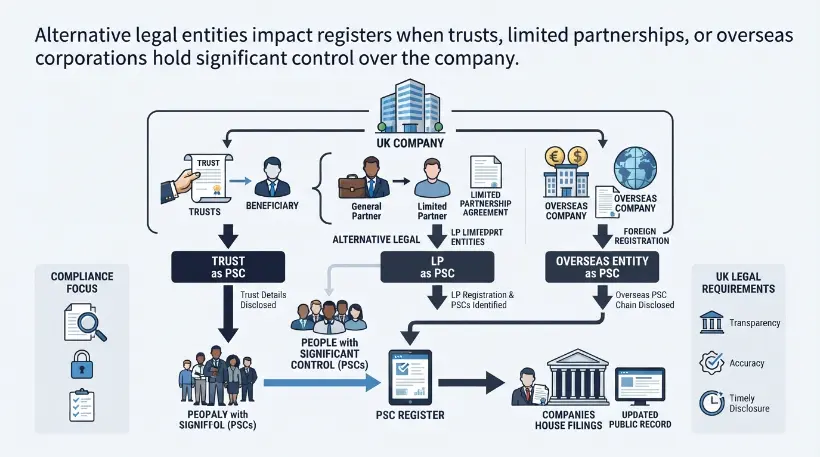
Tracing control through complex corporate chains requires analysing ultimate beneficial ownership structures. Trusts holding qualifying shares necessitate recording trustee details and trust formation specifics. Overseas entities exercising control must provide legal entity identifiers and proof of registration. Unregistered corporate bodies require detailed documentation of their governing law and legal form.
Understanding these complex structures prevents severe compliance oversights during corporate audits.
| Entity Type | Required Documentation | Verification Source |
| Trusts | Trust deed extracts and trustee identities | Certified legal instruments |
| Overseas Companies | Legal Entity Identifier and foreign register extract | International business registries |
| Limited Partnerships | Partnership agreement and general partner details | National partnership registers |
| Nominee Shareholders | Declaration of trust and ultimate owner identity | Beneficial ownership disclosures |
Managing these intricate structures demands expert guidance to navigate multi-jurisdictional compliance hurdles. Companies must balance transparency mandates with strict data privacy obligations when recording foreign entities. Regular reviews of layered corporate ownership prevent unexpected statutory breaches.
What Actionable Strategies Prevent Common PSC Register Errors?
Preventing errors requires standardising data collection, centralising register management, conducting regular compliance audits, and engaging specialist corporate service providers.
Establishing standardised administrative workflows eliminates human error during data entry processes. Centralising register management within a single digital platform ensures version control and audit readiness. Conducting internal compliance audits every 90 days identifies discrepancies before regulators intervene. Engaging professional advisory services guarantees adherence to evolving corporate governance legislation.
Businesses seeking structured support can review the insights outlined in Why Do PSC Details Need Updating Within 14 Days? to understand foundational legal drivers. When leadership teams require hands-on administrative execution, utilizing How to Keep Your PSC Register Current With Form My Company? provides a direct operational solution. Form My Company ensures that every statutory filing meets exact regulatory standards without straining internal resources.
Rigorous oversight of corporate registers protects businesses from unexpected legal liabilities and financial penalties. Maintaining immaculate records demonstrates corporate integrity to investors, financial institutions, and regulatory authorities.
Explore our PSC Register guide,
How to Prepare Certified Documents for a Business Bank Account?
How to Avoid the Cost of Booking a Private Solicitor for Certification?
Frequently Asked Questions
What is a PSC register and who needs to keep one?
A PSC register is an official record of the People with Significant Control who own or control a UK limited company. Form My Company notes that all active UK companies, limited liability partnerships, and eligible Scottish partnerships must identify individuals holding over 25% of shares or voting rights and file these details with Companies House.
What information must be included in the PSC register?
The PSC register must document the full name, service address, date of birth, nationality, and residential address of each beneficial owner. Form My Company highlights that filings must also specify the exact nature of control and the applicable ownership percentage band, such as over 25% up to 50%.
How long do companies have to update their PSC details?
Companies must record any ownership changes internally within 14 days and submit the updated information to Companies House within an additional 14-day window. Form My Company emphasizes that meeting these statutory deadlines prevents severe compliance breaches, financial penalties, and potential officer prosecution.
Do people with significant control need to verify their identity?
Yes, all individuals designated as a PSC must complete mandatory identity verification for Companies House compliance. Form My Company explains that controllers must authenticate their credentials using GOV.UK One Login or an Authorised Corporate Service Provider to obtain a unique personal verification code.
What happens if a company fails to maintain its PSC register?
Failing to maintain an accurate PSC register or neglecting to notify Companies House of ownership shifts is treated as a criminal offence under UK law. Form My Company warns that non-compliance can result in uncapped financial fines, legal enforcement actions, and potential corporate strike-off.