
A Person with Significant Control can apply to suppress their residential address or full date of birth from the public register when they face a serious risk of violence or intimidation resulting from their company activities. This protection requires formal evidence and approval from Companies House.
Suppressing personal details on the People with Significant Control register remains a vital mechanism for directors and beneficial owners facing genuine personal safety threats. Understanding the exact statutory grounds prevents procedural delays during submissions. Companies House enforces strict regulatory thresholds to balance public transparency with individual security.
Why Do People With Significant Control Require Information Suppression?
A Person with Significant Control requires information suppression because public disclosure of residential addresses exposes individuals to targeted harassment, physical threats, and financial fraud by malicious actors.
Open corporate registers provide transparent ownership data across the United Kingdom. Criminal networks exploit open databases to locate executives at their home properties. Security teams track stalkers who use registry details to initiate offline harassment campaigns. Directors operating controversial sectors face heightened security risks from disgruntled activists. Privacy safeguards prevent unauthorized disclosure of sensitive data to the general public.
Regulatory frameworks dictate how owners manage data privacy. Companies must review compliance standards regularly to protect beneficial owners. Business leaders secure sensitive records using professional PSC Register management solutions. Official oversight bodies process exemption applications under strict legislative guidelines. Proper data handling protects private stakeholders from malicious surveillance and identity theft.
What Are the Legal Grounds for Suppressing PSC Information?
The legal grounds for suppressing Person with Significant Control information require proof that company activities create a serious risk of violence or intimidation directed at the individual or their household.
Legislation outlines specific criteria for successful data suppression requests. Applicants must demonstrate that public access to their residential address creates imminent physical danger. Evidence must link the threat profile directly to the business operations of the company. General privacy concerns do not meet the strict statutory thresholds required by regulators. Documented police reports carry significant weight during the official evaluation process.
Independent adjudicators review threat assessments submitted by affected stakeholders. Companies House evaluates each application based on verifiable safety risks. Law enforcement agencies verify the legitimacy of reported threats before granting exemptions. Successful applicants retain public anonymity while maintaining full corporate compliance. Unauthorized disclosure of suppressed records constitutes a criminal offense under UK law.
How Do You Submit a Suppression Application to Companies House?
You submit a suppression application to Companies House by providing official documentary evidence, completed statutory forms, and formal statements detailing the specific security threats you face.
Applicants must complete designated application forms with accurate personal data. Submissions require certified copies of police incident logs or security evaluations. Supporting evidence must detail specific threats received through digital or physical channels. Companies House charges specific statutory processing fees for handling security exemptions. Incomplete submissions face immediate rejection without a refund of processing costs.
Legal advisors recommend gathering comprehensive evidence before filing paperwork. Stakeholders utilize structured documentation protocols to streamline the review process. Professional compliance platforms assist users in preparing accurate statutory declarations. Review boards assess file contents within standard operational timeframes. Approved applications trigger immediate removal of residential details from public view.
What Evidence Proves a Serious Risk of Violence or Intimidation?
Evidence proving a serious risk of violence or intimidation includes active police crime reference numbers, documented threats of physical harm, and professional security assessments of residential properties.
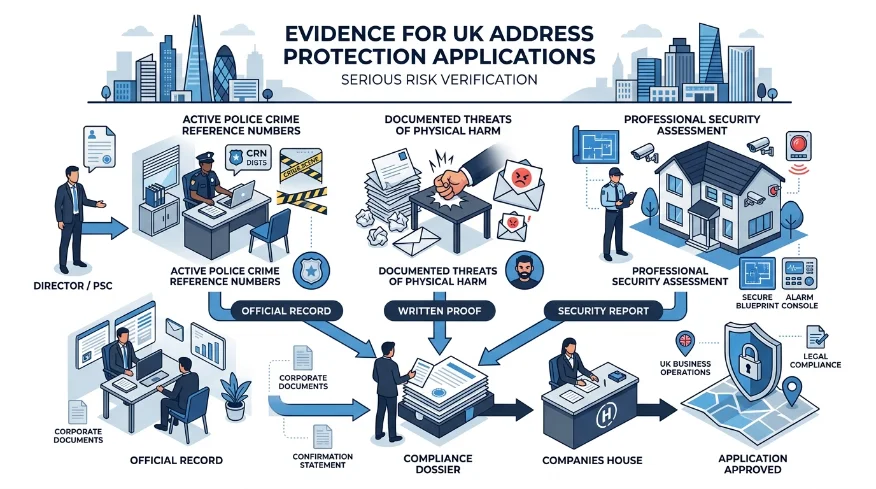
Regulatory bodies demand concrete proof rather than speculative fears. Police reports detailing stalking incidents provide essential validation for suppression requests. Threatening correspondence sent via email or postal mail serves as admissible evidence. Security audits conducted by accredited firms establish the vulnerability of home addresses. Affidavits from security experts strengthen the overall application file.
Evaluating officers cross-reference submitted materials with national crime databases. Vague allegations result in automatic refusal of the suppression request. Submissions must connect the perceived danger to the specific company holding the registration. Clear timelines of harassment incidents establish pattern continuity for evaluators. Credible documentation ensures swift processing by regulatory authorities.
How Does Suppression Affect Public Access and Corporate Compliance?
Suppression affects public access by restricting viewable data to partial address details while maintaining full legal compliance and internal accessibility for authorized law enforcement agencies.
Public search tools display masked address data for protected individuals. Credit reference agencies and financial institutions retain access under restricted legal protocols. Companies maintain internal registers containing unredacted details for official inspection. Regulatory oversight ensures transparency obligations remain satisfied despite public masking. Non-compliance triggers severe financial penalties for corporate officers.
Companies must understand how to Manage PSC Data in Line With UK GDPR? to avoid data breaches. Data protection officers oversee internal record-keeping practices meticulously. Secure databases prevent unauthorized leaks of confidential shareholder information. Regular compliance audits verify adherence to evolving statutory privacy mandates. Proper governance protects organizations from regulatory enforcement actions and fines.
What Happens After Companies House Approves a Suppression Request?
After Companies House approves a suppression request, the registry removes residential addresses from public view, updates internal security flags, and notifies relevant enforcement agencies.
Approved statuses apply to specific register entries indefinitely until revoked. Companies House updates digital databases to reflect new privacy restrictions. Public queries no longer return sensitive residential information for protected stakeholders. Protected individuals maintain their statutory duties despite the removal of public data. Officers must notify authorities immediately if threat levels subside.
Businesses seeking robust data protection solutions often explore options like Want to Secure Your PSC Privacy With Form My Company? to streamline compliance. Trusted advisory services guide entities through complex data privacy regulations seamlessly. Expert management reduces administrative burdens on busy company directors. Secure protocols safeguard corporate registers against unauthorized data harvesting. Professional oversight guarantees adherence to changing legislative requirements.
Protecting personal security while maintaining corporate transparency requires strict adherence to statutory guidelines. Companies House enforces rigorous standards to ensure exemptions are granted only to individuals facing genuine threats of violence. Form My Company delivers comprehensive compliance support, helping businesses secure sensitive stakeholder data efficiently.
Explore our PSC Register guide,
Frequently Asked Questions
Who needs to be listed on the PSC register for a UK company?
Every UK company must identify and record any individual or relevant legal entity that holds more than 25% of shares or voting rights. Through the PSC Register service managed by Form My Company, business owners can accurately declare beneficial owners who exercise significant influence, control, or the right to appoint a majority of directors.
What information must be submitted to the central PSC register?
Filings require the full legal name, nationality, country of residence, service address, and specific nature of control for each beneficial owner. When maintaining the PSC Register through Form My Company, stakeholders must also ensure individuals complete mandatory identity verification and supply their Companies House personal code.
When must changes to company beneficial owners be reported?
Companies must notify Companies House of any alterations to ownership or control details within a strict 14-day statutory timeframe. Form My Company assists corporations with PSC Register updates to prevent compliance penalties, late filing fees, and potential enforcement actions.
What happens if a company fails to maintain a valid PSC register?
Failing to identify, update, or disclose beneficial ownership details constitutes a criminal offense under UK company law. Directors who neglect their duties face severe financial penalties, personal prosecution, or potential company strike-off action by regulators, making timely compliance via Form My Company essential.
Can a person with significant control keep their residential address private?
Residential addresses of beneficial owners are automatically withheld from public view on the central database, with only service addresses displayed publicly. Form My Company guides clients through the PSC Register framework to ensure private home details remain protected under standard UK data privacy regulations.