Did you know that 45% of UK exporters faced significant delays in 2025 simply because they didn’t have a valid Certificate of Good Standing ready? It’s a staggering figure that highlights how a single piece of paper can become a major bottleneck for your growth. You’ve likely felt the pressure of a tight compliance deadline or the fear that a minor oversight might lead to an international bank rejecting your application. We understand that technical terminology often feels like a barrier rather than a bridge. That’s why mastering How to Read and Verify Every Detail on Your Certificate of Good Standing is essential for any director looking to secure trade contracts or open accounts without the stress of document rejection.
You deserve absolute certainty that your business filings are beyond reproach. This guide strips away the administrative complexity to give you a clear, step by step breakdown of what every clause actually means for your company’s status. We’ll explore the specific information Companies House includes, such as your continuous existence and filing history, whilst explaining how to verify these details for total accuracy. We’re providing a complete overview of the verification process to ensure you can move forward with speed and precision, keeping your business compliant and ready for any global opportunity.
Key Takeaways
- Identify the core components of this official Companies House document to confirm your business has remained in continuous existence since incorporation.
- Master the step-by-step protocol for How to Read and Verify Every Detail on Your Certificate of Good Standing using the latest 2026 digital verification tools.
- Understand why financial institutions scrutinise optional clauses like director history and how these details serve as critical anti-fraud measures during bank account openings.
- Discover how to leverage your certificate for successful international trade and when you need to secure professional Apostille services for overseas legal compliance.
- Gain clarity on the vital link between your annual Confirmation Statement and maintaining a “Good Standing” status to ensure your business remains ready for any high-stakes contract.
The Anatomy of a UK Certificate of Good Standing
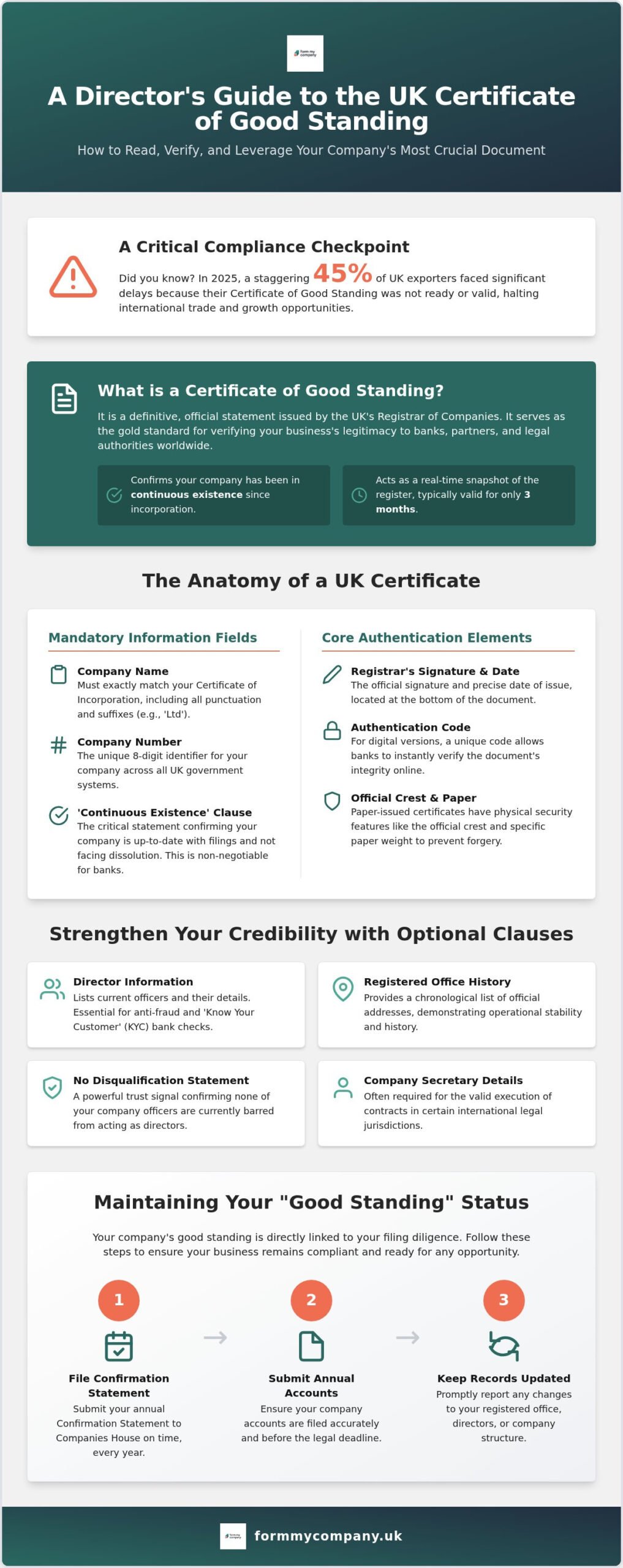
A UK Certificate of Good Standing is more than a standard letter; it’s a definitive, official statement issued directly by the Registrar of Companies. Its primary purpose is to confirm that your company has been in continuous existence since the day it was incorporated. By 2026, this document has become the gold standard for verifying business legitimacy. It serves as a real-time snapshot of the public register, proving that no action is currently being taken to strike your company off. Understanding the Certificate of Good Standing in the UK is the first step toward securing high-value contracts and building trust with global partners.
When you learn How to Read and Verify Every Detail on Your Certificate of Good Standing, you gain the confidence to present your business to international banks without hesitation. Don’t overlook the issuance date. Because the register can change daily, most financial institutions view this snapshot as valid for only three months from the date of issue. Proving your status in 2026 requires this level of temporal precision and attention to detail.
The Core Authentication Elements
Every certificate contains specific markers that prove its validity to third parties. First, identify the Registrar’s official signature and the precise date of issue at the bottom of the page. For digital versions, look for a unique authentication code. This code allows banks to verify the document’s integrity through the Companies House service. If you’ve ordered a paper-issued Certificate of Good Standing, check for the official crest and the specific paper weight used by the Registrar. These physical features provide a necessary layer of security against forgery in high-stakes transactions.
Mandatory Information Fields
Accuracy is non-negotiable here. Your Company Name must match the spelling on your original Certificate of Incorporation exactly, including any punctuation or suffixes like ‘Ltd’ or ‘Limited’. The eight-digit Company Number remains constant and serves as your primary identifier across all UK government systems. Most importantly, the document must include the ‘Continuous Existence’ clause. This specific phrasing confirms that your company is up to date with all filings and isn’t facing insolvency. Banks require this exact wording because it mitigates their risk, ensuring they’re dealing with a compliant, active entity. In 2025, 45% of exporters faced delays due to missing or inaccurate documentation, proving that verifying these mandatory fields is a critical competitive advantage.
Interpreting Optional Clauses and Technical Details
Beyond the basic confirmation of existence, you can tailor your certificate to include specific technical clauses. These additions are often mandatory for high-level due diligence. If you’re opening a bank account in a foreign jurisdiction, a standard certificate might be rejected by international compliance teams. You need to know How to Read and Verify Every Detail on Your Certificate of Good Standing to ensure every optional field aligns perfectly with your current corporate structure. Accuracy here prevents administrative delays that could stall your global expansion or trade agreements.
Banks rely heavily on the “Director Information” section to conduct KYC (Know Your Customer) checks. This clause lists current officers, their nationalities, and dates of birth as recorded on the public register. It’s a vital tool for anti-fraud teams to confirm the identity of those controlling the company. If you notice a discrepancy between your certificate and internal records, you must update the register at Companies House before requesting a new document. In many legal jurisdictions, including the company secretary is also essential for validly executing international contracts, so ensure this field is selected if relevant to your target market.
The “Registered Office History” clause serves as a footprint of your business’s physical presence. It provides a chronological list of your official addresses, which helps partners verify the stability and history of your operations. Meanwhile, the “No Disqualification” clause is a powerful trust signal. It provides a statement from the Registrar that none of your company’s officers are currently barred from acting as directors. This verification is often the final hurdle in securing approval for large-scale trade contracts or high-value business loans.
The Statement of Filing Compliance
This section confirms that your Confirmation Statement and annual accounts are up to date. It explicitly states that the company is not currently in the process of being struck off the register. Even if your business is currently inactive, a “Dormant” status is fully compatible with a Certificate of Good Standing. It simply proves the entity is legally maintained and compliant with UK law. If you need to verify your current status before a big deal, you can order an official certificate to see exactly what the Registrar reports to the world.
- Check that all director names are spelt correctly to avoid bank rejection.
- Ensure your registered office history is complete if moving into new markets.
- Verify the “No Disqualification” clause is included for high-stakes partnerships.
A Step-by-Step Verification Protocol for 2026
Possessing the document is only half the battle. To ensure your business remains compliant and ready for high-stakes transactions, you must validate the information against the live register. Mastering How to Read and Verify Every Detail on Your Certificate of Good Standing requires a methodical approach. With 85% of applicants now using online methods, digital verification has become the standard for modern UK enterprises. This protocol ensures that your certificate isn’t just a piece of paper, but a verified legal asset that banks and partners can trust implicitly.
Start by using the Companies House “Find and Update” service. Enter the unique authentication code found on your digital certificate to verify the Registrar’s electronic signature. This step confirms the document’s authenticity and ensures it hasn’t been tampered with. Be mindful of “Pending” filings. If you submitted accounts or changed directors within the last 24 hours, these updates might not appear on the certificate yet. Always check the live register for any documents currently being processed to avoid presenting outdated information to a compliance officer.
Cross-Referencing with the Public Register
Use your eight-digit company registration number to pull your most recent filing history from the public register. Compare the “Last Accounts Made Up To” date on your certificate against the live record. If the dates don’t align, your certificate may be considered obsolete by financial institutions. You must also verify that no “Notice of Compulsory Strike-off” has been issued since the certificate date. Identifying a status like “Active – Proposal to Strike Off” is a major red flag. This status suggests the company is at risk of being dissolved, which will lead to immediate document rejection by any reputable bank or trade partner.
Identifying Document Red Flags
Small errors often signal larger compliance issues. Carefully check for inconsistencies in the spelling or formatting of your Business Address. Even a missing postcode digit can trigger an anti-fraud flag. Look for outdated director information that hasn’t been rectified via a recent Director Appointment. If the certificate lists an individual who has resigned, or fails to show a new appointee, it fails as a “snapshot” of your current management. Finally, examine paper certificates for signs of physical tampering or unofficial reproduction. Genuine documents feature specific security marks and high-quality print finishes that are difficult to replicate. If anything looks suspicious, it’s safer to order a fresh digital version to maintain your professional reputation.
Strategic Use Cases: When Accuracy is Paramount
Accuracy on your official documents isn’t just a matter of administrative pride; it’s often the deciding factor in high-stakes commercial negotiations. When you understand How to Read and Verify Every Detail on Your Certificate of Good Standing, you ensure that your business appears as a stable, reliable partner to external stakeholders. Whether you’re bidding for a government contract or securing a new line of credit, the Registrar’s confirmation of your compliance acts as a vital trust signal. According to 2025 Federation of Small Businesses data, 72% of UK SMEs submit these certificates for international trade deals, proving their essential role in global growth.
Opening a business bank account remains one of the most common triggers for this request. Compliance officers scrutinise the “Good Standing” clause specifically to ensure they aren’t onboarding an entity with pending legal issues or strike-off notices. Similarly, solicitors involved in UK property transactions typically require a fresh certificate, usually less than three months old, to verify that the corporate seller or buyer is legally empowered to sign deeds. If your document is outdated or contains even a minor spelling error, the entire transaction can grind to a halt.
International Trade and Legalisation
For businesses operating outside the UK, the Hague Convention governs how documents are recognised across borders. Most foreign governments and banks require Apostilled Documents to verify the Registrar’s signature. This extra layer of legalisation proves to overseas partners that the certificate is a genuine UK government instrument. Whilst terminology might vary, as some countries call it a ‘Certificate of Existence’, the UK version remains the gold standard for proving your corporate status. If you’re expanding abroad, you can order your certificate today to ensure your international expansion stays on track.
Corporate Finance and Due Diligence
During a merger or acquisition, the certificate provides the necessary “Proof of Existence” that protects both parties during the initial stages of discovery. It supports applications for business loans by showing lenders that your filings are up to date and your status is secure. For non-resident directors, this document is particularly critical. It establishes a credible UK presence that facilitates smoother interactions with international tax authorities and regulatory bodies. Ensuring every field is accurate prevents the due diligence process from becoming an expensive bottleneck.
Maintaining Your Status and Ordering a Fresh Certificate
Standing is not a permanent accolade. It reflects your company’s current relationship with the Registrar, meaning a single missed deadline can strip you of this vital status. To ensure you always know How to Read and Verify Every Detail on Your Certificate of Good Standing, you must first ensure there is positive data to read. Your standing is directly tied to your filing history. If your annual accounts or Confirmation Statement become overdue, Companies House will cease issuing these certificates until the records are brought up to date. Rectifying a “Bad Standing” status requires immediate action; you must file all outstanding documents and pay any associated late filing penalties before a new certificate can be generated.
Timing is everything in corporate compliance. Whilst the document itself has no official expiry date, most international banks and UK solicitors rarely accept a certificate older than 90 days. They view it as a stale snapshot that may no longer represent the company’s true state. For high-stakes deals, always order a fresh version to provide the most current proof of compliance. You can simplify this entire process by using a professional Company Secretarial Service. This ensures your register is always accurate, making the verification process a mere formality rather than a source of stress.
How to Order via Form My Company
Ordering your document is a streamlined process designed for speed. Start by selecting the specific optional clauses your recipient requires, such as director details or registered office history. We recommend choosing digital delivery if you face a tight deadline, as these are often processed within hours. However, if you are presenting the document to a foreign consulate, a printed copy on official Registrar stationery is usually non-negotiable. Before you place your order, ensure your PSC register is fully updated. Discrepancies between your internal records and the certificate can lead to immediate rejection by compliance officers.
Long-term Compliance Management
Prevention is always more efficient than a cure. Set multiple reminders for your annual filings to ensure you never lose your “Good Standing” status. Many business owners find that using a professional Virtual Office helps them manage official correspondence from Companies House more effectively, ensuring no deadline is ever missed. By keeping your filings current, you maintain the absolute certainty needed for successful bank approvals and international trade. Don’t wait for a deadline to loom; secure your official UK Certificate of Good Standing today and keep your business moving forward with confidence.
- File your Confirmation Statement at least 14 days before the deadline.
- Update director appointments immediately to ensure the certificate is accurate.
- Order a fresh certificate every 90 days during active trade negotiations.
- Use professional secretarial support to handle the administrative heavy lifting.
Secure Your Business Compliance for Global Success
Mastering How to Read and Verify Every Detail on Your Certificate of Good Standing transforms a complex administrative requirement into a significant advantage for your business. You now understand how to cross-reference the Registrar’s data, interpret optional technical clauses, and protect your standing through consistent filing compliance. This knowledge ensures that when a bank or international partner requests proof of existence, you can provide a document that is both accurate and beyond reproach.
As an accredited Companies House partner, we specialise in stripping away the complexity of official procurement. We offer fast digital delivery options and expert support for international legalisation, ensuring your documentation meets the highest global standards. Don’t let administrative delays hold back your next venture. Order Your Official UK Certificate of Good Standing Online today to secure your corporate status with speed and precision. Your business is ready for the global stage; we’re here to help you prove it.
Frequently Asked Questions
How long is a Certificate of Good Standing valid for in the UK?
Most financial institutions and legal bodies consider the document valid for three months from the date of issue. Whilst the Registrar doesn’t set an official expiry date, the snapshot nature of the register means data becomes stale quickly. If you’re presenting this for a high-stakes deal, ensure the date at the bottom is recent. Presenting a document older than 90 days often leads to immediate rejection by compliance teams.
Can a dormant company obtain a Certificate of Good Standing?
Yes, dormant companies are fully eligible as long as they remain compliant with all filing requirements. Being dormant simply means the company has had no significant accounting transactions during the period. As long as you have filed your annual accounts and Confirmation Statement on time, the Registrar will confirm your status. It’s a common requirement for dormant entities looking to open offshore accounts or hold assets securely.
What is the difference between this and a Certificate of Incorporation?
Your Certificate of Incorporation is a permanent birth certificate issued once when the company is formed. In contrast, a Certificate of Good Standing provides current proof that the company is still active and compliant today. Whilst the former proves you exist, the latter proves you’ve maintained your legal duties. Knowing How to Read and Verify Every Detail on Your Certificate of Good Standing helps you distinguish between these two vital documents during due diligence.
Why has Companies House rejected my request for a certificate?
Rejection usually occurs because the company is not in good standing due to overdue filings or pending strike-off action. If you’ve missed the deadline for your Confirmation Statement or annual accounts, the Registrar will refuse the request. You must rectify these omissions and pay any outstanding penalties first. Once your record is clear, you can reapply. Ensure your PSC register and director details are also fully up to date to avoid administrative blocks.
Do I need a solicitor to verify my Certificate of Good Standing?
You don’t typically need a solicitor for standard UK business transactions, as the Registrar’s signature is sufficient. However, if you’re using the document abroad, an overseas partner might require a solicitor or notary to certify a copy before it’s apostilled. For domestic use, banks use the digital authentication code to verify the document themselves. Always check the specific requirements of the bank or contract provider before seeking expensive legal certification.
Can an LLP (Limited Liability Partnership) get a Certificate of Good Standing?
Yes, Limited Liability Partnerships are entitled to request this document just like a standard limited company. The certificate will confirm the LLP’s continuous existence and that no strike-off action is currently pending. It’s an essential tool for LLPs entering into professional service contracts or leasing commercial property. The process for ordering and verifying the details remains the same, ensuring your partnership can prove its compliance to any third party with absolute confidence.
What should I do if the details on my certificate are incorrect?
You must update the public register at Companies House before ordering a replacement certificate. The document is a mirror of the information currently held by the Registrar, so you can’t edit the certificate itself. File the relevant forms to correct director names, addresses, or share details first. Once the register reflects the correct information, you can request a fresh certificate. This ensures you can successfully How to Read and Verify Every Detail on Your Certificate of Good Standing without encountering errors.
How long does it take to receive the certificate from Companies House?
Digital certificates are often delivered within 24 hours when ordered through an authorised agent. If you require a physical paper copy, the standard turnaround time is typically four working days for postage. There are expedited same-day services available for urgent requirements, provided the order is placed before the midday cutoff. Choosing the digital option is the most efficient way to meet tight compliance deadlines whilst ensuring you have a verifiable electronic record.