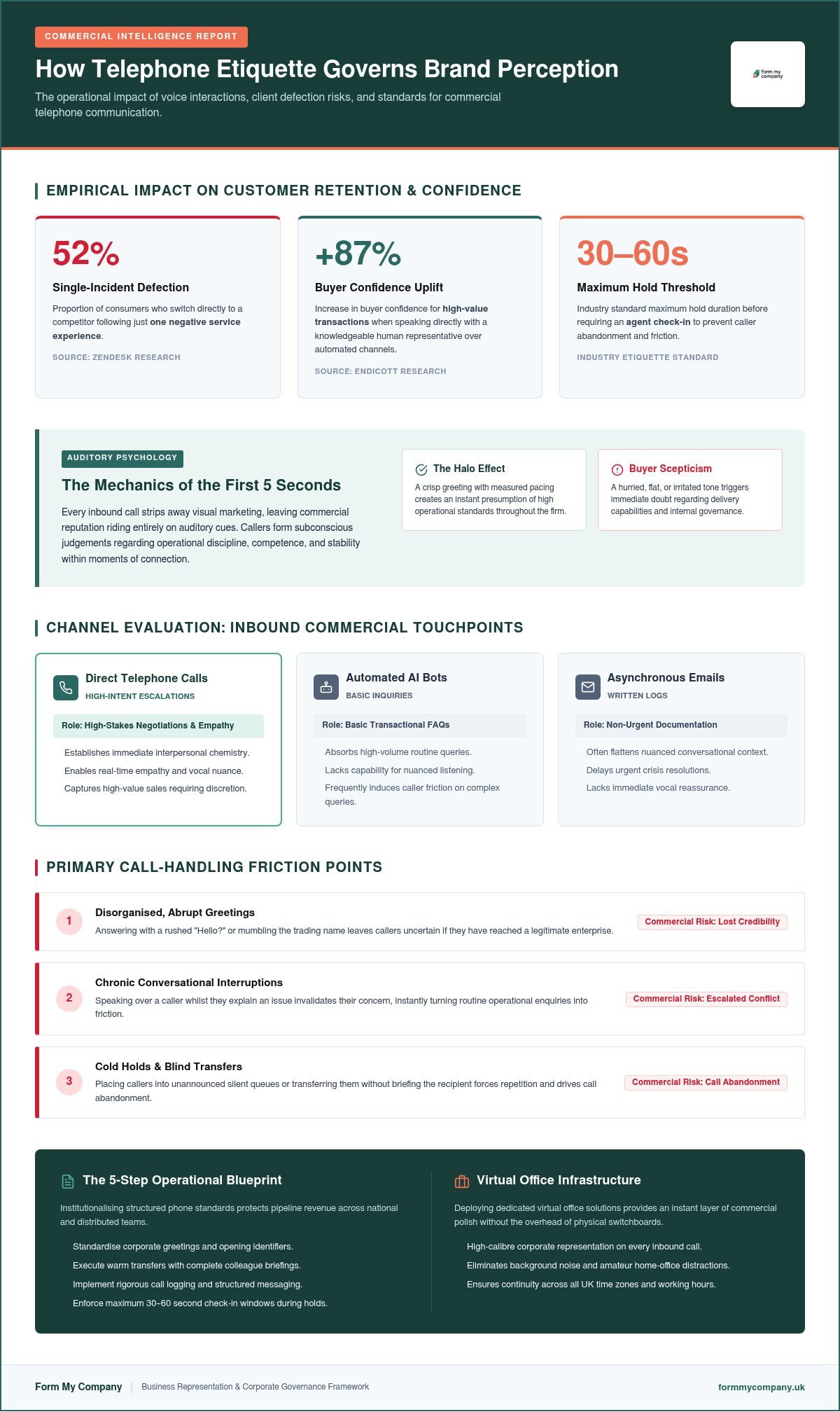
According to research from Zendesk, 52% of consumers will switch to a direct competitor after enduring just one negative service experience. Every incoming voice call either compounds hard-won client trust or quietly drains your commercial valuation. You’ve likely poured considerable resources into professional marketing, sharp branding, and polished proposals; however, sloppy first-touch call handling can unravel that investment in seconds. Understanding the 7 ways bad phone etiquette damages your brand is essential if you want to safeguard your company’s market reputation and stop lucrative contracts from slipping away.
We know how difficult it is to maintain consistent telephone standards whilst managing distributed teams across Britain. In this guide, you’ll discover how substandard call handling quietly erodes commercial equity, alongside actionable benchmarks to build an infallible operational standard. We’ll examine the primary communication blunders sabotaging your pipeline, review proven voice protocols, and explore the professional call infrastructure needed to keep every client interaction flawless.
Key Takeaways
- Auditory cues shape commercial credibility within seconds, meaning tone, pacing, and greeting structure dictate customer perceptions of your competence.
- Discover the 7 ways bad phone etiquette damages your brand, from abrupt greetings and cold holds to defensive listening habits that drive clients away.
- Preventable call-handling errors lead to silent client defection, compounding long-term revenue loss and quietly undermining marketing acquisition spend.
- Institutionalise a structured five-step operational blueprint to standardise corporate greetings, warm transfers, and message logging across distributed teams.
- Deploying dedicated Virtual Office Services delivers an instant layer of professional polish, ensuring incoming callers always receive high-calibre corporate representation.
The Anatomy of Telephone Etiquette: Why Voice Interactions Govern Brand Perception
Every inbound call strips away your visual marketing, leaving your commercial reputation riding entirely on auditory cues. Callers form immediate subconscious judgements about your operational stability, competence, and authority within moments of connection. When you analyse the 7 Ways Bad Phone Etiquette Damages Your Brand, you quickly realise that voice communication functions as an unfiltered window into your company’s operational discipline.
A polished website or sharp corporate deck cannot rescue an interaction derailed by an unenthusiastic greeting or audible background clutter. Research from Endicott reveals that speaking directly with a knowledgeable human representative increases buyer confidence in high-value transactions by 87% compared to automated channels. Voice calls represent high-stakes touchpoints. When a caller dials your organisation, they are seeking rapid reassurance, clarity, and competence. Delivering anything less projects disorganisation, poor internal governance, and questionable business stability.
The Psychology of the First Five Seconds on the Phone
Auditory psychology dictates that pitch, pacing, and greeting cadence establish instant authority. A crisp greeting delivered at an even pace creates an immediate halo effect; the caller subconsciously assumes your operational standards are equally meticulous. Conversely, a hurried, flat, or irritated tone triggers instant buyer scepticism. Adhering to professional customer service standards from the very first syllable ensures prospective clients feel secure rather than questioning your ability to deliver.
Voice Versus Digital: Why Telephone Contact Remains Crucial in 2026
While automated chatbots and self-service portals absorb basic transactional traffic, voice has evolved into the escalation channel for high-intent enquiries. Modern commercial clients use telephone calls for high-stakes moments, such as complex bespoke negotiations, project escalations, and sensitive partner discussions. Unlike asynchronous email threads, voice interaction allows for real-time empathy, vocal warmth, and nuanced active listening that digital algorithms cannot replicate.
- Asynchronous emails: Often flatten nuance, delay urgent resolutions, and lack immediate reassurance during operational crises.
- Automated AI bots: Useful for basic frequently asked questions, but frequently induce caller rage when managing complex enterprise queries.
- Direct telephone calls: Establish immediate interpersonal chemistry, cement customer loyalty, and capture high-value sales that require human discretion.
Failing to standardise voice interactions introduces severe commercial friction. Learning the primary 7 Ways Bad Phone Etiquette Damages Your Brand enables your organisation to protect its hard-won pipeline, eliminate amateur missteps, and present an infallible corporate standard across every national call touchpoint.
7 Ways Bad Phone Etiquette Damages Your Brand Reputation
Telephone slip-ups are rarely isolated accidents. Instead, they signal deeper operational neglect to prospective partners and clients. Left unchecked, poor handling practices quietly degrade buyer confidence. Here are the 7 Ways Bad Phone Etiquette Damages Your Brand across daily customer touchpoints.
Greeting Failures and Premature Interruptions: Ways 1, 2, and 3
First impressions set the tone for the entire relationship. When front-line staff mishandle the opening seconds, callers immediately doubt your professionalism:
- Way 1: Disorganised, abrupt greetings. Answering with a rushed “Hello?” or mumbling the trading name leaves callers confused about whether they reached a legitimate enterprise.
- Way 2: Chronic interruptions. Talking over a caller while they explain an issue invalidates their concern, instantly turning an operational enquiry into emotional friction.
- Way 3: Cold holds and blind transfers. Industry etiquette standards advise that hold times should never exceed 30 to 60 seconds without an agent check-in. Shoving callers into silent queues or transferring them without briefing the next colleague forces them to repeat themselves, accelerating call abandonment.
Apathy, Distraction, and Unanswered Demands: Ways 4 and 5
Auditory distractions and disinterested tones reveal internal disorganisation. Modern callers pick up on subtle acoustic cues immediately:
- Way 4: Audible multitasking and background clutter. Keyboard clatter, office banter, or muffled side conversations prove your team isn’t focused on the client. It conveys disrespect and suggests their business isn’t a priority.
- Way 5: Flat apathy and rigid defensiveness. Responding with monotone indifference or defensive phrases like “that’s just company policy” erodes goodwill. It transforms routine customer support into an adversarial dispute.
Broken Commitments and Clumsy Terminations: Ways 6 and 7
How an interaction concludes determines the lasting impression of your brand. When follow-up discipline collapses, enterprise credibility vanishes:
- Way 6: Forgotten callback promises. Failing to record critical details, such as caller names or phone numbers, leads to missed follow-ups. Broken callback promises flag administrative unreliability to corporate clients.
- Way 7: Abrupt call closures. Ending an exchange without confirming the issue is resolved or thanking the caller feels dismissive. It leaves high-intent prospects feeling like inconvenient interruptions rather than valued partners.
Eliminating these systemic mistakes requires reliable internal processes and dedicated communication infrastructure. Many expanding enterprises protect their external reputation by integrating professional call answering solutions, ensuring every incoming ring is met with immediate, structured courtesy.
The Hidden Commercial Toll: Calculating the Cost of Damaged Client Trust
Every botched telephone exchange carries a measurable financial penalty. While leaders obsess over conversion funnels, advertising budgets, and organic rankings, unmonitored call habits quietly bleed balance sheets. Examining how the 7 Ways Bad Phone Etiquette Damages Your Brand translates into balance-sheet losses shows that poor call handling directly depresses customer lifetime value while driving up marketing acquisition costs.
Global data from the Qualtrics XM Institute reveals that businesses put nearly $3 trillion in annual revenue at risk due to poor customer experiences. Their findings show that 47% of consumers slash their spending after a bad interaction, with 13% cutting ties completely. Meanwhile, the National Customer Service Association notes that it takes 12 positive experiences to repair the commercial damage of a single unresolved negative encounter. The mathematics are unforgiving: allowing sloppy phone manners to persist forces your marketing team to work twelve times harder simply to maintain baseline revenue.
Direct Customer Churn versus Negative Review Amplification
The true danger of substandard phone support lies in quiet abandonment. Research from Coveo and Zendesk indicates that 56% of consumers never bother to file a formal complaint after a negative service call; they simply defect in silence to an alternative provider. Those who do speak out often take their grievances to public review portals and social channels. These visible reprimands depress organic search conversion rates, introduce customer doubt during inbound sales cycles, and inflate client acquisition expenditure across your entire operation.
Opportunity Loss in B2B Partnerships and High-Value Contracts
Enterprise buyers and procurement directors rely heavily on phone interactions to evaluate a supplier’s operational rigour. A single mismanaged touchpoint can kill an enterprise tender before the proposal reaches the evaluation panel:
- Procurement risk screening: B2B decision-makers treat careless call transfers, background chatter, or evasive receptionists as red flags that point to deeper delivery issues.
- Contractual valuation drops: Substandard communication signals internal administrative dysfunction, encouraging procurement officers to negotiate aggressive price discounts or look elsewhere.
- Cumulative revenue attrition: Losing a multi-year enterprise relationship wipes out predictable recurring income that takes quarters of aggressive outbound selling to replace.
Preventing these financial leaks requires treating telephone protocols as core corporate assets rather than low-priority front-of-house tasks. Left unaddressed, the commercial toll from the 7 Ways Bad Phone Etiquette Damages Your Brand compounds across every channel, ultimately eroding your enterprise value and destroying market credibility.
Establishing an Uncompromising Call Standard: A 5-Step Operational Blueprint
Transforming front-line communication requires more than asking staff to “be polite”. You need an enforceable operational blueprint that removes guesswork. Understanding the systemic failures behind the 7 Ways Bad Phone Etiquette Damages Your Brand is only half the battle; the true competitive advantage comes from embedding systematic quality controls across your organisation.
Industry data indicates that elite support operations achieve a First Call Resolution (FCR) rate above 80%, while standard operations hover between 70% and 79%. Reaching that top tier demands defined procedures for every voice touchpoint. Follow this five-step operational methodology to build an infallible inbound call standard.
Step 1 and Step 2: Standardised Scripting and Empathetic De-escalation
Begin by replacing rigid, robotic dialogue with flexible conversational guidelines:
- Step 1: Implement modular greeting frameworks. Mandate that every call opens with the company name, representative’s identity, and a clear offer of assistance within three seconds. Provide adaptable scripts that sound natural rather than scripted.
- Step 2: Train teams in active listening and de-escalation. Teach agents to let distressed callers finish without interruption. Use neutral, reassuring language such as “I understand why that creates a challenge, let’s fix it right now” to defuse tension immediately.
Steps 3 to 5: Routing Protocols, Quality Audits, and CRM Alignment
Once conversational standards are set, secure your technical handoffs and accountability mechanisms:
- Step 3: Enforce strict warm-transfer protocols. Ban cold transfers entirely. Staff must brief the receiving colleague on the caller’s identity and query details before completing any line handover.
- Step 4: Conduct regular peer-review call audits. Establish monthly scorecards that assess greeting cadence, active listening, and hold compliance against an industry Average Speed of Answer (ASA) benchmark of 28 seconds or less.
- Step 5: Mandate instant CRM logging. Ensure every agent logs caller contact details, contextual notes, and clear next steps within sixty seconds of hanging up. This guarantees continuity across distributed teams.
Following this framework eliminates the operational blind spots that cause front-line missteps. You can instantly standardise your client touchpoints and secure professional call handling across Britain by exploring dedicated Virtual Office Services for your business.
Systematising these procedures ensures that the 7 Ways Bad Phone Etiquette Damages Your Brand never gain a foothold in your day-to-day operations, giving your firm the stability and polish required to win enterprise-level trust.
Professional Infrastructure: Elevating Telephone Standards with Form My Company
Internal call handling eventually breaks down as an enterprise expands. When founders, consultants, and operational leads juggle high-value deliverables alongside ringing telephones, consistency drops. Team members rush callers off the line, miss critical messages, or allow inbound enquiries to ring out. Recognizing the 7 Ways Bad Phone Etiquette Damages Your Brand is vital, but managing calls internally while scaling distributed operations nationwide often proves unsustainable.
According to the recognized industry “80/20” benchmark, 80% of incoming customer calls should be answered within 20 seconds to maintain caller satisfaction and keep abandonment rates below 5%. Falling short of these metrics risks immediate revenue loss. Rather than hiring costly full-time reception staff or risking amateur telephone slip-ups, agile businesses partner with dedicated infrastructure providers to secure enterprise-grade credibility.
The Strategic Advantage of Dedicated Answering Services
Outsourcing your switchboard to trained specialists insulates your firm from front-line communication errors. Dedicated UK-based receptionists handle every interaction using custom greetings tailored to your trading identity, providing prompt, courteous engagement without rigid, robotic scripts. Discover how professional call answering protects your brand image by capturing every high-intent opportunity while shielding your core team from disruptive screening tasks.
- Guaranteed greeting consistency: Eliminates casual, hurried, or unprofessional openings across all incoming calls.
- Intelligent routing and screening: Connects critical calls seamlessly while logging accurate caller notes for asynchronous review.
- Elastic volume management: Absorbs sudden surges in customer calls effortlessly, preventing extended queues or abandoned lines.
Building an End-to-End Corporate Presence for Growing Firms
Modern credibility relies on more than voice standards alone. Leading UK enterprises combine structured telephony with prestigious national virtual offices to present a fully cohesive corporate image. Pairing an authoritative telephone presence with professional correspondence handling ensures small operations match the polish of established conglomerates.
Form My Company provides the foundational infrastructure needed to launch, protect, and scale UK businesses. Whether you require official statutory filings, dedicated call handling, or comprehensive corporate solutions via Form My Company packages, our managed facilities ensure your firm maintains flawless operational governance at every customer touchpoint.
Preventing the 7 Ways Bad Phone Etiquette Damages Your Brand begins with professional infrastructure. Backing your team with dedicated receptionists and virtual office facilities ensures your organisation projects infallible authority on every call.
Transform Your Telephone Experience into Commercial Growth
Every telephone interaction serves as an immediate test of your operational integrity. When you eliminate the 7 Ways Bad Phone Etiquette Damages Your Brand, you protect high-intent leads, safeguard client trust, and separate your enterprise from careless competitors. Establishing crisp greeting protocols, enforcing warm line transfers, and maintaining active listening turn everyday inbound calls into dependable commercial assets.
Scaling your operations shouldn’t compromise your front-of-house standards. Beyond supporting limited companies, LLPs, and PLCs with comprehensive UK company formation packages, Form My Company provides a full suite of virtual office facilities and professional administrative support services to keep your communication sharp. Don’t let preventable front-line errors undermine your marketing investments; protect your corporate reputation with Form My Company call answering solutions and present an infallible standard to every prospective client who dials your firm.
Frequently Asked Questions
What is the most damaging telephone etiquette mistake a business can make?
Chronic interruption combined with indifferent initial greetings causes the fastest brand damage. Talking over a prospective client signals operational arrogance and invalidates their inquiry instantly. When exploring the 7 ways bad phone etiquette damages your brand, failing to actively listen proves particularly lethal. It destroys interpersonal rapport within seconds, leaving callers feeling dismissed and driving high-intent corporate buyers directly to alternative service providers across Britain.
How does poor phone etiquette directly reduce sales conversion rates?
Poor telephone etiquette kills conversion rates by eroding buyer confidence before sales discussions even begin. When callers encounter disorganised greetings, audible background distractions, or abrupt holds, they assume your delivery capabilities are equally chaotic. Commercial decision-makers interpret sloppy call manners as a sign of internal dysfunction, prompting them to abandon inbound enquiries and discard proposals before your sales team gets an opportunity to present solutions.
Can call handling scripts sound natural rather than robotic to callers?
Yes, call handling scripts sound entirely natural when structured as modular conversational frameworks rather than rigid, word-for-word templates. Effective frameworks outline essential stages, such as stating your company identity, actively validating the caller’s concern, and confirming next actions, while allowing front-line staff to use their own conversational vocabulary. This approach preserves necessary compliance standards while fostering genuine empathy and rapport with prospective clients.
Why do modern customers still prefer calling over using digital channels?
Customers prefer calling because voice interaction offers immediate clarity, nuanced empathy, and rapid resolution for complex or urgent issues. While automated bots and email ticketing handle basic queries, high-stakes decisions and escalations demand real-time human discretion. Speaking directly to a knowledgeable representative eliminates the frustrating ambiguity of back-and-forth digital messages, giving clients absolute certainty that their commercial requirements are being prioritised.
What is the acceptable maximum time a customer should be kept on hold?
Industry operational standards dictate that callers should never remain on hold for more than 30 to 60 seconds without a personal check-in. Placing a client on an open-ended hold without requesting permission triggers immediate friction and escalates call abandonment. If an issue requires a longer investigation, the representative should explain the delay, ask if the caller prefers to wait, or arrange an exact callback time.
How do dedicated call answering services protect a growing business brand?
Dedicated call answering services protect your brand by guaranteeing that trained UK receptionists handle every inbound call with consistent, high-calibre courtesy. Outsourcing call management prevents the 7 ways bad phone etiquette damages your brand from taking root during periods of rapid internal growth. It ensures prompt pick-up times, uniform company greetings, accurate message logging, and seamless warm transfers without overburdening internal staff with constant administrative interruptions.
Can small enterprises afford professional telephone answering infrastructure?
Yes, modern virtual office and call answering arrangements make enterprise-grade telephony accessible to startups and growing small businesses nationwide. Instead of funding full-time in-house receptionists and complex switchboard hardware, firms can leverage shared virtual office infrastructure. This flexible operational model delivers prestigious corporate representation, dedicated call screening, and message dispatching at a fraction of traditional administrative overhead, allowing small businesses to compete directly with established corporations.