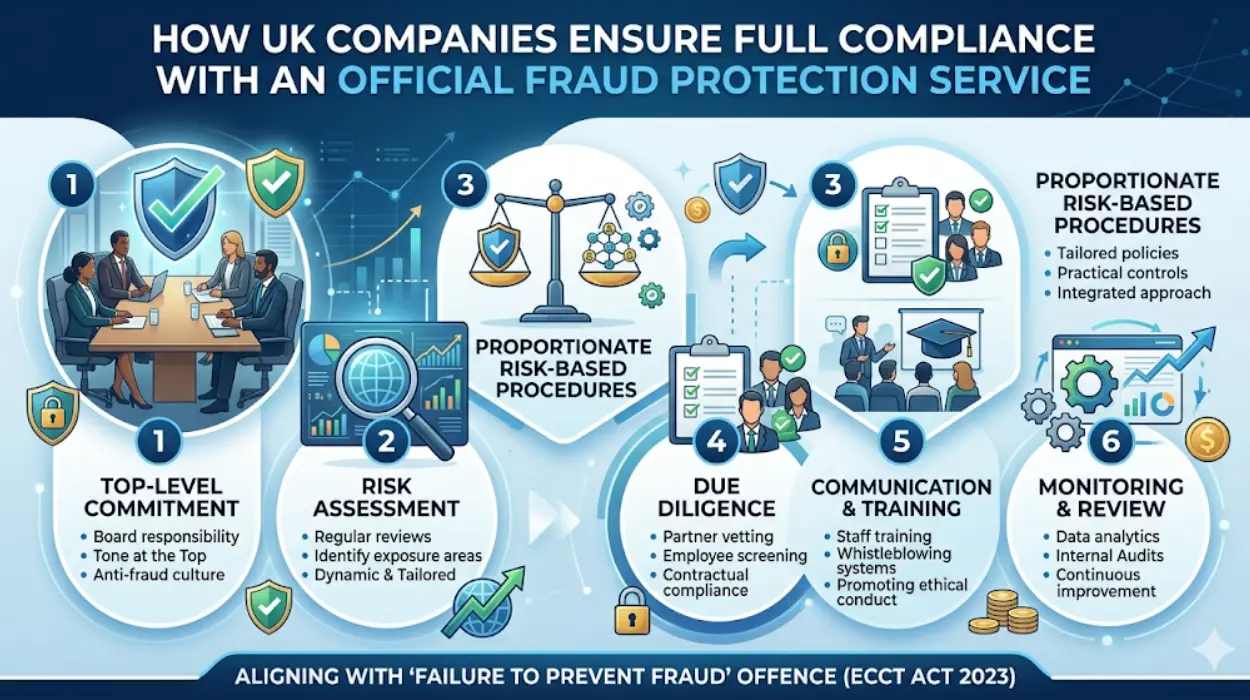
UK companies can ensure full compliance with an official fraud protection service by combining strong internal governance over company records with a professionally managed fraud protection solution that monitors Companies House data and intervenes when risk indicators appear. By aligning internal controls, data protection duties, and ongoing monitoring, businesses can reduce identity theft and corporate hijack risk while staying within current UK company law and privacy regulations.
Understanding fraud risks in UK company records
Corporate identity fraud usually starts with weaknesses in how company data is created, stored, and updated. When director details, registered office addresses, or filing histories are poorly controlled, criminals can exploit these gaps to impersonate a company, change its details, or mislead suppliers and banks.
In the UK, a company’s statutory information is widely accessible through Companies House, which is essential for transparency but also creates opportunities for abuse if data is not monitored and safeguarded carefully. Criminals may file unauthorised changes, alter officer details, or register fake charges or appointments that look legitimate at first glance. Fraudsters then leverage these changes to open bank accounts, secure credit, or defraud customers and suppliers in the company’s name.
Official reforms under the Economic Crime and Corporate Transparency framework aim to reduce these abuses by tightening data validation and improving information protection, but they do not remove the company’s responsibility to monitor its own profile and react quickly to suspicious activity. Businesses still need structures, policies, and services that track changes, investigate anomalies, and ensure that any fraudulent filings are challenged and corrected promptly.
Your legal responsibility over UK company records
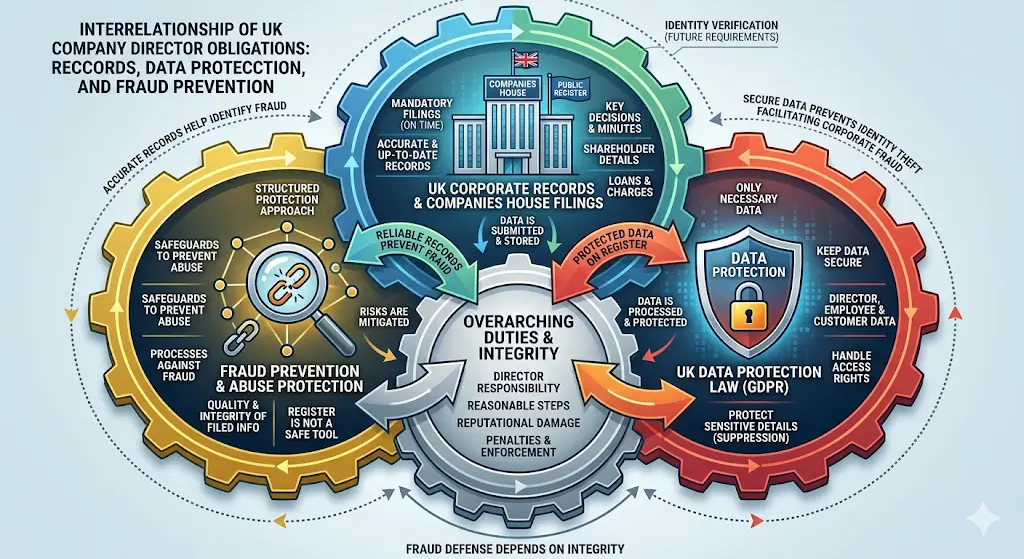
Directors of UK companies have a legal obligation to keep accurate and up-to-date company and accounting records and to file statutory information with Companies House on time. This includes maintaining details about shareholders, key decisions, loans, charges over assets, and other records that define the company’s structure and obligations. Failure to keep proper records or incorrect filings can trigger penalties, enforcement action, and serious reputational damage.
Alongside corporate records duties, companies that handle personal data must comply with UK data protection law when storing and using information about directors, employees, and customers. That means holding only the data that is necessary, keeping it secure, and handling access and suppression rights correctly when individuals ask for protection of sensitive details. When personal information about directors appears on public registers, businesses must understand when that information can be limited or protected and how to apply for suppression through the appropriate channels.
Recent measures designed to prevent abuse of Companies House data also place more emphasis on the quality and integrity of information filed by companies. Directors are expected to take reasonable steps to prevent the register from being used as a tool for fraud, which in practice means having processes and safeguards in place rather than assuming that the public register alone will keep their business safe. This is where a structured fraud protection approach becomes essential.
What “official fraud protection” really means
Official fraud protection in the context of UK company records is more than a one-off check or a basic alert service; it is an end‑to‑end framework that combines regulatory compliance, identity verification, and escalation procedures. At its core, a formal Fraud Protection service focuses on protecting the integrity of your company’s identity on public registers and in key counterparties’ systems.
A robust service will monitor your Companies House profile, detect changes as soon as they are filed, and flag any appointment, registered office, or shareholding updates that do not match authorised instructions. It should also integrate with internal approval workflows, so only validated instructions from authorised officers can be used to support filings or corrections. Where suspicious activity is found, the service should guide or handle the process of reporting the issue, engaging Companies House, banks, or law enforcement where appropriate.
Importantly, official fraud protection is not limited to monitoring; it supports evidential record‑keeping and documentation. This ensures that, if you need to challenge a fraudulent filing or prove that appropriate steps were taken, you can demonstrate that your company had controls, monitoring, and escalation mechanisms in place. That evidential trail can be crucial when dealing with regulators, insurers, or law enforcement agencies.
Why DIY controls often fall short at BOFU stage
At the bottom of the funnel, buyers are already comparing DIY approaches with managed services and are weighing convenience, risk, and long‑term cost. Many businesses initially attempt to manage fraud risk internally by relying on directors or administrators to “keep an eye” on Companies House and email notifications. While this can reduce some risk, it often fails for three reasons.
First, manual monitoring is inconsistent. Busy teams quickly fall behind on checking changes, particularly when multiple entities, subsidiaries, or group structures are involved. If no one has explicit responsibility for monitoring company records, changes can go unnoticed for weeks or months. Second, internal teams may not recognise subtle red flags, such as a seemingly minor change in a director’s address or an unusual sequence of filing amendments that indicates an attempted takeover. Without specialist knowledge, these signs can be dismissed as administrative anomalies rather than serious threats.
Third, DIY approaches usually lack a defined response plan. Even when a suspicious change is spotted, there may be uncertainty about who should respond, how to collect evidence, or which route to use to correct the record and notify affected parties. This slows down remediation at precisely the moment when speed is most critical. A properly managed Fraud Protection solution addresses these gaps with structured monitoring, expert analysis, and clear response pathways.
To explore the difference in more depth, you can draw on guidance like “Your Legal Responsibility to Protect Your UK Company Records,” which looks at the regulatory side of record-keeping and how it links to fraud risk. Using this kind of informational context makes it much easier to decide what level of protection your company needs at each stage of its growth.
Key components of a compliant Fraud Protection framework
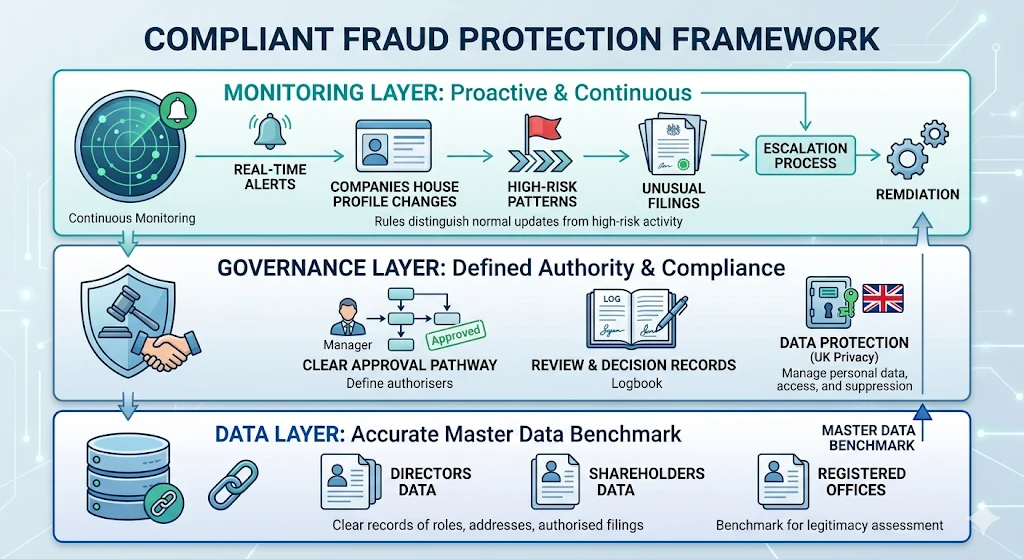
To ensure full compliance when using an official Fraud Protection service, it helps to think of the framework in three layers: data, governance, and monitoring. Each layer contributes to both legal compliance and practical fraud prevention.
At the data layer, you need accurate, complete, and consistent information about directors, shareholders, and registered offices across internal systems and public registers. This includes having clear records of who holds which role, which addresses are official, and which filings are authorised. The Fraud Protection service should use this master data as the benchmark when assessing whether new filings or changes appear legitimate or potentially fraudulent.
At the governance layer, your company must define who can authorise filings, who is responsible for reviewing monitoring alerts, and how decisions are recorded. A clear approval pathway ensures that the Fraud Protection provider always knows which instructions are genuine, reducing the chance of social engineering. Governance should also define how data protection is handled, including where personal data is stored, who can access it, and how suppression or protection requests are managed in line with UK privacy rules.
At the monitoring layer, the service should provide proactive, real‑time or near‑real‑time alerts for changes to your Companies House profile and other key indicators. Monitoring should be continuous, not periodic, with rules that distinguish normal administrative updates from unusual or high‑risk patterns. For example, repeated attempts to change the registered office, unexpected additions of directors, or rapid re‑filing of the same form can all signal higher‑risk activity. The monitoring layer should connect straight into your escalation process, so that suspicious changes lead directly to investigation and remediation.
How Form My Company’s Fraud Protection fits into your compliance strategy
Form My Company positions Fraud Protection as a structured, managed service that integrates into your company’s existing governance and compliance arrangements rather than sitting alongside them as a separate, standalone tool. By focusing on corporate records, public register data, and the specific way UK companies interact with Companies House, the service is designed to address real-world risk rather than generic cybersecurity.
When you work with Form My Company, you can align the service with your responsibilities already outlined in resources such as your internal record‑keeping policies and external guidance on company records. That allows you to connect statutory duties around record accuracy and timeliness with real‑time monitoring and intervention. Over time, this integrated approach supports not only fraud prevention but also better overall corporate governance and audit readiness.
For organisations that have already compared self‑managed controls to managed fraud services, materials like “DIY Protection vs. Managed Fraud Services: Which is More Secure?” provide a useful commercial and decision‑focused lens. They help decision‑makers see where outsourcing delivers better consistency, faster response, and clearer accountability, especially for companies with multiple directors, complex ownership structures, or limited internal compliance capacity.
Practical steps to implement full compliance with Fraud Protection
To make sure your business is fully compliant when using an official Fraud Protection service, it helps to approach implementation in a series of practical steps. These steps ensure that the service is grounded in accurate data, clearly governed, and properly documented from day one.
First, consolidate and verify your core company data. Ensure that your registered office address, directors’ details, and shareholder information are correct in internal systems and match what appears on Companies House. Any discrepancies should be corrected before the Fraud Protection service starts monitoring, so that the initial baseline is clean and reliable.
Second, define roles and responsibilities around the service. Assign a primary contact who will receive alerts, approve responses, and coordinate with Form My Company. Clarify who can authorise changes to company details and filings, and make sure the Fraud Protection provider has a current list of authorised officers. Document this governance structure so that there is no ambiguity during a potential incident.
Third, embed the service into your incident response and compliance processes. When a suspicious change is flagged, there should be a pre‑agreed path that covers investigation, evidence collection, communication with Companies House, and, if needed, escalation to banks or other stakeholders. This is where a managed Fraud Protection solution adds particular value, helping you move quickly from detection to resolution within a framework that supports both regulatory compliance and operational continuity.
Ensuring full compliance with an official Fraud Protection service is ultimately about more than ticking regulatory boxes; it is about protecting the identity, reputation, and continuity of your business in an environment where company data is both highly visible and highly valuable to fraudsters. By combining accurate records, clear internal governance, and a professionally managed Fraud Protection framework, you can significantly reduce the risk of corporate identity theft and unauthorised changes to your statutory profile.
Form My Company brings these elements together into a structured Fraud Protection solution tailored to the way UK companies actually operate. By integrating monitoring, escalation, and governance support, the service helps directors fulfil their responsibilities over company records while keeping fraud risk under active control. For organisations at the bottom of the funnel, this offers a practical and professional route to safeguarding company identity without overloading internal teams.
What is Fraud Protection for a UK company?
Fraud Protection for a UK company is a set of controls, monitoring tools, and procedures designed to stop unauthorised changes, identity theft, and financial crime using the company’s details. From My Company provides Fraud Protection that focuses on safeguarding official company information, transactional activity, and access to sensitive data.
Why does my business need a Fraud Protection service?
Your business needs Fraud Protection to reduce the risk of corporate identity theft, unauthorised filings, and fraud losses that can arise from misuse of company or director information. A structured Fraud Protection service from From My Company helps you detect suspicious activity early and put evidence‑based controls in place.
How does From My Company’s Fraud Protection service work in practice?
From My Company’s Fraud Protection service combines monitoring of company information, verification of high‑risk changes, and clear escalation steps when anomalies are detected. The service focuses on protecting your official company records and supports your existing compliance processes with documented, repeatable controls.
Is Fraud Protection only about cybersecurity and online scams?
Fraud Protection is broader than pure cybersecurity and includes protecting company records, verifying changes to director or address details, and preventing misuse of your legal entity. From My Company’s Fraud Protection service addresses both digital risks and risks linked to public filings and corporate identity.
Can Fraud Protection help me meet my legal responsibilities as a company director?
Yes, a well‑designed Fraud Protection service supports your duty to keep accurate records, protect personal data, and act to prevent fraud against your company. From My Company’s Fraud Protection framework helps directors align day‑to‑day monitoring and incident response with those responsibilities in a structured way.