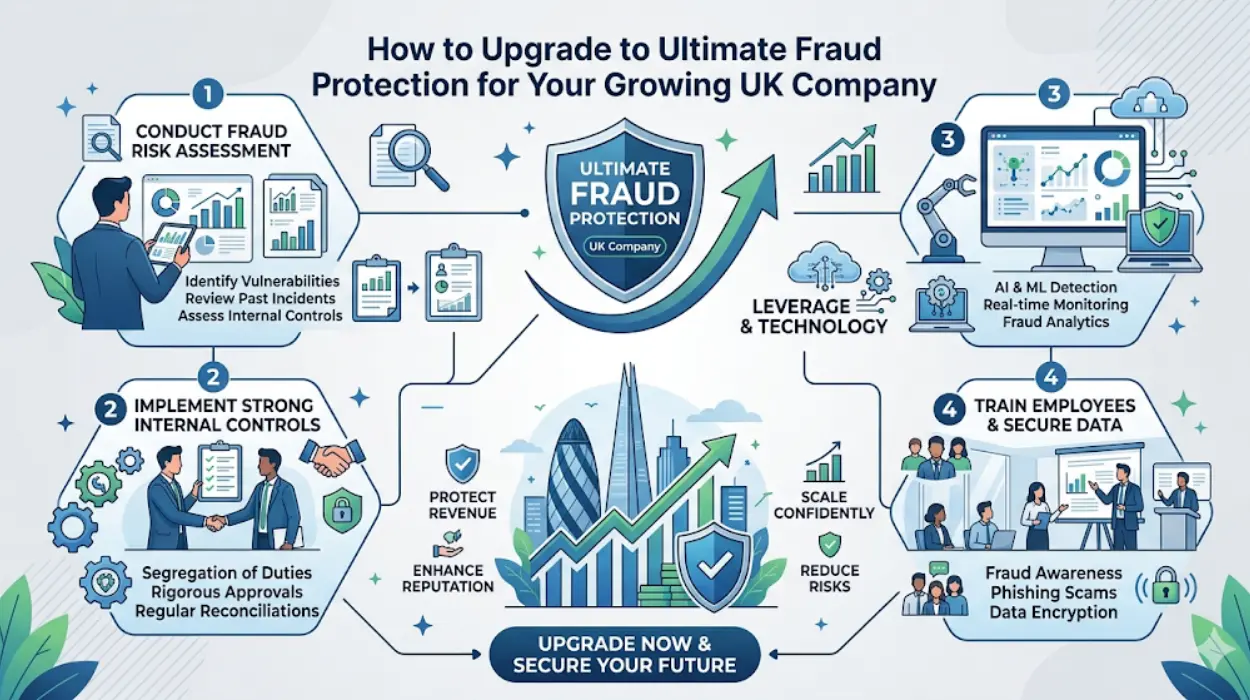
Growing UK businesses are increasingly attractive to fraudsters because they combine higher transaction volumes, more accounts, and evolving digital processes with limited internal security headcount. Identity‑based fraud alone now accounts for around 64% of fraud cases reported to the UK’s national fraud database, with synthetic and AI‑aided identities making verification harder.
Ultimate‑grade fraud protection is designed specifically for this stage: it matches the scale and complexity of a growing company while embedding controls that larger enterprises use, such as multi‑factor verification, real‑time monitoring, and decision‑based rules tailored to your business model. For a scaling UK business, that often means fewer false‑positive approvals, faster genuine‑customer onboarding, and lower exposure to chargebacks, clawbacks, and costly recovery work.
What “Ultimate Fraud Protection” typically covers
For a UK‑based service such as the Fraud Protection offering at Form My Company, “ultimate”‑level protection usually blends identity, transaction, and behavioural analytics into one integrated layer. Typical components include:
- Identity and director‑level verification using trusted sources to confirm that business owners, directors, and people with significant control are who they claim to be.
- Continuous monitoring of payment and banking‑related activity, including unusual volumes, locations, or timing that fall outside normal business patterns.
- Automated fraud‑alert rules that flag suspicious supplier invoices, payroll changes, or account‑access events so internal teams receive alerts before money is moved.
In practice, this allows a growing UK company to keep operating at speed while still meeting the tighter identity‑verification expectations now being reinforced under the Economic Crime and Corporate Transparency Act 2023 and related reforms at Companies House. A business that has upgraded to an enterprise‑grade Fraud Protection layer can show auditors, insurers, and partners that it has taken proactive steps to reduce its exposure to organised fraud networks.
How identity fraud impacts growing businesses
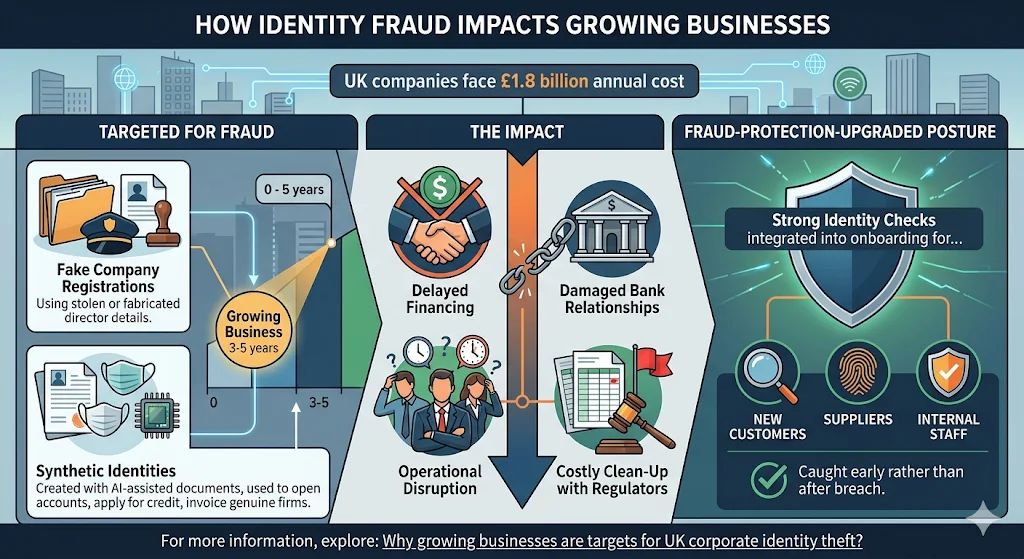
Identity fraud is one of the most common and damaging threats facing UK companies today, costing the economy an estimated £1.8 billion annually. Growing businesses often fall between “too small to ignore” and “too new to be robust,” which makes them prime targets for:
- Fake company registrations using stolen or fabricated director details.
- Synthetic identities created with AI‑assisted documents that mimic real businesses, used to open accounts, apply for credit, or invoice genuine firms.
For a three‑to‑five‑year‑old company, the impact is not just financial. An identity‑fraud incident can delay financing, damage bank relationships, and trigger a costly clean‑up with credit‑reference agencies and regulators. A fraud‑protection‑upgraded posture helps by baking strong identity checks into the onboarding of new customers, suppliers, and even internal staff, so that suspicious entities are caught early rather than discovered after a breach. For more information also explore Why growing businesses are targets for UK corporate identity theft?
Why a “basic” protection layer is no longer enough
Many small businesses start with simple measures: separate bank‑login devices, basic password‑manager usage, and ad‑hoc invoice checks. As the business grows, though, these controls become unmanageable and often get bypassed under pressure to move quickly.
Ultimate‑grade Fraud Protection is designed to scale with complexity, not just volume. It replaces scattered checks with:
- Centralised rules and thresholds (for example, automatic holds on payments above a certain amount or to new supplier accounts until a manual review).
- Integration with bookkeeping, payment, and onboarding tools so that anomalies are surfaced where they matter most.
For a growing UK founder, the difference is often between “hope users do the right thing” and “the system automatically intervenes when something looks wrong.” This shift is what separates basic security hygiene from a mature, upgrade‑worthy fraud‑protection stack.
How to align fraud protection with your business model
Not every UK business faces the same fraud profile. A service‑based agency dealing mostly in invoices and retainers will care about different triggers than a product‑based retailer handling high‑volume card transactions and returns. When upgrading to an Ultimate Fraud Protection layer, the first step should be mapping:
- Payment channels (bank transfers, cards, digital wallets, and recurring invoices).
- Customer‑onboarding touch‑points (sign‑up forms, contracts, and KYC‑style checks).
- Supplier and payroll‑related workflows (invoice‑approval chains, changes to bank details, and employee‑onboarding).
A tailored Fraud Protection configuration then applies different rule sets to each of these flows. For example, one rule might require a second‑person approval whenever a new supplier bank account is added, while another might block unusually large card‑not‑present transactions during off‑hours. By aligning these rules with how your business actually operates, you reduce friction for genuine activity while catching the patterns that fraudsters repeatedly exploit.
Real‑world benefits for firms that upgrade
Firms that move from basic security to an enterprise‑grade Fraud Protection service report several measurable improvements:
- Reduced incident‑response time, because alerts are prioritised and tied directly to business workflows rather than buried in generic security dashboards.
- Lower false‑positive rates on legitimate transactions, since the system learns normal patterns over time and flags only what is statistically unusual.
- Stronger evidence of due diligence for banks, insurers, and regulators, which can translate into more favourable terms and faster dispute resolution.
For a UK company that has recently secured funding or expanded into new markets, a clear upgrade to Ultimate Fraud Protection can also act as a credibility signal to partners and investors, demonstrating that you are treating fraud as a strategic risk rather than an afterthought.
Practical steps to upgrade your fraud protection
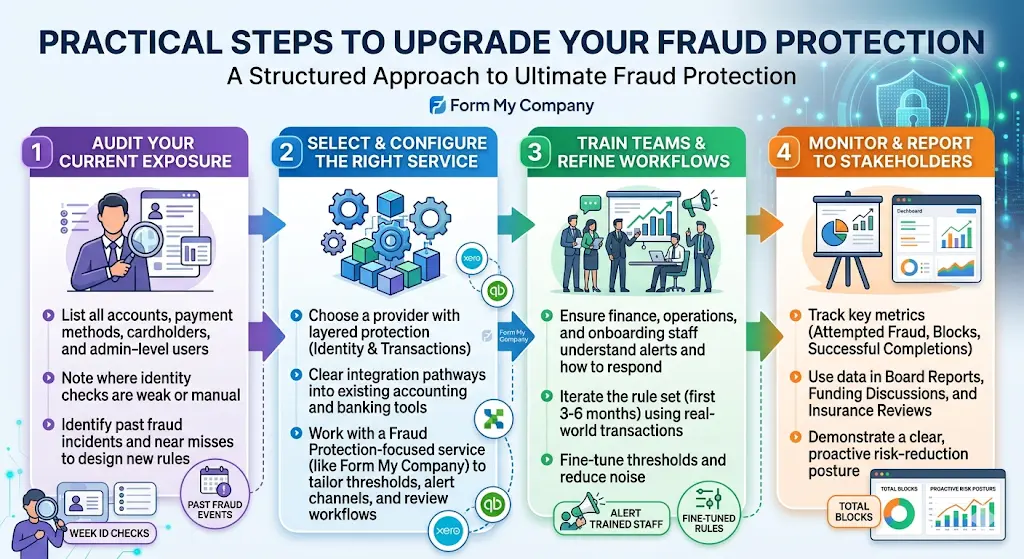
To move from your current state to an Ultimate Fraud Protection posture, most growing UK businesses benefit from a structured approach:
- Audit your current exposure
- List all accounts, payment methods, cardholders, and admin‑level users, noting where identity checks are weak or manual.
- Identify where fraud has already occurred or been narrowly avoided, using those incidents as examples when designing new rules.
- Select and configure the right service
- Choose a provider that offers layered protection for both identity and transactions, with clear integration pathways into your existing accounting and banking tools.
- Work with a Fraud Protection‑focused service such as the one offered by Form My Company to tailor thresholds, alert channels, and review workflows to your specific business size and risk tolerance.
- Train teams and refine workflows
- Ensure finance, operations, and onboarding staff understand what an alert means and how to respond without delaying legitimate work.
- Iterate the rule set over the first three to six months, using real‑world transactions to fine‑tune thresholds and reduce noise.
- Monitor and report to stakeholders
- Track key metrics such as attempted fraud incidents, blocks, and successful completions to show the impact of the upgrade.
- Use that data in board reports, funding discussions, and insurance reviews to demonstrate a clear, proactive risk‑reduction posture.
Why Form My Company’s Fraud Protection supports scaling businesses
Growing UK companies often struggle to find fraud solutions that are both sophisticated enough for their stage and simple enough to deploy without a dedicated security team. Form My Company positions its Fraud Protection offering as a practical, service‑oriented solution that bridges this gap, combining identity‑verification logic with continuous monitoring and clear escalation paths tailored to businesses navigating scale‑up and compliance changes.
By embedding these protections into core company‑setup and ongoing‑operations workflows, Form My Company helps founders focus on growth rather than firefighting after a fraud incident. For a growing UK business, upgrading to an Ultimate‑grade Fraud Protection service is less about “buying another tool” and more about building a defensible, repeatable security posture that can evolve as your turnover, teams, and markets expand. Also explore Scaling your business safely with enterprise‑grade fraud alerts.
What is fraud protection for UK businesses?
Fraud protection for UK businesses refers to a set of tools and processes that help detect, prevent, and respond to financial, identity, and transaction‑based fraud. From My Company’s Fraud Protection service combines identity checks, transaction monitoring, and alert rules to reduce the risk of unauthorised payments and account misuse.
Why do growing UK companies need fraud protection?
Growing UK companies are attractive targets because they handle more transactions, bank accounts, and digital onboarding, often without a dedicated security team. From My Company’s Fraud Protection helps scaling firms manage these risks by embedding automated checks into payments, payroll, and supplier workflows.
How does fraud protection help prevent payment fraud?
Fraud protection for payment fraud typically uses rule‑based monitoring to flag suspicious transfers, new payees, or unusually high amounts. From My Company’s Fraud Protection service applies these checks across bank feeds and accounting systems so businesses can halt or review risky payments before they settle.
Can fraud protection stop corporate identity fraud in the UK?
Yes, fraud protection can significantly reduce corporate identity fraud by verifying business owners, directors, and people with significant control against trusted data sources. From My Company’s Fraud Protection includes identity‑verification layers that help catch fake registrations and synthetic‑identity schemes early in the onboarding process.
Is fraud protection suitable for small and medium UK businesses?
Fraud protection is designed for small and medium UK businesses that want enterprise‑style controls without running a full‑time security team. From My Company’s Fraud Protection offers scalable rules and monitoring that match the size and complexity of growing firms while fitting into standard bookkeeping and banking workflows.