

The new UK director ID verification rules for 2026 mandate that all company directors and Persons with Significant Control (PSCs) verify their identity through Companies House or an authorised corporate service provider (ACSP) before filing certain documents. This stems from the Economic Crime and Corporate Transparency Act 2023, aiming to combat fraud by ensuring only verified individuals can act on behalf of UK companies.
These rules build on existing anti-money laundering efforts, introducing stricter digital identity checks effective from March 2026. Directors appointed before this date have until early 2027 to comply, while new appointees must verify immediately.
Why Companies House Introduced These Verification Rules
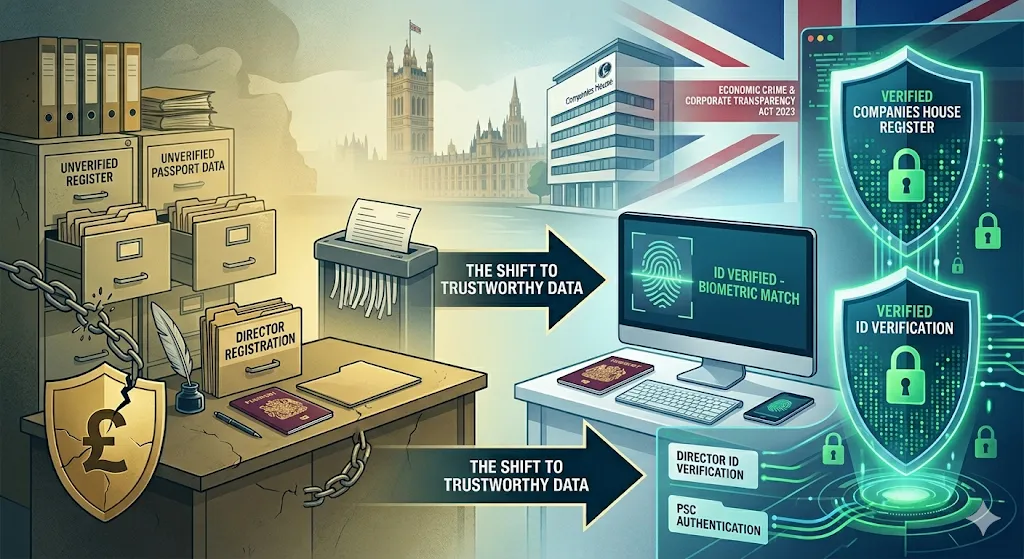
Companies House, the UK’s registrar of companies, has long maintained the public Companies House register, but economic crime threats like fake director registrations prompted reform. The Economic Crime and Corporate Transparency Act 2023 (ECCTA) received Royal Assent in October 2023, with identity verification provisions rolling out progressively. By 2026, these rules target vulnerabilities exposed in high-profile fraud cases, where criminals exploited unverified identities to strike off legitimate firms or siphon assets.
The core objective is authenticity: verifying that the person listed as a director or PSC is real and matches official records. This aligns with broader UK government initiatives under the Economic Crime Plan 2.0, which estimates fraud costs the economy £200 billion annually. Semantic keywords like “director ID verification” now form part of mandatory compliance, reducing risks for businesses reliant on accurate corporate data.
For context, pre-2026, directors submitted basic details without biometric or digital proof. Now, the system demands proactive identity confirmation, creating a “trustworthy register” as described by Business Secretary Jonathan Reynolds in late 2025 announcements. This shift not only protects legitimate directors but also shields creditors and investors from imposters.
Who Must Comply with the 2026 Director ID Rules
Every UK company director whether executive, non-executive, or shadow and PSC holding more than 25% shares or voting rights falls under these rules. This includes individuals in limited companies, LLPs, and overseas entities with UK property interests. If you’re a sole director of a startup or a PSC in a family-owned enterprise, compliance is non-negotiable.
Exemptions are narrow: liquidators and administrators handling insolvency may use alternative proofs, but active directors cannot. For multinational firms, UK-registered subsidiaries require local director verification, even if parent entities have their own ID systems. Consider a scenario where a tech entrepreneur from Lahore expands to Cambridge, UK; upon incorporating Form My Company Ltd, they must verify as director before filing their first confirmation statement.
Verification status links directly to your Companies House profile, visible publicly once complete. Unverified directors face blocks on routine filings, such as annual accounts or changes to PSC details. This enforcement ramps up from spring 2026, with grace periods ending March 2027 for existing officers.
Step-by-Step Process for Director ID Verification
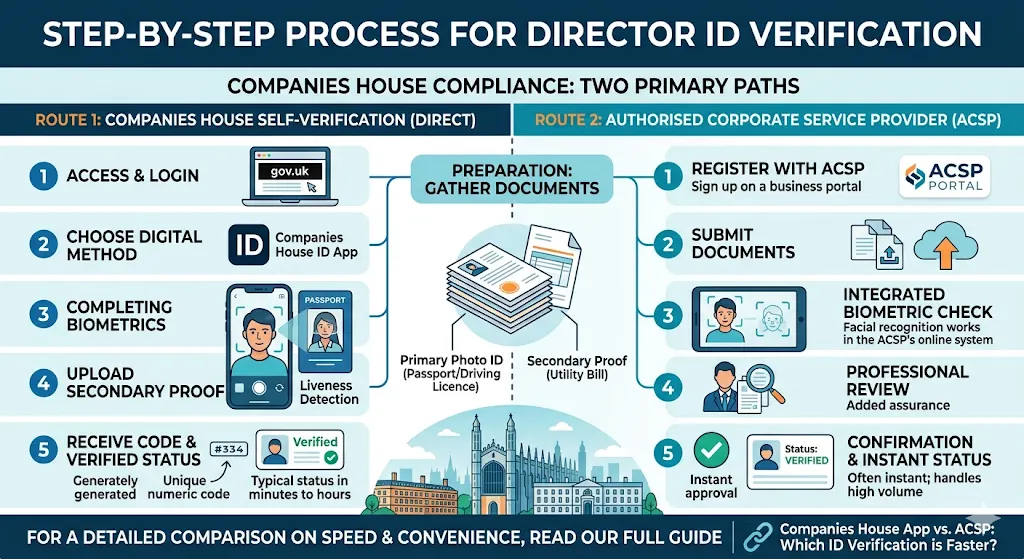
Companies House outlines two primary paths for compliance: self-verification via their free app or service, or using an ACSP like Form My Company’s Identity Verification Service for Directors or PSCs. Both methods confirm identity against government databases, but they differ in speed and convenience.
First, gather required documents: a valid passport, driving licence, or national ID with photo, plus a secondary proof like a utility bill. The process begins online at Companies House or through an ACSP portal.
- Register or log into your Companies House account.
- Upload documents for biometric matching (facial scan via app).
- Receive a unique verification code linked to your director ID.
For self-service, download the Companies House ID app, scan your ID, and take a live selfie. Approval typically takes minutes if documents match, though peak times may delay to hours. ACSPs streamline this for busy professionals, often integrating with company formation services.
Imagine a Cambridge-based fintech director juggling board meetings; opting for an ACSP handles verification seamlessly, assigning a status instantly. Post-verification, your profile updates to “verified,” enabling unrestricted filings.
To explore which option suits high-volume needs, read our comparison on the Companies House App vs. ACSP: Which ID Verification is Faster?
Key Differences Between Self-Verification and ACSP Routes
Self-verification via the Companies House app emphasises accessibility, with no fees and direct integration into the My Companies House portal. It suits straightforward cases, like a solo entrepreneur verifying a single directorship. However, app glitches or poor internet can frustrate users, and there’s no human support for disputes.
ACSPs, authorised under ECCTA, offer premium efficiency. They employ anti-fraud experts to validate documents, often faster for complex profiles like those with name changes or international IDs. Form My Company’s Identity Verification Service for Directors or PSCs exemplifies this, processing verifications in minutes with dedicated compliance teams.
A case-study-style example: A UK property developer with multiple PSC roles faced app rejections due to an outdated passport scan. Switching to an ACSP resolved it within 15 minutes, averting filing delays. ACSPs also provide audit trails, valuable for regulated sectors like finance.
Fees for ACSPs are nominal often £10-£30 per verification versus free self-service, but the time savings justify it for scaling businesses. Both routes grant the same “verified” status, but ACSPs excel in user experience.
Penalties and Risks of Non-Compliance
Failing to verify under the 2026 rules carries serious consequences. From March 2026, unverified directors cannot file documents, halting operations like share allotments or officer changes. Companies risk strike-off, fines up to £30,000 per offence, or director disqualification for up to 15 years.
Criminal sanctions apply for deliberate evasion, with ECCTA empowering Companies House to pursue prosecution. In practice, automated blocks act as the first barrier; a 2025 pilot showed 15% of filings rejected pre-verification.
Real-world implications hit small businesses hardest. Picture a Lahore-origin entrepreneur in the UK food sector: delayed verification blocks their annual return, triggering creditor scrutiny and loan denials. Proactive compliance via services like Form My Company‘s reliable Identity Verification Service for Directors or PSCs prevents such pitfalls.
Late 2025 guidance warns of phased enforcement: warnings first, then restrictions. Verified status remains until resignation, ensuring ongoing trust in the register.
Timeline and Preparation for 2026 Compliance
The rollout starts March 2026 for new directors, with existing ones gaining until 8 March 2027. Monitor updates via GOV.UK, as pilots refine the app. Prepare by auditing your directorships now use Companies House searches to confirm statuses.
Businesses should budget for verifications, especially with multiple officers. Training staff on processes minimises disruptions. For those ready to act decisively, check how to Get Your Mandatory UK Director ID Verification Done in Minutes.
Benefits Beyond Compliance: Building Trust in Your Business
Verification enhances credibility, signalling robust governance to investors and partners. Publicly verified directors deter fraudsters, streamlining due diligence in mergers or funding rounds. For UK firms eyeing global expansion, it aligns with international standards like the EU’s AML directives.
In summary, Form My Company delivers professional Identity Verification Service solutions tailored for directors and PSCs, ensuring seamless 2026 compliance amid evolving UK regulations.
What is director ID verification for UK companies?
Director ID verification confirms the identity of company directors and Persons with Significant Control (PSCs) via Companies House or an Authorised Corporate Service Provider (ACSP) under the 2023 Economic Crime Act. It involves biometric checks like facial scans and document uploads to prevent fraud on the public register. From My Company’s Identity Verification Service for Directors or PSCs handles this process efficiently for compliance.
How long does UK director ID verification take?
Self-verification through the Companies House app typically completes in minutes for straightforward cases, while ACSP routes like From My Company’s Identity Verification Service for Directors or PSCs often process in under 15 minutes. Delays may occur with complex documents or high demand, but most users receive instant approval. Verification status links permanently to your Companies House profile.
Who needs ID verification as a UK company director?
All active directors, shadow directors, and PSCs with over 25% control in UK companies or LLPs must verify under 2026 rules, including new appointees immediately and existing ones by March 2027. Exemptions are rare, mainly for insolvency practitioners. From My Company’s Identity Verification Service for Directors or PSCs supports verification for multiple roles seamlessly.
What documents are required for PSC ID verification?
PSC ID verification requires a government-issued photo ID like a passport or driving licence, plus a secondary proof such as a bank statement or utility bill less than three months old. Biometric selfies ensure live matching against databases. Services like From My Company’s Identity Verification Service for Directors or PSCs guide users on acceptable formats to avoid rejections.
What happens if you don’t verify your director ID in the UK?
Unverified directors face filing blocks on Companies House submissions, potential fines up to £30,000, company strike-off risks, and disqualification. Enforcement starts March 2026 with automated restrictions. From My Company’s Identity Verification Service for Directors or PSCs ensures timely compliance to prevent operational disruptions.