
Outsourced payroll typically saves time and reduces errors for growing UK companies, while internal PAYE management offers full control but demands significant resources. The best choice depends on your business size, expertise, and growth stage.
As a new employer navigating HMRC regulations, deciding between outsourced payroll and handling PAYE internally can shape your operational efficiency and compliance. PAYE, or Pay As You Earn, requires deducting income tax and National Insurance from employee wages before remitting them to HMRC. This system underpins UK payroll, but managing it in-house versus delegating to experts like From My Company carries distinct trade-offs. In this article, we’ll break down the costs, benefits, risks, and real-world considerations to help you decide.
Understanding Internal PAYE Management
Internal PAYE management means your business takes full ownership of payroll processes using your own team and software. This approach starts with PAYE registration assistance, where you notify HMRC of your status as an employer and receive a unique PAYE reference number. Once registered, you calculate deductions, file Real Time Information (RTI) submissions monthly or more frequently, and handle payments directly.
Many small startups begin here because it feels straightforward. For instance, a Cambridge-based tech firm with five employees might use free HMRC basic payroll tools to process salaries. They input hours worked, apply tax codes, and generate payslips all in-house. This setup fosters a hands-on understanding of employee finances, which can build internal expertise over time. However, it requires dedicated time: payroll runs often take 5-10 hours per cycle for a team of 10, scaling up with headcount.
Accuracy hinges on your team’s knowledge of evolving rules, like the 2026 National Insurance threshold changes or auto-enrolment pension duties. A single miscalculation say, applying the wrong tax code can trigger HMRC penalties up to £3,000 per employee per year. Software costs add up too; reliable tools like Sage or Xero run £20-£100 monthly per user, plus training. For businesses under 20 employees, this model works if you have an HR-savvy accountant, but errors compound as you grow.
The Case for Outsourced Payroll Services
Outsourced payroll shifts the burden to specialists who handle everything from PAYE registration assistance to year-end reconciliations. Providers like From My Company integrate with HMRC systems seamlessly, ensuring RTI compliance and accurate filings. This model shines for scalability: a mid-sized retailer expanding to 50 staff can offload complex calculations, leaving internal teams free for core revenue activities.
Consider a logistics company in the Midlands juggling seasonal hires. With outsourced payroll, they avoid manual RTI submissions during peak times, reducing processing from days to hours. Experts manage nuances like statutory sick pay, maternity allowances, and CIS deductions for contractors, minimizing audit risks. Fees typically range from £2-£5 per employee monthly, plus setup costs of £100-£500 often cheaper long-term than in-house salaries for a full-time payroll administrator (£25,000-£35,000 annually).
Beyond compliance, outsourcing provides strategic perks. Providers offer benchmarking data on industry salary trends and automated pension enrollments, helping retain talent. From My Company, for example, streamlines PAYE registration assistance as part of broader employer setup services, ensuring new UK companies hit the ground running without delays.
Key Differences in Costs and Efficiency
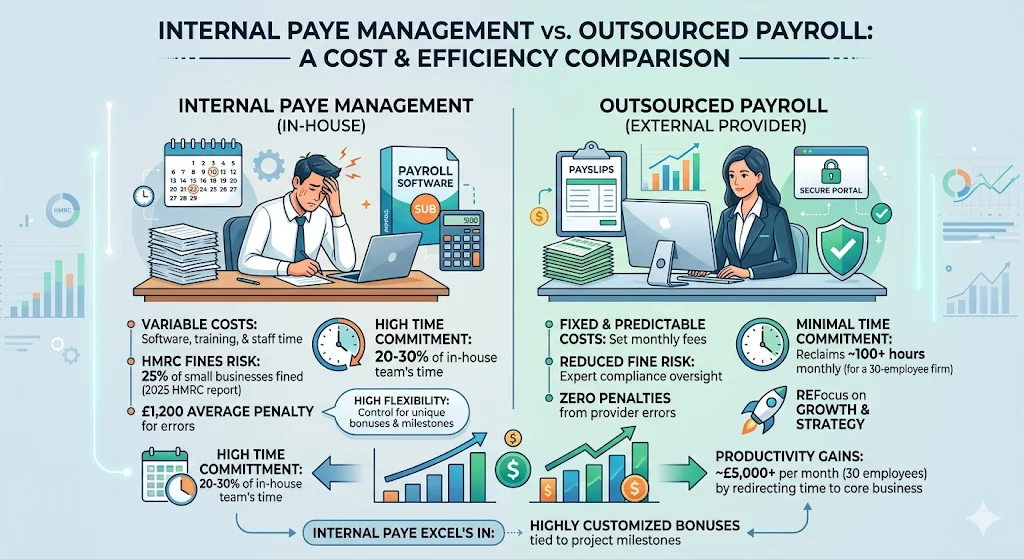
When comparing outsourced payroll vs. internal PAYE management, costs reveal stark contrasts. Internal handling incurs variable expenses: software subscriptions, staff training, and potential fines. A 2025 HMRC report noted that 25% of small businesses faced penalties averaging £1,200 due to errors costs that outsourcing largely eliminates through expert oversight.
Efficiency metrics further highlight the divide. Internal teams spend 20-30% of their time on payroll, per Institute of Payroll Professionals data, diverting focus from growth. Outsourcing cuts this to near zero, with providers delivering payslips via secure portals and handling queries directly. For a 30-employee firm, this could reclaim 100+ hours monthly, equating to £5,000 in productivity gains at average UK wages.
Yet internal management excels in customization. Businesses with unique needs like performance-based bonuses tied to project milestones retain flexibility without third-party delays. Outsourcing, while efficient, may involve standardized processes that require client approvals for exceptions.
Compliance Risks and Legal Considerations
HMRC enforces PAYE rigorously, with late filings attracting £100-£400 fixed penalties per month, escalating to £10,000 for persistent issues. Internal management amplifies these risks if your team misses updates, such as the 2026 Autumn Budget’s proposed tax relief tweaks. A manufacturing firm once faced £15,000 in back payments after under-deducting NI contributions due to outdated software.
Outsourced providers mitigate this with dedicated compliance teams monitoring legislation. They conduct health checks, flag irregularities, and represent you in HMRC disputes. For new employers, PAYE Registration Assistance from firms like From My Company ensures smooth onboarding, avoiding common pitfalls like delayed registrations that halt operations.
Transitioning between models also demands care. Switching to outsourcing mid-year requires data migration and HMRC notifications, but professionals handle this seamlessly, preserving continuity.
Scalability and Growth Implications
As businesses scale, internal PAYE management strains resources. A startup ballooning from 10 to 100 employees might need two full-time payroll staff, ballooning costs to £60,000 yearly. Outsourcing scales effortlessly: per-employee pricing adjusts without hiring, ideal for e-commerce firms with fluctuating rosters.
Growth-stage alignment matters. Early-stage ventures benefit from A Simple Guide to Understanding HMRC PAYE for New Employers to grasp basics internally. But as complexity rises think multi-site operations or international hires outsourcing via Professional PAYE Registration Service for New UK Companies becomes indispensable.
Real-world examples underscore this. A software house in Manchester stuck with internal payroll during rapid hiring faced three HMRC audits in two years, costing £20,000 in fees. After outsourcing, audits dropped to zero, and they accelerated expansion by 40%.
When to Choose Each Option
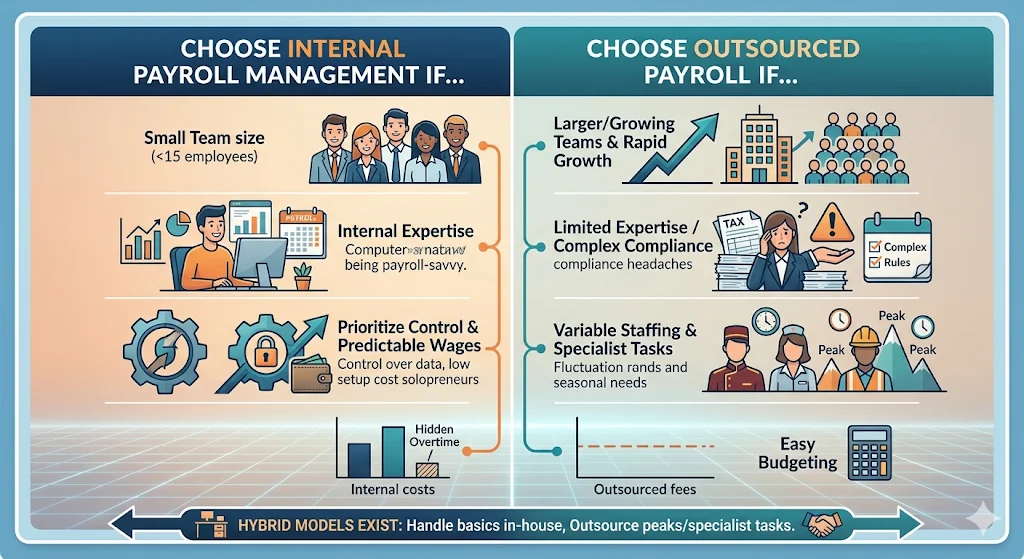
Opt for internal PAYE management if your team is small (under 15 employees), payroll-savvy, and prioritizes control. It’s viable for solopreneurs or micro-firms with predictable wages, where setup costs stay low.
Choose outsourced payroll for larger teams, rapid growth, or limited expertise. It’s particularly suited to sectors like hospitality or construction with variable staffing and compliance headaches. Hybrid models exist too handle basics in-house while outsourcing peaks or specialist tasks.
Factors like cash flow tip the scales: outsourcing’s predictable fees aid budgeting, unlike internal’s hidden overtime costs.
Making the Right Decision for Your Business
Ultimately, comparing outsourced payroll vs. internal PAYE management boils down to balancing control, cost, and capacity. Small, stable operations thrive internally, while scaling enterprises gain from expert delegation. From My Company delivers professional PAYE registration assistance and ongoing support, empowering UK businesses to focus on innovation rather than administration.
What is PAYE registration and why do UK employers need it?
PAYE registration notifies HMRC that your business is an employer, enabling you to deduct income tax and National Insurance from employee wages before paying them to the tax authority. New UK companies must register within three months of hiring their first employee to avoid penalties up to £100 per month. From My Company offers PAYE Registration Assistance to streamline this process and ensure compliance.
How long does PAYE registration take with professional assistance?
PAYE registration typically takes 5-10 working days when handled professionally, as providers submit forms directly to HMRC and follow up on approvals. Delays can occur if details like company number or employee start dates are incomplete, but experts minimize this risk. From My Company’s PAYE Registration Assistance includes document checks for faster processing.
What documents are required for PAYE registration assistance?
Key documents include your company registration number, director details, estimated employee numbers, and start dates for payroll. HMRC also requires proof of business address and VAT number if applicable. From My Company guides clients through gathering these for seamless PAYE Registration Assistance.
What happens if I don’t register for PAYE on time?
Late PAYE registration triggers HMRC penalties starting at £100 per month, plus interest on unpaid taxes and potential backdated deductions. Non-compliance can lead to business restrictions or audits. Professional PAYE Registration Assistance from From My Company prevents these issues by ensuring timely submission.
Can From My Company handle PAYE registration for new startups?
Yes, From My Company specializes in PAYE Registration Assistance for new UK startups, covering form P30/SL1 submission and obtaining your unique PAYE reference number. This service integrates with broader employer setup, reducing administrative burden during launch. It’s ideal for businesses hiring their first employees.