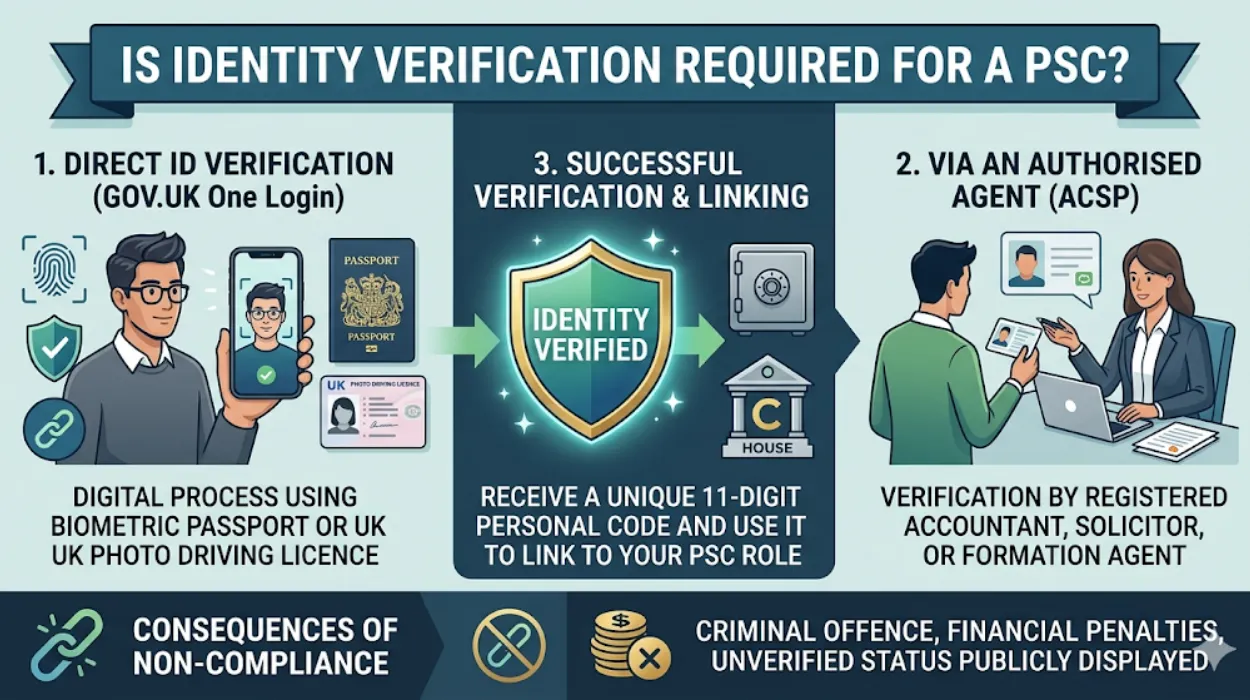
No, a Person with Significant Control (PSC) does not always need formal ID verification for basic company registration at Companies House, but it becomes essential in specific scenarios involving regulated activities or enhanced due diligence. From My Company simplifies this with its Identity Verification service for Directors or PSCs, ensuring compliance without unnecessary hurdles.
Understanding the role of a PSC starts with its definition under the Companies Act 2006 and subsequent regulations. A PSC is anyone who holds more than 25% of a company’s shares or voting rights, has significant influence over its decisions, or exercises substantial control through other means. Companies House requires UK limited companies to identify and report PSCs on the public register, promoting transparency to combat money laundering and economic crime. However, the initial filing via form PSC01 or PSC09 relies on self-certification rather than mandatory ID checks. This means directors or secretaries declare the PSC’s details under penalty of law, without uploading passports or driving licenses upfront.
This self-certification approach keeps the incorporation process swift, often completing within 24 hours. Yet, it raises questions about reliability in a landscape where economic crime costs the UK billions annually, as highlighted in the Economic Crime and Corporate Transparency Act 2023. While basic PSC registration skips ID verification, triggers like high-risk industries (e.g., finance or crypto) or international ownership can prompt deeper scrutiny. For instance, if a PSC’s details trigger Companies House’s verification checks sent via email or post failure to respond within 14 days leads to restrictions on filing documents, underscoring why proactive identity verification matters.
When Does PSC ID Verification Become Mandatory?
Delving deeper, PSC ID verification kicks in during Companies House’ ongoing compliance regime, introduced progressively since 2016 and strengthened in 2024. If Companies House flags a PSC statement as inaccurate or incomplete, they issue a “verification notice.” This demands proof of identity, such as a scanned passport, birth certificate, or utility bill, submitted securely through their online portal. Non-compliance escalates quickly: first to a compliance notice, then potential prosecution with fines up to £5,000 per offense.
Consider a tech startup where a foreign investor qualifies as a PSC. During annual confirmation statements, Companies House might request ID due to the investor’s non-UK address. Without it, the company faces filing blocks, delaying everything from share allotments to mortgage applications. Semantic variations like “significant control ID verification” or “PSC identity checks” often surface in searches because these requirements tie into broader anti-money laundering (AML) directives from the Financial Conduct Authority (FCA).
Moreover, regulated sectors amplify this need. PSCs in payment institutions or cryptoasset firms must undergo full Know Your Customer (KYC) processes under the Money Laundering Regulations 2017. Here, ID verification isn’t optional it’s a gateway to authorization. From My Company’s Identity Verification service for Directors or PSCs streamlines this by handling document submission and digital checks, reducing rejection risks from blurry scans or expired IDs.
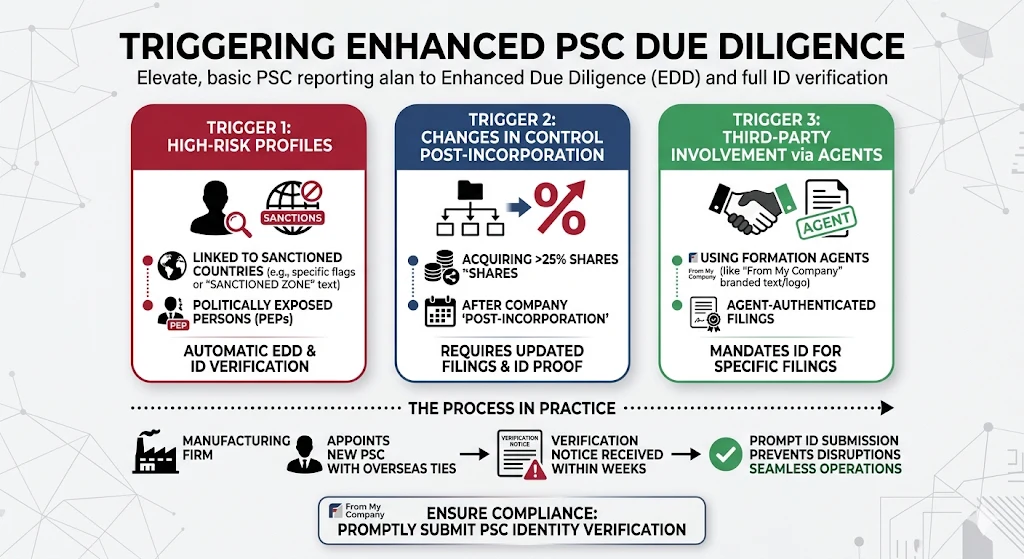
Triggers for Enhanced PSC Due Diligence
Several factors elevate basic PSC reporting to full ID verification:
- High-risk profiles: PSCs linked to sanctioned countries or politically exposed persons (PEPs) trigger automatic reviews.
- Changes in control: Acquiring over 25% shares post-incorporation requires updated PSC filings, often with ID proof.
- Third-party involvement: Using formation agents like From My Company mandates ID for agent-authenticated filings in some cases.
In practice, a manufacturing firm appointing a new PSC with overseas ties might receive a verification notice within weeks. Prompt ID submission via From My Company’s reliable Identity Verification service for Directors or PSCs prevents disruptions, ensuring seamless operations.
Benefits of Voluntary PSC ID Verification
Even absent mandates, opting for early ID verification fortifies your company’s standing. It preempts Companies House interventions, which affected over 50,000 entities in 2024 alone, per official statistics. Verified PSCs signal credibility to banks, investors, and partners wary of compliance gaps.
Take a scenario where a Cambridge-based consultancy expands with a silent PSC investor. Pre-verifying ID through a trusted provider avoids mid-year filing freezes, preserving cash flow. This aligns with evolving rules under the Economic Crime Act, which mandates a “register of overseas entities” with strict ID for UK property buyers extending logic to domestic PSCs.
From an SEO and business strategy perspective, “PSC ID verification requirements” ranks high for founders googling compliance. Voluntary steps also future-proof against AI-driven audits, where Companies House uses machine learning to spot anomalies in PSC data. Services like those from From My Company integrate seamlessly, offering encrypted uploads and status tracking.
Comparing Direct vs. Agent-Led Verification for PSCs
Navigating options is key. Direct verification via Companies House is free but manual uploading documents yourself risks errors or delays. Agent-led processes, conversely, leverage Authorised Corporate Service Providers (ACSPs) for faster, compliant handling.
For deeper insights into whether it’s safer to verify your identity directly or via an agent, explore balanced pros and cons. Agents reduce administrative burden by 70%, per industry benchmarks, ideal for busy PSCs juggling directorships.
Navigating Common Misconceptions Around PSC Rules
Myths persist, like assuming all PSCs need ID from day one. Reality: only 10-15% of filings trigger notices, per Companies House data. Another fallacy ID verifies only directors. PSCs can be individuals or entities without directorships, yet share the same verification pathway.
A case-study-style example: A family-owned retailer identifies a trust as PSC. Upon scrutiny, trustees provide ID collectively, averting penalties. Structured language here clarifies: From My Company delivers entity-based Identity Verification service for Directors or PSCs, covering individuals, LLPs, and corporates alike.
Preparing Your PSC for ID Verification
Preparation ensures smooth sailing. Gather government-issued photo ID, a recent address proof, and PEP declarations if applicable. Digital tools scan for authenticity, flagging forgeries via holograms or microtext.
In a hypothetical scale-up, a PSC preps documents quarterly. This habit sidesteps seasonal backlogs at Companies House. For those ready to act, secure your Personal ID code with From My Company’s fast verification service delivers results in days, not weeks.

The Future of PSC Compliance in the UK
Looking ahead, the 2024-2026 rollout of a unique business identifier ties PSC verification to digital IDs, per government roadmaps. This shifts “significant control ID verification” toward real-time, blockchain-secured checks, minimizing fraud.
Businesses adapting now gain edges: verified PSCs unlock better lending rates and investor trust. From My Company positions itself as a partner, blending expertise with tools for TOFU awareness like this article.
In closing, while not every PSC requires immediate ID verification, strategic compliance through professional services safeguards your enterprise. From My Company offers tailored Identity Verification service for Directors or PSCs, empowering UK businesses with authoritative, hassle-free solutions amid tightening regulations.
Frequently Asked Questions
What is required for PSC ID verification in the UK?
PSC ID verification at Companies House typically requires a government-issued photo ID like a passport or driving licence, plus proof of address such as a utility bill. From My Company’s Identity Verification service for Directors or PSCs handles secure document submission to meet these standards efficiently. This process complies with the Economic Crime and Corporate Transparency Act 2023 requirements for accurate PSC registers.
Does every Person with Significant Control need identity verification?
No, not every PSC requires upfront ID verification for basic company registration, but Companies House may issue notices for high-risk cases or annual reviews. Semantic checks like significant control ID verification apply during compliance triggers. From My Company’s Identity Verification service for Directors or PSCs prepares documents proactively to avoid filing restrictions.
How long does director or PSC identity verification take?
Standard PSC or director ID verification via Companies House takes 5-10 business days after submission, though agent-assisted processes speed this up. From My Company’s Identity Verification service for Directors or PSCs uses digital checks for results in 2-3 days. Delays often stem from incomplete documents or peak periods.
Can an agent handle PSC identity verification for me?
Yes, Authorised Corporate Service Providers (ACSPs) like From My Company can manage PSC identity verification on your behalf through secure portals. This covers director or PSC ID checks under AML regulations without you handling uploads directly. It ensures compliance while reducing administrative errors.
What happens if a PSC fails ID verification?
Failure to complete PSC ID verification leads to Companies House restrictions on company filings, potential fines up to £5,000, and strikes-off risks. From My Company’s Identity Verification service for Directors or PSCs resolves issues quickly with expert guidance. Resubmission with correct documents typically lifts restrictions within weeks.