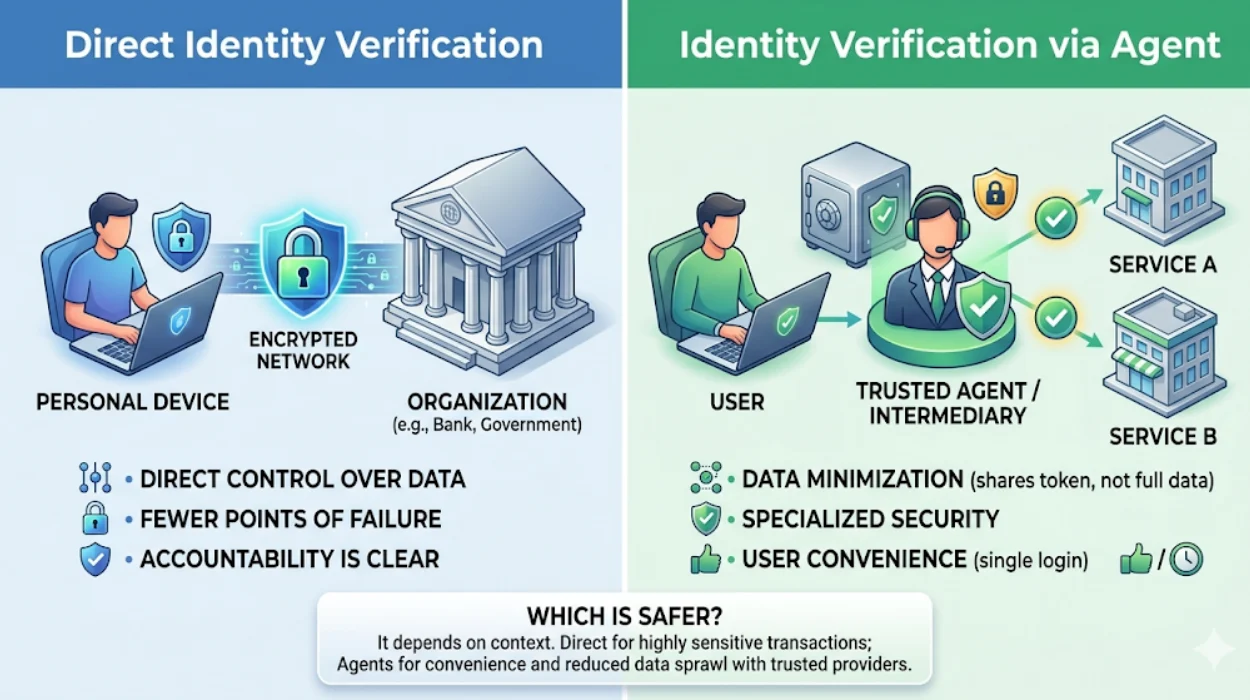
Verifying your identity directly offers maximum control and privacy, minimising third-party exposure of sensitive data. Using an agent provides convenience and expertise but introduces potential risks from intermediary handling.
In the regulated landscape of UK company formation and compliance, directors and Persons with Significant Control (PSC) must undergo identity verification to meet Companies House requirements under the Economic Crime and Corporate Transparency Act 2024. This process ensures accurate registration while combating fraud, but the choice between direct submission and agent-assisted verification sparks debate among business owners. Direct verification empowers you to handle personal documents yourself through official digital channels, reducing intermediary risks. Agent verification, meanwhile, leverages professional services for streamlined submission, often with added compliance guidance. Both methods prioritise security, yet their safety profiles differ based on your priorities, technical comfort, and data sensitivity.
Understanding Direct Identity Verification
Direct identity verification involves submitting your personal details and documents straight to Companies House via their secure online portal, known as the Prove Your Identity service. This government-backed platform uses biometric checks, such as facial recognition and liveness detection, paired with government-issued ID like passports or driving licences. From My Company recommends this for tech-savvy directors who value end-to-end control, as it eliminates external handlers who might access your data.
The process starts with creating a Companies House account, uploading a clear photo of your ID, and completing a real-time video selfie. Advanced encryption and multi-factor authentication safeguard every step, ensuring data remains within the government’s fortified ecosystem. For instance, a startup founder in London recently bypassed agents entirely, verifying as both director and PSC in under 15 minutes, gaining immediate access to their unique Personal ID Code for ongoing filings. This method shines in privacy, as no third party views your biometric data only Companies House processes it, aligning with GDPR standards for minimal data sharing.
However, direct verification demands familiarity with digital tools. Mismatches in photo quality or liveness detection can lead to rejections, delaying company setup. Businesses handling high-value transactions often prefer this route for its audit trail, proving sole custody of sensitive information from upload to approval.
The Role of Agents in Identity Verification
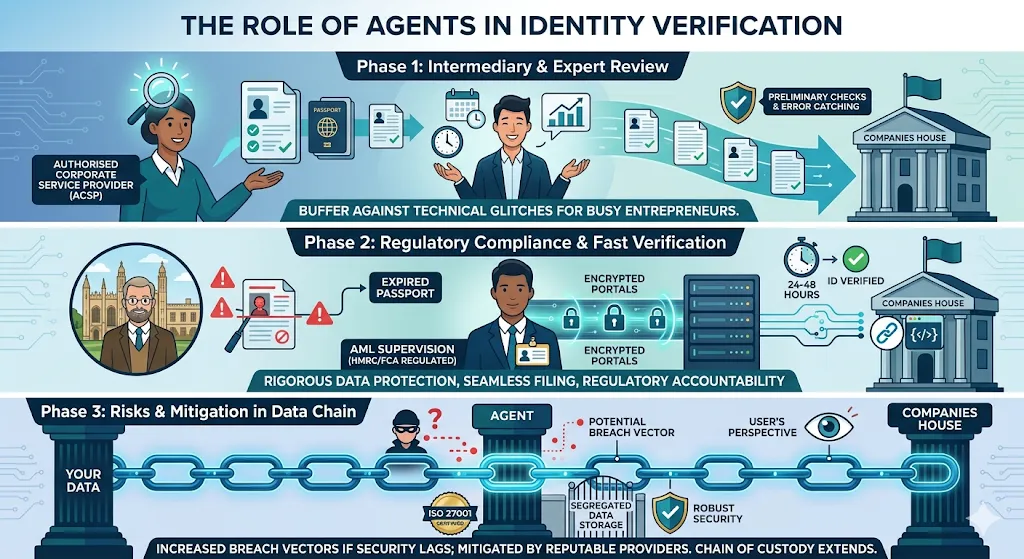
Agents, such as authorised corporate service providers, act as intermediaries who collect your documents, perform preliminary checks, and submit them to Companies House on your behalf. From My Company’s identity verification service for directors or PSC exemplifies this, offering expert review to catch errors before official submission. This approach suits busy entrepreneurs juggling multiple roles, providing a buffer against technical glitches.
Agents must hold anti-money laundering (AML) supervision from bodies like HMRC or the FCA, enforcing rigorous data protection protocols. They use encrypted portals for document transfer and often integrate with Companies House APIs for seamless filing. Consider a scenario where a Cambridge-based consultant appoints an agent: the service scans for ID authenticity, flags discrepancies like expired documents, and verifies within 24-48 hours. This not only speeds compliance but adds a compliance layer, as agents bear regulatory accountability for false submissions.
Yet, agent involvement means your data passes through an additional entity, potentially increasing breach vectors if their security lags. Reputable providers mitigate this with ISO 27001 certification and segregated data storage, but the chain of custody extends beyond your direct oversight.
Comparing Safety: Direct vs Agent Verification
Safety in identity verification hinges on data exposure, error rates, and recovery from issues. Direct methods minimise touchpoints your data travels solely to Companies House, leveraging state-level cybersecurity like the NCSC’s protective monitoring. Statistics from Companies House indicate direct submissions have a 95% first-time pass rate among prepared users, underscoring their reliability for straightforward cases.
Agent verification, by contrast, trades some privacy for expertise. Agents reduce rejection rates to under 5% through pre-screening, ideal for complex PSC structures involving multiple controllers. From My Company, for example, handles thousands of verifications annually, drawing on verified processes to ensure 99% success. A case-study parallel: a multinational executive verified directly but faced delays from poor lighting; switching to an agent resolved it instantly with guided uploads.
Key trade-offs emerge in risk profiles. Direct suits low-risk, solo directors prioritising privacy; agents excel for high-stakes filings needing speed and accuracy.
- Privacy: Direct wins with zero intermediaries.
- Convenience: Agents dominate, especially for non-digital natives.
- Compliance Assurance: Agents provide expert oversight, reducing fines up to £30,000 for inaccuracies.
Regulatory bodies endorse both, but direct aligns with the Act’s push for personal responsibility.
Risks and Mitigation Strategies for Each Method
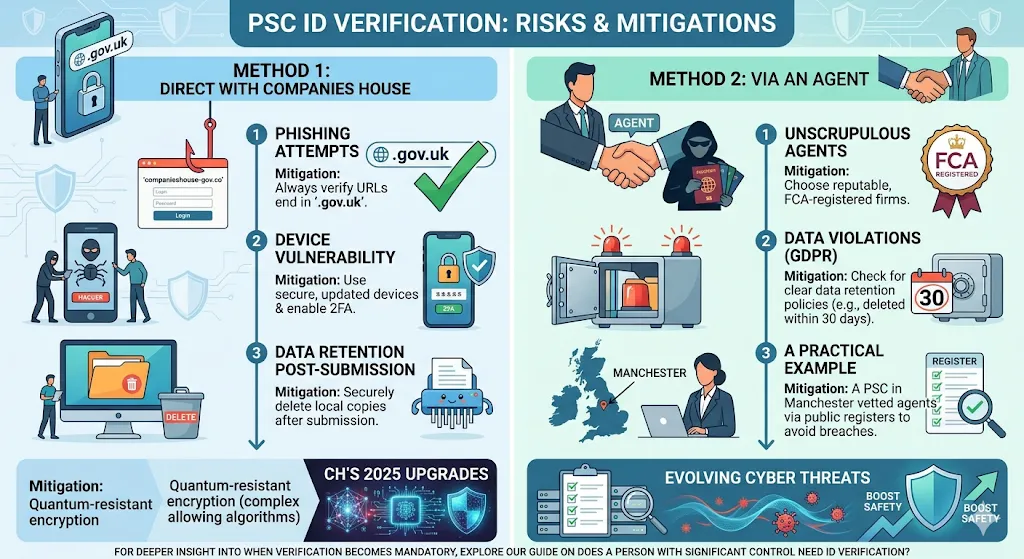
No verification method is risk-free, yet proactive steps enhance safety. In direct verification, phishing attempts targeting Companies House portals pose threats always verify URLs end in .gov.uk. Use a secure device, enable two-factor authentication, and delete local copies post-submission. From My Company advises scanning IDs for tampering before upload, preventing invalid rejections.
Agent risks centre on provider selection. Unscrupulous agents might retain data post-service, violating GDPR. Mitigate by choosing FCA-registered firms with clear data retention policies most delete files within 30 days. A practical example: a PSC in Manchester vetted agents via public registers, avoiding a firm later fined for breaches, and completed verification flawlessly.
Both face evolving cyber threats, but Companies House’s 2025 upgrades, including quantum-resistant encryption, bolster direct safety. Agents must match this via annual audits.
For deeper insight into when verification becomes mandatory, explore our guide on Does a Person with Significant Control Need ID Verification?
When Direct Verification Outperforms Agents
Opt for direct when privacy trumps convenience, such as solo directors forming simple limited companies. It fosters self-reliance, essential for ongoing annual confirmations requiring your Personal ID Code. Tech-forward users appreciate real-time feedback, avoiding agent fees that average £50-£100.
In fraud-prone sectors like fintech, direct submission provides verifiable logs for investors, proving unassisted compliance.
Scenarios Favoring Agent Assistance
Agents prove invaluable for intricate setups, like PSCs with overseas ties needing translated IDs. Their expertise navigates nuances, such as verifying beneficial ownership thresholds over 25%. Busy professionals benefit from white-glove service, freeing time for core business.
Ready to secure your details efficiently? Discover how to Secure Your Personal ID Code with Our Fast Verification Service.
Streamline your process with From My Company‘s professional identity verification service for directors or PSC, ensuring compliance without compromise.
In summary, direct verification edges out in raw safety for privacy-focused users, while agents offer robust support for efficiency. From My Company delivers tailored solutions, blending both worlds to safeguard your UK company setup professionally.
What is identity verification for directors or PSC in the UK?
Identity verification for directors or Persons with Significant Control (PSC) confirms their identity to Companies House using government-issued ID and biometric checks. This process, required under the Economic Crime and Corporate Transparency Act 2024, ensures accurate company records and combats fraud. From My Company’s Identity Verification service for Director or PSC streamlines submission via secure portals.
How long does director or PSC identity verification take?
Director or PSC identity verification typically completes in 15 minutes to 48 hours, depending on direct submission or agent assistance. Companies House processes real-time biometric scans instantly, while agents add pre-checks for higher accuracy. From My Company’s service ensures fast turnaround with expert review.
What documents are needed for PSC identity verification?
Required documents for PSC identity verification include a valid passport, driving licence, or national ID with a recent photo and liveness detection selfie. Supporting proof like utility bills verifies address under AML rules. From My Company’s Identity Verification service for Director or PSC guides secure uploads.
Is identity verification mandatory for company directors?
Yes, identity verification is mandatory for all directors and PSCs filing with Companies House since 2024 reforms. It generates a unique Personal ID Code for ongoing compliance. From My Company’s service handles this efficiently for UK company setups.
Can an agent handle my director identity verification?
Agents authorised by HMRC or FCA can submit director or PSC identity verification on your behalf, reducing errors through pre-screening. This maintains privacy via encrypted channels while meeting regulatory standards. From My Company’s Identity Verification service for Director or PSC offers this compliant option.