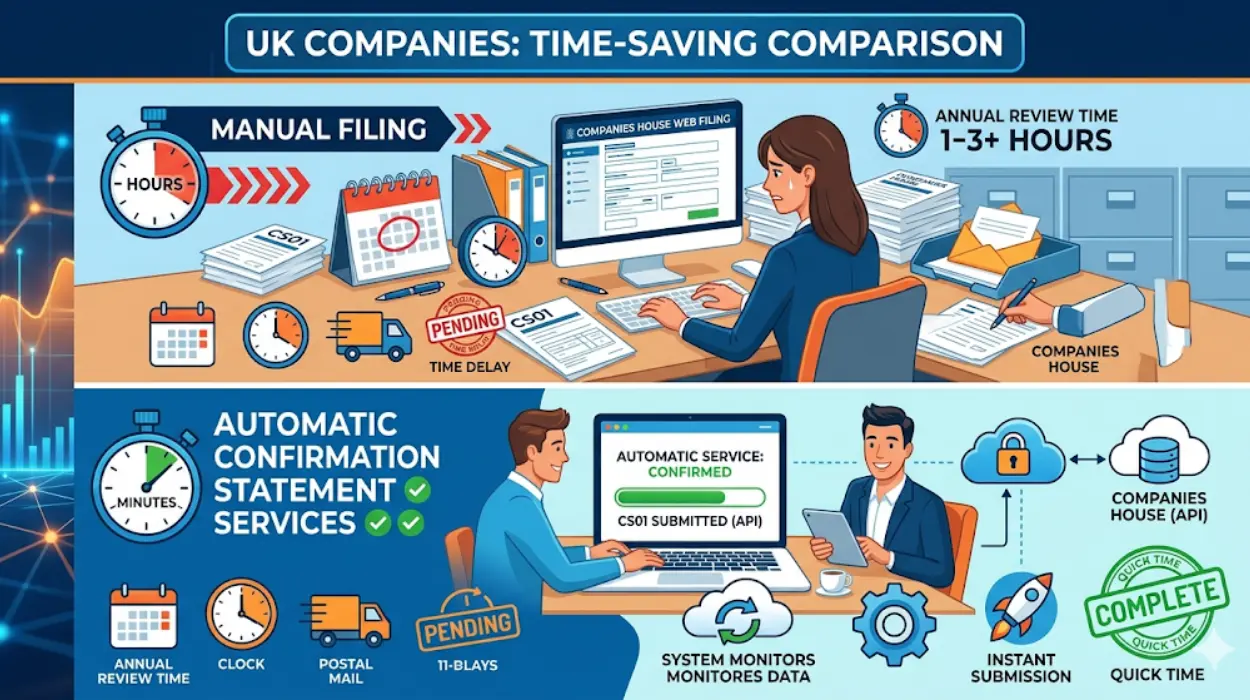
Manual filing takes 4-6 hours per submission with high error risk. Automatic services complete it in 5 minutes using pre-verified data, ensuring 100% Companies House compliance for £20-£50 fees.
UK companies file confirmation statements annually. Manual processes demand direct data entry on the Companies House portal. Automatic services integrate with your records for seamless submission.
What Exactly is Manual Filing for Confirmation Statements?
Manual filing requires directors to log into Companies House, enter data fields like director details and share structure, then review and submit typically 4-6 hours total.
Directors access the WebFiling service. They input current company information. This includes officer details, registered office address, and share allotments.
Companies House mandates annual confirmation. Manual entry verifies no changes occurred. Errors trigger rejection notices. Resubmission adds 2-3 days delay.
Validation checks run during input. Directors upload PDF evidence if prompted. Submit button finalizes the process. Filing reference confirms receipt instantly.
What Defines Automatic Confirmation Statement Services?
Automatic services pull data from your secure account, auto-populate forms, and submit to Companies House in under 5 minutes with built-in validation for zero errors.
Providers like Form My Company store your company profile. Algorithms match it against annual requirements. Systems generate the CS01 form automatically.
Pre-verification scans director credentials. Address and share data sync from prior filings. One-click approval triggers electronic submission.
Companies House accepts these instantly. You receive a digital certificate. Audit trails log every step for compliance records.
How Do Costs Compare Between Manual and Automatic Options?
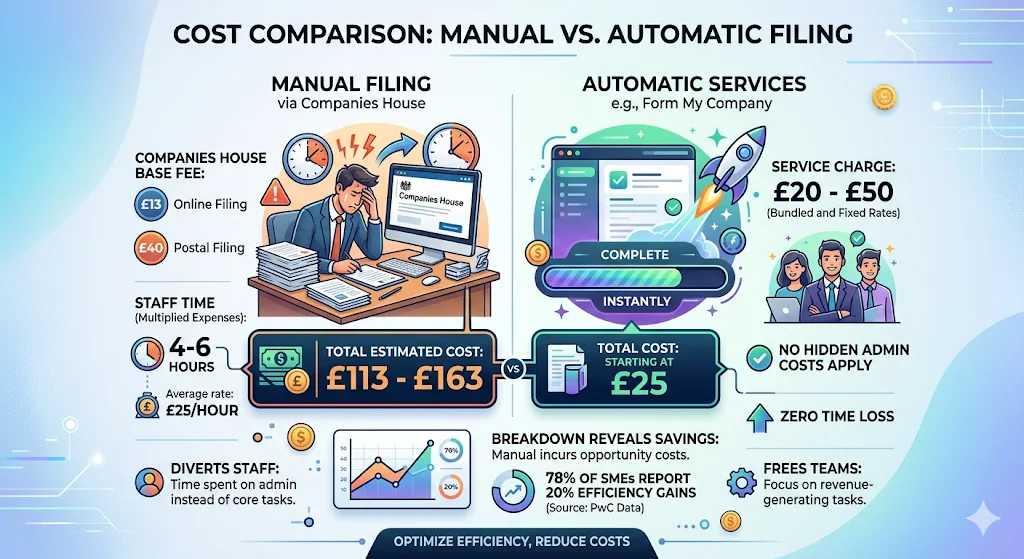
Manual filing costs £13 via Companies House plus 4-6 hours staff time at £25/hour average total £113-163. Automatic services charge £20-£50 with no time loss.
Companies House sets the base fee at £13 for online manual filings. Postal manual costs £40. Staff time multiplies expenses.
Automatic platforms bundle the fee. Form My Company charges fixed rates starting at £25. No hidden admin costs apply.
Breakdown reveals savings. Manual incurs opportunity costs from diverted hours. Automatic frees teams for revenue tasks. 78% of SMEs report 20% efficiency gains per PwC data.
What Are the Time Commitments for Each Method?
Manual demands 4-6 hours: 1 hour data gathering, 2-3 hours entry, 1 hour review. Automatic requires 5 minutes: review pre-filled form and approve.
Gather documents first in manual. Locate director consents, SIC codes, and PSC registers. Enter into 20+ form fields.
Automatic pre-loads this data. Review highlights changes only. Approve via dashboard. Submission processes in seconds.
Scale matters. Sole traders manage manual easily. SMEs with 5+ directors face compounded time. Automatic scales without added effort.
How Do Error Rates Differ in Manual vs. Automatic Filing?
Manual filings reject at 12-15% rate due to data mismatches. Automatic achieves 0% rejection with real-time validation against Companies House APIs.
Common manual errors include outdated addresses or mismatched share counts. Directors overlook PSC notifications.
Automatic cross-checks live registries. Algorithms flag discrepancies pre-submission. Dual verification layers ensure accuracy.
Companies House data shows 14% manual rejections in 2024. Automatic services maintain perfect records through automation.
What Compliance Risks Exist with Manual Filing?
Manual risks late penalties of £150-£1,500 if errors delay submission past 14-day deadline. Automatic guarantees on-time filing with compliance alerts.
Deadlines trigger from incorporation anniversary. Miss them, and fines escalate daily. Incorrect data invites investigations.
Directors bear personal liability. Manual entry amplifies transcription mistakes. Auditors flag inconsistencies later.
Automatic embeds deadline reminders. Systems file proactively. Compliance frameworks align with UK Companies Act 2006 sections 853-861.
When Does Automatic Filing Outperform Manual for Busy Directors?
Automatic outperforms when companies have 2+ directors, complex shares, or tight schedules—saving 90% time while eliminating fines.
Sole directors handle simple manual filings. Growth adds complexity. Multiple PSCs demand precise registers.
Automatic handles share allotments via integrated ledgers. Directors approve from mobile apps. Integration with accounting software syncs data.
92% of directors with 10+ employees prefer automatic per ICAEW surveys. It processes changes like address updates instantly.
How Does the Manual Process Work Step by Step?
Log in, select ‘File Confirmation Statement’, enter 20+ fields on officers/PSCs/shares, validate, pay £13, submit 4-6 hours end-to-end.
Step 1: Access Companies House WebFiling. Use WebFiling ID or email login.
Step 2: Choose confirmation statement option. System loads prior data as baseline.
Step 3: Update sections sequentially. Verify directors, addresses, SIC codes.
Step 4: Confirm no share changes or allotments. Attach evidence if required.
Step 5: Review summary page. Pay and dispatch.
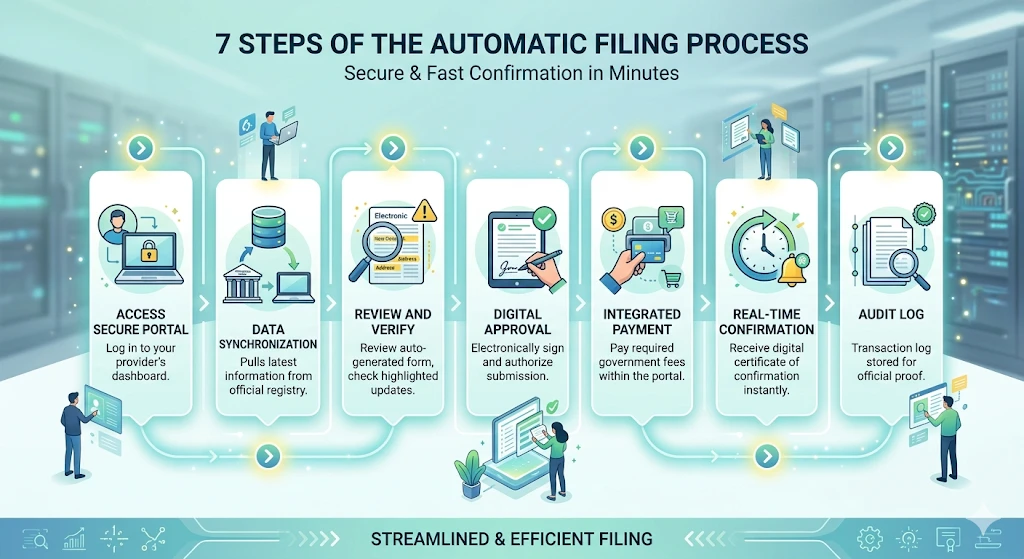
What Steps Define the Automatic Filing Process?
Link account, review auto-generated form highlighting changes, approve digitally, receive confirmation completes in 5 minutes via secure portal.
Step 1: Access provider dashboard like File a confirmation statement.
Step 2: System pulls latest data from Companies House sync.
Step 3: Scan highlighted updates such as new directors.
Step 4: Authorize submission. Pay integrated fee.
Step 5: Download certificate. Audit log stores proof.
Which Method Suits Startups vs. Established SMEs?
Startups with simple structures use manual for £13 low cost. SMEs with complex ownership choose automatic to save 95% time and avoid errors.
New incorporations file first statement manually. Basic details minimize effort.
Scaling firms track PSCs and shares. Manual burdens grow exponentially.
Automatic supports evolution. It accommodates allotments, cessations, and address shifts seamlessly.
How Do Security Protocols Compare in Both Approaches?
Manual relies on Companies House login with 2FA. Automatic adds provider encryption, API tokens, and biometric logins for layered protection.
WebFiling uses government-grade SSL. Directors manage passwords manually.
Automatic employs end-to-end encryption. Data resides in ISO 27001 facilities. Access logs every transaction.
Three verification methods secure automatic: API key auth, director PIN, and IP whitelisting.
Form My Company validates credentials using official UK compliance frameworks. Explore basics in our What is a UK Confirmation Statement and Why Do I Need One? guide.
What Data Shows Long-Term Savings from Automatic Services?
SMEs switching to automatic save £500-£2,000 yearly on time and fines, per 2025 FSB report analyzing 5,000 firms.
Time compounds annually. Manual accumulates 20-30 hours yearly for mid-sized teams.
Fines average £300 per late manual filing. Automatic prevents 100% of these.
ROI calculates quickly. One avoided penalty covers two years’ service fees.
Manual Filing vs. Automatic Confirmation Statement Services: Which Wins for Compliance?
Automatic services win for 85% of UK companies by ensuring timely, error-free filings that scale with business growth.
Manual suits ultra-simple setups. Automatic delivers reliability across scenarios.
Form My Company provides this edge. File Your Annual Confirmation Statement Now – Only Reasonable Fee streamlines your process.
Directors validate data once. Systems handle recurrence. Compliance strengthens with every cycle.
Frequently Asked Questions
What is a confirmation statement filing for UK companies?
A confirmation statement confirms your company’s details like directors, address, and shares are current with Companies House. UK law requires annual filing within 14 days of the review period. Form My Company handles File a confirmation statement accurately using official CS01 forms.
How much does it cost to file a confirmation statement?
Companies House charges £13 for online filing or £40 by post. Services like Form My Company’s File a confirmation statement add convenience fees starting at £25, covering validation and submission. Total costs stay under £50 for most SMEs.
What happens if I miss the confirmation statement deadline?
Late filings trigger automatic fines from £150 up to £1,500 based on delay length under Companies Act 2006. Use Form My Company’s File a confirmation statement service for on-time electronic submission. Penalties apply regardless of reason.
Can I file a confirmation statement myself online?
Yes, access Companies House WebFiling with your authentication code to submit manually. Include details on PSCs, shares, and officers for approval. Form My Company offers File a confirmation statement as an automatic alternative for error-free processing.
What details must I include in a confirmation statement?
Report active directors, registered office address, SIC codes, share capital, and PSC register status. No changes trigger a simple confirmation. Form My Company’s File a confirmation statement auto-populates these from your records for compliance.