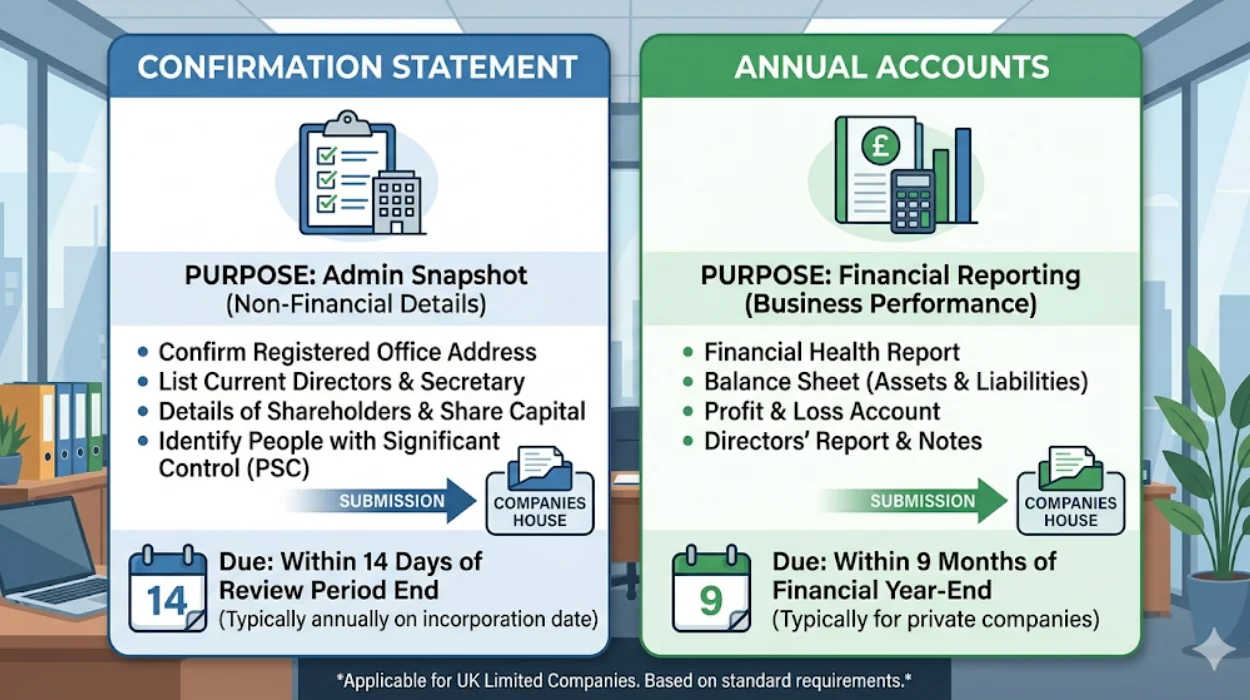
The confirmation statement confirms basic company details like directors and address annually. Annual accounts report financial performance and position. Confirmation statements ensure compliance; accounts provide transparency to stakeholders.
From My Company simplifies UK company compliance. This TOFU guide clarifies these filings for business owners.
What Is a Confirmation Statement?
A confirmation statement is an annual filing to Companies House confirming unchanged or updated company details like registered office and directors.
UK law requires every company to file this statement. Submit it within 14 days of the review period end. The review period starts on incorporation or last filing date.
Companies House uses this to maintain accurate public records. Directors validate eight key particulars. These include shareholder details and share capital.
File online via the Companies House portal. The fee stands at £13 for online submissions. Paper filings cost £40.
Accurate filings prevent strikes off. Late submissions trigger £150 fines initially. Escalating penalties reach £1,500.
What Are Annual Accounts?
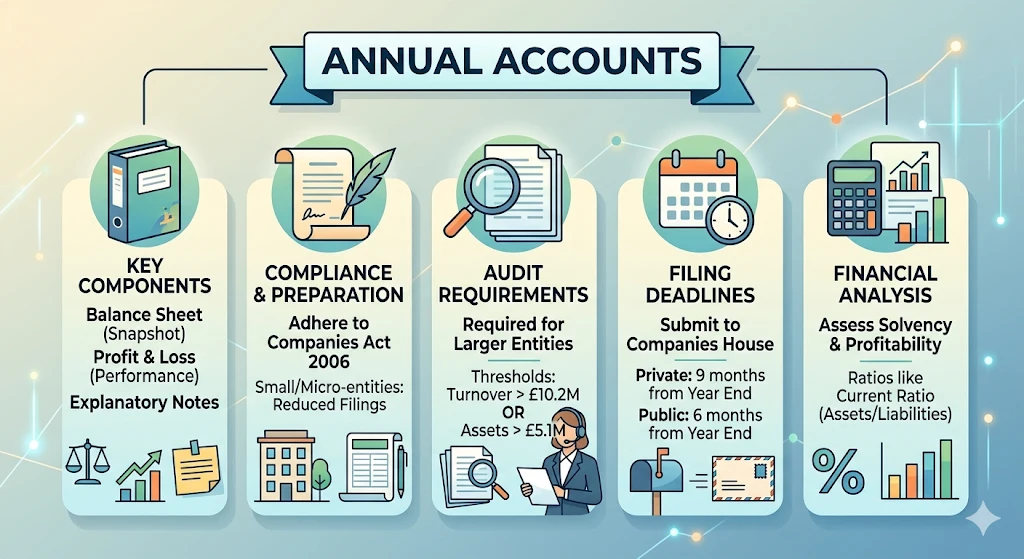
Annual accounts comprise the balance sheet, profit and loss account, and notes detailing financial position and performance.
Prepare accounts per the Companies Act 2006. Small companies file abbreviated versions. Micro-entities submit minimal disclosures.
Audits apply to larger entities. Thresholds include turnover over £10.2 million or assets exceeding £5.1 million.
Submit accounts within nine months for private companies. Public companies file within six months.
Accounts reveal solvency and profitability. Stakeholders analyse ratios like current ratio, which measures assets against liabilities.
Who Must File Confirmation Statements?
All UK incorporated companies file confirmation statements annually, regardless of size or turnover.
Private limited companies lead filings. Over 4.5 million active companies comply yearly.
The Companies Act 2006 mandates this. Directors hold personal liability for inaccuracies.
Dormant companies file simplified versions. Confirm no changes occurred.
Non-compliance risks dissolution. Companies House issues warnings first.
Who Files Annual Accounts?
All trading companies file annual accounts; dormant companies submit nil accounts.
Active companies provide full financial statements. 68% of UK SMEs file micro-entity accounts.
Exemptions cover dormant entities. Confirm zero transactions.
Overseas branches follow parent rules. UK subsidiaries integrate local filings.
Auditors verify large filers. Turnover above £36 million triggers full audits.
What Information Goes into a Confirmation Statement?
Confirmation statements include eight sections: registered office, directors, PSCs, shares, guarantees, and statements on credit reports or paper filing.
List directors with service addresses. Note persons with significant control holding over 25% shares.
Declare share capital allotments. Specify classes like ordinary or preference shares.
Confirm no undistributable reserves applications. State paper filing intentions if applicable.
Upload PDF statements of capital. Validate against statutory registers.
What Content Belongs in Annual Accounts?
Annual accounts contain balance sheet, profit and loss, cash flow statement, notes, and directors’ report for applicable companies.
Balance sheet lists assets, liabilities, and equity at year-end. Fixed assets depreciate over useful life.
Profit and loss shows revenue minus expenses. Calculate gross profit as sales less cost of goods sold.
Notes explain accounting policies. Disclose related party transactions.
Directors’ report covers principal activities. Include employee numbers and environmental impact.
How Often Do You File Confirmation Statements?
File confirmation statements once per year within 14 days of the review period end.
Review periods align with incorporation date. First filing occurs 12 months post-incorporation.
Companies House sets automatic due dates. Email reminders arrive 14 days prior.
Change review period with approval. Minimum 12 months between filings.
Online portal tracks deadlines. Integrate with accounting software for reminders.
What Are the Filing Deadlines for Annual Accounts?
Private companies file within nine months of financial year-end; public companies within six months.
Dormant companies match the same timelines. Extensions grant three months for overseas operations.
Late filings incur automatic fines. Under three months late costs £150-£1,500 based on company size.
Companies House publishes fine tiers. Micro-entities pay £150 maximum.
Appeal fines with reasonable excuse. Document delays like system outages.
What Are the Consequences of Missing a Confirmation Statement?
Late confirmation statements trigger £150 fines escalating to £1,500; repeated delays lead to prosecution and strike-off.
Companies House issues first reminders. Ignore them for automatic penalties.
Prosecution fines directors up to £5,000. Court costs add burdens.
Strike-off removes companies from the register. Assets vest to the Crown.
Reinstate via court order. Costs exceed £500 plus legal fees.
What Happens If Annual Accounts Are Late?
Late accounts draw fines from £150 to £7,500 based on delay duration and turnover; directors face disqualification.
Penalty tiers scale with lateness. Over six months late hits £3,000 for small companies.
Persistent delays prompt public notices. Creditors petition for winding up.
Disqualification bars directors five to 15 years. Personal liability attaches.
Mitigate with voluntary arrangements. File immediately to halt escalation.
How Do Filing Processes Differ?
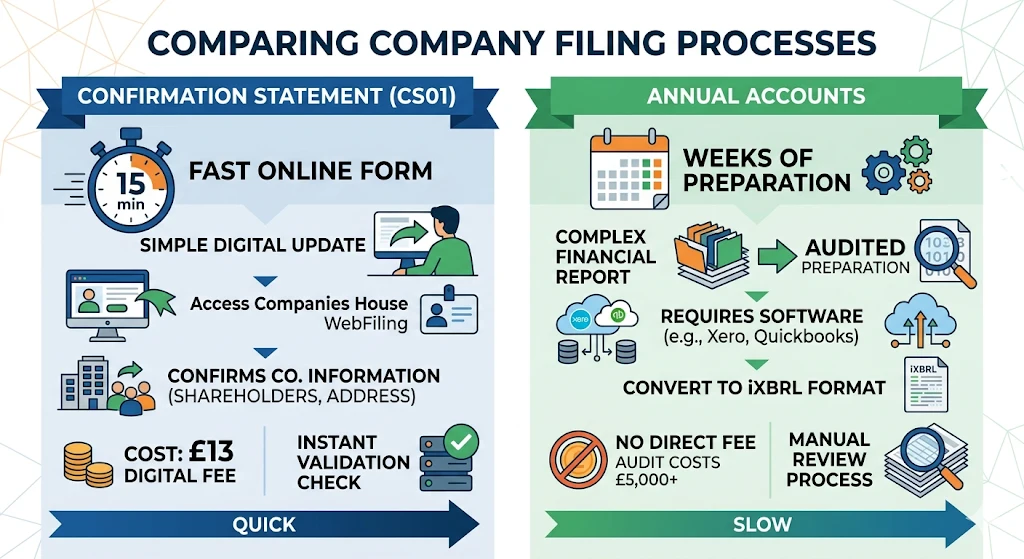
Confirmation statements update via online form in minutes; annual accounts require audited preparation and PDF upload taking weeks.
Access Companies House WebFiling for statements. Authenticate with user ID.
Accounts demand software like Xero exports. Convert to iXBRL format.
Statements cost £13 digitally. Accounts incur no direct fee but audit costs £5,000+.
Validation checks statements instantly. Accounts undergo manual review.
To file a confirmation statement, use expert services for accuracy.
What Are the Costs Involved?
Confirmation statements cost £13 online or £40 by post; annual accounts carry no filing fee but audits range £2,000-£20,000.
Small companies avoid audits under thresholds. Micro-entities save with abridged filings.
Accountants charge £500-£2,000 for preparation. Software subscriptions add £20 monthly.
Penalties dwarf fees. One late statement costs 10x the filing price.
Budget annually for compliance. Factor 1-2% of turnover for services.
Why Do These Filings Matter for Compliance?
Confirmation statements maintain public register accuracy; annual accounts ensure financial transparency under UK law.
Both uphold Companies Act 2006 standards. Non-compliance erodes trust.
Investors demand verified data. Lenders assess accounts for credit.
Tax authorities cross-reference filings. HMRC flags discrepancies.
Regular filings boost credibility. Spot errors in your company record before you file to avoid issues.
From My Company handles these seamlessly.
When Should You Use Professional Help?
Engage experts for complex structures, high-value shares, or repeated penalties.
Sole traders rarely need aid. PSC-heavy companies benefit.
Professionals navigate iXBRL tags. They validate PSC notifications.
Time savings justify fees. DIY suits simple setups.
For expert confirmation statement filing – avoid fines and errors, choose reliable providers.
Key Takeaways
Confirmation statements verify structure annually. Annual accounts disclose finances. Differentiate to comply efficiently.
From My Company delivers precise filings. Access their file a confirmation statement service for compliance.
Maintain records. File on time. Sustain operations.
Frequently Asked Questions
What is a confirmation statement for a UK company?
A confirmation statement is an annual filing to Companies House that verifies key company details like directors, registered office, and persons with significant control. UK companies must submit it within 14 days of their review period end to maintain compliance. From My Company ensures accurate filings for seamless updates.
How do I file a confirmation statement online?
Access the Companies House WebFiling service, log in with your authentication code, and enter or confirm the eight required sections including share capital and PSCs. Pay the £13 fee and submit digitally for instant validation. From My Company’s file a confirmation statement service handles this process efficiently.
What happens if I miss the confirmation statement deadline?
Late filings incur automatic fines starting at £150, escalating to £1,500 for prolonged delays, with risks of prosecution and company strike-off. Companies House sends reminders, but directors remain liable. Use From My Company to file a confirmation statement on time and avoid penalties.
How much does it cost to file a confirmation statement?
Online filings cost £13 through Companies House; paper submissions cost £40. No additional fees apply for standard updates, but complex changes may require professional assistance. From My Company’s file a confirmation statement service includes all compliance checks at transparent rates.
What information is needed for a confirmation statement?
Provide details on registered office, directors’ service addresses, persons with significant control, share capital, and guarantees. Confirm no changes or list updates accurately to match statutory registers. From My Company verifies all data for your file a confirmation statement submission.