
Appointing a director is an important decision for any UK company, whether you are bringing in a business partner, strengthening your leadership team or preparing for a change in management. The process involves checking eligibility, following the company’s articles of association, obtaining the correct approval and notifying Companies House within the required deadline.
This guide explains how to appoint a director, the legal requirements, the difference between board and shareholder approval, the documents involved and the responsibilities that follow an appointment. It also explains when professional support can help companies manage the process.
What Does Appointing a Director Mean?
Appointing a director means formally giving an eligible individual responsibility for participating in a company’s management and governance. Directors make decisions about business operations, finances, strategy, compliance and the company’s long-term interests.
A director appointment must follow the procedure set out in the company’s articles of association and comply with applicable company law. Once the appointment takes effect, the company must maintain accurate records and notify Companies House within the relevant statutory deadline.
The process generally involves three stages: approving the appointment, collecting the necessary information and completing the required company records and filings.
What Are the Legal Requirements for Appointing a Director?
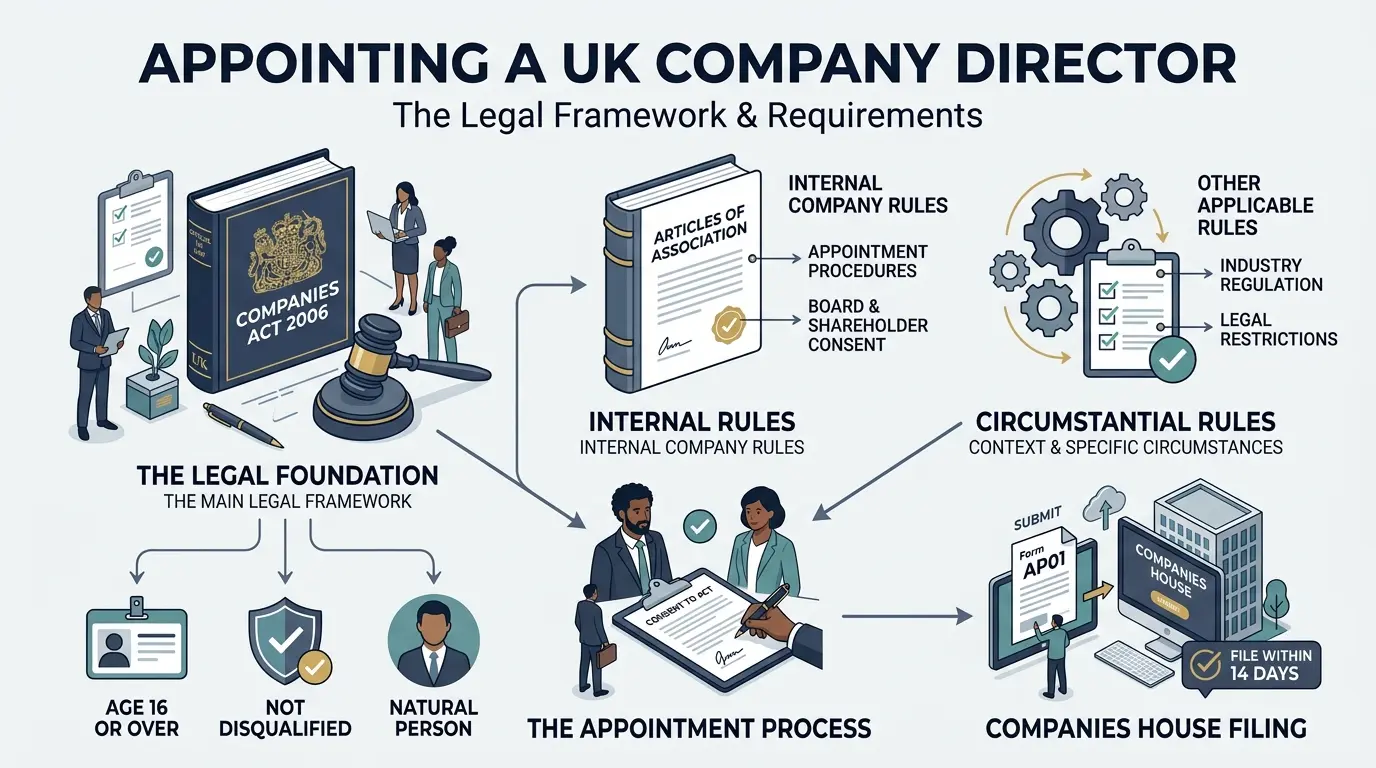
The Companies Act 2006 establishes the main legal framework for directors of UK companies. Companies must also follow their articles of association and any other rules applicable to their circumstances.
Age and Eligibility Requirements
An individual must generally be at least 16 years old to become a director of a UK company. There is no general upper age limit.
The proposed director must not be prohibited from acting because of a disqualification order or another applicable legal restriction. Certain bankruptcy restrictions can also affect eligibility.
Before proceeding, the company should check that the individual is legally eligible and understands the responsibilities associated with the position.
Minimum Number of Directors
A private limited company must have at least one director, and at least one director must be a natural person. A public limited company generally requires at least two directors.
The company should also review its articles of association for any provisions concerning board size, appointment powers or additional conditions.
Identity Verification
Companies House identity verification requirements form part of the current director appointment process. Directors must complete the applicable verification process and provide the required Companies House personal code for the relevant filing.
The company should confirm that the proposed director has met these requirements before submitting the appointment notification. The precise procedure depends on the appointment and the applicable Companies House process.
How to Appoint a Director: Step-by-Step Process
The correct appointment procedure depends on the company’s articles of association and circumstances. The following steps provide a practical framework.
Step 1: Identify the Need for a New Director
Establish why the company needs another director and what responsibilities the individual will undertake. The appointment may involve a co-founder, an experienced business professional, a senior employee or someone with expertise in a specific area.
Consider the person’s experience, availability, suitability for the role and understanding of directors’ responsibilities. Defining the role clearly helps establish expectations before the appointment takes effect.
Step 2: Review the Articles of Association
The articles of association explain how the company is governed and how directors can be appointed. Review these provisions before deciding which approval process to follow.
Depending on the articles, the existing board may have authority to appoint a director, or the appointment may require shareholder approval. A shareholders’ agreement may also contain relevant provisions.
Do not assume that every company must use the same method. Follow the procedure applicable to the company and retain the supporting records.
Step 3: Obtain the Required Approval
Once the appropriate procedure has been confirmed, obtain the necessary approval through a board decision, shareholder resolution or another permitted process.
Record the decision in board minutes or the relevant written resolution. The record should identify the proposed director, the decision taken and the effective appointment date.
Step 4: Obtain Consent and Verify Identity
Confirm that the proposed director agrees to accept the role. Collect the information required for the appointment and ensure that the individual has completed the applicable Companies House identity-verification process.
Explain the director’s responsibilities and make sure they understand the company’s expectations, governance arrangements and relevant compliance obligations.
Step 5: Prepare the Appointment Documents
Prepare the internal documents required to evidence the appointment. Depending on the company’s circumstances, these may include board minutes, a shareholder resolution, consent documentation and updated company records.
Check that the director’s personal details and appointment date are consistent across the relevant documents.
Step 6: Notify Companies House
The company generally must notify Companies House of a director’s appointment within 14 days of the appointment taking effect. The appropriate filing must include accurate information and meet the applicable identity-verification requirements.
For an individual director, the notification generally uses the AP01 process. The filing method and requirements should be checked against current Companies House guidance.
For the detailed filing process, read our guide to adding or appointing a director on Companies House.
Step 7: Update Company Records
After the appointment, update the company’s internal records and retain the supporting documents. Check the public Companies House record after the filing has been processed.
Depending on the business, you may also need to inform the company’s bank, accountant, insurer or other relevant parties. If the new director will also become a shareholder or a person with significant control, check whether separate records or filings are required.
Board Resolution vs Shareholder Resolution
Board and shareholder resolutions serve different purposes. The appropriate method depends on the company’s articles of association and applicable legal requirements.
| Consideration | Board resolution | Shareholder resolution |
|---|---|---|
| Who makes the decision? | The company’s directors | The company’s shareholders |
| When is it used? | Where the board has authority to make the appointment | Where the articles or applicable rules provide for shareholder appointment |
| How is it recorded? | Usually through board minutes or a permitted written record | Through meeting minutes or an appropriate written resolution |
| What must be checked? | The board’s authority and decision-making procedure | Voting rights, notice requirements and the applicable resolution procedure |
An ordinary shareholder resolution generally requires more than 50% of votes cast to support it, subject to the applicable rules. However, shareholder approval is not automatically required for every director appointment.
Review the company’s articles and any relevant shareholders’ agreement before choosing the approval route. If the provisions are unclear, seek appropriate professional advice.
What Documents Are Needed to Appoint a Director?
Preparing the relevant information before the appointment can reduce errors and administrative delays. The precise requirements depend on the company and the appointment process.
Director Information
The company will generally need the incoming director’s full legal name, date of birth, nationality, occupation, country of residence, relevant address information and appointment date.
The service address is used for official correspondence and appears on the public register. Residential address information is handled separately and is not ordinarily displayed publicly in the same way.
Consent and Identity Verification
The company should confirm that the individual agrees to act as a director and has completed the applicable identity-verification process.
Do not assume that a passport scan, utility bill or signed consent document alone satisfies every Companies House requirement. Follow the current process for the appointment and the individual’s circumstances.
Internal Approval Records
Retain the board minutes, shareholder resolution or other document authorising the appointment, as applicable. Keep the supporting records needed to demonstrate that the appointment followed the company’s governing documents.
For more information about appointment paperwork and filing requirements, read our guide to director appointment forms and Companies House.
Director Appointment Checklist
Before finalising the appointment, confirm that:
The proposed director meets the relevant eligibility requirements.
The articles of association have been reviewed.
The required internal approval has been obtained.
The individual has agreed to act as director.
Applicable identity-verification requirements have been completed.
The director’s personal details and appointment date are accurate.
The Companies House notification will be submitted within the deadline.
Internal records will be updated after the appointment.
What Happens After a Director Is Appointed?
A director takes on legal responsibilities when the appointment takes effect. The company should provide the information and support needed to help the new director understand the role.

Directors’ Legal Duties
The Companies Act 2006 sets out general duties that include acting within powers, promoting the success of the company, exercising independent judgment, applying reasonable care, skill and diligence, avoiding conflicts of interest and declaring relevant interests.
These duties affect everyday decisions as well as major transactions. Directors should understand the company’s financial position, assess risks and act in accordance with their legal responsibilities.
Financial and Company Records
The company should maintain appropriate accounting and reporting processes. Directors need to understand the arrangements for financial records, statutory filings and monitoring the company’s ability to meet its obligations.
The appointment should also be reflected accurately in the company’s internal records and relevant public filings.
Conflicts of Interest
A new director should disclose relevant interests and follow the company’s procedures for managing conflicts. The company should explain any applicable restrictions in its articles, policies or other arrangements.
A structured induction can help the new director understand the organisation’s objectives, governance framework and principal risks.
Can a Non-UK Resident Become a Company Director?
Yes. An individual does not generally need to be a UK resident or UK national to become a director of a UK company. However, the individual must meet the applicable eligibility requirements and complete the relevant Companies House identity-verification and filing process.
The company should collect accurate personal details and confirm the appropriate service address and verification requirements. Do not assume that a UK or EEA service address is a universal requirement for every director appointment.
Overseas appointments may involve additional practical considerations, such as international identity documents and remote communication. Check the current requirements rather than relying on assumptions about nationality or residence.
Can a Corporate Entity Be Appointed as a UK Company Director?
Corporate director appointments are subject to specific legal restrictions and requirements. A company should not assume that another company can automatically be appointed as its director.
Before considering a corporate appointment, check the current statutory rules, the company’s articles and the applicable filing requirements. These arrangements differ from the standard process for appointing an individual director.
For a focused explanation, read our guide to whether a corporate entity can be a UK company director.
Common Mistakes to Avoid When Appointing a Director
Ignoring the Articles of Association
Using the wrong approval process can create problems with the appointment. Review the company’s governing documents before passing a resolution or submitting a filing.
Submitting Incorrect Information
Errors in names, addresses, dates or other personal details can create inconsistencies between company records and Companies House information. Check all details before submission.
Overlooking Identity Verification
Identity verification is part of the current Companies House framework. Confirm that the director has completed the required process and that the necessary personal code is available for the filing.
Missing the Filing Deadline
Record the appointment date and assign responsibility for submitting the notification promptly. Late or incomplete filings can create compliance issues, so the company should not leave the notification until a later routine filing.
Failing to Update Internal Records
Companies House notification does not replace the company’s own record-keeping responsibilities. Retain the approval documents, update internal records and inform relevant parties where necessary.
Not Explaining Directors’ Responsibilities
A new director should understand the legal duties associated with the role. Provide relevant company information, explain governance procedures and establish clear expectations for decision-making.
When Should You Seek Professional Help?
Some companies can manage a straightforward director appointment internally if they understand their articles, approval requirements and filing responsibilities. Other appointments may require additional attention because of unclear governing documents, identity-verification issues or changes involving several directors.
Professional support can help with preparing appointment paperwork, checking the information required for filing and managing relevant company administration.
If you are comparing internal administration with external support, assess the complexity of the appointment, the company’s available expertise and the consequences of inaccurate records. Choose a service based on the assistance you actually need rather than assuming every appointment requires the same level of support.
Frequently Asked Questions
How do you appoint a director in the UK?
Review the company’s articles of association, obtain the required approval, confirm that the individual agrees to act, complete the applicable identity-verification process and notify Companies House within the statutory deadline. Update the company’s internal records as well.
How long do you have to notify Companies House of a new director?
The company generally has 14 days from the date the appointment takes effect to notify Companies House. Check the current filing requirements and submit accurate information within the applicable deadline.
Who can appoint a company director?
The authority to appoint a director depends on the company’s articles of association and applicable law. The existing board may have the power to appoint a director, or shareholder approval may be required.
Does a new director need to be a UK resident?
No general UK residency requirement applies to individual directors of UK companies. The individual must still meet the applicable eligibility, identity-verification and filing requirements.
What documents are required to appoint a director?
The company generally needs the information required for the appointment filing, evidence of the relevant internal approval and confirmation that the individual agrees to act. Current Companies House identity-verification requirements must also be met.
Can I appoint a director without holding a board meeting?
A physical board meeting is not always necessary. Depending on the company’s articles and applicable procedures, the appointment may be authorised through a permitted written decision or shareholder resolution. Confirm the correct method before proceeding.
What happens if the company misses the filing deadline?
Missing the applicable deadline can create compliance issues. The company should submit accurate information promptly and seek guidance if it has missed a deadline or needs to correct its records.
Can I appoint a director myself?
Yes. A company can manage its own appointment if it follows the applicable legal requirements and its governing documents. Professional assistance is an option for businesses that need help with paperwork, filing and company records.
Arrange a Director Appointment with Form My Company
Appointing a director involves more than selecting the right person. The company must follow its governing documents, meet current eligibility and identity-verification requirements, record the appointment correctly and fulfil its filing responsibilities.
Form My Company offers support for businesses managing director appointments and related company administration. Explore the Director Appointment and Resignation service to review the available support and take the next step towards keeping your company records up to date.