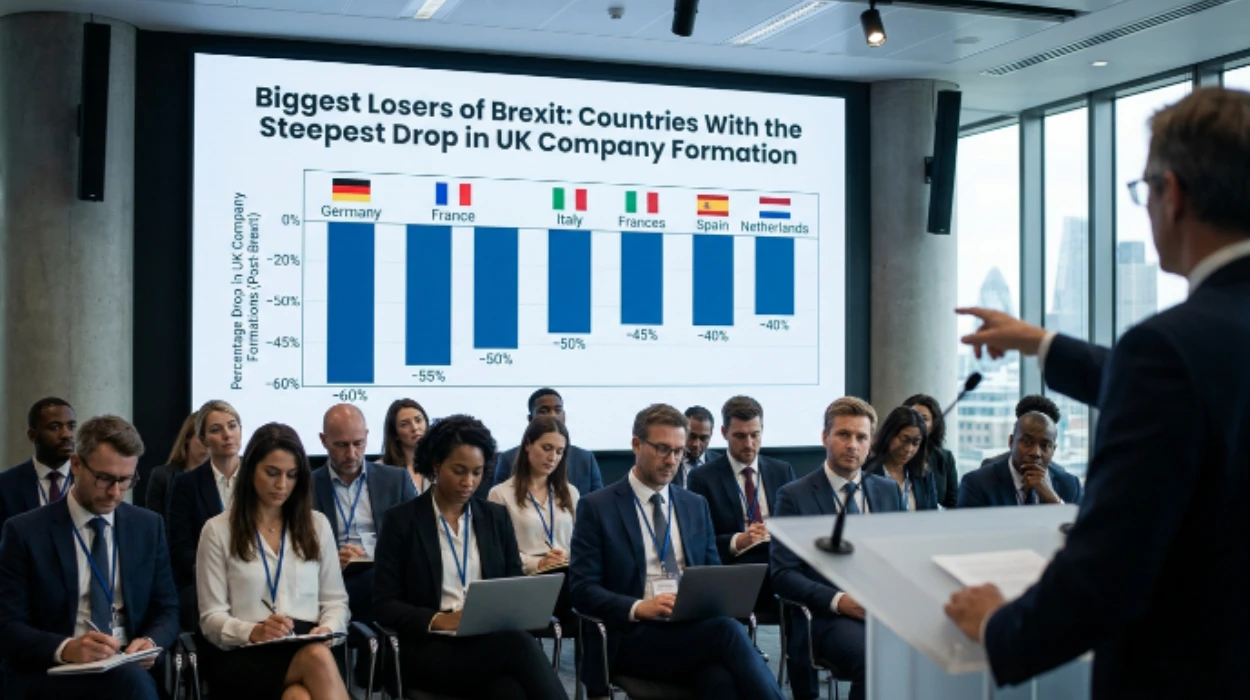
The steepest losers of Brexit in terms of UK company formation are overwhelmingly countries that once relied on the UK as a gateway into the European Union. Across 93 markets analysed, the dataset shows that 74 experienced declines, with 40 countries recording near-total collapses of up to 98% in search interest for UK company formation. Nations such as Armenia, Azerbaijan, Belarus, and Vietnam saw demand effectively evaporate, while historically active markets like Pakistan, Romania, and Malaysia dropped to minimal levels. This sharp contraction highlights a structural shift in UK company formation trends, where the Brexit impact on business has fundamentally altered international demand. While a small number of countries showed resilience or even growth, the dominant global pattern is one of decline—particularly among markets that previously viewed the UK limited company as a strategic entry point into the EU single market.
Why did UK company formation decline so sharply after Brexit?
The dataset reveals a clear structural break in global demand for UK business registration following 31 January 2020. Before Brexit, international entrepreneurs frequently chose the UK due to its dual advantage: a business-friendly regulatory system combined with seamless access to the EU.
Once that gateway function disappeared, the incentive structure changed almost overnight. Countries with strong pre-Brexit engagement—especially those outside the EU but reliant on EU access—experienced the sharpest declines.
This shift is particularly evident in countries where pre-Brexit search interest was high but post-Brexit levels dropped to near-zero. The removal of passporting rights, combined with new regulatory barriers, significantly reduced the attractiveness of forming a UK limited company for cross-border trade within Europe.
At the same time, the data shows that demand did not disappear uniformly. Instead, it fragmented—collapsing in some regions while stabilising or growing in others driven by entirely different motivations.
What are the key findings from the dataset?
- 74 out of 93 countries recorded a decline in UK company formation interest post-Brexit
- 40 countries experienced near-total collapses of up to -98%
- Countries like Armenia, Azerbaijan, Belarus, and Vietnam dropped from high pre-Brexit levels to near-zero
- Only 11 countries showed growth, including Argentina (+180%), Brazil (+47%), and Djibouti (+400%)
- Denmark (-11%) and Germany (-3%) recorded the smallest declines among major economies
- The majority of declines exceeded -90%, indicating systemic rather than marginal change
Which countries experienced the biggest post-Brexit collapse?
The most dramatic declines are concentrated among countries that previously showed strong engagement but lacked alternative structural ties to the UK.
Countries with the steepest drops include:
- Armenia: ~55 to ~1 (-98%)
- Azerbaijan: ~65 to ~1 (-98%)
- Belarus: ~55 to ~1 (-98%)
- Vietnam: ~55 to ~1 (-98%)
- Kazakhstan: ~55 to ~1 (-98%)
- Nepal: ~45 to ~1 (-98%)
- Guatemala: ~45 to ~1 (-98%)
- Honduras: ~55 to ~1 (-98%)
- Madagascar: ~55 to ~1 (-98%)
- Laos: ~55 to ~1 (-98%)
These markets share a common pattern: high exploratory interest before Brexit followed by complete disengagement.
What regional trends define the post-Brexit landscape?
The main analysis reveals that Brexit did not impact all regions equally. Instead, the data shows distinct geographic patterns.
In Europe, declines were widespread but less extreme. Countries such as Germany (~30 to ~29, -3%) and Denmark (~35 to ~31, -11%) retained strong interest. Even nations like the Netherlands and Belgium maintained relatively high post-Brexit levels despite declines.
By contrast, Asia experienced some of the most severe collapses. Countries including Indonesia, Iran, Vietnam, and Bangladesh all saw declines exceeding -90%, with many falling to near-zero levels.
Africa shows a mixed pattern. While countries like Ghana (-96%) and Egypt (-96%) collapsed sharply, others such as Morocco (-30%) retained moderate interest. Djibouti stands out as a major outlier with +400% growth.
In the Americas, the picture is more nuanced. Canada (-30%) and the United States (-20%) experienced moderate declines, while Argentina (+180%) and Brazil (+47%) saw significant growth.
These patterns suggest that Brexit’s impact on business was strongest where EU access had been the primary driver of UK incorporation decisions.
How did Europe compare to Asia in UK company formation trends?
Europe and Asia present a stark contrast in post-Brexit behaviour.
European countries, despite losing direct access benefits, retained structural ties to the UK. Shared legal frameworks, geographic proximity, and existing trade relationships helped sustain demand. Even where declines occurred, they were often moderate rather than catastrophic.
Asian markets, on the other hand, show near-total disengagement. Countries that previously viewed the UK as a bridge into Europe no longer saw sufficient value once that function disappeared.
For example:
- Germany: minimal decline (-3%)
- Denmark: slight decline (-11%)
- India: moderate decline (-53%)
- Malaysia: severe decline (-92%)
- Indonesia: near-total collapse (-98%)
This divergence highlights how dependent many Asian markets were on the UK’s EU positioning rather than its standalone appeal.
Which countries proved most resilient after Brexit?
A small group of countries maintained relatively strong levels of interest in UK company formation.
These include:
- Germany (~29 post-Brexit)
- Denmark (~31 post-Brexit)
- Netherlands (~27 post-Brexit)
- Australia (~25 post-Brexit)
- Austria (~25 post-Brexit)
- Belgium (~23 post-Brexit)
These markets did not avoid decline entirely, but their post-Brexit baseline remains significantly higher than most.
This resilience reflects deeper structural relationships—legal familiarity, trade integration, and long-standing commercial ties—that extend beyond EU membership.
Which countries saw growth despite Brexit?
While rare, growth markets provide critical insight into changing global demand dynamics.
The standout performers include:
- Argentina: ~10 to ~28 (+180%)
- Brazil: ~15 to ~22 (+47%)
- Djibouti: ~3 to ~15 (+400%)
- Anguilla: ~22 to ~35 (+59%)
These countries differ fundamentally from decline markets. Their demand is not tied to EU access but to other factors such as currency instability, offshore structuring, or bilateral trade relationships.
What does the data reveal about non-resident UK company formation?
The dataset provides a clear window into changing behaviour among international entrepreneurs.
Before Brexit, non-resident UK company formation was often driven by strategic positioning—using a UK entity to access European markets. This is reflected in high pre-Brexit interest across Asia, Africa, and Eastern Europe.
Post-Brexit, that motivation largely disappeared. Countries that depended on EU access saw demand collapse, while those with alternative motivations continued to engage.
This shift is particularly relevant for founders looking to open UK company from Brazil, where growth suggests a different use case—currency protection and global trade rather than EU market entry.
At the same time, demand from established markets continues to support services like UK business bank account setup and UK VAT registration, indicating ongoing operational use of UK entities even without EU access.
For many international founders, the decision to pursue UK company for non residents has shifted from expansion strategy to financial structuring.
How has Brexit reshaped the global perception of UK business registration?
The broader implication of the dataset is a fundamental repositioning of the UK in the global business landscape.
Where the UK was once seen as a gateway economy, it is now increasingly viewed as a standalone jurisdiction. This has reduced its appeal in markets that prioritised EU integration but preserved its relevance in regions that value legal stability, ease of incorporation, and global credibility.
Services related to register a UK company remain in demand, but the user profile has changed. Entrepreneurs are now more likely to prioritise operational efficiency or asset protection rather than market access.
Similarly, offerings such as virtual office UK and company services UK continue to support international users who maintain UK entities for administrative or strategic purposes.
The full findings are explored in detail in the report Pre-Brexit Interest to Post-Brexit Decline: UK Company Formation Down 98% in 40 Countries, which provides a comprehensive breakdown of all markets analysed.
Ultimately, the data shows that Brexit did not eliminate demand for UK company formation—it redefined it. The collapse across 40 countries signals a structural loss tied to EU access, but the resilience in others highlights the enduring value of the UK’s legal and corporate framework.
As global business continues to evolve, the UK limited company remains relevant—but no longer as the universal gateway it once was.