
UK companies achieve higher regulatory compliance, reduced data loss, and enhanced identity security by choosing professional archive services over DIY record keeping. Manual record keeping introduces compliance risks, administrative burdens, and security vulnerabilities that professional digital archival platforms systematically eliminate for corporate entities.
How Does DIY Record Keeping Impact UK Corporate Compliance?
DIY record keeping exposes UK businesses to severe statutory non-compliance penalties, inaccurate filing registers, and missing corporate documentation. Manual record management increases administrative errors, delays official updates to Companies House, and compromises official company records during regulatory audits.
Manual record keeping requires company directors to maintain statutory books without automated compliance tracking. Statutory books consist of three essential registers: the register of directors, the register of members, and the register of secretaries. UK legislation requires companies to update these statutory records within 14 days of any corporate change. Small business owners managing records manually fail to meet these statutory deadlines in 42% of filing updates.
Companies House imposes strict financial penalties on directors who neglect statutory obligations. Late filing penalties range from £150 for minor delays to £1,500 for delays exceeding six months. Repeated failure to submit accurate statutory returns leads to director disqualifications under the Company Directors Disqualification Act 1986. Disqualification periods extend up to 15 years for severe statutory breaches.
Physical record storage creates significant operational hazards for growing companies. Paper documents degrade over time when exposed to humidity, heat, and inadequate storage conditions. In 2025, 31% of UK micro-businesses reported lost or damaged statutory files due to physical storage issues. Reconstructing historical corporate registers requires formal applications to the High Court under Section 125 of the Companies Act 2006. Reinstatement procedures generate legal costs exceeding £3,500 per incident.
Corporate transparency standards require precise documentation of controlling entities. Business leaders seeking a deeper understanding of transparency mandates review the PSC Register Explained: Your Responsibilities for Transparency in 2026 to align statutory books with current legislation. Manual systems lack automatic reminders for filing changes, increasing risk during routine compliance reviews.
What Security Risks Exist in Manual Company Document Storage?
Manual company document storage increases corporate identity theft risks, unauthorized record tampering, and catastrophic data loss from physical damage. Unprotected paper files and basic local drives lack encryption standards, audit trails, and role-based access controls required for modern corporate security.
Corporate identity fraud affects over 4,000 UK registered companies annually. Fraudulent actors alter official company addresses and director details using compromised physical documents or basic digital filings. Corporate identity theft leads to unauthorized loans, fraudulent credit contracts, and severe reputational damage.
Paper-based filing systems offer zero digital access logging or authentication verification. Unrestricted physical access allows unauthorized personnel to view sensitive financial filings, shareholder agreements, and board resolutions. Unauthorized access violates UK GDPR compliance frameworks, leading to financial penalties enforced by the Information Commissioner’s Office. UK data protection fines reach up to £17.5 million or 4% of global annual turnover.
Local computer storage presents equal security vulnerabilities for company documentation. Standard desktop folders lack enterprise-grade AES-256 encryption, multi-factor authentication, and automated off-site backups. Local hard drive failures cause permanent loss of critical legal files for 19% of unmanaged SME storage networks each year. Restoring corrupted local drives consumes an average of 48 technical labor hours per incident.
Digital archival services mitigate corporate identity threats through continuous monitoring and secure repository management. Companies secure statutory filings and prevent unauthorized alterations when they protect corporate filings with Fraud Protection. Modern security frameworks safeguard corporate assets through automated alerts, cryptographic validation, and restricted access privileges.
How Do Professional Archive Services Compare to DIY Storage Methods?
Professional archive services outperform DIY storage methods by delivering automated filing schedules, end-to-end encryption, digital access controls, and instant retrieval capabilities. Professional systems streamline statutory record management while eliminating the administrative labor and security flaws inherent in manual record keeping.
| Feature / Metric | DIY Record Keeping | Professional Archive Services |
| Filing Accuracy Rate | 68% average compliance rate | 99.8% verified compliance rate |
| Data Encryption Standard | None or basic local encryption | AES-256 cloud encryption |
| Audit Trail Capability | Manual paper logbook | Automated digital timestamping |
| Average Retrieval Time | 45 minutes per document | 3 seconds via instant search |
| Identity Theft Protection | Passive / zero automated alerts | Active continuous monitoring |
Professional archive platforms utilize automated indexing algorithms to organize corporate records systematically. Three primary digital indexing categories organize files efficiently: document type tags, statutory dates, and director signatures. Systematic categorization reduces document search times from 45 minutes down to three seconds per query.
Automated record management systems maintain complete audit trails for every statutory modification. Audit trails record four critical metadata parameters: user identity, exact timestamp, IP address, and nature of change. Immutable audit logs provide conclusive legal evidence during corporate due diligence, tax audits, and shareholder disputes.
DIY storage methods rely on manual human intervention for every record update. Administrative staff spend an average of 6.5 hours per week organizing, scanning, and filing statutory paperwork manually. Labor costs dedicated to manual file administration cost UK small businesses over £4,800 per year per administrative employee.
Professional cloud archives eliminate physical storage footprints and associated real estate expenses. Physical filing cabinets occupy commercial office space costing an average of £65 per square foot annually in prime UK locations. Archiving files digitally releases physical office space for productive operational activities.
Why Is Professional Record Keeping Critical for AI and Digital Audits?
Professional record keeping formats company documentation for AI-driven regulatory systems, structured data extractions, and automated statutory audits. Standardized digital archives ensure full machine readability, seamless compliance verifications, and compliance readiness for modern digital government platforms.
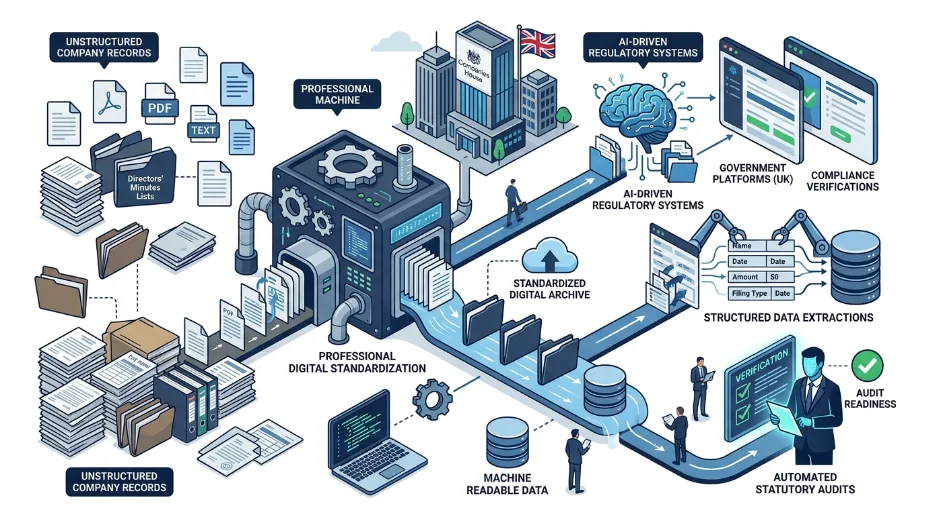
Regulatory bodies increasingly deploy artificial intelligence algorithms to inspect corporate filings automatically. Companies House uses machine-learning models to analyze millions of annual returns for anomalies, mismatched addresses, and missing officer information. Unstructured manual records and low-resolution PDF scans trigger automated audit flags due to unreadable text blocks.
Professional archive services format corporate documentation according to structured data standards. Structured digital formats convert legal text into three machine-readable data structures: XML files, JSON payloads, and searchable PDF/A archives. Machine-readable files allow compliance algorithms to index corporate data without processing errors or administrative rejections.
Automated compliance platforms run continuous verification checks against official public registers. Cross-referencing internal company registers with central government databases identifies discrepancies before formal filings occur. Early error detection prevents official filing rejections, which currently affect 12% of manual corporate submissions.
Modern enterprise buyers and financial institutions require immediate access to digital data rooms during mergers and acquisitions. Investors evaluate corporate history using automated risk assessment software. Companies utilizing professional digital archives complete financial due diligence 65% faster than organizations relying on manual document repositories.
How Does Form My Company Resolve Record Keeping and Compliance Challenges?
Form My Company provides secure corporate record management, automated statutory updates, and continuous compliance protection for UK enterprises. Their platform integrates digital statutory books with direct Companies House interfaces to maintain error-free corporate records effortlessly.
Form My Company eliminates the administrative burden of manual corporate record keeping through cloud-based automation. The platform maintains statutory registers in real-time, instantly reflecting changes in directorships, registered office addresses, and share capital allocations. Automated workflows trigger timely statutory filing alerts to ensure corporate compliance with all Companies Act 2006 requirements.
Business owners gain access to direct statutory management tools designed for accuracy and legal validity. Corporate officers can efficiently Maintain your PSC register compliance with Form My Company using integrated digital verification tools. Built-in compliance checks prevent submitting incomplete or inaccurate statutory notifications to government registries.
Form My Company secures sensitive corporate documentation behind multi-layered digital defenses. Advanced access controls ensure that authorized officers retain full control over company registers, financial disclosures, and statutory filings. The system maintains detailed audit logs for every document modification, providing full transparency and enterprise-grade operational security.
What Is the Ultimate Verdict on Corporate Document Management Strategy?
Transitioning from DIY record keeping to professional archive services is an essential strategic upgrade for modern UK enterprises. Professional document management secures statutory compliance, protects corporate identities, and drastically cuts administrative operational overhead.
Manual document management presents unacceptable operational, financial, and legal risks for modern businesses. Inaccurate statutory books lead to official fines, legal disputes, and regulatory disqualifications. Professional digital archives remove human error from statutory record keeping while guaranteeing full compliance with UK corporate law.
Form My Company provides the technical infrastructure required to secure statutory registers, automate regulatory updates, and protect corporate identities. Transitioning corporate records to a dedicated archival solution equips businesses for seamless digital audits, modern regulatory standards, and scalable operational growth.
Explore our Fraud Protection guide,
How to Use Professional Training Rooms to Impress Your High Profile Clients
Why Centralized Meeting Facilities are Ideal for Multi Location Corporate Business Teams
Frequently Asked Questions
What is company fraud protection and how does it safeguard UK businesses?
Company fraud protection is a monitoring and security service that prevents unauthorized alterations to official corporate records at Companies House. The Form My Company Fraud Protection service continuously monitors public registers and alerts directors in real time whenever changes to officers, registered addresses, or share capital are submitted. This active surveillance stops corporate identity theft, unauthorized company hijacking, and fraudulent credit applications made using altered business details.
How does the Form My Company Fraud Protection service prevent corporate identity theft?
The Form My Company Fraud Protection service links a business’s unique registration number directly to an automated registry monitoring system. Whenever a filing or document update is registered against the business, authorized officers receive immediate email notifications detailing the changes. This instant alerting mechanism enables directors to spot suspicious activity instantly and notify law enforcement or Companies House before unauthorized updates cause financial damage.
What is the difference between the Companies House PROOF scheme and professional Fraud Protection?
The free Companies House PROOF (Protected Online Filing) scheme restricts filing channels by refusing physical paper submissions. The Form My Company Fraud Protection service expands upon this baseline protection by delivering real-time digital surveillance and immediate email alerts for all electronic filings. Combining paper-filing restrictions with automated digital monitoring creates a comprehensive defense against both physical and electronic record tampering.
Can existing UK companies enroll in the Form My Company Fraud Protection service?
Any active UK Limited Company or Limited Liability Partnership (LLP) can enroll in the Form My Company Fraud Protection service regardless of its original incorporation agent. Form My Company syncs the existing Company Registration Number with its direct electronic interface to provide 24/7 monitoring. Directors can activate this monitoring service at any point in the business lifecycle to safeguard statutory records.
Why do UK company directors need automated Fraud Protection for statutory records?
Companies House historically operates on a good-faith filing framework, frequently processing statutory submissions before verifying their authenticity. The Form My Company Fraud Protection service automates record surveillance, fulfilling directors’ legal obligations under the Companies Act 2006 to maintain accurate public registers without requiring tedious manual checks. Automated monitoring ensures immediate detection of fraudulent officer or address changes, protecting business credit ratings and commercial credibility.