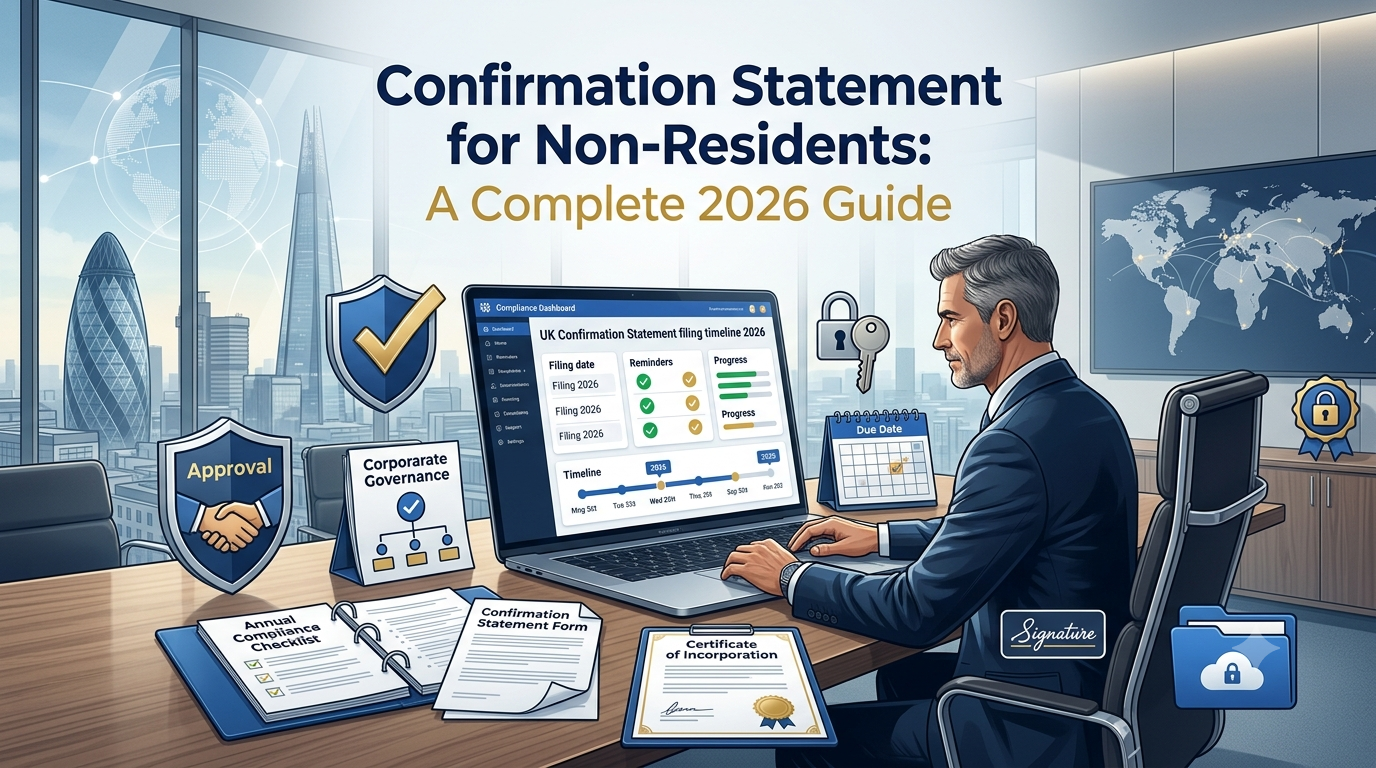
Confirmation Statement for Non-Residents
If you own a UK limited company from abroad, one of your most important annual responsibilities is the confirmation statement. This is the yearly filing that keeps your company’s information at Companies House up to date, and missing it can put your company at real risk of penalties or strike-off. Managing this obligation from overseas has its own practical considerations, from time zones to keeping PSC details current when you’re not physically in the UK. At Form My Company, we file confirmation statements for non-resident-owned UK companies as part of our ongoing support. This guide explains everything non-resident owners need to know.
What Is a Confirmation Statement?
A confirmation statement is an annual filing that confirms the key information Companies House holds about your company is accurate and up to date. It’s a snapshot of your company’s structure and details, and every active UK company (including dormant ones) must file at least one every 12 months.
The confirmation statement checks:
- Registered office address. Your company’s official legal address.
- Directors and secretary. The people responsible for running the company.
- Shareholders and share capital. Who owns the company and how the shares are structured.
- Persons with Significant Control (PSCs). Individuals who own or control the company, typically holding more than 25% of shares or voting rights.
- SIC codes. The codes describing your company’s main business activities.
If any of these details have changed since your last confirmation statement, you update them either before or as part of your filing.
Why This Matters More When You’re Non-Resident
Filing a confirmation statement is a legal requirement for every UK company, but non-resident owners face some specific practical challenges that make it worth paying extra attention to:
- No physical presence in the UK. You’re not passing your registered office regularly, so mail-based reminders can be missed easily.
- Time zone differences. Companies House operates in UK time, and if something needs a quick response, being in a very different time zone can slow you down.
- Distance from professional support. UK-based founders often use a local accountant who handles filings routinely. Non-residents may not have the same automatic touchpoints.
- Different mental calendar. Non-resident owners often think of their UK company as a “background” asset, which makes it easier to miss the annual filing deadline.
- Multi-jurisdiction tax and reporting. You may have parallel reporting obligations in your home country, which can complicate priorities.
These aren’t reasons to avoid running a UK company from abroad. They’re reasons to have a clear system for handling the confirmation statement each year.
Key Deadlines and Filing Requirements
Every company has a confirmation statement “review period” running from either the date of incorporation or the date of the last confirmation statement, typically 12 months long. You then have 14 days after the review period ends to file. Missing this window can put you at risk of Companies House proceedings, so tracking your date carefully matters.
The filing itself must be:
- Submitted online (digital filing). Currently the standard and cheapest option.
- Accompanied by the filing fee. The digital confirmation statement fee is £50 as of February 2026.
- Filed even if nothing has changed. The confirmation statement is required annually regardless of whether your company’s information has changed. Dormant companies also file.
The £50 fee is payable once in each 12-month payment period, no matter how many confirmation statements you file within that period. So if you file multiple times in one year to update details, you don’t pay twice.
How to File as a Non-Resident
The filing itself is done through Companies House WebFiling or through a company services provider like Form My Company. As a non-resident, you can file from anywhere in the world.
The process involves:
- Reviewing your company’s current information on the Companies House register. Making sure directors, PSCs, share capital, registered office, and SIC codes are all accurate.
- Making any updates before or during the filing. Changes to shareholders, for example, can be reported within the confirmation statement itself. Other changes, like adding a director or updating a registered office, need separate filings first.
- Submitting the filing and paying the £50 fee. Digital submission is processed quickly, usually within 24 hours.
- Receiving confirmation. Once accepted, your company’s confirmation statement is on record for another year.
Doing this correctly the first time avoids follow-up queries from Companies House and keeps your compliance clean.
PSC Updates and Why They Matter for Non-Residents
The Persons with Significant Control (PSC) register is one of the most important elements of the confirmation statement, and it’s an area where non-resident owners sometimes get caught out.
If you’re a non-resident owner of a UK company, you’re almost certainly a PSC yourself (as the person owning or controlling more than 25% of the shares). Your PSC details must be:
- Accurate and current. Your name, address, and nature of control must match reality.
- Identity-verified under the ECCTA. Under the Economic Crime and Corporate Transparency Act, all PSCs must complete identity verification with Companies House. This applies to non-resident PSCs just like UK-based ones.
- Updated if things change. If your ownership stake changes, you move house, or your control of the company changes, the PSC register needs updating.
The confirmation statement is a natural moment to check PSC details are still correct. If they’ve drifted (like an address change you didn’t report at the time), the confirmation statement is a chance to fix things.
The ECCTA Identity Verification Impact
Under recent Companies House reforms, identity verification for directors and PSCs became mandatory from 18 November 2025. This affects confirmation statements in a specific way:
- Existing directors and PSCs have transition deadlines. Depending on your circumstances, verification may be due at the time of your next confirmation statement or aligned with your birth month.
- Unverified directors face restrictions. Companies House can block certain filings from unverified directors, and companies risk penalties for allowing unverified directors to continue in role.
- New PSCs at any point need verification. If PSC changes are being reported in a confirmation statement (or beforehand), the new PSC needs to have completed verification.
If you haven’t yet completed identity verification, doing so before your next confirmation statement is a good idea. As an Authorised Corporate Service Provider (ACSP), Form My Company can handle identity verification for non-resident directors and PSCs remotely.
Common Confirmation Statement Mistakes for Non-Residents
A few issues come up regularly with non-resident-owned companies:
- Missing the 14-day filing deadline. Non-resident owners are more prone to missing deadlines simply because there’s no physical UK presence to receive reminders. Setting your own calendar alerts helps.
- Assuming “nothing changed” means no filing. The confirmation statement is required annually regardless. Nothing changing is fine, but not filing is not.
- Reporting share changes without filing them separately first. Some changes (like adding a new director) need separate Companies House filings before or alongside the confirmation statement.
- Not verifying identity in time. Under the ECCTA, unverified directors and PSCs can face restrictions on filings, including the confirmation statement itself.
- PSC drift. Non-resident owners sometimes move house internationally without updating their PSC address on the register, causing a mismatch by the time the confirmation statement is due.
- Filing under old registered office details. If you’ve changed your registered office (or your service address), make sure the confirmation statement reflects the current position.
- Not tracking the review period accurately. The 12-month period runs from either incorporation or the last confirmation statement, not from any calendar date. Getting this wrong can lead to missed deadlines.
Working through the filing carefully, especially the first time, avoids all of these.
Consequences of Not Filing
Failing to file a confirmation statement is a serious matter:
- It’s a criminal offence. Both the company and its directors can face prosecution.
- Companies House can begin strike-off proceedings. Meaning your company can eventually be removed from the register and cease to exist legally.
- Directors can be held personally responsible. For failures to comply with statutory duties.
- Company records become unreliable. Affecting banking, contracts, and any due diligence.
- Fines can apply. Alongside possible disqualification for directors who repeatedly fail to comply.
For non-resident owners, these consequences can catch you unaware if you don’t have someone actively tracking your obligations. That’s why annual confirmation statement support is one of the most valuable services for overseas-owned UK companies.
Filing Alongside Wider Compliance
The confirmation statement isn’t the only annual obligation for a UK company. You’ll also need to:
- File annual accounts. With Companies House, on a separate deadline based on your accounting reference date.
- File a Corporation Tax return. With HMRC.
- Register and file for VAT. If applicable to your business.
- Keep other statutory registers up to date. Directors’ register, PSC register, register of members.
- Meet identity verification obligations. Under the ECCTA.
For non-resident owners, coordinating all of these can be complex. Working with an ACSP for the Companies House side and a qualified UK accountant for the tax side is a common and sensible setup.
How Form My Company Helps
We support non-resident owners with their confirmation statements and wider compliance as part of our ongoing services. As an Authorised Corporate Service Provider (ACSP), we handle:
- Tracking your confirmation statement review period and deadlines
- Reviewing your Companies House record before filing
- Filing the confirmation statement and paying the £50 fee on your behalf
- Making any necessary updates to directors, PSCs, or other details
- Identity verification (IDV) support for directors and PSCs under the ECCTA
- Compliant UK registered office address in Bolton BL1
- UK director’s service address to keep your home address off the public register
- Coordinating with your accountant on wider compliance if needed
This means you can run your UK company from anywhere in the world without worrying about missing the annual filing.
File Your Confirmation Statement Correctly Today
For non-resident owners of UK companies, the annual confirmation statement is one of the most important things to get right, and one of the most common things to slip through the cracks. With Form My Company, filing your confirmation statement is quick, accurate, and fully supported, wherever you’re based. Get in touch today and let us keep your UK company compliant, year after year.
Frequently Asked Questions
Do non-resident-owned UK companies need to file a confirmation statement?
Yes. Every active UK company, including those owned by non-residents and dormant companies, must file a confirmation statement at least once every 12 months, regardless of where the directors or shareholders are based.
How much does the confirmation statement cost?
The digital filing fee is £50 as of February 2026. This is payable once per 12-month payment period, regardless of how many statements you file within that period.
How often do I file a confirmation statement?
At least once every 12 months. The 12-month “review period” runs from either your incorporation date or your last confirmation statement date, and you have 14 days after that period ends to file.
Can I file my confirmation statement from abroad?
Yes. The filing is done online through Companies House WebFiling or through a company services provider, so it can be completed from anywhere in the world. As an ACSP, we can file on your behalf.
Does the ECCTA affect my confirmation statement?
Yes. Under the ECCTA, directors and PSCs must complete identity verification, and existing directors have transition deadlines often aligned with the confirmation statement. Unverified directors can face restrictions on filings.
What happens if I miss the confirmation statement deadline?
Failing to file is a criminal offence, can lead to Companies House strike-off proceedings, and directors can be held personally responsible. Fines and possible disqualification can also apply. Filing on time each year avoids these consequences.
Can I update PSC details in my confirmation statement?
Yes. Some updates, including PSC details, can be reported within the confirmation statement itself. Other changes, like adding a director or changing your registered office, may need separate filings before or alongside the confirmation statement.