
Convert Sole Trader to Ltd
Converting from sole trader to limited company is one of the most important business structure decisions many UK entrepreneurs face. As your business grows, the tax advantages, limited liability protection, and professional credibility of a limited company become increasingly valuable. But the conversion itself involves specific steps: incorporating a new limited company, transferring your business, deregistering with HMRC as self-employed, and setting up new tax arrangements. Get it right, and you’re set up for growth with the benefits of limited company status. Get it wrong, and you can face unexpected tax bills, banking complications, and admin headaches. At Form My Company, we help sole traders convert to limited company status as part of our formation and compliance services. This guide walks you through the whole process in 2026.
Why Convert from Sole Trader to Ltd?
There are several genuine reasons to consider incorporation:
Limited liability protection. Your personal assets are protected if the business faces claims or debts.
Tax efficiency at higher income levels. Corporation Tax rates can be more efficient than higher-rate personal Income Tax.
Business credibility. Some clients, especially corporate customers, prefer working with limited companies.
Business growth. Attracting investment, hiring employees, or accessing larger contracts often requires limited company status.
Business continuity. The company continues to exist independently of you, useful for succession planning.
Retirement planning. Company-based pensions and other tax-efficient arrangements.
Tax planning flexibility. Dividends, salary combinations, timing of income.
Access to certain markets. Some industries or contracts require limited company status.
Business asset protection. Separating business from personal legal and financial exposure.
Professional image. For growing businesses.
Whether conversion makes sense depends on your specific situation, but for many growing sole traders, it becomes worthwhile at some point.
When to Convert
The right timing depends on multiple factors:
Income levels. As you cross into higher-rate personal Income Tax bands, Corporation Tax often becomes more efficient. From April 2026, dividend tax rates rise (basic rate 10.75%, higher rate 35.75%), so the total tax comparison shifts.
Business scale. Growing businesses often need the professional structure a limited company provides.
Contract requirements. Some contracts specifically require limited company status.
IR35 considerations. For contractors, IR35 rules affect the conversion decision.
Investment plans. Attracting investors typically requires limited company status.
Employment plans. Hiring employees works better through a limited company.
Business protection needs. Where limited liability becomes materially important.
Family or succession planning. Where separation of business from personal matters.
Regulatory changes. As tax rules evolve, the calculus can change.
Personal circumstances. Retirement planning, tax residency, or other personal factors.
Professional tax advice is essential for timing decisions. Getting it wrong can be expensive.
Tax Comparison: Sole Trader vs Ltd Company
Understanding the tax comparison helps clarify the decision:
Sole Trader Tax
Income Tax on all profits. Directly taxed at personal Income Tax rates.
National Insurance contributions. Class 2 (£3.55 per week from April 2024) and Class 4 (9% between £12,570 and £50,270, 2% above).
Personal tax return. Annual Self Assessment.
Simple accounting. Easier compliance for smaller businesses.
No dividend structure. All profits treated as personal income.
Losses. Can offset against other income.
Business use of car. Different rules.
Limited Company Tax
Corporation Tax. 25% main rate, or 19% small profits rate for companies with profits up to £50,000. Marginal relief for companies between £50,000 and £250,000.
Dividends. After Corporation Tax, remaining profits can be distributed as dividends. From April 2026, dividend tax rates are 10.75% (basic rate), 35.75% (higher rate), and 39.35% (additional rate).
Salary to director. Deductible for Corporation Tax purposes, personal Income Tax and National Insurance apply to salary paid.
Dividend allowance. £500 tax-free from April 2025.
Personal Allowance. Still applies to any salary paid.
More complex accounting. Company accounts, Corporation Tax return, PAYE if paying salary.
Business use of car. Different rules, including “benefit in kind” considerations.
Which is More Efficient?
For lower profit levels (say under £30,000), sole trader is often simpler and possibly more efficient. For higher profit levels, especially over £50,000, limited company structure can save significant tax. But it’s not universal, and it depends on:
Your specific profit level. Not just gross income.
How you extract money. Salary, dividends, or a combination.
Personal tax circumstances. Other income, spousal considerations.
Pension contributions. Company pension contributions are highly tax-efficient.
Family and estate planning. Long-term wealth transfer considerations.
Professional advice from a qualified UK accountant is essential for this calculation.
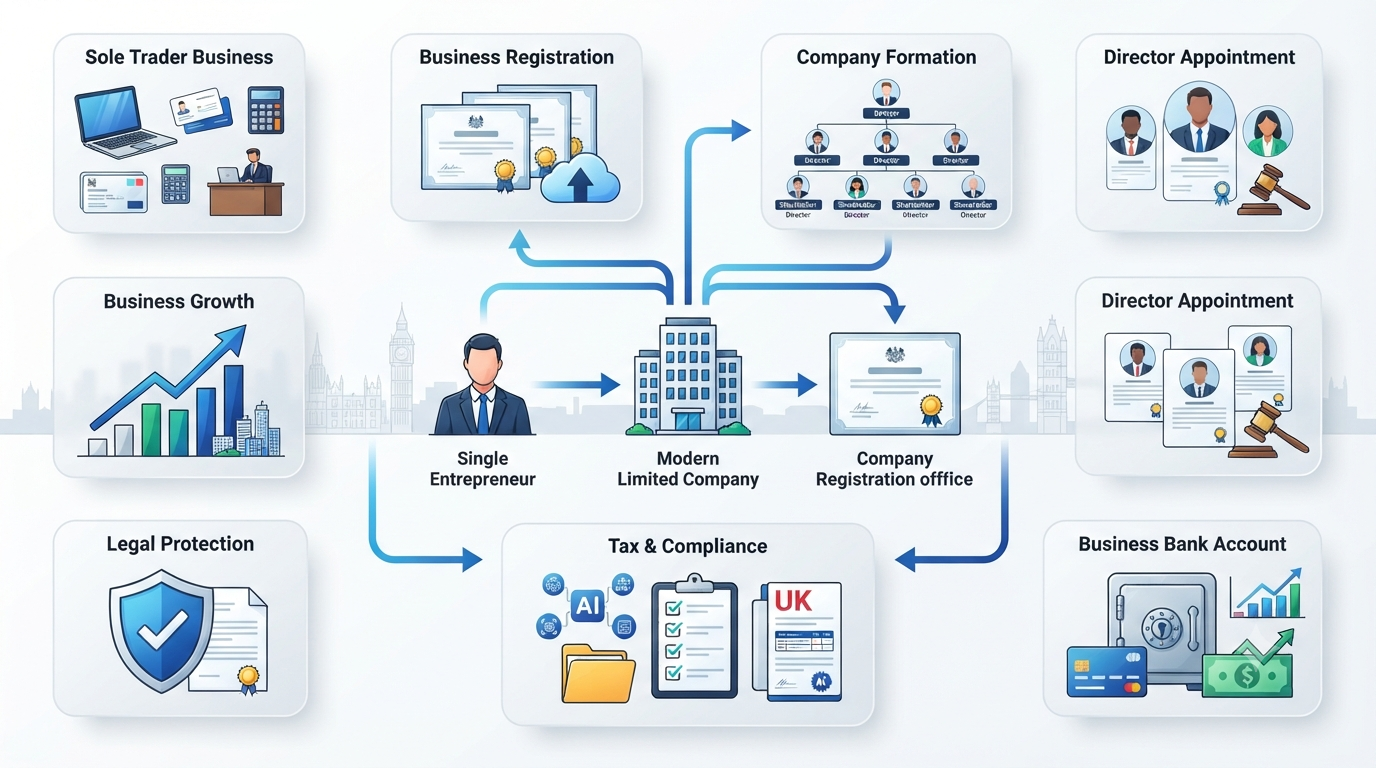
The Conversion Process: Overview
Converting from sole trader to limited company involves multiple steps:
Step 1: Confirm the decision. With professional tax advice.
Step 2: Incorporate a limited company. Setting up the new company.
Step 3: Transfer the business. Assets, contracts, and operations.
Step 4: Deregister as self-employed. With HMRC.
Step 5: Set up new tax arrangements. Corporation Tax, PAYE, potentially VAT.
Step 6: Transition contracts and banking. Update clients, suppliers, and financial arrangements.
Step 7: Manage the transition period. Coordinating the change.
Step 8: Ongoing compliance. Under the new structure.
Each step involves specific requirements and timing considerations.
Step 1: Confirm the Decision With Professional Advice
Before any conversion:
Consult a qualified UK accountant. For tax planning specific to your situation.
Consider a UK solicitor. For legal aspects of business transfer.
Analyse your specific tax position. Not just theoretical benefits.
Consider IR35 implications. For contractors specifically.
Review contract terms. For any restrictions or considerations.
Plan the timing. For optimal tax efficiency and business continuity.
Understand ongoing costs. Company compliance vs sole trader simplicity.
Consider capital gains implications. For business assets being transferred.
Plan for HMRC coordination. Deregistration timing matters.
Document the analysis. For future reference.
Getting proper advice at the outset saves significant complications later.
Step 2: Incorporate a Limited Company
The formation step:
Company name. Choose and verify availability at Companies House.
Business structure. Private limited company (Ltd) is most common.
Directors. You’ll be the initial director. Potentially additional directors depending on ownership.
Shareholders. Establish ownership structure.
Share capital. Nominal starting amount (£1 minimum).
PSC identification. As Person with Significant Control if you own 25%+.
Registered office address. Meeting UK requirements.
SIC codes. Reflecting your business activity.
Companies House filing. Through Form IN01 (or online formation service).
Filing fee. £50 for digital incorporation (£100 from February 2026 for the new digital fee).
Certificate of Incorporation. Received once approved.
Identity verification. Under ECCTA rules, if not already completed.
The incorporation itself is straightforward with our services. Coordination with your accountant is important for tax planning.
Step 3: Transfer the Business
Moving your sole trader business to the new limited company:
Business asset transfer. Physical and intangible assets.
Business contracts. Existing client contracts, supplier agreements, leases.
Employees. If applicable, TUPE transfer considerations.
Intellectual property. Domain names, trademarks, copyright.
Ongoing obligations. For anything that carries forward.
Timing considerations. For a clean handover.
Documentation. Business transfer agreement, if formal.
Capital gains implications. For business assets being transferred at market value.
Incorporation relief. Where applicable to defer capital gains.
Ongoing bank arrangements. Business bank accounts.
Insurance. Business insurance transferred or newly arranged.
Regulatory registrations. Any specific business licences or registrations.
Trading name. Whether your existing sole trader trading name transfers.
This step requires careful planning and professional support.
Step 4: Deregister as Self-Employed With HMRC
Notify HMRC that you’re no longer self-employed:
Notify HMRC of ceased trading. Through your accountant or directly.
File your final Self Assessment return. For the tax year in which you cease self-employment.
Include cessation date. Officially the date business transfers.
Consider PAYE registration. For the new limited company if you’ll pay yourself a salary.
VAT deregistration. If you were VAT-registered as a sole trader, consider deregistration.
Class 2 and Class 4 NIC. Cessation of self-employed NIC.
Notification timing. Within specific HMRC deadlines.
Personal tax obligations. Still apply to any income received.
Coordinating with HMRC properly avoids complications and back tax issues.
Step 5: Set Up New Tax Arrangements
The limited company has its own tax setup:
Corporation Tax registration. With HMRC.
Corporation Tax UTR (Unique Taxpayer Reference). For the company.
Accounting reference date. Company’s financial year end.
Corporation Tax return timing. Filed with HMRC.
VAT registration. If applicable and helpful.
PAYE registration. If you’ll pay yourself or others a salary.
Making Tax Digital compliance. For VAT and eventually broader.
HMRC agent authorization. If your accountant handles Corporation Tax on your behalf.
Ongoing accountant relationship. Corporate tax and accounting are typically more complex than sole trader.
Professional accountant support is essentially standard for limited companies.
Step 6: Transition Contracts and Banking
Updating stakeholders:
Business bank account. New account under the limited company name.
Payment gateways. Update to reflect the new company.
Marketplace listings. For online sellers.
Client contracts. New or updated agreements under the limited company.
Supplier agreements. Where relevant.
Insurance policies. Under the limited company.
Business premises. Lease or ownership arrangements.
Regulatory registrations. Where applicable.
Bank facilities. Loans, overdrafts, credit cards.
Professional advisers. Update accountant, solicitor, insurance broker.
Marketing materials. Website, business cards, email signatures.
Coordinating this transition preserves business continuity.
Step 7: Manage the Transition Period
The changeover requires coordination:
Effective transition date. When the change actually takes effect.
Overlap periods. Where necessary.
Communication. With clients, suppliers, and stakeholders.
Financial reconciliation. For the transition period.
Any outstanding matters from the sole trader business. Debts, receivables, obligations.
Historical records. Preserved for statutory record-keeping periods.
Contingency planning. For any issues during transition.
Good planning prevents disruption to your business operations.
Step 8: Ongoing Compliance Under the New Structure
After the conversion:
Companies House filings. Confirmation statement, accounts, director changes.
HMRC Corporation Tax. Annual returns and payments.
VAT if applicable. Quarterly returns under Making Tax Digital.
PAYE if applicable. RTI submissions and payments.
Statutory registers. Register of directors, PSCs, members.
Board resolutions and meetings. For statutory decisions.
Company accounts. Annual full accounts (unless small company exemptions apply).
Ongoing accountant relationship. For tax compliance.
Company secretarial support. For ongoing Companies House work.
Insurance and business protection. Under the limited company.
The compliance burden is higher than sole trader but comes with the benefits of limited liability and tax planning flexibility.
Common Mistakes to Avoid
A few issues come up regularly:
Converting too early. Before profits justify the additional complexity.
Not getting professional tax advice. Both accountant and potentially solicitor.
Missing HMRC deregistration. Continuing to file as self-employed after the change.
Not planning for capital gains implications. On asset transfers.
Overlooking incorporation relief. Where it could apply.
Not considering IR35. For contractors.
Missing PAYE setup. Before paying yourself a salary.
Poor contract transition. Where client contracts don’t reflect the change.
Not updating banking properly. Continuing to receive payments personally.
Missing VAT considerations. Whether to remain registered, deregister, or newly register.
Not planning for the transition period. Where old and new structures overlap.
Not maintaining company records. Statutory books, PSC register, etc.
Underestimating ongoing compliance burden. Company accounts, Corporation Tax, PAYE.
Professional support significantly reduces these risks.
Special Considerations
Some specific situations to consider:
IR35 for contractors. IR35 rules affect the conversion decision and ongoing compliance for contractors.
Business partnerships. Converting from partnership to limited company follows different rules.
LLPs. Have different considerations from partnerships.
Multi-shareholder companies. Additional planning for ownership structure.
Family businesses. For family and estate planning.
Estate planning. Company ownership structure for inheritance.
International considerations. For non-resident conversions.
Regulated sectors. For businesses in specific industries.
Franchise businesses. Where the franchise agreement affects structure.
E-commerce and marketplace sellers. Special considerations for online businesses.
Property investment. Different tax considerations than trading businesses.
Each has specific implications worth understanding.
For Non-Resident Owners
If you’re a non-resident considering conversion:
UK residency status matters for the sole trader. If you were operating as sole trader while non-resident, the conversion is fundamentally different.
UK tax residency of the new company. Central management and control considerations.
Directors and PSC verification. Under ECCTA.
UK registered office. Required for the new company.
Bank account setup. Non-resident considerations.
Home country tax implications. For the conversion itself and ongoing operations.
Multi-jurisdictional advice. Both UK and home country professional advice essential.
Structuring considerations. Where the company operates and is managed matters.
For non-resident sole traders considering UK limited company conversion, coordinated professional advice across jurisdictions is essential.
How Form My Company Helps
We handle the formation side of sole trader to limited company conversion as part of our services. As an Authorised Corporate Service Provider (ACSP), we can:
Handle UK company formation. For your new limited company.
Provide compliant registered office address. In Bolton BL1.
Handle identity verification. For directors and PSCs under ECCTA.
Update Companies House records. For the new company.
Coordinate with your accountant. For the tax planning and HMRC coordination.
Point you toward qualified UK accountants. For the tax planning that’s essential to the conversion decision.
Support VAT registration. If applicable to the new company.
Set up director’s service address. To protect your home address from public record.
Support ongoing Companies House compliance. Confirmation statements, filings.
Coordinate the transition. With your accountant handling tax matters.
Non-resident support. For overseas owners considering conversion.
Bundle with wider services. As part of ongoing compliance package.
For the formation and compliance side of your conversion, we handle it professionally. For the tax planning that’s essential to the decision itself, work with a qualified UK accountant.
Consider Your Conversion Options Carefully
Converting from sole trader to limited company is a significant business decision with real tax, compliance, and operational implications. Getting the timing, tax planning, and formation right matters. Working with a qualified UK accountant for the tax planning and Form My Company for the formation and ongoing compliance is typically the best combination. Get in touch today about the formation and compliance side of your conversion.
Frequently Asked Questions
When should I convert from sole trader to limited company?
The right timing depends on profit levels, business plans, and tax circumstances. As profits cross into higher-rate personal Income Tax bands (typically £30,000-£50,000+), Corporation Tax structure often becomes more efficient. Professional tax advice is essential.
What are the tax advantages of a limited company vs sole trader?
For higher profit levels, dividends (after Corporation Tax) can be more efficient than higher-rate personal Income Tax on all profits. Dividend allowance provides £500 tax-free from April 2025. Company pension contributions are highly tax-efficient. Corporation Tax rates: 25% main, 19% small profits (up to £50,000).
What is incorporation relief?
A tax relief that can defer capital gains tax on assets transferred from your sole trader business to the new limited company at market value. Complex rules apply. Professional tax advice essential.
Do I need to notify HMRC when converting?
Yes. Notify HMRC that you’re no longer self-employed as a sole trader. File your final Self Assessment return covering the period to cessation. Set up new tax arrangements for the limited company (Corporation Tax, potentially PAYE and VAT).
Can I keep my existing sole trader business bank account?
Not for the new limited company. Legally, the limited company needs its own business bank account. You may keep your sole trader account for any personal matters or to run down historic transactions.
Does converting affect my client contracts?
It can. Client contracts may reference you personally as a sole trader. New or updated contracts under the limited company name are typically needed. Coordination with clients matters.
Do I need professional advice for the conversion?
Almost always yes, both a qualified UK accountant (for tax planning) and Form My Company or another ACSP (for formation). Professional advice significantly improves outcomes and avoids costly mistakes.
Can Form My Company handle my conversion?
For the formation side, yes. We handle the UK company formation, registered office, identity verification, and ongoing Companies House compliance. For the tax planning and HMRC coordination essential to the conversion decision, we point you toward qualified UK accountants.