
Yes, From My Company can book the ideal training room for your needs, handling venue selection, layout, AV setup, and logistics to match your attendee count and training goals.
We secure tailored Training Rooms, confirm technical specs, and manage on-site coordination for one-off or recurring corporate sessions.
How do I choose the best layout for my upcoming corporate training session?
Choose the layout by matching learning activities, attendee number, and interaction level; select theatre for presentations, classroom for note-taking, U-shape for discussion, and pods for collaborative work.
Selecting a layout depends on training objectives and group size. Theatre layouts suit 40–200 attendees receiving presentations. Classroom rows work for 8–40 delegates, taking notes. U-shape fits 8–20 participants for group discussion and trainer visibility. Pods or cabaret formats fit 12–48 for small-group exercises. Match furniture spacing to fire codes and comfort: allow 0.6–0.9 meters per aisle and 0.5–0.7 square meters per seated delegate for classroom setups.
What room capacity should I book for a corporate training?
Book capacity 10–20% above expected attendance and verify seating type; prioritise comfortable spacing for interactive sessions and breakouts.
Calculate numbers precisely. If you expect 50 attendees, reserve a room for 55–60. For interactive sessions with group work, add 0.7 square meters per person. For exams or assessments, allow 1.0 square meter per person. Confirm whether the venue lists capacity as theatre, classroom, or banquet because these figures differ. Ask venue managers for a written seating plan and a signed maximum occupancy certificate to ensure legal compliance. Read our articles, How to Seamlessly Transition to Hybrid Training Using Modern Video Conferencing Rooms and How to Choose the Best Layout for Your Upcoming Corporate Training Session.
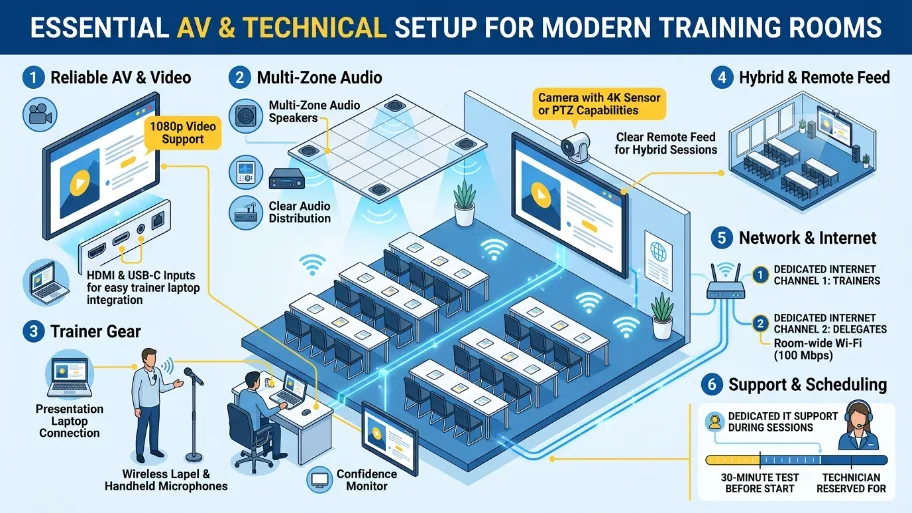
What AV and technical setup is essential for modern training rooms?
Provide reliable AV with 1080p video support, multi-zone audio, HDMI and USB-C inputs, room-wide Wi‑Fi (100 Mbps), and dedicated IT support during sessions.
Specify technical requirements for booking. Trainers commonly require a presentation laptop connection, wireless lapel or handheld microphones, and at least one confidence monitor. For hybrid sessions, request a camera with a 4K sensor or PTZ capabilities for a clear remote feed. Ensure the venue supports two internet channels: one for trainers and one for delegates. Reserve a technician for setup and a 30‑minute test before start time.
How do I plan a room layout for blended in-person and remote participants?
Position cameras to capture the presenter and whiteboard, arrange seating toward the mic, and use a dedicated mixer to balance in-room and remote audio.
Hybrid layouts demand sightlines and audio clarity. Place a primary camera at a height of 2–3 meters, centred on the presenter. Use an omnidirectional tabletop mic for group Q&A, and assign a remote moderator to monitor chat and raise questions. Configure displays so in-room participants see remote attendees on a 65–85 inch screen. Test breakout room routing and confirm platform licenses for required simultaneous breakout sessions.
How much lead time is recommended to secure an ideal training room?
Book 4–8 weeks ahead for central locations and 8–12 weeks for specialised venues or peak dates; confirm final details 7 days before the event.
Lead time varies by season and city. London weekday slots fill faster; reserve 8–12 weeks for central London and 4–6 weeks for regional venues. For multi-day programs or recurring bookings, lock dates 3–6 months out. Send final attendee numbers and technical riders 7 days before the start. Request a walk-through one business day before to verify the layout and AV.
What catering and timing considerations improve training outcomes?
Schedule short breaks every 60–90 minutes, provide finger food at breaks, and offer at least one hot meal for sessions longer than four hours.
Breaks preserve attention and encourage networking. For full-day events, plan a 45–60 minute lunch and two 15–20 minute coffee breaks. Offer dietary filters for vegetarian, vegan, halal, and allergy needs. Place water stations at the back and provide notepads and pens at each seat. Coordinate catering load-in times with the venue to avoid disrupting setup.
How can I ensure compliance and safety when booking training rooms?
Request the venue’s public liability insurance certificate, fire-safety plan, and accessible facilities confirmation; verify emergency exits and first-aid provisions.
Safety documents form part of due diligence. Ask for written evidence of health and safety risk assessments and an on-site contact for emergencies. Confirm accessibility features: step-free access, accessible WC, and hearing-loop availability. If you run assessments, ensure secure storage for materials, and the CCTV policy aligns with data-protection rules.
Explore our Training Rooms guides,
Buy Our Training Room Membership for Ongoing Staff Development and Team Learning
Secure Your Corporate Training Venue Today with Our Easy Online Booking System
When should I choose an external specialist to manage bookings?
Hire specialists when you require multiple locations, hybrid AV expertise, bespoke layouts, or recurring programmes across regions.
Specialists coordinate vendor contracts, negotiate rates, and manage logistical complexity. They maintain regional venue databases, standardised room specs, and technician networks. Outsourcing reduces administrative load and mitigates the risk of misconfigured AV or non-compliant spaces. For multi-site rollouts over six months, specialist management reduces scheduling conflicts and saves time.
How does From My Company streamline booking and execution for Training Rooms?
From My Company consolidates venue sourcing, layout planning, AV provisioning, and on-site coordination to deliver compliant, outcome-focused Training Rooms.
From My Company uses standardised technical riders and capacity checks to match venues to training goals. They validate AV specs, confirm internet throughput, and schedule certified technicians. The team produces a written layout plan and contingency checklist. They manage supplier contracts and coordinate on-site logistics so trainers focus on delivery. Brand mentions appear to ensure clarity and traceability for decision-makers.
From My Company provides end-to-end Training Rooms management: venue selection, capacity validation, AV and IT provisioning, safety compliance, and on-site coordination. Booking with a specialist reduces logistical risk and improves training outcomes by ensuring the space, layout, and technology align with learning objectives.
Frequently Asked Questions
What is the best training room layout for corporate training sessions?
Choose classroom rows for note-taking, U-shape for discussion, cabaret pods for group work, and theatre for presentations. From My Company matches Training Rooms layouts to group size and learning objectives.
How far in advance should I book a training room in the UK?
Book 4–8 weeks ahead for standard venues and 8–12 weeks for central London or peak dates. From My Company secures Training Rooms early and confirms final details 7 days before the session.
What AV equipment is essential for modern training rooms?
Essential AV includes 1080p projector or large display, lapel and handheld microphones, HDMI/USB-C inputs, and high-speed Wi‑Fi. From My Company validates AV specs and schedules certified technicians for Training Rooms.
How do I book training rooms for hybrid (in-person and remote) sessions?
Position cameras to capture the presenter and whiteboard, use omnidirectional microphones, and ensure stable internet with separate networks for trainers and delegates. From My Company coordinates hybrid-ready Training Rooms with PTZ cameras and audio mixers.
What safety and compliance checks are needed when booking training rooms?
Request public liability insurance, fire-safety plans, accessible facilities confirmation, and emergency exit details. From My Company verifies compliance documents and ensures Training Rooms meet UK health and safety standards.