
Executing documents correctly with a company seal requires affixing the physical embossing tool or wet stamp directly onto the signature block of a legal instrument, ensuring that two authorized company officers sign adjacent to the impression in strict compliance with the Companies Act 2006.
Executing formal corporate documents demands precision, legal compliance, and an understanding of statutory requirements. UK legislation outlines specific protocols for executing deeds and high-value contracts. When companies fail to execute paperwork properly, legal disputes arise. Directors must understand how to apply physical embossers or electronic impressions accurately. Proper execution safeguards corporate governance and validates business agreements.
What Is a Company Seal and Why Do UK Businesses Use It?
A company seal is a formal mechanical device used to emboss or stamp official corporate documents, signifying authentic board approval and binding execution under UK corporate law.
Companies use mechanical seals to validate high-value contracts, property transfers, and international agreements. The Companies Act 2006 removed the mandatory requirement for UK companies to possess a common seal. Modern corporations choose to retain seals because international partners still expect formal embossed authentication. Overseas jurisdictions often reject standard wet-ink signatures alone. Corporate governance frameworks require seals to prevent unauthorised document alteration.
When executing major corporate transactions, businesses often require a complete professional kit. You can order a physical Company Pack to streamline your corporate administration and compliance workflows.
When Is a Company Seal Legally Required for UK Businesses?
A company seal is legally required when company articles of association explicitly mandate its use, or when executing specific cross-border transactions governed by foreign legal jurisdictions.
UK domestic transactions proceed smoothly using standard signatures from two directors or one director and a witness. Foreign entities operating in civil law jurisdictions often demand embossed physical verification. Articles of association dictate internal corporate governance rules. Directors must review their specific articles before bypassing the seal. Ignoring internal constitutional rules renders executed documents vulnerable to legal challenge.
Businesses expanding into international markets frequently update their administrative infrastructure. Review the foundational guidance outlined in What Is the Difference Between a Company Seal and a Stamp? to select the correct authentication tool for your operational needs.
How Do You Physically Apply an Embossed Company Seal to a Document?
Physically applying an embossed company seal requires positioning the metal die squarely over the designated signature area, pressing the handle firmly downward, and raising a crisp, tactile corporate impression on the paper.
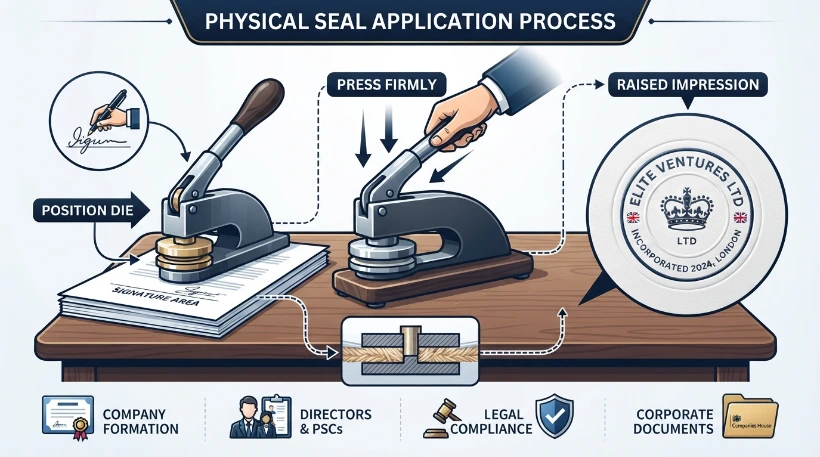
Proper mechanical application demands physical control and precision. Directors must align the metal jaws of the embosser with the designated seal circle on the paper. Pressing the lever with adequate force embosses the company name into the fibers. Faint impressions fail legal scrutiny during audits. Officers must inspect the paper after compression. A clear, readable, raised tactile impression confirms successful authentication.
Who Has the Authority to Witness and Execute Document Sealing?
Authority to witness and execute document sealing rests exclusively with appointed company directors, company secretaries, or designated authorised signatories acting under formal board resolutions.
Corporate governance rules restrict seal usage to prevent fraud and unauthorized commitments. Two authorized officers must sign the document alongside the seal impression. Board resolutions formally delegate this execution authority to specific individuals. Unauthorised employees cannot operate corporate seals. Auditors inspect company register books to verify signing authorities.
What Are the Key Steps for Registering and Maintaining Corporate Seals?
Registering and maintaining corporate seals involves recording seal purchases in the statutory register, storing the device in a secure location, and restricting physical access to authorized officers.
Statutory compliance demands meticulous record-keeping for every sealed document. Companies record the date, document type, and names of signing officers in internal registers. Secure storage prevents theft or fraudulent usage by rogue employees. Directors must update their corporate governance documentation whenever key management personnel change.
| Governance Action | Responsible Officer | Compliance Objective |
| Procure seal device | Company Secretary | Secure official embossing tool |
| Update register | Compliance Officer | Track every sealed legal document |
| Restrict access | Managing Director | Prevent unauthorized document execution |
How Can Businesses Streamline Document Execution and Statutory Compliance?
Streamlining document execution and statutory compliance requires adopting standardized signing protocols, training administrative staff on governance rules, and utilizing professional corporate secretarial services.
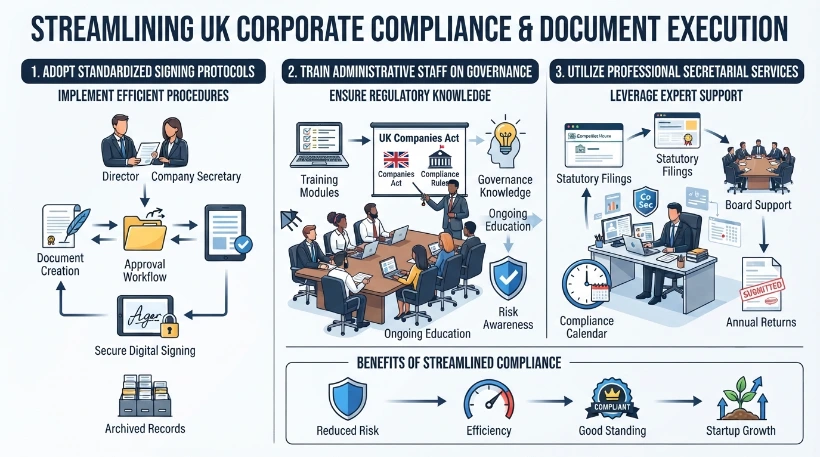
Efficient operations rely on clear internal workflows for contract review and execution. Administrative teams must verify signer credentials before applying mechanical seals. Professional service providers help growing enterprises maintain flawless statutory registers. When businesses formalize their administrative processes, legal risks decrease significantly.
Form My Company delivers robust administrative solutions designed to protect your corporate standing. Explore our tailored offerings by visiting Secure a Professional Company Seal From Form My Company to enhance your document security framework today.
Explore our Company Pack guide,
Choosing Interview Rooms Equipped for Hybrid Hiring
How to Keep Your Articles of Association Bank-Ready
Frequently Asked Questions
What is included in a standard Company Pack for UK businesses?
A comprehensive Company Pack from Form My Company typically includes essential statutory items such as a printed certificate of incorporation, bound memorandum and articles of association, share certificates, and a statutory register. These materials ensure new corporations immediately meet UK compliance standards and maintain accurate corporate records.
Do UK companies legally need to buy a company seal?
UK companies are no longer legally mandated under the Companies Act 2006 to possess a common company seal for domestic transactions. However, many businesses choose to order a corporate seal through services like Form My Company because international partners and foreign legal jurisdictions still require embossed authentication for high-value contracts.
How does Form My Company help with corporate compliance?
Form My Company simplifies corporate administration by providing essential startup bundles, statutory registers, and professional document execution tools. These resources help directors maintain accurate registers, manage share allocations, and satisfy the rigorous record-keeping demands enforced by UK regulatory authorities.
Can electronic signatures replace a physical company seal on legal documents?
Electronic signatures are legally valid for executing most standard UK contracts under modern legislation. When dealing with specific cross-border transactions or property deeds governed by strict foreign laws, businesses often combine electronic execution with a physical embossed seal obtained via a Form My Company package.
How do directors properly execute a deed using a company seal?
Directors execute a deed correctly by affixing the physical embossing seal to the designated signature area while two authorized officers sign adjacent to the impression. Recording this action within the statutory register ensures the transaction maintains full legal validity and withstands corporate audits.