Imagine you’re on the verge of closing a major cross-border deal, only for a foreign bank to halt everything because they don’t recognise your paperwork. It’s a common frustration for UK directors who find that a standard incorporation certificate simply isn’t enough to prove their company’s current health. You know your business is compliant, but learning how to explain a Certificate of Good Standing to your overseas business partner can feel like an uphill battle when technical jargon gets in the way. It’s perfectly natural to feel anxious when international deals stall over administrative details that seem straightforward on home soil.
We’re here to help you bridge that communication gap and master the art of UK compliance documentation. This article provides a clear roadmap for describing your company’s “clean bill of health” to anyone outside the UK, ensuring your ventures stay on track. We’ll examine the recent shift toward “summary statement” wording, the necessity of FCDO legalisation for the 120 plus countries under the Hague Apostille Convention, and the most efficient ways to secure your documents. From understanding the impact of the Economic Crime and Corporate Transparency Act to navigating express delivery options, you’ll gain the confidence to lead your partners through the verification process with ease.
Key Takeaways
- Understand the vital difference between a Certificate of Incorporation and a Certificate of Good Standing, which serves as a current health certificate for your firm.
- Master how to explain a Certificate of Good Standing to your overseas business partner by describing it as an official summary statement that verifies your company’s continuous existence.
- Identify the specific statutory details included in the document, such as confirmation that all annual accounts and confirmation statements are fully up to date.
- Recognise why international banks and registries usually require these documents to be legalised with an FCDO apostille for cross-border verification.
- Learn how to streamline the acquisition process by using a professional agent to ensure your certificate includes all necessary officer details from the start.
Understanding Why Overseas Partners Request a Certificate of Good Standing
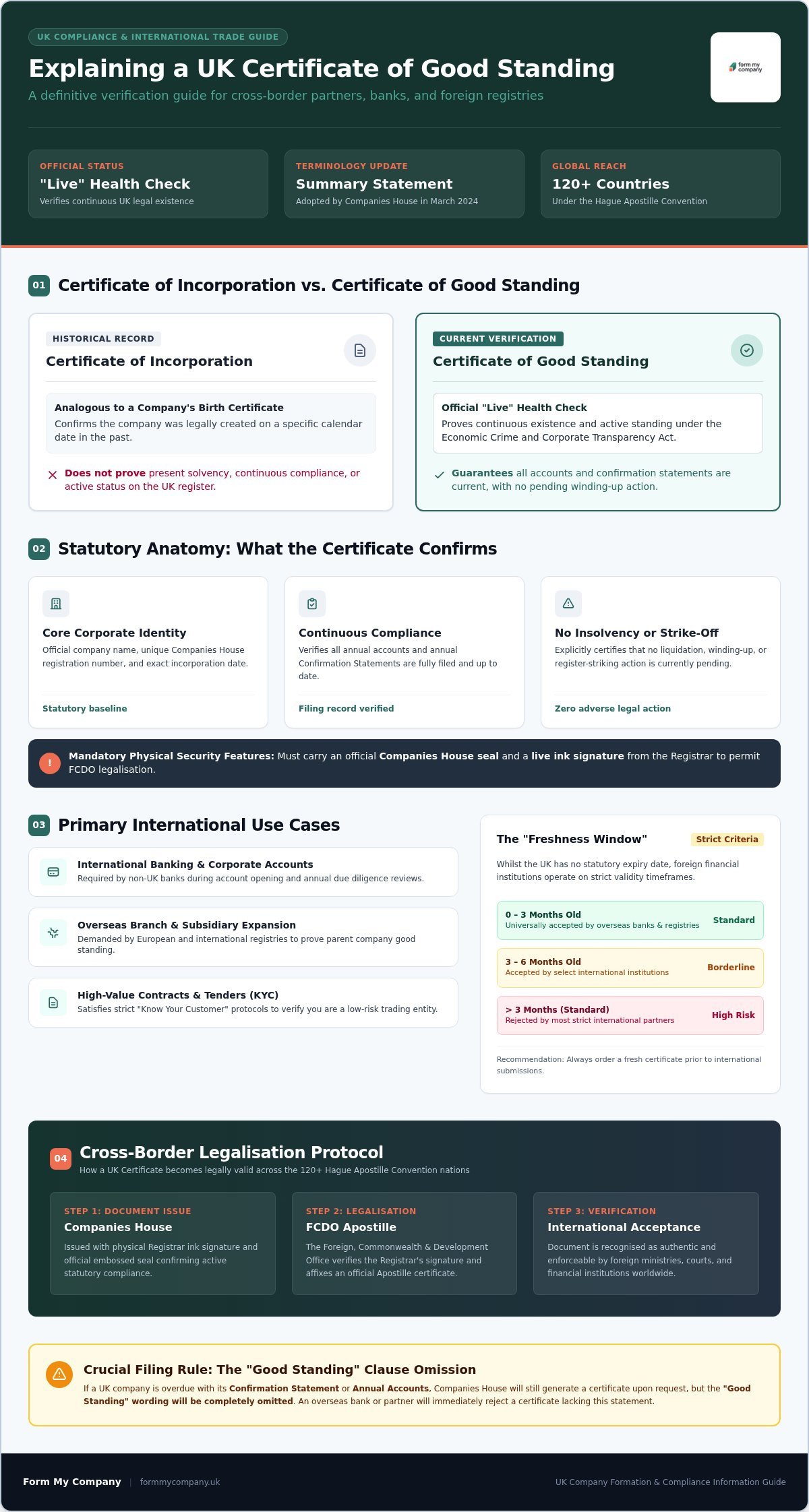
When you trade internationally, trust is the currency that matters most. A foreign bank or a new supplier doesn’t know your history, so they rely on official documentation to bridge that gap. A Certificate of Good Standing is an official statement from Companies House that acts as a “live” health check for your business. It confirms your company has been in continuous existence since incorporation and remains active on the register. Learning how to explain a Certificate of Good Standing to your overseas business partner is easier when you frame it as an official UK government endorsement of your company’s reliability. Since March 2024, Companies House has technically referred to the wording as a “summary statement,” but its legal function remains identical.
This document proves that no liquidation, winding-up, or striking-off action is currently pending against your firm. International authorities view this as essential because it guarantees they aren’t dealing with a business on the verge of collapse. The concept of good standing is a globally understood benchmark. It tells your partners that you’ve met every regulatory requirement mandated by the UK’s Economic Crime and Corporate Transparency Act. Without this verification, foreign entities have no way of knowing if your company is still legally authorised to conduct business.
The Role of Continuous Compliance in International Trade
Staying current with your filings builds immediate credibility. Whilst the UK’s public register is accessible, many overseas partners lack the technical knowledge to interpret raw data from Companies House. They prefer a certified document that does the work for them. Your ability to produce this certificate depends entirely on your filing history. Regularly submitting your Confirmation Statement and annual accounts ensures your record stays clean. If your filings lapse, the “good standing” wording is removed from the certificate, which can cause significant delays or even cancellations in international deals.
Common Scenarios: Banking, Contracts, and Tenders
You’ll typically encounter requests for this certificate during specific business milestones that involve cross-border cooperation. These requests are standard practice for modern due diligence.
- International Banking: Most banks outside the UK require a certificate issued within the last three to six months to open or maintain a corporate account.
- Expanding Abroad: When registering as a foreign branch amongst European neighbours, local registries need proof that the UK parent company is active and compliant.
- High-Value Contracts: Satisfying “Know Your Customer” (KYC) requirements for international tenders often hinges on this document to prove you’re a low-risk, established partner.
The Anatomy of a UK Certificate of Good Standing
When you need to know how to explain a Certificate of Good Standing to your overseas business partner, start with the physical evidence of your company’s legitimacy. A certified certificate from Companies House is a formal paper document that carries significant weight in international law. It displays your company name, registration number, and exact date of incorporation. Crucially, it features the official Companies House seal and a live ink signature from the Registrar. This signature is essential; without it, the Foreign, Commonwealth & Development Office (FCDO) cannot affix an apostille for international use. You can find a full breakdown of these security features in the Companies House certified certificate guidance.
Timing is everything when presenting this document. Whilst the certificate doesn’t have a statutory expiry date in the UK, international banks and registries typically operate on a strict freshness window. Most partners will reject a document that is more than three months old. They want to see a current snapshot of your firm, not a historical record. If you are learning how to explain a Certificate of Good Standing to your overseas business partner, clarify that the document confirms your company is “up to date” with all statutory filings at the precise moment of issue.
Key Information Included by Companies House
Beyond the basics, you can tailor the certificate to satisfy specific partner requests. You can choose to include the names and details of current directors and secretaries, their nationalities, and their service addresses. It also confirms your registered office address as it appears on the public record. Most importantly, the document contains a definitive statement regarding the absence of any legal proceedings to dissolve or strike off the firm. This provides the ultimate peace of mind for a partner entering a high-value contract.
What “Good Standing” Actually Means in 2026
In the current regulatory environment, “Good Standing” is the gold standard for corporate legitimacy. Under the Economic Crime and Corporate Transparency Act 2023, Companies House has become a proactive gatekeeper. A company might be listed as “Active” on the register, but that doesn’t mean it is in good standing. To qualify for the summary statement, your firm must have a perfect history of timely accounts and confirmation statement filings. It also requires at least one natural person as a director who has passed mandatory identity verification. If you’ve missed a single deadline, Companies House will refuse to issue the “good standing” wording, effectively halting your international progress.
Ensuring your document contains all the necessary officer details is vital for a smooth verification process. You can easily secure a comprehensive Certificate of Good Standing through our streamlined ordering platform to avoid any filing errors.
Certificate of Good Standing vs. Certificate of Incorporation
Whilst your Certificate of Incorporation is the permanent “birth certificate” of your business, the Certificate of Good Standing serves as a “current health certificate.” Understanding this distinction is vital when you are figuring out how to explain a Certificate of Good Standing to your overseas business partner. One proves origin. The other proves current status. Relying on an incorporation document from five years ago tells a partner nothing about your current filing status or whether you’ve faced recent strike-off notices. This is why international banks and agencies almost always demand both to complete their due diligence.
The Incorporation certificate never changes. It marks the moment your company was brought into existence. In contrast, a Certificate of Good Standing is a snapshot in time. It captures the exact state of your company’s compliance at the moment the Registrar signs it. If you haven’t yet secured your latest proof of compliance, you can Get an Official Certificate of Good Standing Today to ensure your international deals remain on track.
Birth Certificate vs. Health Certificate
Your incorporation document proves you started the business legally and established its initial structure. It’s a foundational piece of evidence, but it lacks the ability to confirm you are still running it legally today. Presenting only an incorporation certificate often leads to partner scepticism. They’ll wonder if the company has since become dormant, entered liquidation, or failed to meet the modern standards of the Economic Crime and Corporate Transparency Act. A health certificate removes these doubts by providing a verified summary of your current standing.
Why One Cannot Replace the Other
Communicating with Your Partner: A Step-by-Step Guide
Providing the right document is only half the battle. You must also provide the context. When you are learning how to explain a Certificate of Good Standing to your overseas business partner, it’s helpful to describe Companies House as the UK’s official government registrar. This isn’t just a private reference; it’s a statutory verification from the same body that governs every one of the 5 million companies on the UK register. It acts as a primary tool for Identity Verification, confirming that your directors have met the strict requirements of the Economic Crime and Corporate Transparency Act 2023. By explaining this clearly, you demonstrate that your business operates under rigorous regulatory oversight.
Explaining the Document’s Validity and “Live” Status
When sending the file, use a clear and authoritative script to set the tone. You might tell your partner: “This document is issued directly by the UK government registrar and verifies our current compliance with all British corporate laws. It confirms that our company is active, our filings are up to date, and no action is pending to remove us from the register.” This clarifies that it verifies our current compliance in a way an older incorporation certificate cannot. Reassure them that the signature of the Registrar of Companies provides the ultimate authority on your firm’s health. Remind them that whilst an incorporation certificate is static, this summary statement is a live reflection of your current standing.
Addressing the Need for Apostilled Documents
Many partners, especially those in the 120 plus countries that are signatories to the 1961 Hague Apostille Convention, will ask for legalisation. You should explain that an Apostille is an international certification that verifies the Registrar’s signature for use abroad. Advise your partners that Apostilled Documents are often a mandatory requirement for non-Commonwealth jurisdictions, such as many nations amongst our European neighbours. It’s also vital to warn them that a digital PDF may not be accepted by their local bank or registry. Most overseas authorities require the physical document bearing the original FCDO legalisation stamp to satisfy their “Know Your Customer” protocols.
Navigating these international requirements can be complex, but you don’t have to handle it alone. You can order your supplementary company documents through our platform to ensure they meet every international standard from the outset.
How to Secure Your Certificate with Form My Company
Getting the document right is as important as knowing how to explain a Certificate of Good Standing to your overseas business partner. If the certificate lacks the specific details your partner requested, such as director information or the registered office address, the deal may stall before it begins. By choosing our Certificate of Good Standing service, you ensure every technical requirement is met from the start. This process is a natural extension of our wider expertise in UK Company Registration, where we guide founders through the complexities of British corporate law with speed and accuracy.
Our Streamlined Ordering Process
We’ve removed the friction from dealing with government departments directly. Our platform is designed to be efficient and reassuring, allowing you to focus on your business whilst we handle the technical paperwork. The process is simple and direct.
- Step 1: Enter your company details on our secure portal to identify your firm on the official UK register.
- Step 2: Customise the certificate to include directors or secretaries if required, ensuring it satisfies specific “Know Your Customer” requests from your partners.
- Step 3: Receive your official document via post or digital delivery, depending on your selected package and the requirements of the receiving authority.
Digital vs. Printed Packages for International Use
Whilst digital versions are convenient for initial checks, the Digital & Print Package is the clear favourite amongst overseas partners. When you are mastering how to explain a Certificate of Good Standing to your overseas business partner, you’ll find that physical documents carry significantly more weight in high-stakes negotiations. Many foreign banks and registries require a tangible copy with a registrar’s signature to be held on their files. Digital files are often seen as temporary, whereas a printed certificate represents a formal, legalised record of your company’s health.
If your partner requires a complete compliance set, we can also assist with Supplementary Company Documents to complete your filing history. Using a professional agent ensures you don’t miss the 11:00 am cutoff for express services or wait weeks for standard postal deliveries from Companies House. We act as your knowledgeable guide, ensuring your international ventures move forward without administrative delays or paperwork confusion.
Streamline Your International Ventures Today
Mastering the distinction between your company’s birth certificate and its current health check is a vital step for any global founder. You now understand that whilst incorporation proves your origin, only a summary statement confirms your ongoing compliance and active status. Knowing how to explain a Certificate of Good Standing to your overseas business partner ensures that administrative requests don’t become roadblocks to your success. By providing a clear, authoritative context for the Registrar’s signature and the role of FCDO legalisation, you build the trust necessary for cross-border growth.
We’ve already helped thousands of international founders secure their official Companies House documents with speed and precision. Whether you need a digital copy for immediate review or a physical version with a full apostille service available for use abroad, we are here to handle the heavy lifting. Don’t let paperwork delays hold back your next big deal. Our service is trusted by thousands of international founders who value accuracy and professional support.
Order Your Official Certificate of Good Standing Today and take the next step in your international journey with complete confidence.
Frequently Asked Questions
What is the difference between a Certificate of Good Standing and a Letter of Good Standing?
A Certificate of Good Standing is a formal, certified document issued by Companies House that carries the official seal and a Registrar’s signature. A “Letter of Good Standing” is often an informal term used by partners or an older reference to HMRC tax status letters. For corporate registry purposes, only the official certificate provides the statutory weight required for international banks. It serves as the definitive proof of your company’s continuous existence and filing compliance.
Can I get a Certificate of Good Standing if my company is dormant?
Yes, dormant companies can obtain this document provided they are fully compliant with their statutory filing obligations. You must have submitted your dormant accounts and annual confirmation statement on time to qualify for the good standing wording. Companies House will issue the certificate as long as there is no pending strike-off action. This is frequently required when a dormant UK parent company needs to verify its status for an overseas subsidiary.
How long is a UK Certificate of Good Standing valid for overseas?
There is no statutory expiry date in the UK, but overseas institutions typically enforce a three to six-month validity window from the date of issue. Most international banks will reject any document older than 90 days. Because the certificate is a point-in-time snapshot, partners want the most recent version possible to ensure no negative changes have occurred. We recommend ordering a fresh certificate just before starting a major international transaction or bank application.
Do I need an Apostille for my Certificate of Good Standing?
You almost certainly need an Apostille if your partner is based in a non-Commonwealth country. An Apostille is an official certificate from the Foreign, Commonwealth & Development Office (FCDO) that legalises the Registrar’s signature for international use. Over 120 countries belonging to the Hague Convention require this stamp to accept UK documents. Learning how to explain a Certificate of Good Standing to your overseas business partner involves clarifying that this legalisation proves the document’s authenticity.
What happens if my company is not in Good Standing?
Companies House will refuse to include the “good standing” summary statement if your filings are overdue or if you lack the required number of directors. If you have received a strike-off notice or failed identity verification under the ECCTA 2023, you won’t qualify. You must resolve all outstanding defaults and update your records before you can secure the certificate. Without that specific wording, the document is often useless for international due diligence and contract negotiations.
How much does it cost to get a Certificate of Good Standing in the UK?
The statutory fee for a standard certified certificate from Companies House is £22, whilst the express same-day service is £65. These government fees apply to the document itself. If you require legalisation, the FCDO charges a statutory fee of £45 per document for a standard paper-based Apostille, plus courier costs. Professional agents often bundle these fees into a single package to simplify the procurement process and ensure all international requirements are met without filing errors.
Can a foreign national order a Certificate of Good Standing for a UK company?
Yes, any individual can order a certified certificate for a UK company, as company records are public information. This is particularly useful for overseas directors who need to establish a British presence. When considering how to explain a Certificate of Good Standing to your overseas business partner, you can reassure them that the document is available to anyone who needs to verify the firm’s legitimacy. Our specialised packages cater specifically to the needs of foreign and European nationals.
How do I add director names to my Certificate of Good Standing?
You must specifically request the inclusion of director details at the time of ordering. By default, the certificate confirms the company’s existence and filing status, but it doesn’t automatically list the board members. You can choose to include director names, nationalities, and service addresses to satisfy specific “Know Your Customer” requirements. Ensuring these details are present is essential for partners who need to verify who has the legal authority to sign international contracts on behalf of the firm.