

Opening a UK business bank account as a non-resident is an important step for overseas entrepreneurs who want to operate a UK company from abroad. The process involves choosing an eligible banking provider, preparing company documents, completing Know Your Customer checks and submitting an application that meets the provider’s requirements.
Form My Company helps international entrepreneurs establish UK companies and access introductions to banking partners that accept eligible non-resident applicants. This guide explains how to open a business bank account as a non-resident, how to apply online from overseas, which documents to prepare and what to do if an application is declined.
Can You Open a UK Business Bank Account from Overseas?
Yes, eligible non-residents can open a UK business bank account from overseas, provided they meet the selected provider’s eligibility and verification requirements. You do not generally need to live in the UK to own a UK limited company or become its director, but individual banking providers set their own acceptance criteria.
Traditional high-street banks may impose residency, address or in-person verification requirements. Digital banking and fintech providers can offer remote applications, international payment facilities and multi-currency features, although acceptance depends on the applicant’s circumstances.
The key is to establish your UK company correctly, identify a provider that accepts your country of residence and business activities, and prepare the required information before applying.
Step-by-Step: How to Open a UK Business Bank Account as a Non-Resident
Opening a business account from abroad becomes more manageable when the process is divided into clear stages.
Step 1: Register Your UK Limited Company
Many providers offering UK business accounts require applicants to have an incorporated UK company. If you have not registered your company yet, complete the incorporation process before beginning your banking application.
You will generally need a Certificate of Incorporation, company registration number and details of the company’s directors and ownership structure. Your company must also have an appropriate UK registered office address.
Form My Company’s private limited company formation package provides a commercial next step for entrepreneurs who need to establish their UK company before applying for banking.
Step 2: Check Banking Eligibility Before Applying
Do not assume that every UK banking provider accepts overseas directors or companies owned by non-residents. Eligibility can depend on your country of residence, the company’s registered jurisdiction, its business activities and the provider’s risk policies.
Before starting an application, check:
- Whether directors living outside the UK are accepted.
- Whether your country of residence is supported.
- Whether the provider accepts your company’s industry.
- Whether international proof of address is permitted.
- Whether the account offers the currencies and payment services you require.
- Whether the application can be completed remotely.
Checking these conditions first helps you avoid spending time on applications that are unlikely to meet the provider’s requirements.
Step 3: Prepare Your Company and Personal Documents
Most providers require information about the company, its directors and its beneficial owners. Preparing these details in advance can reduce delays caused by missing or inconsistent information.
Commonly requested documents and details include:
- Certificate of Incorporation.
- Company registration number.
- Valid passport or other accepted identity document.
- Proof of residential address.
- UK registered office address.
- Information about directors, shareholders and beneficial owners.
- Description of business activities and expected transactions.
- Supporting business evidence, such as a website, invoices or contracts, where requested.
The exact requirements vary by provider. Some may request additional evidence about the source of funds, expected payment destinations or the company’s commercial purpose.
Step 4: Complete the Online Application
Once you have confirmed eligibility and gathered your documents, complete the application through the provider’s website or mobile application.
Enter your company information carefully and make sure it matches the official incorporation records. Provide accurate details about your ownership structure, business activities, expected turnover and international payment requirements.
If the provider requests additional documentation, respond promptly and ensure that uploaded documents are clear and valid. Avoid submitting inconsistent information across different sections of the application.
Step 5: Complete KYC and Identity Verification
Know Your Customer checks, commonly called KYC, help providers establish who owns and controls a business and assess its financial activities. Depending on the provider, verification may involve uploading identity documents, confirming an address, completing a selfie or video check, and answering questions about the business.
Overseas applicants should check whether their identity documents and proof of address are accepted before applying. Additional checks may be required for complex ownership structures or businesses operating in higher-risk sectors.
Submitting an application does not guarantee approval. The provider makes the final decision after completing its verification and risk assessment.
Step 6: Activate the Account and Prepare to Trade
Once approved, review the account’s terms, fees, transaction limits and available features. Set up any required business debit cards, payment permissions and accounting integrations.
If you trade internationally, activate the currencies you need and check the costs of receiving, converting and sending money. Keep business transactions separate from personal spending and maintain accurate records from the beginning.
Which Banking Options Are Available to Non-Resident UK Companies?
The right option depends on your business model, payment requirements and preferred method of managing money.
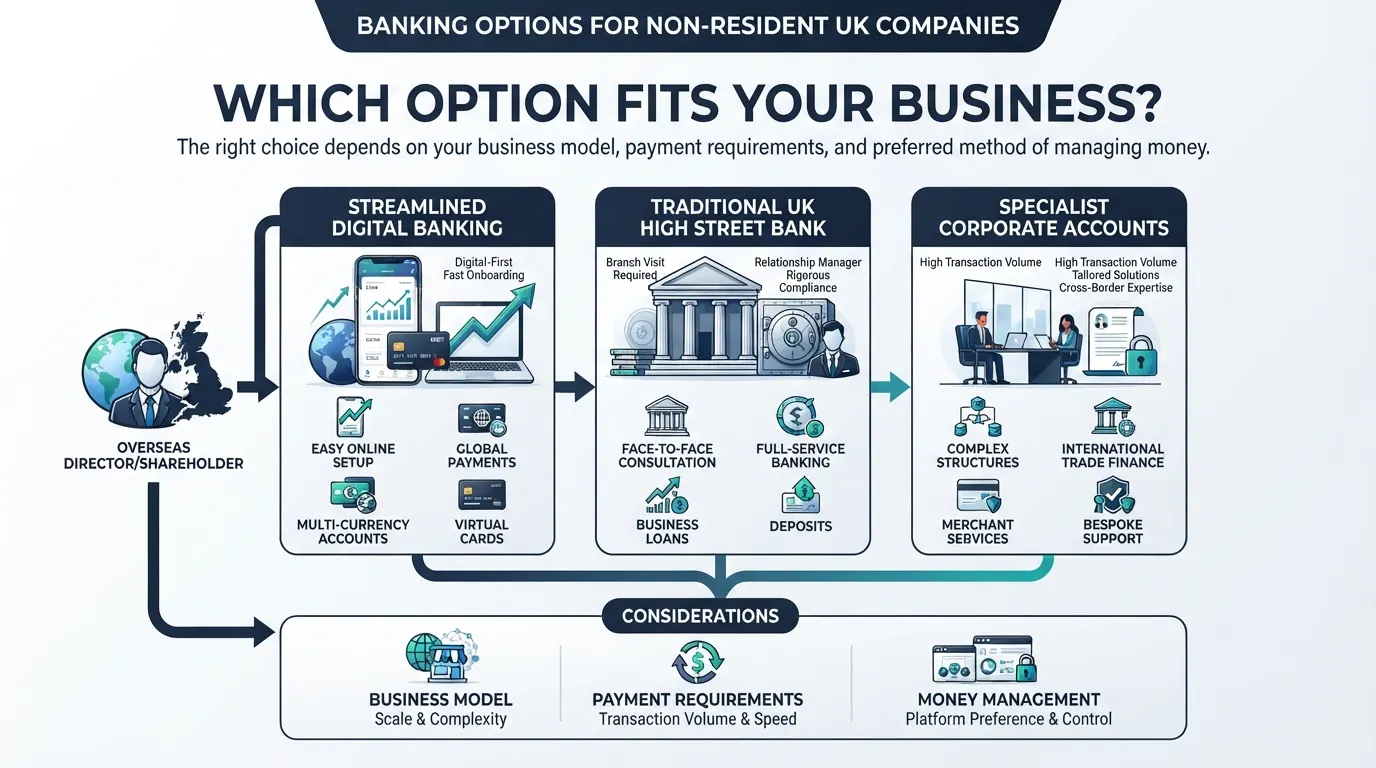
Digital and Fintech Business Accounts
Digital providers can be attractive to overseas founders because they often offer online applications and remote account management. Some provide UK account details, international transfers and multi-currency facilities.
For example, Wise Business offers business payment services and multi-currency functionality, subject to its current eligibility criteria and terms. Applicants should confirm whether their country of residence, company structure and intended activities are supported.
Digital providers do not all operate as fully licensed banks. Check how customer funds are protected and whether the provider offers FSCS deposit protection or safeguards funds under the applicable e-money rules.
Traditional UK High-Street Banks
Established banks may offer a broader range of banking services, lending options and business support. However, some have stricter requirements for directors living overseas, including UK residential address requirements or in-person verification.
Contact the bank or review its current eligibility guidance before applying. A UK registered office address alone does not guarantee acceptance.
Multi-Currency and International Business Accounts
Companies receiving payments from international customers may benefit from accounts that support multiple currencies and cross-border transactions.
Compare exchange rates, transfer charges, supported currencies, local receiving details and settlement times. A multi-currency account may complement a separate business current account rather than replace it.
For more detail, read our guide to UK business accounts for international payments.
What Documents Do Non-Residents Need to Open a UK Business Bank Account?
Requirements differ between providers, but most applications involve a combination of personal identification, address verification and company documentation.
Proof of Identity
A valid passport is commonly requested for overseas directors and beneficial owners. Other identity documents may be accepted depending on the provider and country of residence.
Make sure the document is current, legible and consistent with the details supplied in the application.
Proof of Address
Providers may request a recent utility bill, bank statement or another accepted document confirming residential address. Some accept international proof of address, while others restrict the documents or countries they support.
Do not assume that a UK registered office address can substitute for the director’s personal proof of address. These serve different purposes.
Company Incorporation Documents
The Certificate of Incorporation and company registration number establish that the UK company is registered. Providers may also request details of the company’s directors, shareholders, beneficial owners and registered office.
Business Activity and Transaction Information
You may need to explain what the business does, who its customers are, where payments will originate and where funds will be sent. Providers can request supporting evidence to understand the company’s activities and assess its risk profile.
Preparing clear and consistent answers makes it easier to respond to verification requests.
How Long Does It Take to Open a Business Bank Account from Abroad?
The time required depends on the provider, the completeness of your application and the complexity of its verification checks.
Some digital providers process straightforward applications relatively quickly. Other applications take longer when additional documents are needed, the ownership structure is complex or the provider requires further checks.
You can help avoid unnecessary delays by:
- Confirming eligibility before applying.
- Preparing all required documents in advance.
- Ensuring that company and personal details match.
- Responding promptly to requests for further information.
- Checking email notifications throughout the application process.
Company incorporation and bank account approval are separate processes. Having an incorporated UK company allows you to begin an eligible application, but it does not guarantee that a provider will approve the account.
Why Might a Non-Resident’s Business Bank Account Application Be Declined?
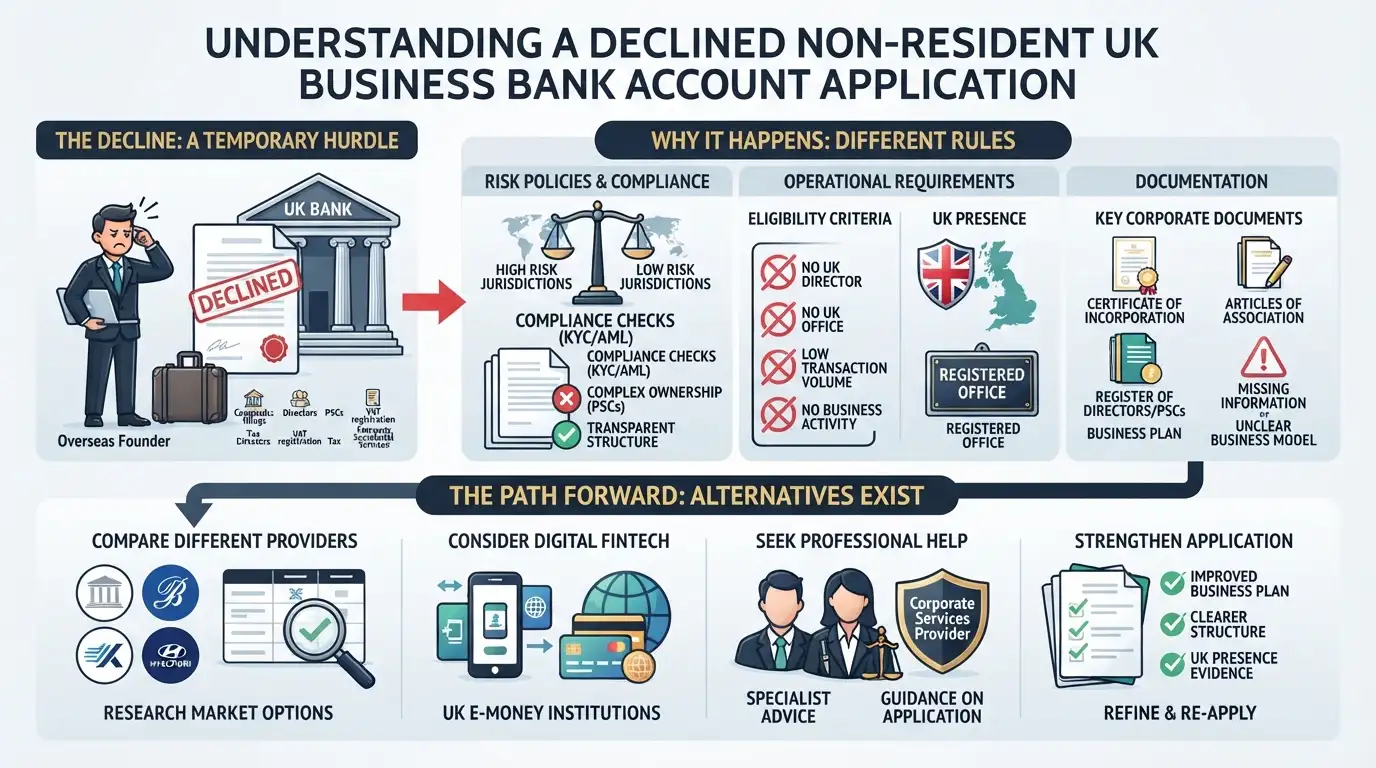
A declined application does not necessarily mean that your business cannot obtain an account elsewhere. Different providers have different eligibility rules and risk policies.
Unsupported Country of Residence
Some providers do not accept applicants based in particular countries. Check the supported-country list before applying.
Incomplete or Inconsistent Documents
Differences between your identity documents, company records and application details can trigger additional checks or rejection. Review the information carefully before submission.
Restricted Business Activities
Providers may restrict particular industries, payment types or business models. Confirm that your activities are permitted before choosing an account.
Unclear Business or Transaction Information
An application may require further explanation if the business model, expected payment volumes or source of funds is unclear. Provide accurate information and supporting evidence when requested.
What to Do If Your Application Is Declined
Read the provider’s decision carefully and ask whether it can explain the reason for declining the application. Correct any documentation issues where possible and check the eligibility criteria of other providers before applying again.
If the problem relates to international payments, e-commerce or accounting requirements, compare providers against those specific needs rather than choosing solely on the basis of application speed.
Choosing an Account for International Business Operations
Opening an account is only the first step. Your choice should also support the way your company operates after approval.
International Payments and Multiple Currencies
If your customers or suppliers are based in different countries, compare supported currencies, exchange rates and international transfer charges.
Our guide to choosing a business bank account that syncs with your new company explains the importance of selecting account features that fit your company’s operational requirements.
E-Commerce Businesses
Online sellers should consider marketplace payouts, payment gateway compatibility, refunds, chargebacks and currency conversion costs. A provider that works for a consultancy may not offer the most suitable facilities for a company selling products internationally.
For a more focused comparison, see our guide to business bank accounts for non-resident e-commerce founders.
Accounting and Financial Management
Accounting integration can simplify reconciliation and improve the accuracy of financial records. Check whether the provider supports your accounting software and whether transactions can be imported or synchronised automatically.
Also review account fees, payment limits, access permissions and reporting features before committing to a provider.
How Form My Company Helps Non-Resident Founders
Form My Company supports international entrepreneurs who want to establish a UK company and explore suitable banking options without travelling to the UK for every stage of the process.
The process begins with company formation and the preparation of incorporation documents. Once the company is registered, eligible founders can be introduced to banking partners that accept non-resident applicants.
The support process helps founders understand the information required for an application and identify banking options aligned with their circumstances. However, each provider conducts its own checks and retains responsibility for the final approval decision.
Entrepreneurs can explore the UK company formation package for non-residents to understand the available formation and banking introduction services.
Frequently Asked Questions
Can I open a UK business bank account online as a non-resident?
Yes, some providers accept online applications from non-resident directors. Eligibility depends on the applicant’s country of residence, company details, business activities and the provider’s verification requirements.
Can you open a UK business bank account from overseas without visiting the UK?
Yes, some digital and fintech providers support remote applications. Traditional banks may have different requirements, so confirm whether an in-person appointment is necessary before applying.
Do I need a UK address to open a business bank account?
A UK company needs an appropriate registered office address. However, the bank may also require the director’s residential address and proof of address. A registered office does not guarantee that the banking application will be accepted.
What documents do non-residents need to open a UK business account?
Common requirements include a passport or accepted identity document, proof of address, Certificate of Incorporation, company registration number and information about the business. Additional documents may be requested depending on the provider.
Can a non-resident open a business bank account without a UK company?
It depends on the type of account and provider. If you specifically need a UK company bank account, incorporation will generally be required. Check the provider’s terms before applying.
What should I do if my application is rejected?
Ask the provider whether it can explain the reason for the decision, address any documentation issues and review other providers’ eligibility requirements. Do not assume that another provider will apply the same criteria.
Can I use a multi-currency account for my UK company?
Yes, where the provider accepts your company and supports your intended currencies and transactions. Review exchange rates, transfer charges, account features and how customer funds are protected before choosing an account.
Start Your UK Company and Banking Application
Opening a UK business bank account as a non-resident begins with the right preparation. Confirm your eligibility, register your company where required, organise your documents and choose a provider that supports your business activities and international payment needs.
Form My Company helps overseas entrepreneurs with UK company formation and introductions to suitable banking partners. Explore the available company formation options and take the next step towards establishing your UK business from abroad.