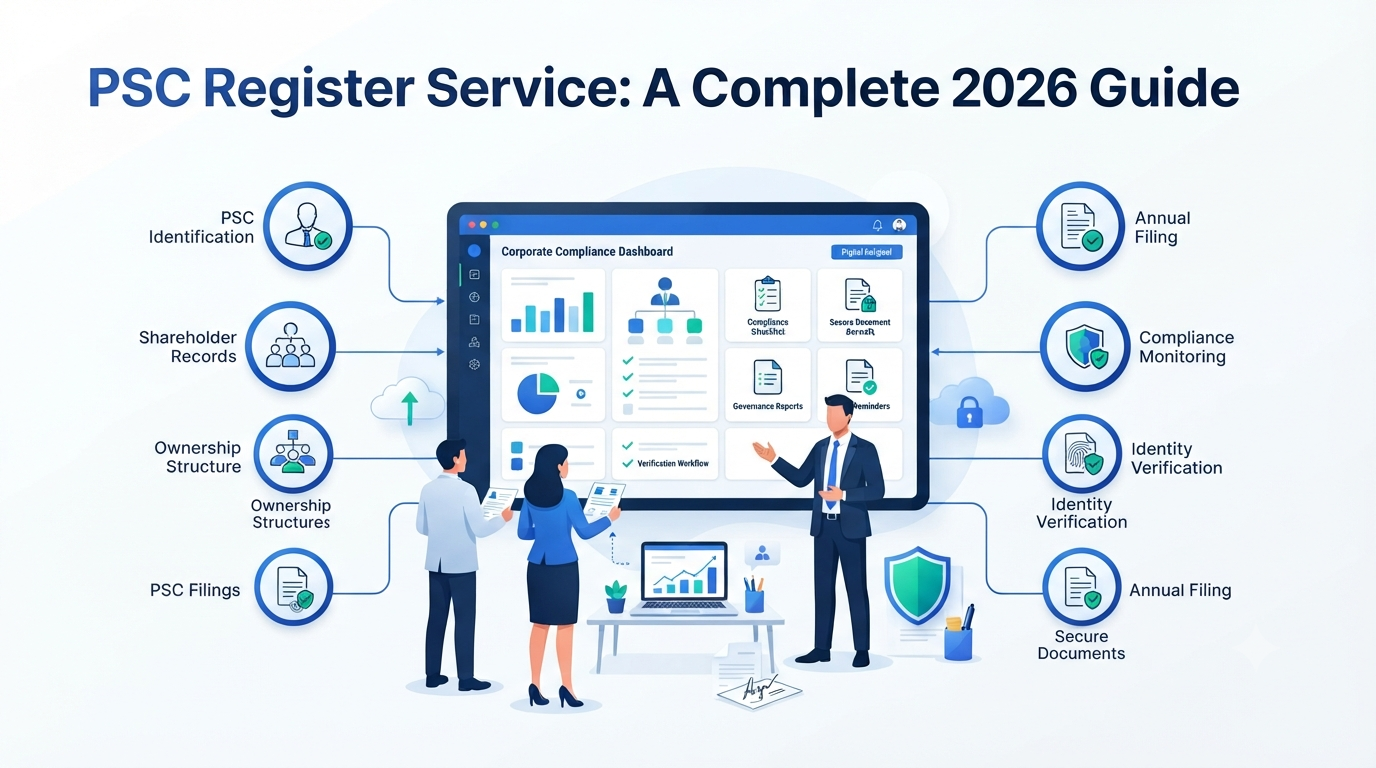
PSC Register Service
The PSC register is one of the most important statutory records every UK company must maintain. It identifies the Persons with Significant Control (PSCs) of the company and forms a public record of beneficial ownership on Companies House. Getting the PSC register right isn’t optional. It’s a legal requirement, and failures can lead to criminal offences, personal fines, and consequences for the company. Under the Economic Crime and Corporate Transparency Act (ECCTA), PSC compliance has become even more important, with mandatory identity verification for all PSCs. At Form My Company, we provide PSC register services as an Authorised Corporate Service Provider (ACSP). This guide explains everything UK company owners need to know about PSC registers and PSC register services.
What Is the PSC Register?
The PSC register is a statutory record that every UK company must maintain, showing who has significant control over the company. Since 2016, companies have been required to identify their PSCs and record them in a specific register. Under Part 21A of the Companies Act 2006, this information is also filed with Companies House and made publicly available on the register.
The PSC register captures:
Persons with Significant Control (PSCs). Individuals who meet one or more of the specific conditions.
Their details. Name, address, date of birth, nationality, country of residence.
Nature of their control. Which of the PSC conditions apply and how.
Any changes. As the ownership or control structure of the company evolves.
Cessation dates. When someone stops being a PSC.
For most UK small companies, the PSC register is straightforward. For companies with more complex ownership, trusts, or corporate structures, it can be genuinely intricate.
What Makes Someone a PSC?
Under UK law, someone is a Person with Significant Control if they meet one or more of these specific conditions:
Condition 1: Ownership of shares. They directly or indirectly hold more than 25% of the shares in the company.
Condition 2: Voting rights. They directly or indirectly hold more than 25% of the voting rights.
Condition 3: Right to appoint or remove directors. They have the right to appoint or remove the majority of the board of directors.
Condition 4: Significant influence or control. They otherwise exercise significant influence or control over the company (or over a trust or firm that meets one of the other conditions).
Meeting any one of these makes someone a PSC. The 25% thresholds are strict, but the fourth condition can catch situations that don’t reach the numeric thresholds. Significant influence or control can include voting agreements, veto rights, or other arrangements that give effective control.
For most single-founder companies, the founder is the sole PSC. For more complex structures (joint ventures, family businesses, trusts, corporate parents), multiple PSCs may exist and each needs to be identified.
Why the PSC Register Matters
The PSC register serves several important functions:
Transparency of ownership. Making beneficial ownership publicly visible helps combat fraud, tax evasion, and money laundering.
Anti-money-laundering compliance. UK AML rules require accurate PSC information for many business transactions.
Company Law compliance. Under the Companies Act 2006, PSC information must be maintained accurately.
Banking and financial services. Banks and other financial services rely on PSC records for due diligence.
Investor confidence. Clear PSC records support investor due diligence and confidence.
Legal accountability. PSCs have specific legal responsibilities as controlling persons.
Regulatory enforcement. Companies House can now enforce PSC compliance actively under enhanced ECCTA powers.
Public interest. Transparency of who controls UK companies serves the public interest.
Failing to maintain accurate PSC records isn’t just an administrative issue. It has real legal and reputational consequences.
PSC Register Compliance Requirements
Every UK company must:
Identify its PSCs. Through diligent inquiry of members, potential PSCs, and the company’s records.
Take reasonable steps to obtain confirmation. From identified PSCs about their status and details.
Enter PSC information on the register. Within the company’s statutory records.
File PSC information with Companies House. Within 14 days of identifying or updating a PSC.
Update the register promptly. When circumstances change (shares transferred, new PSCs appear, PSCs cease).
Reflect PSCs on the annual confirmation statement. Ensuring the register is current.
Ensure PSCs complete identity verification. Under ECCTA rules.
Handle refusals or non-responses. With specific statutory procedures when PSCs don’t cooperate.
Report specific circumstances. When PSC information cannot be obtained or verified.
Getting all of this right requires ongoing attention, particularly as companies grow, restructure, or change ownership.
The ECCTA Impact on PSCs
The Economic Crime and Corporate Transparency Act has significantly affected PSC compliance:
Mandatory identity verification. Since 18 November 2025, all PSCs must complete identity verification with Companies House. This is a separate legal requirement in addition to being on the PSC register.
PSCs who aren’t directors. Have a specific verification deadline of the 14th of their birth month.
Enhanced Companies House powers. To query PSC information, investigate potentially fraudulent structures, and act on non-compliance.
Enforcement escalation. Through 2026, enforcement against non-compliant PSC information is expanding.
Cross-verification. Companies House can now cross-check PSC data against other records.
Failure to Prevent Fraud offence. ACSPs and regulated services have statutory duties around PSC accuracy.
Public register visibility. Enhanced visibility means PSC information is subject to more scrutiny than ever.
The result is that PSC register compliance has moved from a routine administrative task to a substantive compliance obligation.
What a PSC Register Service Covers
A professional PSC register service typically includes:
Initial PSC identification. Analyzing your company’s ownership structure to identify all PSCs correctly.
PSC register setup. Creating or updating your statutory PSC register.
Companies House filings. Filing PSC information with Companies House initially and on updates.
Identity verification coordination. For PSCs, including support with the ECCTA verification process.
Ongoing register maintenance. Updating as circumstances change.
Confirmation statement coordination. Making sure PSC information is current for annual confirmation statements.
Change management. Handling PSC additions, removals, and detail changes.
Complex structure guidance. For companies with trusts, corporate parents, or joint ventures.
Documentation support. Maintaining evidence of PSC identification and inquiry processes.
Correspondence handling. Managing communications with PSCs, especially non-responsive ones.
Statutory notice preparation. For situations requiring formal PSC inquiries.
Companies House correspondence. Responding to PSC-related queries from Companies House.
Coordination with wider compliance. Working with your accountant, solicitor, and other advisers.
For most UK companies, this is more work than expected. Professional support significantly reduces the burden and error risk.
Who Needs a PSC Register Service?
While every UK company must maintain a PSC register, formal services are particularly valuable for:
Companies with multiple owners. Where more than one PSC exists or ownership is complex.
Companies with corporate shareholders. Where PSCs need to be traced through corporate structures.
Companies with trust arrangements. Where beneficial owners may be trust beneficiaries or settlors.
Family businesses. Where family members may hold indirect control.
Companies with non-resident owners. Where identity verification and information collection can be more complex.
Companies undergoing restructures. Where PSC information changes frequently.
Companies with foreign parent entities. Where PSCs must be identified through international corporate chains.
Growing companies. Where increasing complexity requires professional oversight.
Companies preparing for investment. Where clean PSC records support investor due diligence.
Regulated companies. Where PSC compliance is scrutinised more closely.
For truly simple companies (sole director-shareholder with straightforward ownership), the PSC register can be maintained internally. Even then, professional support ensures ECCTA compliance.
The PSC Identification Process
Correctly identifying PSCs requires careful analysis:
Analyse the ownership structure. Direct shareholders and their percentages.
Assess voting arrangements. Whether voting rights differ from shareholding.
Consider control agreements. Shareholder agreements, voting arrangements, veto rights.
Investigate corporate shareholders. For registrable relevant legal entities (RRLEs) and to trace to natural person PSCs.
Analyse trust structures. For trust beneficiaries, settlors, and trustees who may be PSCs.
Consider indirect control. Through voting proxies, shareholder groupings, or other arrangements.
Look at director appointment rights. Who can appoint or remove the majority of directors.
Assess significant influence. Other arrangements that give effective control.
Document the analysis. Maintaining records of how PSCs were identified.
For companies with straightforward ownership, this is often quick. For more complex structures, professional analysis is essential.
Registrable Relevant Legal Entities (RRLEs)
Alongside individual PSCs, companies must consider Registrable Relevant Legal Entities:
Definition. A corporate entity that would be a PSC if it were an individual, and that is subject to its own PSC disclosure requirements.
When RRLEs are recorded. Instead of tracing through to individual PSCs behind the corporate entity.
When to trace through. If the corporate entity isn’t an RRLE, PSCs must be traced through to natural persons.
Documentation. The RRLE analysis must be documented in the PSC register.
This is a common source of confusion. Companies often incorrectly trace through corporate structures when the corporate entity itself should be recorded as an RRLE.
Common Mistakes in PSC Compliance
A few issues come up repeatedly:
Missing PSCs. Where founders or investors are overlooked because ownership isn’t obvious.
Incorrect PSC identification. Recording someone as a PSC who isn’t, or missing someone who is.
Missing significant influence PSCs. Focusing only on the 25% thresholds and missing Condition 4.
Wrong RRLE treatment. Tracing through when RRLEs should be recorded, or vice versa.
Delayed Companies House filings. Missing the 14-day deadline for PSC changes.
Failing to update. As circumstances change.
Missing ECCTA identity verification. Especially the birth-month deadline for existing PSCs.
Poor documentation. Not maintaining records of how PSCs were identified.
Not handling non-responsive PSCs. With appropriate statutory procedures.
Incorrect notice procedures. When formal inquiries are needed.
Missing complex arrangements. In corporate groups, family structures, or trust arrangements.
Not coordinating with confirmation statements. Where PSC accuracy matters.
Professional support significantly reduces these risks.
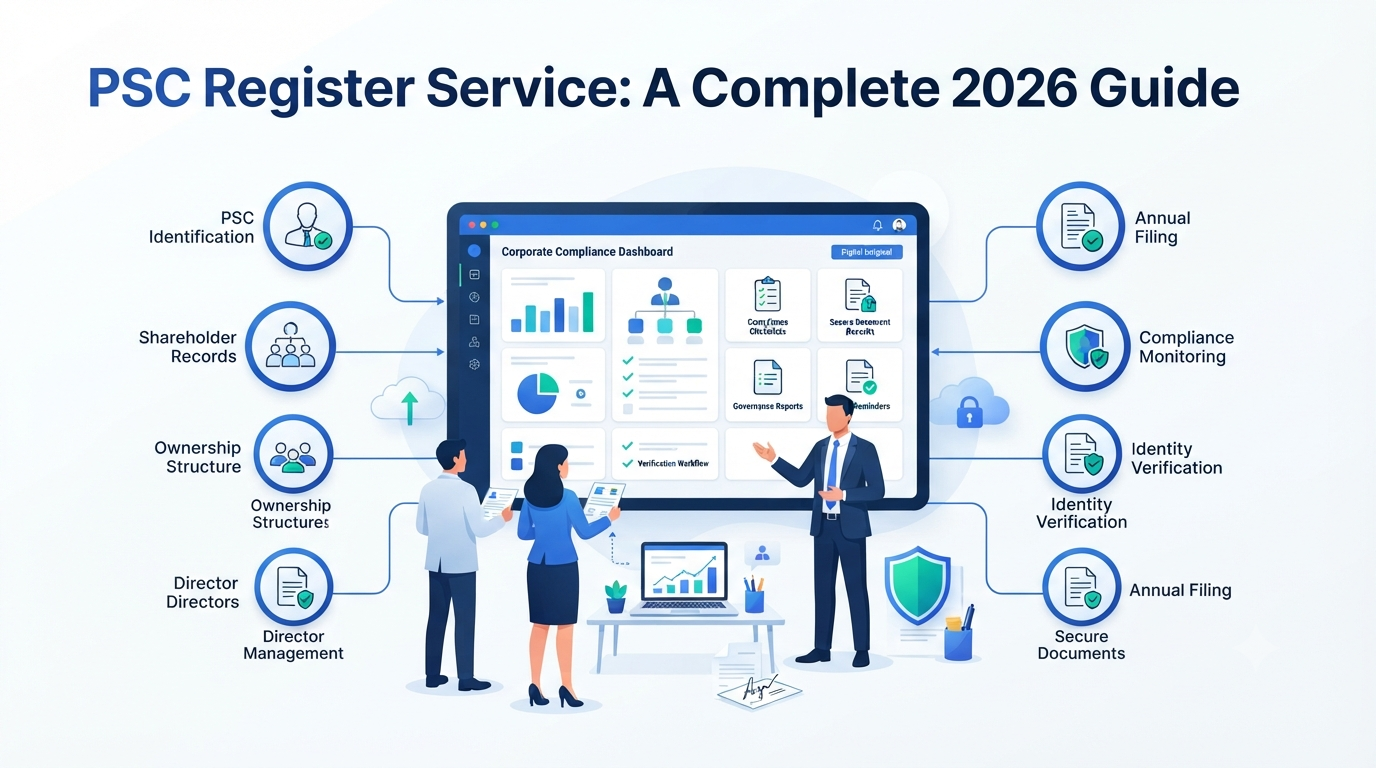
PSC Register Services for Non-Resident Owners
Non-resident owners face specific PSC challenges:
Physical distance from statutory records. UK-based statutory registers need someone to maintain them.
ECCTA identity verification. From abroad, verification through the standard app can be challenging.
Communication with Companies House. Time zones and language add friction.
PSC changes across borders. International changes need coordination.
Corporate parent tracing. International corporate structures require careful analysis.
Trust arrangements. International trusts have their own PSC implications.
Multiple jurisdiction considerations. Where beneficial ownership rules differ across countries.
For non-resident owners, working with an ACSP that provides PSC register services is often essentially standard practice.
PSC Register vs Confirmation Statement
Understanding the distinction:
PSC register. A statutory record maintained internally by the company, showing PSCs and their details. Must be maintained continuously.
PSC information on Companies House. Publicly filed, updated separately from the register.
Confirmation statement. Annual filing confirming your company’s overall details, including PSC information.
Relationship. The PSC register informs Companies House filings. The confirmation statement includes PSC information but doesn’t replace ongoing PSC register maintenance.
Both need to be maintained together, but they’re separate obligations.
Consequences of PSC Non-Compliance
Failing to maintain accurate PSC records has serious consequences:
Criminal offences. Both for the company and its directors.
Personal penalties. Fines up to £30,000 for individuals.
Company penalties. Fines and potential restrictions.
Director disqualification. For serious or repeated non-compliance.
Companies House enforcement. Enhanced ECCTA powers include striking off companies with false or missing PSC information.
Banking issues. Banks may refuse services or freeze accounts for companies without proper PSC records.
Reputational damage. Public visibility of PSC non-compliance affects business relationships.
Investigation risk. Non-compliance can trigger scrutiny across other compliance areas.
Professional PSC register services significantly reduce these risks by ensuring accurate, timely compliance.
How Form My Company Provides PSC Register Services
We provide comprehensive PSC register services as an Authorised Corporate Service Provider (ACSP). Our services include:
PSC identification and analysis. Analyzing your ownership structure to identify all PSCs correctly.
PSC register setup. Creating or updating your statutory PSC register.
Companies House filings. Both initially and on changes.
Identity verification support. For PSCs under the ECCTA, coordinated remotely for non-resident PSCs.
Ongoing register maintenance. As your company evolves.
Confirmation statement coordination. Ensuring PSC information is current.
Change management. For PSC additions, removals, and detail changes.
Complex structure guidance. For companies with trusts, corporate parents, or joint ventures.
Coordination with wider compliance. With your accountant and other advisers.
Non-resident support. For overseas owners maintaining PSC compliance.
Bundled services. In our compliance packages.
Whether you’re setting up your PSC register for the first time, managing changes, or working through complex ownership structures, we provide professional support.
Get Your PSC Register Compliant Today
The PSC register is a critical statutory obligation for every UK company, and getting it right protects your company, your directors, and your legal position. With Form My Company, PSC register services are straightforward and fully supported as part of our compliance offering. Get in touch today and let us handle your PSC register while you focus on your business.
Frequently Asked Questions
What is the PSC register?
The PSC register is a statutory record every UK company must maintain, showing who has significant control over the company. Since 2016, this information has also been filed with Companies House and made publicly available on the register.
Who is a Person with Significant Control (PSC)?
Someone who holds more than 25% of shares or voting rights, has the right to appoint or remove a majority of the board, or otherwise exercises significant influence or control. There are four specific conditions, and meeting any one makes someone a PSC.
How often does the PSC register need updating?
Continuously as circumstances change. Any changes must be filed with Companies House within 14 days. Additionally, PSC information must be confirmed accurate on the annual confirmation statement.
Do PSCs need to complete identity verification?
Yes. Under the ECCTA, all PSCs must complete identity verification with Companies House. Existing PSCs who aren’t directors have a specific deadline of the 14th of their birth month.
What if I don’t know who my PSCs are?
The Companies Act 2006 requires “reasonable steps” to identify PSCs. This can involve inquiries of members, review of shareholder registers, and analysis of any ownership arrangements. Professional support helps navigate complex situations.
What are RRLEs?
Registrable Relevant Legal Entities. Corporate entities that would be PSCs if they were individuals, and that are subject to their own PSC disclosure requirements. Sometimes RRLEs are recorded instead of tracing through to individual PSCs.
What happens if my PSC register isn’t accurate?
Non-compliance can lead to criminal offences, personal fines up to £30,000, company fines, director disqualification, banking issues, and reputational damage. Enhanced ECCTA powers make Companies House enforcement more likely.
Can Form My Company handle my PSC register?
Yes. As an ACSP, we provide comprehensive PSC register services including identification, register setup, Companies House filings, identity verification support, ongoing maintenance, and coordination with confirmation statements. We support both UK-based and non-resident owners.