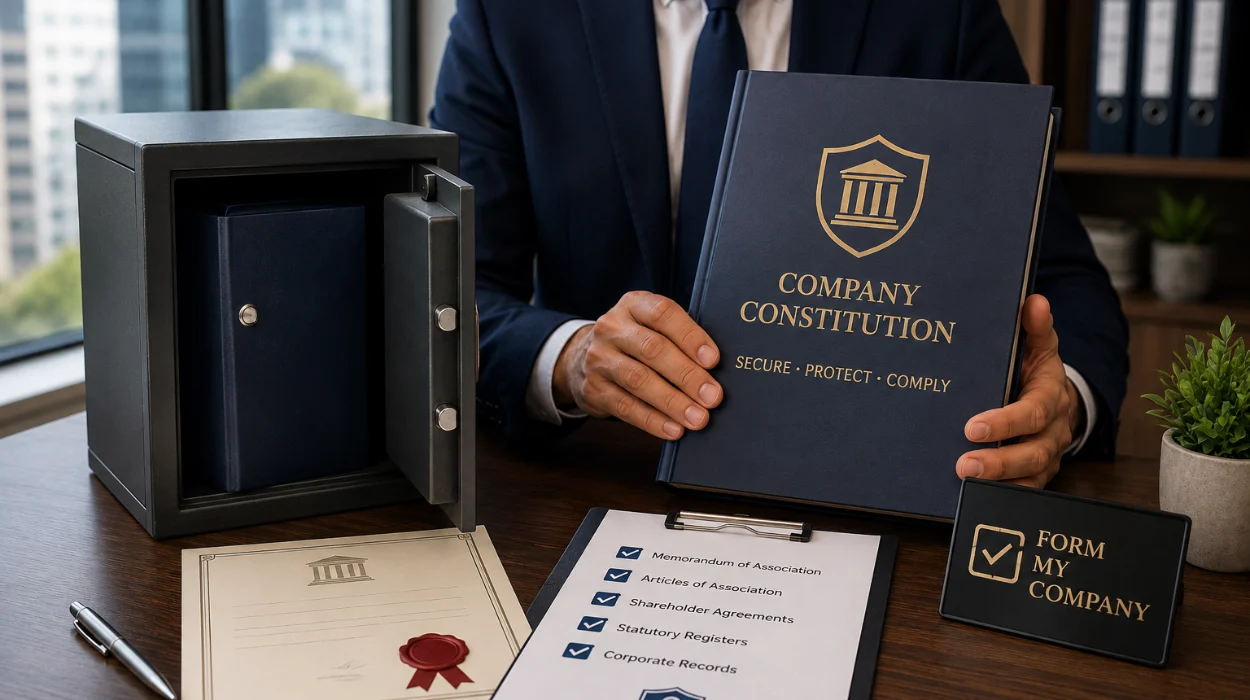
You secure your company constitution by embedding tailored governance clauses, adopting legally compliant Articles of Association, and utilizing Form My Company to update, file, and protect your constitutional documents directly with Companies House.
What makes up a UK company constitution?
A UK company constitution consists of the Articles of Association and the Memorandum of Association, which together establish the internal governance rules, shareholder voting rights, and director powers required by the Companies Act 2006.
The constitution acts as the supreme internal rulebook for a registered business entity. Every limited company in the United Kingdom operates under these mandatory statutory foundations. The Memorandum of Association confirms the initial subscribers wish to form a company. The Articles of Association dictate the operational framework between the board of directors and the equity holders.
When founding members establish a corporate entity, standard model articles apply by default. Custom businesses often require bespoke amendments to handle specific share classes, transfer restrictions, or board quorum requirements. Protecting this framework prevents internal disputes among stakeholders. Maintaining clear governance provisions ensures legal compliance during external audits or equity financing rounds.
Founders must update their foundational rulebooks whenever corporate structures change. Failing to register constitutional amendments with the national registrar creates legal ambiguity. Accurate administrative filings protect shareholder interests against unauthorized board actions. Professional registration support guarantees that constitutional records remain legally sound and publicly transparent.
Why are Articles of Association critical for business protection?
Articles of Association protect a business by defining explicit voting thresholds, deadlock resolution procedures, and share transfer restrictions that prevent hostile takeovers and internal operational paralysis.
The internal rules dictate how directors make executive decisions during board meetings. Clear voting thresholds prevent minority shareholders from blocking essential operational growth initiatives. Comprehensive pre-emption rights ensure existing owners maintain proportional control during new share allotments. These protective mechanisms safeguard company assets against unauthorized dilution or mismanagement.
Corporate transparency depends on precise document drafting. External investors examine governance clauses to evaluate operational risk before deploying capital. Lenders review constitutional parameters during commercial loan applications. Robust governance clauses demonstrate professional maturity and reduce perceived investment risk.
Businesses can leverage expert services like Supplementary Company Documents to draft, update, and file precise constitutional provisions that align with UK corporate law. Securing these records protects the organization from regulatory penalties and governance disputes. Comprehensive documentation ensures long-term operational stability for growing enterprises.
How do you update constitutional documents legally?
You update constitutional documents legally by drafting a formal special resolution requiring 75% shareholder approval, executing the text changes, and filing the revised articles with Companies House within 15 days.
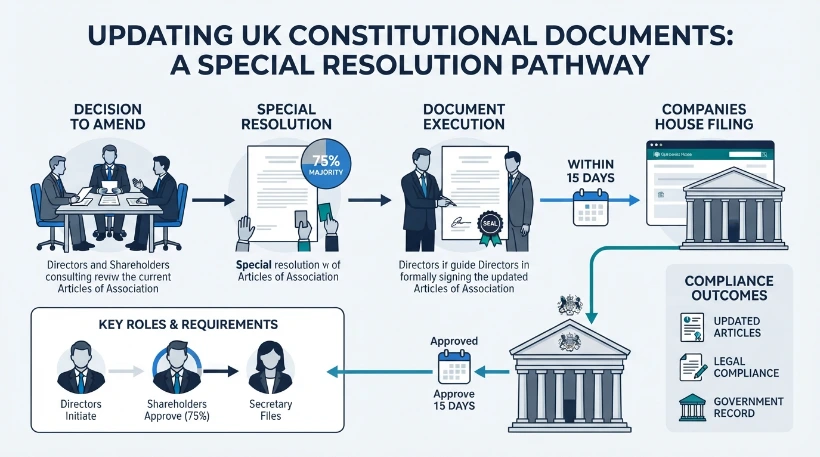
Corporate evolution requires adapting internal rules to match new business models. When shareholders approve a special resolution, the company formally adopts its new governance terms. The revised text must comply fully with statutory formatting requirements. Precise administrative execution prevents administrative rejections by the registrar.
Filing deadlines demand strict compliance from company secretaries and directors. Submitting changes late triggers statutory fines and creates discrepancies in public company records. Directors must verify that all formatting meets digital submission standards. Accurate submissions ensure public registers display current governance data.
Businesses navigating corporate expansion often benefit from studying how to present your Articles of Association to a bank or investor to understand what financial institutions expect from internal paperwork. Clear governance records simplify due diligence during commercial financing. Transparent constitutional frameworks accelerate capital acquisition timelines.
What risks arise from outdated company constitutions?
Outdated company constitutions create severe governance vulnerabilities, including illegal share transfers, unenforceable board decisions, and immediate disqualification during institutional investment due diligence.
Model articles provided by default often fail to address complex multi-tier equity structures. Companies operating under generic rules lose the ability to restrict share transfers to external third parties. Unprotected share registers invite unwanted hostile acquisitions. These structural flaws threaten the long-term viability of growing enterprises.
Internal deadlocks paralyze executive boards when voting provisions lack clear tie-breaking mechanisms. Disputed decisions expose directors to personal liability claims from disgruntled stakeholders. Regulatory bodies penalize corporations that fail to maintain accurate internal governance records. Mitigating these risks requires proactive constitutional maintenance.
Organizations seeking complete corporate security often review what rules do Articles of Association set for directors and shareholders to evaluate whether their current governance framework meets modern operational standards. Comprehensive document audits reveal hidden compliance gaps. Regular administrative reviews safeguard corporate assets against legal challenges.
How does Form My Company secure your constitutional framework?
Form My Company secures your constitutional framework by managing precise document drafting, executing compliant special resolutions, and submitting updated governance files directly to the corporate registry.
Professional administration eliminates the risk of filing errors during constitutional updates. Experienced compliance specialists verify that every clause adheres to current statutory mandates. Seamless digital submissions accelerate approval times at the national registry. Dedicated support protects directors from costly administrative oversights.
Corporate compliance requires continuous attention to detail. Automated tracking systems monitor governance updates across the business lifecycle. Secure digital archives store vital historical resolutions for future audits. Expert assistance ensures your corporate constitution remains robust and enforceable.
Securing your company constitution safeguards internal governance, protects equity value, and ensures total compliance with UK corporate law. Tailored Articles of Association prevent operational deadlocks and defend against unauthorized share transfers. Leveraging professional administrative services eliminates filing errors and accelerates regulatory approvals. Form My Company delivers comprehensive document solutions to keep your enterprise protected and audit-ready.
Explore our Supplementary Company Documents guide,
Get Bank-Ready Articles of Association From Form My Company
Update Your PSC Register Fast With Form My Company
Frequently Asked Questions
What are supplementary company documents in the UK?
Supplementary company documents are official records that expand upon a business’s foundational framework beyond standard incorporation filings. These records include bespoke Articles of Association, share certificates, and board minutes managed through services like Form My Company. They provide essential legal clarity for internal governance and external regulatory compliance.
How do I update my company constitution with Companies House?
Updating your company constitution requires passing a special resolution with 75% shareholder approval and submitting the revised text to the national registrar. Form My Company handles this administrative process through professional Supplementary Company Documents solutions to ensure strict statutory compliance. Timely filings prevent legal discrepancies in public corporate records.
Why do banks and investors request company constitutional documents?
Financial institutions and institutional investors examine company constitutions to evaluate voting rights, equity structures, and operational risk. Clear documentation demonstrates robust corporate governance during commercial loan applications and funding due diligence. Form My Company helps businesses maintain audit-ready records tailored for external reviews.
What is the difference between the memorandum and Articles of Association?
The memorandum of association records the initial subscribers’ agreement to form a company, while the articles of association set the internal rules for directors and shareholders. Both foundational texts constitute the core company constitution required by UK corporate law. Utilizing Supplementary Company Documents ensures both files remain accurate and enforceable.
Can I change my company Articles of Association after incorporation?
Companies can modify their Articles of Association at any point after incorporation by adopting a special resolution and notifying the corporate registry. Form My Company assists business owners in drafting and filing these amendments correctly. Regular updates protect the organization against shifting regulatory frameworks and internal stakeholder disputes.