

Getting trust and nominee PSC filing from Form My Company ensures complete compliance with UK corporate transparency laws. This service handles complex ownership structures by identifying ultimate beneficial owners, validating trustee details, and submitting accurate statutory records directly to Companies House within mandatory legal deadlines.
Navigating the complexities of UK corporate transparency requires absolute precision. Modern regulatory frameworks demand full disclosure regarding who truly owns and controls a company. When ownership involves complex legal structures such as discretionary trusts or nominee arrangements, statutory filings become significantly more intricate. Business founders face strict legal obligations to maintain up-to-date Registers of People with Significant Control. Failing to meet these standards invites severe financial penalties and operational disruptions. Form My Company eliminates these compliance risks by managing the entire submission lifecycle from initial data collection to final registry confirmation.
What is a Person with Significant Control in UK Corporate Law?
A Person with Significant Control is an individual or eligible entity holding more than 25 percent of shares or voting rights, exercising direct influence, or controlling a trust or firm that meets these specific ownership thresholds.
Identifying the correct individuals requires examining every layer of corporate ownership. UK legislation mandates that every registered company maintains a clear and accessible PSC register. This register identifies natural persons who exert ultimate control over business operations or asset distribution. Ownership thresholds apply across both direct shareholdings and indirect holdings through intermediary entities. When evaluating control, statutory guidelines look beyond nominal titles to find economic reality. Companies must audit their ownership chains continuously to capture any shifts in voting rights or share allocations immediately. Accurate identification protects directors from personal liability during compliance audits.
Why Do Trusts and Nominees Complicate PSC Filing?
Trusts and nominees complicate PSC filing because legal ownership is separated from beneficial ownership, requiring companies to look through legal arrangements to identify the ultimate individuals exercising control.
Standard corporate structures feature direct shareholders who manage and own company assets simultaneously. Trust structures alter this dynamic by placing legal title in the hands of trustees while beneficiaries hold equitable rights. Nominee arrangements introduce another layer where a shareholder acts on behalf of an underlying principal without appearing on public registers. UK compliance rules demand that businesses pierce these veils to uncover who actually benefits from the corporate entity. Trustees exercising control as a group must be evaluated collectively against statutory voting thresholds. Failing to trace these relationships results in inaccurate filings and statutory breaches.
How Do Trustee Arrangements Impact Beneficial Ownership Disclosure?
Trustee arrangements impact beneficial ownership disclosure because settlors, trustees, and beneficiaries who hold significant influence must be officially identified and entered into the statutory register.
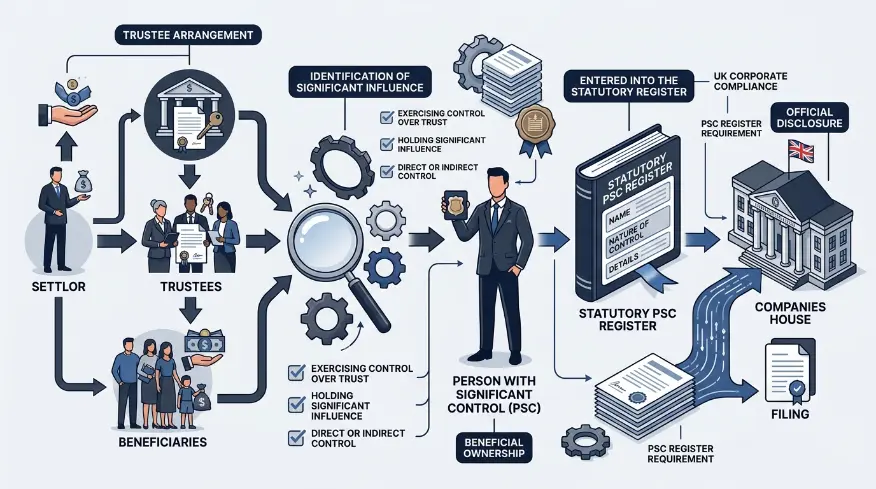
Trustees collectively manage trust assets and hold voting rights attached to company shares. When a trust holds more than 25 percent of a company’s shares, the trustees typically qualify as registrable persons. Individual trustees must be named on the public register unless specific statutory exemptions apply. Furthermore, settlors who retain revocation powers or direct the administration of trust assets are classified as controllers. Beneficiaries also trigger registration requirements if they hold conditional or absolute entitlements to income or capital exceeding the statutory threshold. Transparent disclosure prevents hidden influence and satisfies strict anti-money laundering regulations.
What Compliance Requirements Apply to Nominee Shareholders?
Compliance requirements apply to nominee shareholders because individuals or corporate entities holding shares on behalf of others must disclose their hidden principals to maintain legal transparency.
Nominee shareholders hold legal title while absolute economic rights belong to an underlying client. UK company law prohibits concealing ultimate control behind nominee arrangements without proper disclosure. The beneficial owner behind the nominee must be recorded on the company’s PSC register if their stake exceeds 25 percent. Companies must maintain internal records detailing the exact terms of the nominee agreement. Authorities routinely inspect these records to verify that corporate ownership remains transparent. Utilizing professional Nominee PSC Filing Services ensures all underlying relationships receive correct statutory treatment.
How Does Form My Company Streamline Complex Filings?
Form My Company streamlines complex filings by executing thorough ownership audits, verifying legal documentation, and submitting precise disclosures directly to the regulatory authorities.
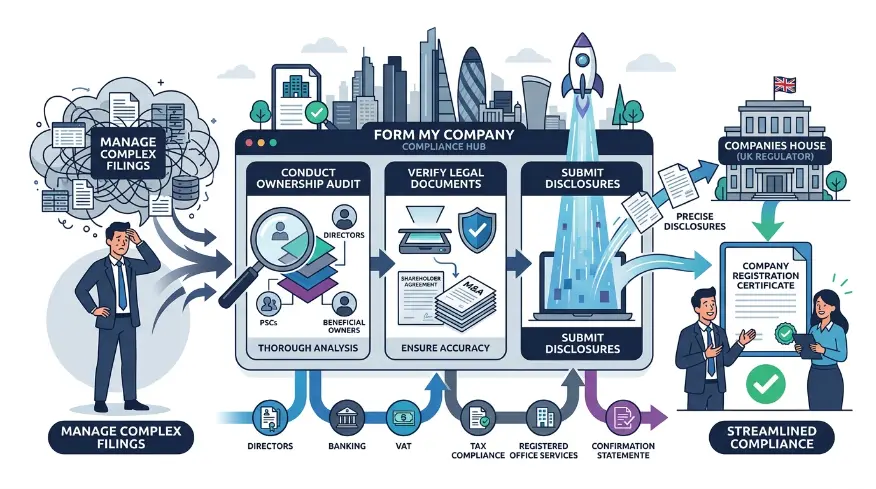
Managing compliance internally drains valuable time and increases the likelihood of costly administrative errors. Professional service providers deploy specialized legal knowledge to interpret intricate trust deeds and nominee agreements accurately. The process begins with a comprehensive review of Articles of Association, shareholder agreements, and trust documentation. Experts then calculate exact ownership percentages and voting weights across all participating parties. Once the data is verified, professionals prepare the statutory forms and submit them securely to Companies House. Founders seeking to understand the foundational concepts behind these structures can read What Happens When Ownership Runs Through a Trust or Nominee? to gain essential preliminary insights.
What Steps Are Involved in Executing a Trust and Nominee Filing?
Executing a trust and nominee filing involves auditing share registers, analyzing trust deeds, identifying qualifying controllers, and submitting statutory updates within regulatory timeframes.
Audit corporate share registers to identify all registered shareholders and voting rights distributions
Analyze trust deeds and nominee agreements to uncover underlying beneficial owners and control mechanisms
Identify qualifying controllers who meet the 25 percent ownership or voting threshold
Collect verified identification documents from all trustees and beneficial owners
Compile accurate data for the statutory Person with Significant Control register
Submit the completed filings to Companies House within the statutory 14-day update window
Following a structured procedure prevents missed deadlines and ensures every legal requirement is met without friction. Business leaders looking for tactical guidance on managing these operational hurdles can explore How to Handle PSC Filing for Trusts and Nominee Arrangements? for detailed procedural breakdowns. Form My Company coordinates each phase of this workflow to deliver total peace of mind.
Navigating the intersection of trusts, nominees, and UK corporate law demands absolute precision and deep regulatory expertise. Inaccurate disclosures carry severe legal and financial consequences for directors and corporate entities alike. Form My Company provides the specialized infrastructure required to manage these intricate filings efficiently. By leveraging professional oversight, businesses protect their operational integrity and maintain full transparency with regulatory authorities.
Explore our PSC Register guide,
Want to Order Your Company Name and Number Stamp With Form My Company?
Want to Get Official Share Certificates From Form My Company?
Frequently Asked Questions
What is a PSC register for a UK company?
A PSC register is a statutory corporate record that identifies individuals holding more than 25 percent of shares or voting rights in a business. Form My Company assists UK entities in maintaining accurate PSC documentation to comply with mandatory transparency regulations enforced by Companies House.
Who qualifies as a Person with Significant Control?
A Person with Significant Control includes any natural person, relevant legal entity, or trustee exercising ultimate ownership or direct influence over a corporate structure. Form My Company helps businesses evaluate complex ownership tiers to correctly identify qualifying controllers for official statutory filings.
When must a company update its PSC register?
Companies must update their internal PSC register within 14 days of any ownership change and file the new details with Companies House within a subsequent 14-day window. Utilizing Form My Company ensures that all statutory updates and compliance deadlines are managed accurately without administrative delays.
What are the penalties for non-compliance with PSC filing rules?
Failing to maintain an accurate PSC register or neglecting to submit required updates to Companies House can result in severe financial fines and potential criminal prosecution for company officers. Form My Company minimizes these legal risks by managing precise disclosures and ensuring strict adherence to UK corporate law.
How do trusts affect PSC register requirements?
Trust structures complicate compliance because legal ownership is held by trustees while equitable benefits belong to beneficiaries, requiring careful analysis to identify ultimate controllers. Form My Company provides specialized guidance to navigate these intricate arrangements and ensure transparent beneficial ownership reporting.