
A UK company director manages daily business operations and holds statutory executive duties, whereas a Person with Significant Control (PSC) holds ultimate ownership or influence by owning over 25% of shares, holding over 25% of voting rights, or exercising significant control.
What Is a Director in a UK Company?
A UK company director is an officially appointed officer responsible for managing daily operational decisions, strategic direction, and statutory compliance duties under the Companies Act 2006. Directors act as legal representatives of the business entity regardless of shareholding status.
Companies House requires every UK private limited company to appoint at least one natural person as a director. Directors execute corporate strategy, enter into commercial contracts, maintain accounting records, and ensure timely filing of annual financial statements. A director does not automatically hold equity in the business. Many companies employ professional executive directors who receive a salary without holding company stock.
The Companies Act 2006 codifies seven statutory duties that every appointed director must fulfill at all times. These duties require directors to act within their legal powers, promote the success of the company, exercise independent judgment, and avoid conflicts of interest. Directors face personal liability, financial penalties, or disqualification if they breach statutory duties or allow a business to trade while insolvent.
Corporate structures allow for distinct categories of directorship depending on administrative needs. Executive directors run day-to-day operations, while non-executive directors offer independent oversight without managing daily workflows. Shadow directors and de facto directors exercise executive influence without formal appointment, bringing equal legal liability under UK corporate law frameworks.
What Is a Person with Significant Control (PSC)?
A Person with Significant Control (PSC) is an individual or registrable legal entity holding ultimate ownership or significant influence over a UK company, typically defined by controlling more than 25% of equity, voting rights, or board appointments.
UK transparency regulations established the PSC register framework in April 2016 to prevent financial crime, money laundering, and opaque corporate ownership. Identifying a PSC requires evaluating beneficial ownership structures rather than public management titles. A PSC may be an individual, an eligible relevant legal entity (RLE), or a public authority meeting statutory criteria.
The Companies Act 2006 specifies five distinct statutory conditions for identifying a PSC within a business structure:
Owns more than 25% of company shares directly or indirectly
Holds more than 25% of voting rights within the business
Retains the legal right to appoint or remove a majority of board directors
Exercises significant influence or control over company operations directly
Controls the activities of a trust or firm that meets any of the first four conditions
UK corporate entities must identify every individual or entity meeting these conditions and record specific personal data on an internal register. Companies must confirm PSC details before submitting verified information to the official public register at Companies House. Failure to maintain an accurate PSC record constitutes a criminal offense by both the company and its officers.
How Do PSC and Director Roles Compare in Legal Responsibility?
Directors hold operational management authority and direct fiduciary obligations to the corporate entity, while PSCs hold ultimate economic power or structural influence without bearing day-to-day managerial duties or statutory director obligations.

The primary distinction between a director and a PSC centers on management versus control. Directors execute operational strategy, manage staff, manage corporate bank accounts, and oversee legal compliance. PSCs exert foundational control over corporate ownership structures, equity distribution, and major shareholder decisions without entering into daily business operations.
Legal liability differs significantly between these two corporate positions under UK law. Directors face explicit civil and criminal penalties for corporate negligence, fraudulent trading, or statutory filing defaults. A PSC who holds no directorship role does not owe fiduciary duties to the company and cannot face prosecution for operational mismanagement or trading failures.
| Feature / Responsibility | UK Company Director | Person with Significant Control (PSC) |
| Core Function | Executive management and operational governance | Beneficial ownership and structural control |
| Primary Statutory Source | Companies Act 2006 (Part 10) | Small Business, Enterprise and Employment Act 2015 |
| Threshold Requirement | Formal appointment by shareholders/board | >25% shares, >25% voting rights, or control |
| Fiduciary Duties | Owes 7 codified statutory duties to the company | Owes no statutory fiduciary duties to the company |
| Filing Requirement | Form AP01 / Directors Register | PSC Register / Companies House PSC filings |
| Personal Liability Risk | High (insolvency, misfeasance, compliance failure) | Low (restricted to share capital limits/ownership) |
Overlapping responsibilities occur frequently in smaller business structures and startup entities. Founder-owners often hold dual status as both sole director and majority PSC. In these instances, the individual must maintain compliance across both regulatory tracks, fulfilling executive duties under director rules while reporting equity control through the beneficial ownership framework.
Can an Individual Be Both a Director and a PSC?
An individual can hold dual status as both a company director and a Person with Significant Control if they manage daily operations while simultaneously meeting the statutory 25% ownership or control thresholds.
Dual status represents the standard operational model for UK small and medium enterprises (SMEs). When an entrepreneur incorporates a private limited business as a sole owner, that founder acts as sole director while holding 100% of issued shares. The individual exercises operational direction as director and retains ultimate beneficial control as a 100% PSC.
Maintaining dual status requires keeping separate administrative records within corporate registers. Companies House requires distinct statutory filings for director appointments and PSC notifications. When an individual updates their residential address or personal details, the company secretary must file separate notification forms to keep both public records accurate.
Changes in equity distribution alter PSC status without automatically changing directorship status. If a founder sells 80% of company shares to investors while remaining managing director, their PSC status changes from over 75% control to under 25% control. If their shareholding falls to 20% without board appointment rights, the founder ceases to be a PSC while remaining an active director.
To maintain full compliance across both roles, businesses should review statutory registers regularly. You can easily navigate complex ownership thresholds by using the guide on How to Confirm Who Counts as a PSC in Your Business to audit individual voting rights and equity structures.
What Are the Public Filing Requirements for Directors and PSCs?
Companies House requires public registration for both roles, requiring Form AP01 filings for director appointments within 14 days and PSC register updates within 14 days of confirming beneficial ownership details.
Public transparency standards mandate accurate tracking of key personnel and beneficial owners. When a business appoints a director, it must submit full name, service address, country of residence, nationality, business occupation, and date of birth details. Companies House displays director service addresses publicly while keeping residential addresses in secure private databases.
PSC reporting protocols demand specific factual verification before filing data on the public record. A company must notify Companies House when an individual meets PSC criteria, when PSC details change, or when an individual ceases to hold significant control. Mandatory PSC disclosure items include full name, service address, residential address, nationality, date of birth, and exact control tier.
Failing to maintain statutory registers triggers strict legal penalties under UK corporate law. Directors who neglect statutory reporting commit a criminal offense punishable by individual financial fines and daily default penalties. Unresolved reporting failures can result in involuntary corporate strike-off, exposing directors to personal liability and commercial disqualification proceedings.
Managing corporate registers demands consistent record-keeping and formal administrative compliance. Businesses streamline compliance by utilizing a dedicated PSC Register service to track statutory changes and prevent filing errors at Companies House.
How Does a Company Identify and Record a PSC?
A company identifies a PSC by reviewing its share register, articles of association, and voting agreements to verify which individuals or legal entities hold over 25% equity, voting control, or board influence.
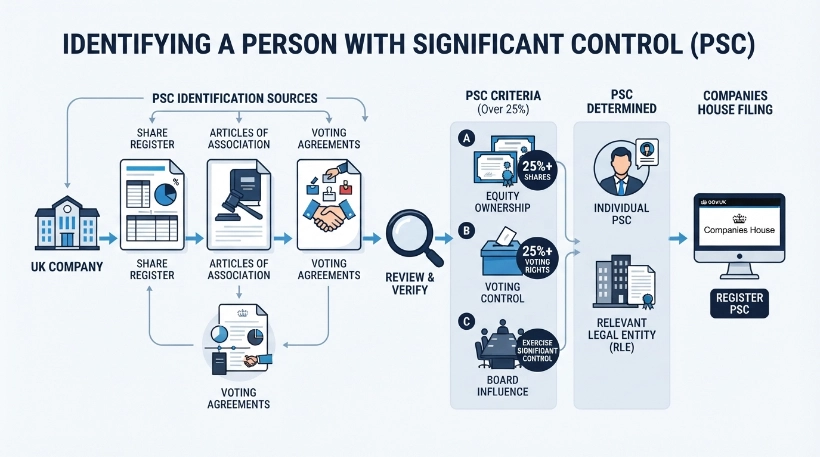
The identification process begins with an audit of the internal register of members. Company officers calculate total issued share capital and evaluate voting rights attached to each share class. When equity structures involve holding companies, trusts, or joint ownership agreements, officers must look through intermediary layers to identify the ultimate individual beneficial owner.
Companies possess statutory powers to compel individuals to disclose beneficial ownership information. Under Section 790D of the Companies Act 2006, a company must issue formal legal notices to anyone it knows or reasonably suspects to be a PSC. Recipients must respond within one month to confirm or correct their personal details and control conditions.
If an individual fails to respond to statutory notices, the company can issue a restrictions notice on their shares. A restrictions notice freezes share transfers, cancels dividend payments, and suspends voting rights associated with those shares until the individual complies. Once verified, the company enters the information into its internal PSC register within 14 days.
Complex corporate structures with foreign parent entities or non-standard voting rights require specialized technical review. Companies seeking fast compliance validation can Get Professional PSC Assessment From Form My Company to audit equity structures and confirm reporting obligations accurately.
How Do Ownership Changes Impact Directors and PSC Records?
Ownership changes alter PSC records whenever equity sales, share transfers, or share issuances shift an individual’s ownership or voting rights across statutory thresholds, whereas directorship records remain unchanged unless board appointments change.
Equity transfers change beneficial ownership structures without automatically altering board membership. When an investor purchases 30% of existing shares from a founding director, the company must register the investor as a new PSC within 14 days. The founder’s PSC status must be updated or removed, but their status as director continues until a formal resignation or board removal occurs.
Issuing new shares dilutes existing ownership percentages and affects PSC status tiers. If a company issues new equity to raise capital, an existing shareholder owning 26% of shares may drop to 20% ownership post-issuance. This dilution removes the shareholder’s PSC status, requiring the company to update its internal register and notify Companies House promptly.
Corporate restructuring events that alter board appointment rights also trigger mandatory filing updates. If an investment agreement grants an investor holding 15% equity the explicit legal right to appoint a majority of board directors, that investor qualifies as a PSC despite holding less than 25% of company shares.
Maintaining synchronized corporate records prevents compliance errors during corporate transactions. Companies must audit both registers during fundraising, refinancing, or ownership sales to ensure accurate public filings and avoid commercial delays.
Summary of Key Differences Between PSCs and Directors
Understanding the operational and legal distinctions between a director and a PSC is essential for maintaining corporate compliance in the UK. While directors handle day-to-day management, executive strategy, and legal duties, PSCs represent ultimate beneficial ownership and structural control.
Companies must maintain accurate internal registers for both roles and file timely updates with Companies House to satisfy statutory requirements under the Companies Act 2006. Form My Company assists UK businesses with expert statutory register maintenance, PSC identification assessments, and seamless corporate filing solutions.
Explore our PSC Register guide,
What Is the Difference Between a Memorandum and Articles of Association?
How Does Room Design Influence Interview Performance?
Frequently Asked Questions
What Is a PSC Register in the UK?
A PSC register is a mandatory statutory record detailing the individuals or legal entities that hold ultimate ownership or significant control over a UK company. It identifies beneficial owners who hold over 25% of shares or voting rights, hold board appointment rights, or exercise direct influence over operations. Form My Company provides a managed PSC Register service to ensure accurate tracking and statutory reporting to Companies House.
Who Counts as a Person with Significant Control (PSC)?
An individual counts as a Person with Significant Control if they meet specific statutory ownership or influence thresholds under UK corporate law. This includes anyone holding more than 25% of company shares, controlling over 25% of voting rights, or retaining the right to appoint or remove a majority of board directors. Businesses can simplify identification and compliance by utilizing the PSC Register management service from Form My Company.
How Quickly Must Ownership Changes Be Updated on the PSC Register?
UK companies must update their internal statutory register within 14 days of confirming any changes to beneficial ownership or PSC details. The company must then submit the updated PSC information to Companies House within a further 14 days to maintain public transparency. Form My Company manages these time-sensitive filings directly through its professional PSC Register compliance portal.
What Happens if a Company Fails to Maintain an Accurate PSC Register?
Failing to identify beneficial owners or maintain an accurate PSC register constitutes a criminal offense by both the company and its directors. Non-compliance can result in severe financial fines, daily default penalties, or potential prosecution for corporate officers. Form My Company protects business owners from regulatory penalties through complete PSC Register filing and ongoing monitoring services.
Can a UK Company Have No PSC Registered?
A company can exist without an individual PSC if no single person or legal entity meets the statutory 25% control or voting thresholds. However, the PSC record cannot be left blank, and the company must submit an official statement to Companies House explaining why no PSC exists. Business owners can correctly file these statutory statements by using the comprehensive PSC Register solutions provided by Form My Company.