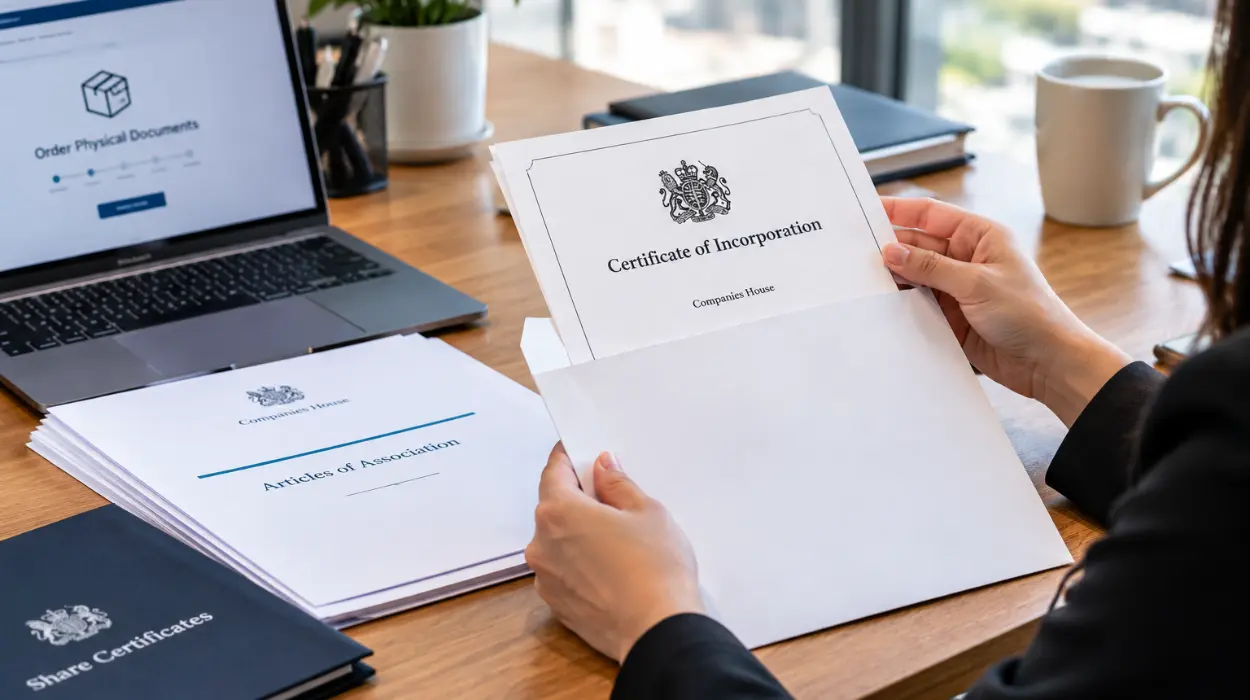
Cross-border due diligence requires verified identity documents, corporate formation records, ownership and control evidence, proof of address, tax and regulatory records, and jurisdiction-specific certifications. The exact document set depends on the parties, transaction type, countries involved, risk profile, and applicable anti-money-laundering requirements.
Cross-border due diligence has an informational search intent. Readers usually want a clear document checklist and a reliable method for validating records across more than one jurisdiction.
Which identity documents establish an individual’s identity?
A valid government-issued photo ID and recent proof of residential address establish an individual’s core identity. Due diligence teams compare the document details, expiry date, photograph, address, and issuing authority against reliable independent sources before accepting the person into a transaction.
A passport is usually the most practical identity document for international checks. It contains a photograph, date of birth, nationality, document number, issue date, and expiry date. National identity cards and photo driving licences can also support verification where the receiving institution accepts them.
Proof of address confirms the person’s usual residential location. Common evidence includes a bank statement, utility bill, local authority tax notice, government letter, or regulated financial institution statement. Most reviewers request a document dated within the previous 3 months. The document must show the individual’s full name, residential address, issue date, and issuer.
Anti-money-laundering due diligence requires firms to identify customers and verify their identities using reliable and independent documents, data, or information. FATF standards set this baseline internationally, while each country applies its own detailed legal and regulatory framework.
Where an individual is a director, shareholder, beneficial owner, signatory, or authorised representative, collect documents for the correct role. A director’s passport does not confirm ownership. A shareholder’s proof of address does not prove authority to sign. Each document supports a separate due diligence conclusion.
For example, a company onboarding process can require three identity records: a passport to verify identity, a bank statement to validate residential address, and a board resolution to confirm signing authority. This evidence trail reduces ambiguity during compliance reviews.
Which company documents verify legal existence?
Corporate due diligence starts with documents that prove a business exists, remains active, and has authority to enter the proposed arrangement. Core records include a certificate of incorporation, constitutional documents, an official registry extract, and current director or officer information.
A certificate of incorporation confirms the legal creation of a company. It normally records the company name, registration number, incorporation date, and jurisdiction. For overseas entities, reviewers often request a certified copy or a recent registry extract because historical incorporation records do not always show current status.
Constitutional documents explain how the entity is governed. For a UK private limited company, these commonly include the memorandum of association and articles of association. In other jurisdictions, equivalent documents include bylaws, statutes, operating agreements, charters, or formation certificates.
A current company registry extract verifies live public information. It can confirm the registered office, current directors, company status, share capital, and filing history. The acceptable age of an extract varies by reviewer, but a document issued within 30 to 90 days is common in cross-border transactions.
Where the company is UK-registered, current Companies House information supports identity and ownership verification. Official PSC guidance requires companies to identify and confirm specified information about people with significant control, including their name, date of birth, nationality, country of residence, service address, date of control, and nature of control.
Cross-border reviewers often request original-language documents alongside an English translation. A translation must reproduce names, registration numbers, dates, share classes, and legal terms accurately. In higher-risk or regulated transactions, a qualified translator’s certification provides an additional level of assurance.
What documents prove beneficial ownership and control?
Beneficial ownership paperwork identifies the people who ultimately own, control, or materially influence a company. The core evidence includes a share register, ownership chart, PSC or beneficial-owner records, corporate registry extracts, and documents linking every entity in the ownership chain.
Ownership due diligence follows the legal chain from the operating company to each ultimate beneficial owner. This process is essential where shares are held through parent companies, nominee arrangements, trusts, partnerships, or overseas corporate vehicles.
A share register records the legal shareholders and their holdings. A cap table can provide a useful summary, but it does not replace the official register where statutory records are required. Reviewers compare the share register with filed confirmation statements, company accounts, transfer records, and registry data.
An ownership chart makes the chain visible. It identifies each intermediate entity, its jurisdiction, its percentage holding, and the natural persons at the top of the structure. Percentages must reconcile across every level. For example, a 60% shareholder in a parent company that owns 80% of a UK subsidiary has a 48% indirect economic interest in the subsidiary.
UK PSC rules use specific ownership and control thresholds. A person generally qualifies as a PSC when they hold more than 25% of shares, more than 25% of voting rights, can appoint or remove a majority of directors, exercise significant influence or control, or control a trust or firm meeting similar conditions.
For a registrable relevant legal entity, Companies House guidance identifies key data points: the entity name, principal office address, legal form, governing law, relevant public register, jurisdiction, and registration number. These details help cross-border reviewers authenticate a corporate owner rather than relying on an unsupported ownership declaration.
Accurate Supplementary Company Documents help present control information in an organised format. They also support consistent records when a recipient requests a company’s ownership position, director details, or PSC-related evidence.
Which authority documents confirm transaction power?
Authority documents show that the company and its representatives can legally approve, sign, and complete the transaction. A board resolution, shareholder resolution, power of attorney, and authorised-signatory list provide the clearest evidence of corporate authority.
A board resolution records a formal decision by the directors. It identifies the transaction, approves relevant documents, appoints authorised signatories, and records any execution conditions. It must match the company’s constitutional documents and applicable local company law.
A shareholder resolution is required where the articles, shareholder agreement, law, or transaction structure reserves approval for shareholders. Examples include major asset sales, changes to share capital, related-party arrangements, and certain acquisitions or restructurings.
A power of attorney authorises a named person to act for the company. Cross-border reliance often requires a clear scope, execution date, signatures, duration, and legal validity under the governing law. Reviewers also check whether the power remains in force and whether it requires notarisation or legalisation.
An authorised-signatory list links named people to defined signing powers. It becomes especially valuable when documents are signed outside the company’s home jurisdiction. The list must align with board minutes, bank mandates, delegated authorities, and the company’s constitutional rules.
Validate both capacity and authority. Capacity confirms that the company exists and can contract. Authority confirms that the person signing has permission to bind that company. These are separate legal questions, and each requires separate documentary evidence.
When do documents require certification, notarisation, or an apostille?
Documents require certification, notarisation, or an apostille when the receiving country, institution, or transaction rules demand formal proof of authenticity. The required level depends on the document type, country of issue, country of use, and whether both countries recognise the Hague Apostille Convention.
A certified copy confirms that a copy matches the original document. A solicitor, notary public, accountant, embassy official, or other authorised professional may certify documents, subject to the recipient’s acceptance criteria. The certifier normally records their name, capacity, signature, date, and contact details.
Notarisation adds formal authentication by a notary public. It is commonly requested for powers of attorney, corporate resolutions, declarations, signature verification, and documents used in jurisdictions with stricter formality requirements.
An apostille authenticates the signature or seal on a public document for use in another Hague Convention country. It does not confirm the commercial accuracy of the document’s content. It confirms the status of the public official who signed or certified it.
Legalisation applies where the destination country does not accept an apostille. This process can involve several authorities, such as the issuing-country foreign affairs office and the destination country’s embassy or consulate. Processing times, fees, and document standards differ by jurisdiction.
Prepare formalisation requirements before signing. If a bank requests a notarised and apostilled board resolution after the deal documents are executed, the transaction timetable can stall while signatories, notaries, and government authorities complete the chain.
For a practical framework on sequencing overseas paperwork, read
how to handle cross-border document requirements. It explains how to map document acceptance rules before submission.
How do AML and sanctions checks affect the paperwork?
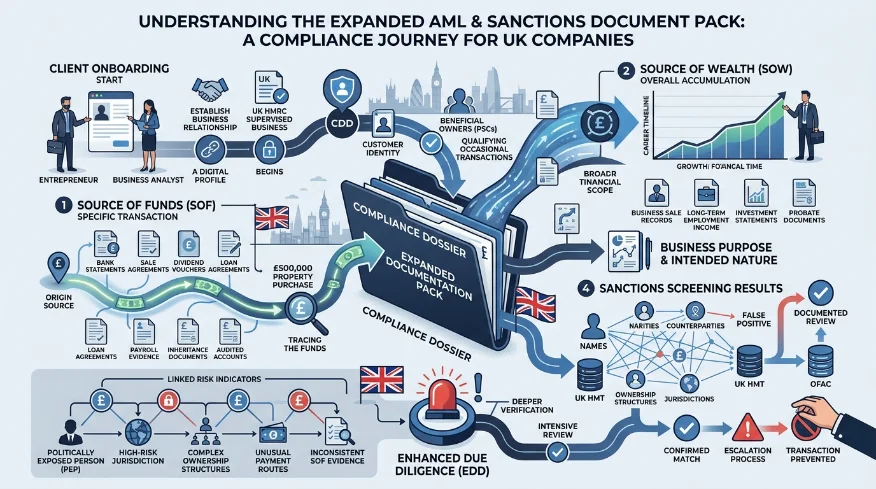
AML and sanctions due diligence expands the document pack beyond incorporation and identity records. Firms collect evidence that verifies customer identity, beneficial ownership, source of funds, source of wealth, business purpose, and screening results against applicable sanctions and politically exposed person databases.
Customer due diligence begins when a regulated firm establishes a business relationship. UK HMRC guidance also states that supervised businesses complete due diligence on customers and beneficial owners, including for qualifying occasional transactions.
Source-of-funds evidence explains where the money for a particular transaction comes from. Documents can include bank statements, sale agreements, dividend vouchers, loan agreements, payroll evidence, inheritance documents, or audited accounts. The evidence must trace the funds from a credible source to the transaction.
Source-of-wealth evidence explains how an individual accumulated their overall financial position. This is broader than a single payment. Evidence may include business sale records, long-term employment income, investment statements, probate documents, or historic company accounts.
Sanctions screening checks names, ownership structures, jurisdictions, and counterparties against relevant sanctions lists. A false positive requires documented review. A confirmed match triggers escalation and may prevent the transaction from proceeding.
Enhanced due diligence applies when risk indicators require deeper verification. Examples include a politically exposed person, a high-risk jurisdiction, complex ownership, unusual payment routes, or inconsistent source-of-funds evidence. Enhanced review increases the quality and depth of evidence rather than merely increasing the number of documents.
How can businesses prepare a cross-border due diligence pack?
A reliable cross-border due diligence pack groups current, verifiable documents by identity, legal existence, ownership, authority, financial provenance, and jurisdictional formalities. A controlled document index lets each recipient locate evidence quickly and assess whether it satisfies local compliance requirements.
Start by identifying the recipient’s exact requirements. Banks, law firms, investors, regulators, payment providers, and counterparties use different acceptance criteria. Request a written checklist that confirms document types, acceptable issue dates, certification rules, translation standards, and submission format.
Then validate consistency across the pack. The company name, registration number, registered address, director names, ownership percentages, and authorised signatories must match. A discrepancy between a share register and an ownership chart creates immediate review questions.
Use a document index with at least five fields: document name, issuing authority, issue date, jurisdiction, and validity status. Add certification and translation status where relevant. This format enables a reviewer to identify gaps without reopening every file.
Maintain version control. Mark superseded documents clearly and retain the latest approved copy. For example, an old director appointment record may conflict with a current registry extract. The document pack must explain the change rather than leaving the recipient to infer it.
Form My Company can help businesses organise Supplementary Company Documents for UK company records that support ownership and control checks. The service is particularly relevant when a cross-border recipient requests structured corporate evidence alongside identity and transaction documents.
Explore Our Supplementary Company Documents Service Guides
Who Can Certify Company Documents in the UK?
When Do You Need Certified Copies of Your Company Records?
What is the practical conclusion for cross-border due diligence?
Cross-border due diligence succeeds when the document pack proves identity, corporate status, ownership, authority, financial legitimacy, and document authenticity in every relevant jurisdiction. Current records, clear ownership mapping, accurate translations, and correctly formalised copies reduce verification delays and compliance risk.
The paperwork is not a single universal checklist. It is a structured evidence set shaped by the parties, the transaction, the countries involved, and the recipient’s compliance duties. A low-risk supplier onboarding and a regulated acquisition can both require identity and corporate records, but their depth of verification differs materially.
Companies achieve better outcomes by collecting records before external review begins. This approach exposes expired passports, outdated registry extracts, incomplete PSC details, missing resolutions, inconsistent shareholdings, and translation gaps while there is time to correct them.
Form My Company supports businesses that require complete UK corporate documentation for international use. Its Supplementary Company Documents service helps structure relevant ownership and company records for recipients conducting due diligence.
For businesses ready to obtain professionally prepared records, review
secure cross-border-ready documents from Form My Company. This decision-stage resource outlines the available document support and the steps for obtaining it.
Frequently Asked Questions
What are Supplementary Company Documents?
Supplementary Company Documents are physical company administration products that help organise and present official records. Form My Company provides a company register, personalised company seal, and self-inking company stamp as part of its Company Pack.
What is included in a company register, seal and stamp pack?
The Form My Company Company Pack includes a physical company register, a company seal, and a customised company stamp. The register stores statutory documents, while the seal and stamp display the company’s registered name and incorporation number on paper records.
Is a company seal legally required in the UK?
No, a company seal is not mandatory for UK companies. A company can use a seal for raised embossing and formal document presentation, but it does not replace valid signatures, board resolutions, or statutory filing duties.
What information appears on a company seal and company stamp?
A company seal and stamp normally show the company’s registered name and incorporation number. Form My Company customises these details for the relevant company, so directors must verify the information before production.
Does a company register keep a business compliant?
A company register helps organise statutory records, including documents relating to members, directors, and people with significant control. It does not itself complete Companies House filings or remove directors’ responsibility to maintain accurate company information