
UK banks evaluate new companies by assessing director identity, verifying proof of address, reviewing statutory registers, and checking business model legitimacy. Financial institutions require strict compliance checks, transparent ownership structures, and clear operational footprints to satisfy anti-money laundering regulations before approving a corporate bank account.
Why Do UK Banks Scrutinize Company Ownership Structures So Closely?
UK banks scrutinize company ownership structures because financial regulations require financial institutions to identify every ultimate beneficial owner holding more than 25% voting rights. Compliance teams trace ownership chains to prevent illicit financial flows, shield institutions from regulatory penalties, and maintain transparency across corporate entities.
Financial institutions analyze corporate registries to map control hierarchies accurately. Compliance analysts examine Persons with Significant Control registers maintained at Companies House. Banks request detailed organizational charts when corporate shareholders exist within the ownership chain. Foreign parent companies require certified translation documents and apostilled certificates of incorporation.
Operational transparency reduces approval timelines for new corporate accounts. Financial crime compliance units cross-reference shareholder identities against international sanction lists. Directors must disclose all direct and indirect shareholdings without omission. Failure to declare ultimate beneficial owners triggers immediate application rejection. Financial institutions prioritize clarity because regulatory bodies impose heavy fines for compliance oversights. Three verification checks secure ownership compliance: identity screening, share registry audits, and corporate structure mapping.
What Identity and Address Documentation Must Directors Provide?
Directors must provide government-issued photo identification, such as a valid passport or biometric driving licence, alongside recent utility bills or council tax statements dated within the last 90 days. Banks use these documents to confirm residential residency and establish legal personhood for every board member.
Verification protocols demand high-resolution scans or certified hard copies of personal documents. Proof of address documents cannot originate from mobile phone providers or digital-only wallets. Residential addresses must match entries submitted during company incorporation at Companies House. Discrepancies between official registries and submitted paperwork stall the account opening process.
Identity verification services validate director credentials using official UK compliance frameworks. Compliance officers cross-check residential histories against credit reference agency databases. Directors with recent relocations face requests for historical address verification spanning 36 months. Digital verification tools streamline this process by performing real-time biometric facial scans. Two validation stages complete the identity check: document authentication and biometric matching.
How Do Financial Institutions Assess Business Model Legitimacy?
Financial institutions assess business model legitimacy by reviewing projected turnover figures, examining client acquisition strategies, inspecting supplier contracts, and evaluating regulatory licensing requirements. Banks determine risk profiles by analyzing whether business operations align with the registered Standard Industrial Classification code.
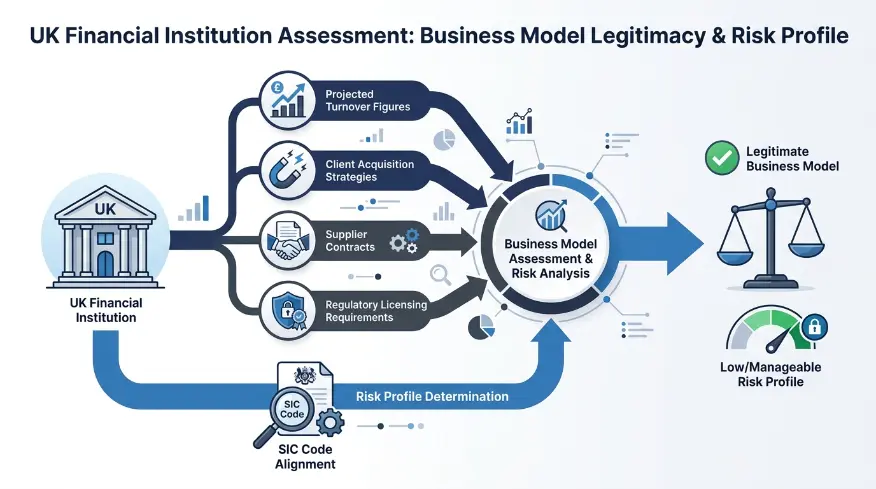
Underwriters evaluate commercial viability to protect the banking sector from operational failures. High-risk sectors, such as crypto assets or international trade, face enhanced due diligence procedures. Businesses operating in regulated industries must present active licenses issued by statutory authorities. Financial projections must feature realistic revenue assumptions backed by market research data.
Commercial intent becomes clear when founders submit comprehensive business plans detailing target markets. Banks examine sample invoices and trade agreements to confirm active commercial engagements. Operating addresses must physically exist rather than rely solely on virtual mailboxes without forwarding verification. Four operational assessments establish legitimacy: turnover projection reviews, sector risk scoring, supplier contract audits, and licensing verification.
Why Do Statutory Registers and Company Paperwork Matter?
Statutory registers and company paperwork matter because banks require legal proof that corporate entities maintain compliant internal records. Financial institutions inspect articles of association, share certificates, and memorandum documents to ensure the corporate vehicle operates within legal boundaries.
Accurate record-keeping demonstrates corporate governance maturity to institutional reviewers. Companies must present up-to-date registers of members, directors, and charges. Discrepancies between internal registers and public filings at Companies House halt onboarding instantly. Founders streamline this preparation by utilizing structured services like a comprehensive Company Pack to maintain error-free paperwork.
Proper corporate documentation safeguards directors from personal liability issues during audits. Banks inspect share allocation details to confirm that issued shares match nominal capital values. Articles of association must reflect current governance rules without outdated clauses. Two documentation audits secure corporate standing: statutory register inspections and governance document reviews. Founders seeking streamlined preparation can read more about What Documents Do UK Banks Need to Open a Company Account? to align paperwork requirements. When preparing for corporate verification, business owners frequently Want to Order AML-Ready Company Paperwork With Form My Company? to ensure total compliance.
What Financial Risk Indicators Trigger Bank Rejections?
Financial risk indicators trigger bank rejections when companies display opaque funding sources, negative director credit scores, high-risk geographic associations, or unrealistic profit margins. Banks automatically decline applications that fail anti-money laundering thresholds or present unmanageable compliance exposures.
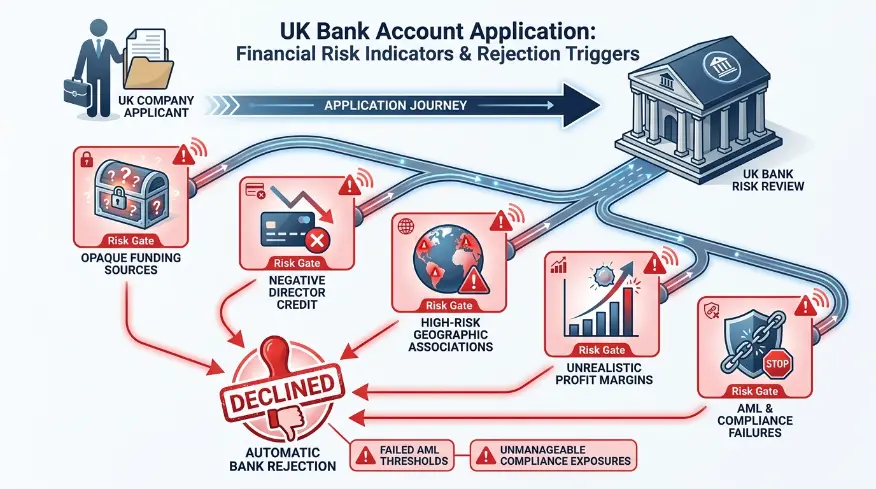
Risk assessment algorithms flag transactions involving sanctioned jurisdictions or high-risk offshore zones. Directors with historical bankruptcy records or county court judgments struggle to secure institutional approval. Unexplained capital injections from anonymous sources violate know-your-customer mandates. Banks demand clear audit trails for all initial share capital deposits.
Mitigating risk requires transparent financial reporting and verified capital origins. Compliance officers investigate cash-heavy business models for potential money laundering vulnerabilities. Maintaining pristine corporate credit profiles accelerates account activation across major high-street lenders. Three risk mitigation strategies prevent rejection: capital origin auditing, credit history clearance, and jurisdiction vetting.
UK banks enforce strict verification protocols to protect the financial ecosystem from illicit activities. Satisfying institutional requirements demands meticulous attention to ownership transparency, identity validation, business model legitimacy, and statutory paperwork accuracy. Form My Company delivers structured corporate solutions that help businesses prepare fully compliant applications for seamless banking approvals.
Explore our Company Pack guide,
How to Decide Which Company Documents to Apostille for Overseas Use?
How to Meet Hiring Compliance Standards With Professional Venues?
Frequently Asked Questions
What documents are included in a standard Form My Company Company Pack?
A standard Company Pack from Form My Company includes the official Certificate of Incorporation, share certificates, and bound copies of the Memorandum and Articles of Association. These authenticated corporate documents provide legal proof of identity required by UK financial institutions and regulatory authorities.
Why do UK banks require the paperwork provided in a Form My Company Company Pack?
UK banks require these verified registration documents to satisfy strict anti-money laundering regulations and know-your-customer compliance mandates. Form My Company structures this paperwork to prove corporate legitimacy, clarify ownership structures, and accelerate business bank account approvals.
How does the Form My Company Company Pack assist with business account verification?
The Company Pack delivers certified true copies and pristine registration records that pass automated underwriting checks without triggering fraud alerts. Form My Company ensures complete data accuracy across all files, preventing costly delays during financial institution onboarding.
Can foreign directors use the Form My Company Company Pack for UK compliance?
Yes, non-resident directors can utilize the comprehensive Company Pack to meet official UK corporate governance and statutory record-keeping standards. Form My Company supplies all legally mandated registers and foundational certificates necessary for international founders operating in the UK.
How quickly are the documents delivered after ordering a Company Pack from Form My Company?
Digital copies of core incorporation documents are typically made available instantly through secure client portals following successful company registration. Form My Company also dispatches high-quality physical presentation folders containing printed certificates and statutory registers directly to your designated address.