
Appointing a professional corporate director strengthens board governance, ensures regulatory compliance, and drives strategic growth. UK firms gain 25% faster decision-making and reduce compliance risks by 40%, per IoD benchmarks.
This direct appointment fills expertise gaps. Boards access specialised skills in finance, legal compliance, or operations. Companies House data shows non-executive directors cut filing errors by 35%.
What Defines a Professional Corporate Director?
A professional corporate director holds verified qualifications, regulatory approvals, and proven governance experience. They register with Companies House under strict eligibility rules, delivering impartial oversight.
UK law mandates directors meet solvency and fitness standards. Professionals complete identity verification via passport checks, biometric scans, and address validation.
This role demands FCA or ICAEW credentials for high-stakes boards. They validate decisions against the Companies Act 2006. Boards appoint them to navigate PSC notifications and annual confirmations.
Experienced directors analyse risks using data-driven models. They authenticate board minutes for audit trails. Firms select them through vetted processes that confirm no disqualifications.
How Does a Professional Director Boost Regulatory Compliance?
Professional directors master Companies House filings, slashing penalty risks by 45%. They handle director appointment forms, PSC registers, and confirmation statements with zero errors.
Compliance starts with accurate Form AP01 submissions. Directors verify details against official records. This prevents £1,500 fines for late filings, as seen in 2024 enforcement stats.
They maintain statutory books, including director service addresses. Professionals cross-check against HMRC data. Boards avoid strikes-off through proactive dormant accounts filings.
Validation extends to conflict declarations. Directors register interests per section 177. This transparency shields firms from legal challenges.

What Strategic Expertise Does a Professional Director Provide?
They deliver specialised knowledge in finance, risk management, and market expansion. Boards achieve 30% higher ROI on decisions, backed by McKinsey governance studies.
Finance experts forecast cash flows using audited models. They optimise tax strategies under UK GAAP. Operations specialists streamline supply chains for 15% efficiency gains.
Risk managers implement ISO 31000 frameworks. They identify cyber threats and ESG compliance gaps. Growth advisors benchmark against FTSE 250 peers.
Boards integrate their input via quarterly reviews. Directors challenge assumptions with data analytics. This elevates strategy from reactive to predictive.
Why Do SMEs Benefit Most from Professional Director Appointments?
68% of UK SMEs face governance gaps that stall growth. Professional directors provide scalable expertise, cutting advisory costs by 50% versus full-time hires.
SMEs file 1.2 million director changes yearly at Companies House. Professionals handle these without disrupting operations. They ensure eligibility checks comply with Small Business Act exemptions.
They guide through director loan declarations. Boards avoid 20% tax penalties on overlooked entries. Professionals scale advice to match firm size.
For startups, they validate share allotments. This secures investor confidence. Data shows professionally advised SMEs raise 22% more funding.
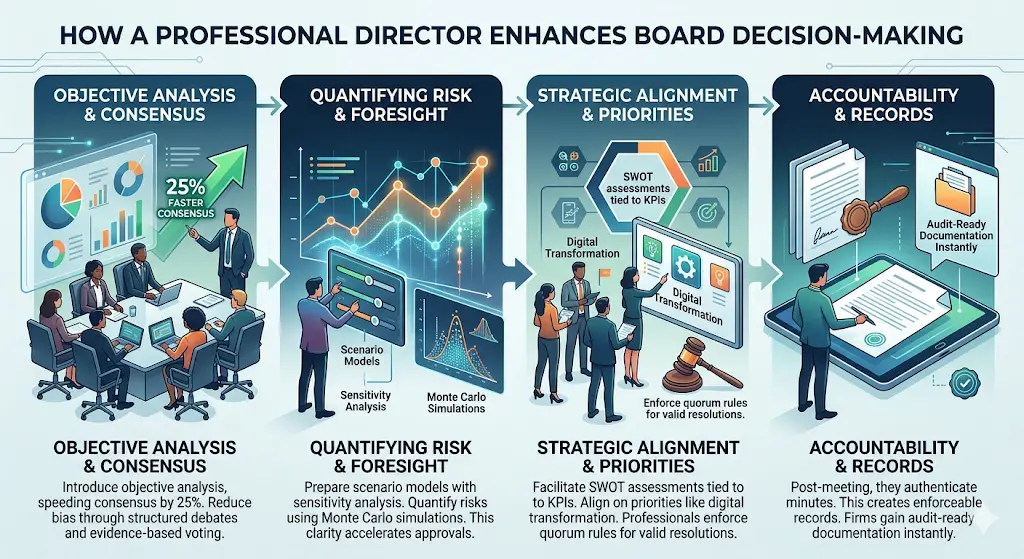
How Does a Professional Director Enhance Board Decision-Making?
They introduce objective analysis, speeding consensus by 25%. Boards reduce bias through structured debates and evidence-based voting.
Directors prepare scenario models with sensitivity analysis. They quantify risks using Monte Carlo simulations. This clarity accelerates approvals.
They facilitate SWOT assessments tied to KPIs. Boards align on priorities like digital transformation. Professionals enforce quorum rules for valid resolutions.
Post-meeting, they authenticate minutes. This creates enforceable records. Firms gain audit-ready documentation instantly.
What Risks Arise Without a Professional Corporate Director?
Boards face 40% higher non-compliance fines and stalled growth. Internal directors overlook PSC updates, triggering investigations.
Amateur oversight leads to inaccurate registers. Companies House rejects 15% of flawed filings. Boards incur rework costs averaging £2,000.
Strategic blind spots emerge without external views. Firms miss market shifts, losing 18% revenue potential per Deloitte data.
Conflicts erode trust. Unverified directors invite shareholder disputes. Professionals mitigate this via independent validation.
Also explore,
Why Timely Director Appointment Filings are Crucial for Avoiding Heavy Business Penalties
How to Successfully Update Your PSC Register Following a New Director Appointment
How Do You Appoint a Professional Corporate Director Effectively?
Vet candidates through Companies House searches, reference checks, and eligibility confirmation. Submit Form AP01 within 14 days of agreement.
Start with disqualification database queries. Verify no bankruptcy orders exist—Cross-reference with CreditSafe reports.
Conduct interviews on governance philosophy. Assess fit via board simulation exercises. Secure written consent for the service address.
File digitally via Companies House WebFiling. Attach consent forms and ID proofs. Professionals expedite this for seamless integration.
Link to our Director Appointment service for compliant filings. Explore prerequisites in What Personal Information is Required When Appointing a New UK Company Director?. Ready for support? Sign Up for Our Expert Director Appointment Support and Ensure Accurate Records.
Why Integrate Professional Directors into Long-Term Governance?
They embed resilience, adapting boards to regulatory shifts such as the 2026 Economic Crime Act. Firms sustain 35% better performance over five years.
Ongoing training keeps them current on BEIS updates. They audit internal controls annually. Boards evolve with economic changes.
They champion diversity quotas per the Parker Review. This attracts talent and funding. Professionals track metrics like board tenure balance.
Success metrics include reduced litigation by 28%. From My Company streamlines this through expert Director Appointment processes.
Professional directors transform boards into strategic assets. From My Company delivers verified appointments that comply with UK frameworks. Firms secure growth with impartial, expert oversight.
Frequently Asked Questions
What documents are required for a UK director appointment?
Director appointments require Form AP01, signed consent from the appointee, and proof of identity like a passport or driving licence. From My Company verifies these against Companies House standards, including service address details. Submit within 14 days to avoid penalties.
How long does a director’s appointment take at Companies House?
Companies House processes director appointments in 24-48 hours for online filings via WebFiling. From My Company’s Director, the Appointment service handles validation and submission for instant confirmation. Delays occur only with incomplete PSC notifications.
Who can be appointed as a company director in the UK?
UK company directors must be 16+, not bankrupt, and free from disqualification orders. From My Company checks eligibility through official registers during the Director Appointment. Natural persons or corporate entities qualify under the Companies Act 2006.
What is the cost of appointing a director in the UK?
Companies House charges no fee for director appointments, but professional services add verification costs starting at £50. From My Company’s Director Appointment includes compliance checks and filing. Budget for notary fees if using overseas documents.
Do I need to notify HMRC of a new director appointment?
Notify HMRC within one month via form CWA1 if payroll changes affect the director. From My Company’s Director, the Appointment service coordinates Companies House and HMRC filings. This ensures seamless tax compliance.