
A new director appointment must be recorded correctly, supported by the appropriate company decision and notified to Companies House in accordance with the applicable requirements. Whether a business is appointing its first director or expanding its existing board, accurate records help maintain corporate transparency and support effective governance.
This guide explains how director appointment filings work, why timing matters, how companies announce a new appointment and what businesses should know about fixed-term director appointments. It also covers the relevant documentation, identity verification requirements and practical steps for maintaining accurate company records.
How Director Appointment Filings Work
A director appointment is the formal process through which an individual takes up a position on a company’s board. The appointment should follow the company’s articles of association and any applicable legal requirements before the relevant information is submitted to Companies House.
For an individual director appointment, the company generally uses the AP01 process. The filing includes the required personal details and identity-verification information. Companies House requires the director’s personal code and confirmation that identity verification has been completed.
Companies should distinguish between the internal decision to appoint a director, the date the appointment takes effect and the subsequent notification to Companies House. Keeping these steps clear helps prevent errors and ensures that the company’s records accurately reflect its governance arrangements.
For businesses that need a broader explanation of the process, our guide to how to appoint a director through Companies House explains the filing procedure in more detail.
What Is the Deadline for Notifying Companies House?
Companies generally have 14 days from the date an individual director’s appointment takes effect to notify Companies House. The company should prepare the required information promptly and ensure the filing meets the current requirements.
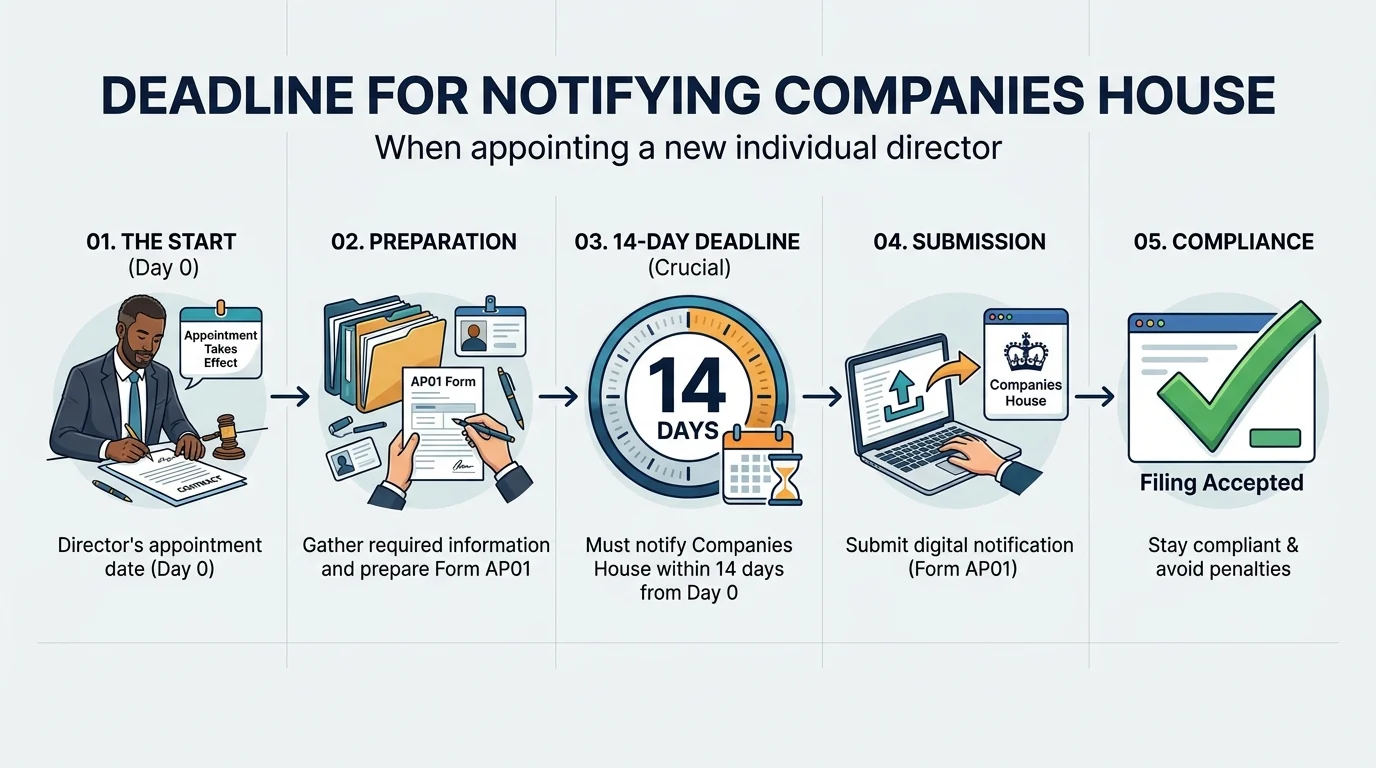
The appointment date and the filing date are not necessarily the same. The company should record when the appointment legally takes effect and calculate the notification deadline from that date.
Why the Appointment Date Matters
The appointment date establishes when the individual becomes a director under the applicable appointment arrangements. It should be supported by the relevant company decision and recorded consistently across the company’s documents.
For example, if a board validly appoints an individual with effect from a specified date, the company should use that effective date when preparing its records and assessing the filing deadline. A verbal discussion about a possible appointment should not automatically be treated as a completed appointment.
What Information Should Be Prepared Before Filing?
Before submitting the appointment, the company should check the individual’s details, confirm the internal approval and ensure that the required identity-verification process has been completed.
The current Companies House AP01 guidance explains the official requirements for notifying Companies House of an individual director appointment.
Companies should avoid relying on outdated advice about paper forms, filing fees or automatic penalties. Check the current official guidance before submitting a filing.
What Happens If a Director Appointment Filing Is Delayed?
Late or incomplete filings can leave the public register inaccurate and create additional administrative work for the company. They may also lead to compliance concerns, particularly where the business repeatedly fails to meet its statutory obligations.
However, a delayed notification does not automatically mean that the appointment is invalid, that the company’s bank accounts will be frozen or that a fixed financial penalty will apply. The consequences depend on the relevant legal requirements and the circumstances of the non-compliance.
Potential Compliance Consequences
Companies should take delayed filings seriously because accurate director information supports transparency and accountability. Where a company identifies an omission, it should establish the correct appointment date, review the filing requirements and take appropriate steps to correct its records.
Repeated failures to meet company filing obligations can contribute to wider compliance problems. Businesses should therefore maintain a clear record of director changes and assign responsibility for submitting the necessary notifications.
How to Respond to a Missed Deadline
If the company has missed a filing deadline, it should not assume that the problem will resolve itself. Review the relevant records, confirm the appointment details and consult the current Companies House guidance to establish the appropriate next step.
Where the circumstances are complicated, professional company secretarial support can help identify the outstanding requirements and organise the necessary documentation.
How to Announce a New Company Director
An announcement informs employees, customers, suppliers, investors and other stakeholders about a change in company leadership. It serves a different purpose from the formal notification submitted to Companies House.
A business may publish a new director appointment announcement on its website, issue a press release or communicate the change directly to relevant stakeholders. The format should reflect the importance of the appointment and the audience that needs to receive the information.
What Should a Director Appointment Announcement Include?
A useful announcement normally includes:
- The new director’s full name and appointed role.
- The effective date of the appointment.
- A concise description of relevant experience or responsibilities.
- The business reason for the appointment, where appropriate.
- A statement from the company or its leadership, if relevant.
- Any approved information about the director’s initial priorities.
The company should confirm the accuracy of all details before publication. It should also obtain any necessary approval for statements attributed to the incoming director or existing leadership.
Government Agency and Corporate Press Releases
A new director appointment government agency press release may communicate a leadership change within a public body, statutory organisation or government-related entity. Corporate announcements, by contrast, generally explain appointments within private businesses or other companies.
The publication method depends on the organisation and the purpose of the announcement. A press release is not a substitute for the relevant statutory filing, and a Companies House filing does not automatically mean that a separate public announcement is required.
Businesses should distinguish between legal notification obligations and optional communications intended to inform stakeholders.
New Director Appointment Government Press Release: What to Include
Organisations preparing a government agency or corporate press release should focus on accurate, verifiable information. The announcement should identify the person appointed, explain the role and state the appointment date where appropriate.
Where the position is for a fixed term, the organisation may also include the term’s duration, start date and end date if these details have been formally confirmed and are suitable for public disclosure.
A clear announcement should not imply that a public authority has endorsed an appointment unless that endorsement is supported by the relevant source. Similarly, organisations should not describe a private company appointment as a government appointment without evidence.
Difference Between an Announcement and an Official Filing
| Requirement | Purpose | Typical information |
|---|---|---|
| Companies House appointment filing | Updates the statutory company record | Director details, appointment information and required identity-verification details |
| Company press release | Communicates a leadership change | Name, role, appointment date, experience and relevant statements |
| Internal board record | Documents the company’s decision | Resolution, decision date and effective appointment details |
| Stakeholder notification | Informs relevant business contacts | Role changes, contact arrangements and operational implications |
These documents may refer to the same appointment, but each serves a different purpose. Companies should ensure that the information is consistent across the relevant records and communications.
What Does an Appointment for 3 Years, 3 Months and 29 Days Mean?
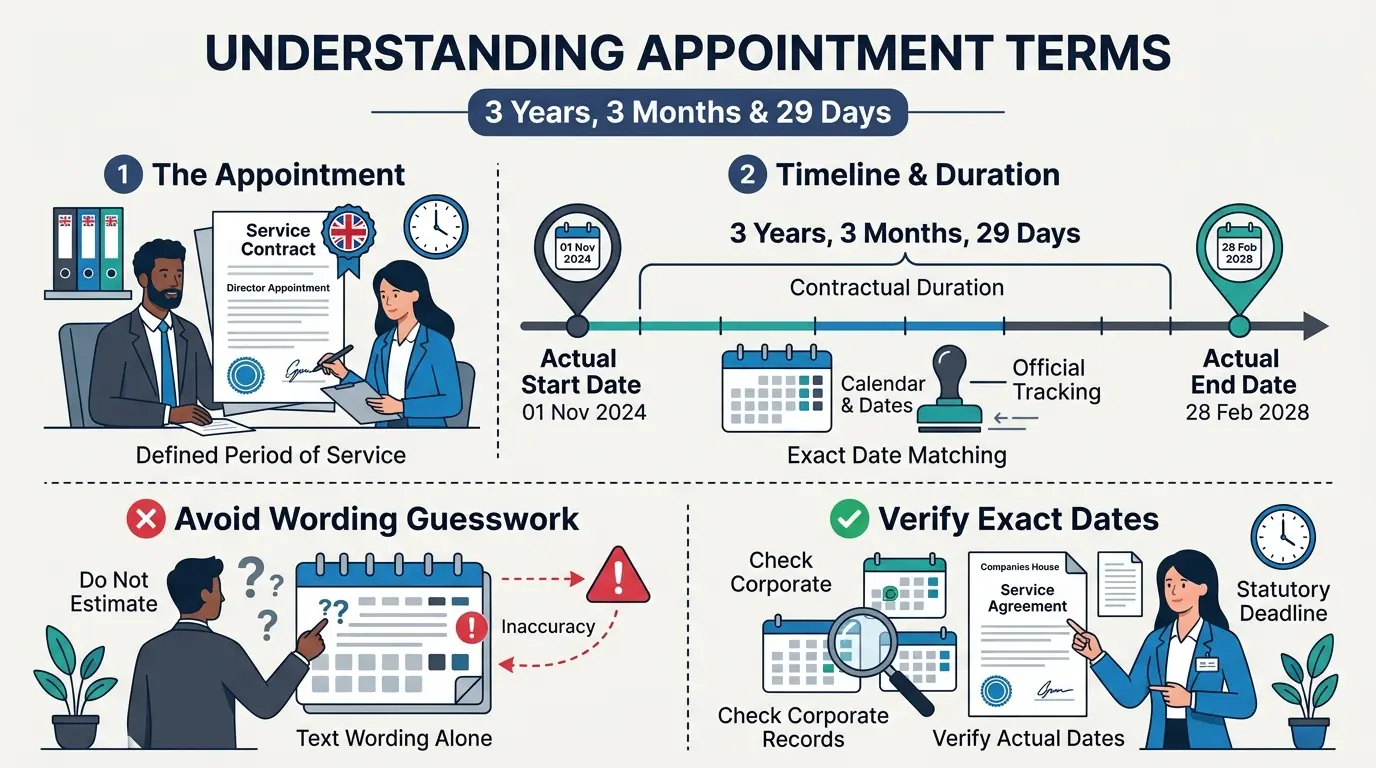
An appointment term of 3 years, 3 months and 29 days describes a defined period of service. The actual start and end dates determine the term, so the duration should not be calculated from the wording alone when an exact contractual or statutory end date matters.
How to Record a Fixed-Term Appointment
Where an individual is appointed for a fixed term, the company or appointing organisation should document the applicable dates and any relevant conditions. It should also identify whether the appointment is subject to renewal, extension, earlier termination or another procedure under the governing documents.
For example, a company may document a director’s appointment as taking effect on a specified date, with the term ending on a separately specified date. Recording both dates avoids ambiguity about the intended duration.
The applicable arrangements depend on the company’s articles, appointment documentation and the nature of the role. A fixed term should not be assumed to renew automatically unless the governing terms provide for that outcome.
Example of a Fixed-Term Appointment
Suppose an organisation announces that a director has been appointed for a term of 3 years, 3 months and 29 days. To understand the appointment accurately, readers would need to establish the commencement date, the stated end date and whether the organisation has published the appointment terms in an official announcement.
The wording alone does not identify the individual, organisation or appointment. Those details must be verified from the relevant official source rather than inferred from the search phrase.
How Companies Can Improve Director Appointment Compliance
A structured process helps businesses manage appointments efficiently and maintain reliable company records.
Maintain a Director Appointment Checklist
The company should record the proposed appointment, check the articles of association, obtain the necessary approval and confirm the effective date. It should then verify the incoming director’s identity and prepare the required Companies House notification.
The company should also retain the supporting documents and update its internal register. Assigning responsibility to a named person or professional adviser helps ensure that the filing deadline is not overlooked.
Use Accurate Records and Document Controls
Director information should be checked before submission. Differences between the appointment decision, the company’s internal records and the information filed with Companies House can lead to unnecessary corrections.
A central record of director changes can help the company track appointment dates, supporting resolutions, filing status and outstanding actions. Reminder systems can support this process, although the company remains responsible for meeting its legal obligations.
Review Related Company Changes
A director appointment may coincide with other changes, such as a new shareholder, an update to the persons with significant control register or a change in the company’s management arrangements. These changes should be assessed separately to establish which records or filings are required.
For guidance on the broader eligibility and appointment process, read our article on the legal requirements and criteria for appointing a new company director.
Businesses that need a more specific explanation of adding a director to an existing limited company can also consult our guide on how to add a director to a limited company.
For further information about appointment documentation, see everything you need to know about director appointment forms and Companies House.
Common Mistakes in Director Appointment Announcements and Filings
Confusing the Appointment Date With the Announcement Date
The date a company announces a director appointment may differ from the date the appointment takes effect. The company should use the legally effective appointment date when assessing the relevant filing deadline.
Treating a Press Release as a Statutory Notification
Publishing an announcement does not replace the required Companies House filing. The company should complete each obligation that applies to its circumstances.
Publishing Unverified Appointment Details
Announcements should not contain unconfirmed names, terms, dates or claims about the individual’s responsibilities. Fixed-term details should be checked against the relevant appointment documents.
Relying on Unsupported Penalty Figures
Businesses should avoid repeating specific penalty amounts or claims about automatic strike-off without checking an authoritative source. The legal consequences depend on the type of filing, the nature of the breach and the applicable enforcement framework.
Forgetting to Update Internal Records
Even where the statutory filing has been submitted, the company should ensure that the board records, register of directors and related documents are accurate and consistent.
Frequently Asked Questions
What does appointed a new company director 3 years 3 months 29 days 2022 mean?
This wording appears to describe a fixed-term director appointment lasting 3 years, 3 months and 29 days, associated with 2022. The wording alone does not establish the identity of the director or the organisation. The original announcement or official appointment record is needed to verify the details.
What is a new director appointment government agency press release?
It is a public announcement communicating the appointment of a director or senior office-holder by a government agency or related organisation. It may include the person’s name, role, appointment date and term, but it does not replace any separate statutory filing that applies.
Is a new director appointment government press release the same as a Companies House filing?
No. A press release communicates an appointment to an audience, while a Companies House filing updates the statutory company record. A business should complete the required filing separately from any public announcement.
How long does a company have to notify Companies House of a new director?
Companies generally have 14 days from the effective date of an individual director’s appointment to notify Companies House. The company should check the current AP01 requirements and ensure that the required identity-verification details are available.
Does every director appointment need a public announcement?
No. A separate public announcement is not universally required for every company director appointment. The company should distinguish between its statutory filing obligations and any communications it chooses or is otherwise required to publish.
What should a company do if it discovers a late director filing?
The company should review the appointment records, establish the effective date, check the applicable filing requirements and take appropriate steps to correct the position. If the circumstances are unclear, seek suitable professional advice.
Get Support With Director Appointment Filings
Accurate director appointment records help businesses maintain reliable statutory information and demonstrate sound corporate governance. Companies should confirm the appointment date, complete the required identity-verification process, submit the appropriate notification and retain supporting documents.
Form My Company can help businesses manage director appointment administration and related company record updates. Explore our Director Appointment and Resignation service to review the available support and take the next step towards maintaining accurate company records.