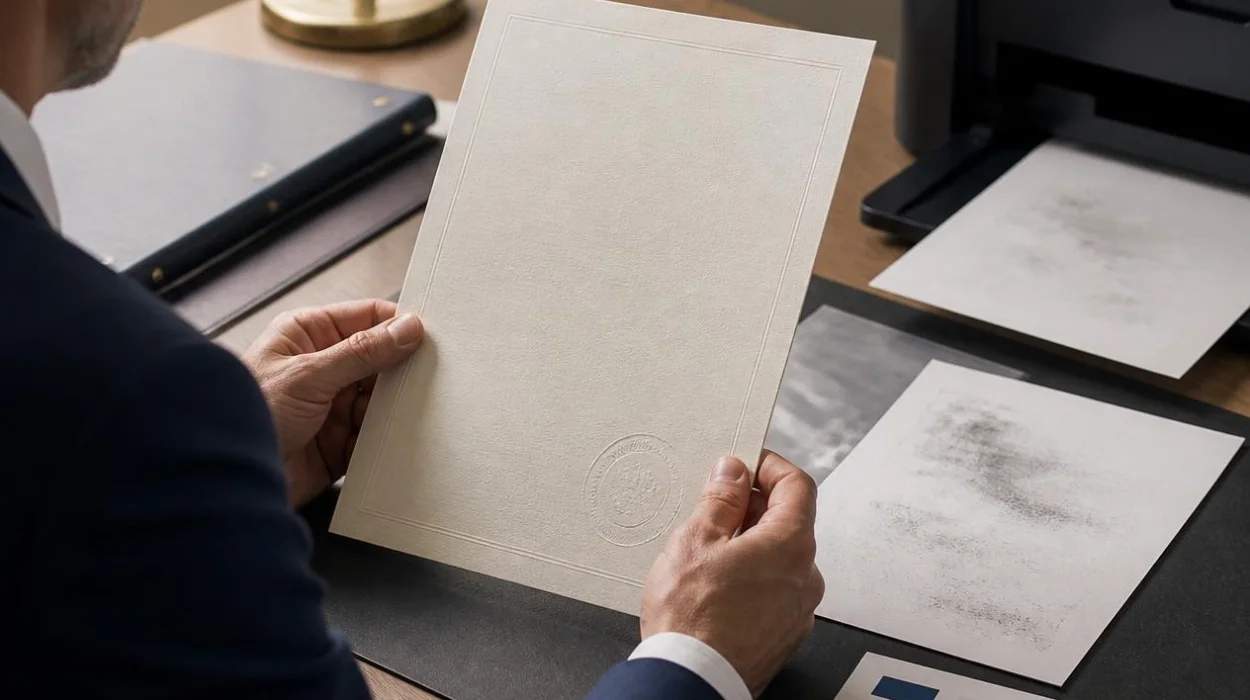
Ordering company documents on official legal paper ensures legal compliance, physical durability, and professional credibility during formal verification. Standard home-printing uses inferior 80gsm paper, which degrades over time and lacks the secure watermarks required by UK financial institutions.
Legal compliance dictates how corporate entities present their official incorporation records to regulatory bodies, banking institutions, and potential investors. Standard home-printing yields thin, lightweight sheets that fail basic archival standards set by government registries. Professional corporate document providers print statutory records on heavy-gauge security paper designed to withstand decades of handling without fading or tearing. Corporate transparency requires physical records to remain legible and intact throughout the entire operational lifecycle of a business.
What Defines Legal Paper for UK Company Documents?
Legal paper consists of high-gsm, watermarked security stock engineered to resist physical degradation and prevent fraudulent document replication.
Statutory requirements mandate that official registers and certificates meet strict physical durability thresholds. Standard printer paper weighs 80gsm, whereas authentic legal paper utilizes a minimum weight of 100gsm to 120gsm. Premium cotton content gives legal paper a distinct textured feel that distinguishes official corporate certificates from everyday office printouts. Document security features include embedded chemical sensitivities, hidden watermarks, and fluorescent fibres designed to expose unauthorized alterations. Official corporate governance demands physical authenticity when directors present registers for inspection during audits.
How Does Home-Printing Compromise Corporate Credibility?
Home-printing compromises corporate credibility by producing flimsy, unauthenticated records that fail visual inspections by banks, landlords, and overseas authorities.
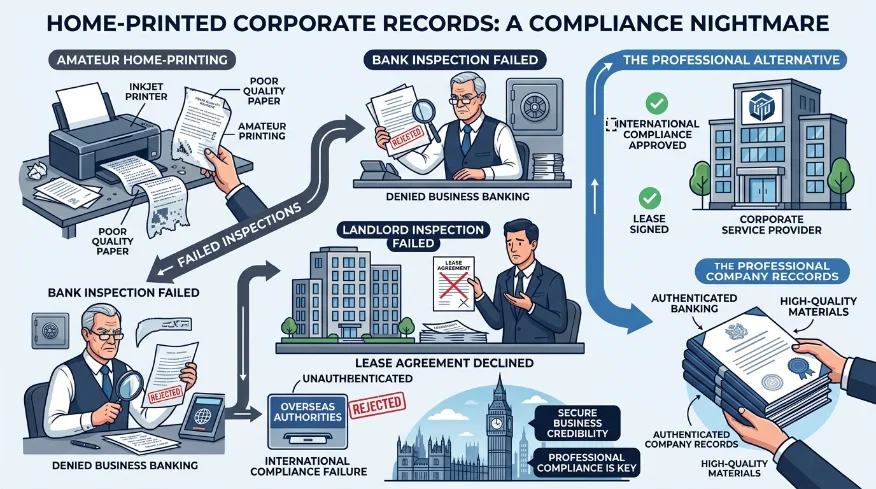
Commercial landlords and high street banks reject flimsy home-printed paperwork because standard office equipment lacks tamper-evident security measures. Inkjet and laser printers deposit surface toner that smudges upon contact with moisture, destroying critical text on share certificates and minutes. Corporate identity suffers when directors present low-quality documentation during high-stakes negotiations or funding rounds. Professional presentation reinforces operational stability, whereas DIY printouts signal a lack of attention to corporate compliance standards. External stakeholders evaluate organizational competence based on the physical quality of statutory paperwork.
Why Do Banks and Financial Institutions Require Physical Legal Paper?
Banks require physical legal paper because rigorous anti-money laundering regulations demand tangible proof of uncompromised corporate identity.
Compliance officers examine physical registers to verify that statutory records bear the authentic hallmarks of official issuance. Digital copies lack tactile security markers, making them vulnerable to digital manipulation and unauthorized replication. Financial institutions evaluate risk by inspecting physical company registers during account opening procedures. Regulatory frameworks enforce strict verification protocols where digital-only printouts fail to satisfy institutional due diligence standards.
How Do Professional Formatting and Materials Protect Shareholder Rights?
Professional formatting and heavy-duty materials protect shareholder rights by creating permanent, tamper-resistant evidence of equity ownership.
Share certificates serve as definitive legal proof of company ownership under corporate law. Standard home-printed certificates degrade rapidly, risking the loss of vital shareholding details over time. Archival-grade security paper prevents text fading and preserves signatures for the entire duration of a company’s existence. Investors rely on durable physical documentation when transferring shares or liquidating corporate assets. Secure document production prevents ownership disputes by maintaining unalterable records of equity distribution.
How Can Businesses Streamline Professional Document Production?
Businesses streamline professional document production by utilizing comprehensive fulfilment packages that deliver authenticated records directly to corporate offices.
Administrative efficiency improves when founders delegate statutory printing to specialized corporate service providers. Avoid DIY printing errors by securing professional-grade materials through a structured Company Pack containing all mandatory registers. Regulatory compliance requires accurate maintenance of statutory books alongside physically secure certificates. Learn more about foundational requirements by reviewing What Are Share Certificates and Who Needs Needs Them? before finalizing your corporate setup. Complete your ordering process efficiently by exploring Want to Order Legal-Paper Company Documents With Form My Company? to receive bound statutory registers on security stock. Form My Company ensures every corporate filing meets exact UK compliance standards through precision printing and professional binding. Form My Company delivers complete statutory registers designed to withstand rigorous institutional inspections. Form My Company eliminates administrative friction for new directors seeking flawless corporate presentation.
Explore our Company Pack guide,
How to Meet Hiring Compliance Standards With Professional Venues?
Looking for Interview Room Features That Keep Candidate Data Safe?
Frequently Asked Questions
What is included in a standard company pack for UK businesses?
A standard company pack from Form My Company includes printed statutory registers, share certificates, and bound copies of the memorandum and articles of association. These essential corporate documents ensure that newly incorporated businesses comply fully with Companies House record-keeping regulations. Utilizing a professional Company Pack eliminates the administrative burden of manual document creation.
Why do UK companies need physical statutory registers?
UK companies must maintain physical statutory registers to comply with the Companies Act 2006 and make corporate data available for authorized inspections. Maintaining these records in a dedicated binder ensures that details regarding directors, secretaries, and shareholders remain accurate and accessible. Financial institutions often inspect these physical registers during corporate banking application reviews.
Are home-printed share certificates legally valid for UK businesses?
Home-printed share certificates remain legally valid provided they contain all mandatory statutory details required by company law. However, standard office paper and desktop printers lack the security features, durability, and professional aesthetic expected by investors and banks. Ordering authenticated certificates through Form My Company guarantees professional presentation and long-term archival resilience.
How long does it take to receive corporate documents after incorporation?
Corporate document delivery timelines typically range between one to three working days following successful company registration at Companies House. Specialized providers print and dispatch statutory books and share certificates directly to the registered office address. Expedited dispatch options ensure that directors can present physical documents immediately for urgent business banking needs.
What is the difference between a digital incorporation certificate and a hardcopy pack?
Digital incorporation certificates exist as PDF files issued directly by Companies House upon successful business formation online. Hardcopy packs provide physical, bound counterparts including printed registers and share certificates produced on secure legal-grade paper. Form My Company supplies these physical additions to help businesses satisfy rigorous offline compliance and banking verification standards.