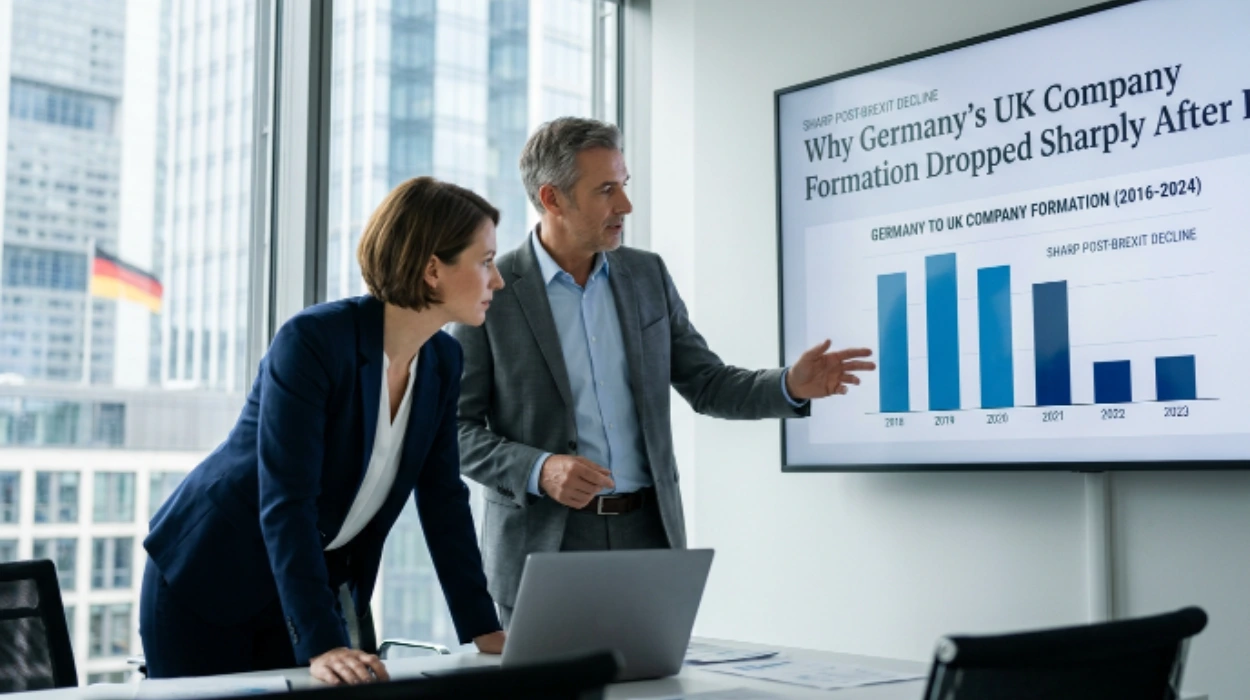
The decline in UK company formation interest from Germany after Brexit was real—but far less severe than most countries. While global demand for UK business registration collapsed across 85% of analysed nations, Germany recorded only a marginal drop of around -3%, from an index of ~30 pre-Brexit to ~29 post-Brexit. This positions Germany as one of the most resilient markets in the dataset, even as countries such as Turkey, Pakistan, and Romania saw declines exceeding 90%.
This divergence highlights a structural shift in UK company formation trends. Before Brexit, Germany—like much of Europe—used UK limited company structures as a gateway to the EU single market. After January 2020, that gateway disappeared. Yet the data suggests that German entrepreneurs did not abandon the UK entirely. Instead, they recalibrated their use of UK incorporation, maintaining demand where it still served independent commercial purposes. In the broader context of Brexit impact on business, Germany represents a critical case study: not collapse, but adaptation within a rapidly changing international business environment.
What are the key findings from the dataset?
- Germany recorded only a -3% decline in UK company formation interest (~30 to ~29)
- 40 countries experienced near-total declines of -98% post-Brexit
- 74 out of 93 countries showed declining interest after Brexit
- Only 11 countries recorded post-Brexit growth, including Argentina (+180%) and Brazil (+47%)
- Denmark retained the highest post-Brexit interest level (~31 index)
- Major economies like India (-53%) and France (-52%) saw significant declines
Why did Germany’s UK company formation decline remain minimal compared to other countries?
Germany stands out because its decline is statistically negligible compared to global patterns. While most countries experienced structural collapse in demand for UK company formation, Germany retained almost identical levels of interest before and after Brexit.
This suggests that German demand was never solely dependent on EU market access. Unlike countries where UK incorporation served primarily as a gateway into Europe, German entrepreneurs appear to have used UK limited company structures for broader purposes. These may include international trade, legal structuring, or access to English-law frameworks—factors that remain intact post-Brexit.
Across the dataset, countries with diversified commercial ties to the UK tended to show greater resilience. Germany fits this pattern closely. Its post-Brexit index of ~29 remains among the highest globally, second only to Denmark (~31), and ahead of the Netherlands (~27) and Australia (~25).
This stability also reflects the maturity of German outbound business activity. Unlike emerging markets that reacted sharply to Brexit, Germany’s engagement with UK company structures appears more institutionalised and less reactive to geopolitical shifts.
How does Germany compare to countries with near-total collapse?
The contrast between Germany and high-decline countries is stark. Nations such as Armenia, Azerbaijan, Belarus, and Vietnam all recorded -98% declines, falling from high pre-Brexit levels to near-zero post-Brexit activity.
In these markets, UK company formation was closely tied to specific economic windows or strategic needs—often linked to EU access. Once that access disappeared, demand evaporated almost entirely.
By comparison, Germany’s minimal decline suggests continuity rather than disruption. While interest levels slightly decreased, they did not collapse. This indicates that German entrepreneurs continue to see value in UK business registration independent of EU membership.
Countries like Pakistan (-89%), Bangladesh (-94%), and Turkey (-96%) illustrate the opposite pattern. These regions experienced dramatic contractions, suggesting that Brexit removed the primary incentive for UK incorporation.
Top 10 Post-Brexit Declines in UK Company Formation Interest (%)
How did European countries perform compared to Germany?
Across Europe, the dataset reveals a mixed but predominantly negative picture. While Germany saw only a -3% decline, most EU countries experienced significantly larger drops.
France declined by -52%, Italy by -58%, and Spain by -40%. Even financially integrated economies like Belgium (-49%) and Austria (-37%) saw notable contractions. These figures reflect the loss of the UK’s role as an EU-accessible jurisdiction.
However, a subset of European countries showed resilience similar to Germany. Denmark (-11%), the Netherlands (-40%), and Switzerland (-33%) maintained relatively strong post-Brexit interest levels.
Germany’s performance sits at the extreme end of this resilience spectrum. Its near-flat trend line suggests that UK company formation remains embedded in German cross-border business strategies.
What patterns emerge when comparing Europe and Asia?
The divergence between Europe and Asia is one of the clearest structural patterns in the dataset.
In Asia, declines were far more severe. Countries such as Indonesia (-98%), Vietnam (-98%), Iran (-98%), and Kazakhstan (-98%) saw near-total collapses. Even major economies like India (-53%) and China (-30%) recorded substantial declines.
By contrast, European countries—while still declining—retained measurable levels of interest. Germany exemplifies this pattern. Its post-Brexit index of ~29 is significantly higher than most Asian markets, many of which dropped to near-zero.
This suggests that geographic proximity, historical integration, and existing commercial relationships played a critical role in sustaining demand for UK incorporation within Europe.
Which countries showed growth despite the Brexit impact?
While the overall trend is negative, a small group of countries recorded post-Brexit growth.
Argentina (+180%), Brazil (+47%), and Djibouti (+400%) stand out as the strongest growth markets. These increases are not linked to EU access but rather to domestic economic conditions and the UK’s continued appeal as a stable legal jurisdiction.
These markets highlight a different use case for UK company formation. Instead of serving as a gateway to Europe, UK companies are being used for capital preservation, international trade, and legal structuring.
Germany does not fall into this growth category, but its stability places it closer to these resilient markets than to the collapsing ones.
Top Post-Brexit Growth & Resilient Markets (%)
How has non-resident UK company formation behaviour changed after Brexit?
The dataset reveals a fundamental shift in non-resident UK company formation behaviour. Before Brexit, international entrepreneurs primarily used UK companies as a bridge into the EU market. After Brexit, this function disappeared almost overnight.
As a result, demand collapsed in countries where EU access was the primary motivation. However, in markets where UK incorporation served broader purposes, interest persisted.
Germany is a clear example of this shift. Its stable demand suggests that German entrepreneurs continue to UK company formation not for EU access, but for other strategic advantages.
For international founders, the process of register a UK company remains attractive due to its simplicity, legal transparency, and global recognition. This is particularly relevant for those exploring UK company for non residents where ease of remote setup is critical.
At the operational level, services such as a UK business bank account and UK VAT registration continue to support international usage of UK entities.
In some cases, infrastructure services like a virtual office UK or bundled UK company packages enable foreign founders to maintain a UK presence without physical relocation.
The full scope of this transition is explored in the report Pre-Brexit Interest to Post-Brexit Decline: UK Company Formation Down 98% in 40 Countries, which maps the global reconfiguration of demand in detail.
Germany’s case suggests that while the motivations have changed, the underlying demand for UK company structures has not disappeared—it has simply evolved.
The post-Brexit landscape for UK company formation is defined less by access to Europe and more by the intrinsic qualities of the UK as a business jurisdiction. The dataset shows a clear global contraction, but also pockets of resilience and even growth.
Germany’s minimal decline illustrates this transition more clearly than any other country. It demonstrates that while Brexit removed a major incentive, it did not eliminate the UK’s relevance in international business.
Instead, it forced a recalibration. Entrepreneurs are no longer using UK companies as gateways—they are using them as standalone tools within a broader global strategy. In that context, Germany’s stability is not an anomaly. It is an early indicator of what the future of UK company formation may look like in a post-Brexit world.