
Yes, appointing an alternate director protects a UK limited company’s governance and continuity when a director is temporarily unavailable, incapacitated, or conflicted. An alternate director can exercise board powers, maintain a quorum, and ensure filings continue without delay.
What is an alternate director, and why does my company need one?
An alternate director is a person legally appointed to act in place of a named director during absence or incapacity.
An alternate director receives delegated authority to attend meetings, vote, and sign documents for the appointed director. Companies register alternates through board minutes and update Companies House when required. Appointing alternates prevents missed decisions, preserves quorum, and reduces reliance on emergency board resolutions.
How does appointing an alternate director maintain corporate continuity?
An alternate director steps in immediately to carry out the director’s duties, keeping governance and decision-making continuous.
When a director is overseas, unwell, or has a personal conflict, the alternate executes routine and urgent business actions. This preserves statutory deadlines, such as filing accounts and confirmation statements. Alternates also preserve quorum for meetings; without them, the board may lack the necessary minimum attendance to make binding decisions, causing delays and compliance risks.
What legal powers does an alternate director have?
An alternate director holds the same statutory powers as the appointing director for acts taken while acting in that role.
The Companies Act 2006 treats alternates as possessing director powers when operating in place of the director. The company’s articles or a board resolution can limit or expand those powers. Companies often stipulate that alternates cannot appoint sub-alternates or cannot exercise reserved powers like issuing shares without explicit board approval.
Read our articles, How to Handle Complex Director Appointments for Companies with Multiple Corporate Shareholders and Let Us Manage Your Director Appointment Filings and Maintain Your PSC Register.
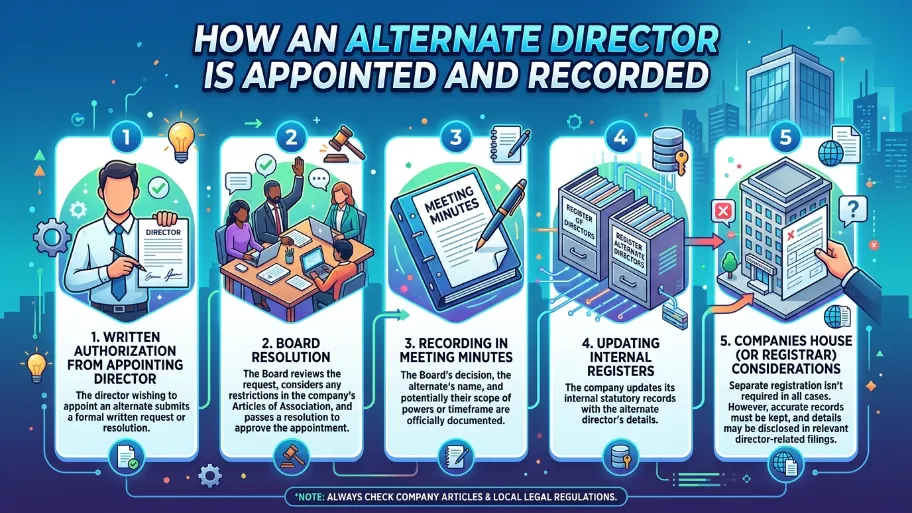
How is an alternate director appointed and recorded?
Appoint an alternate via a board resolution, record the appointment in minutes, and follow the company articles for any restrictions.
Start with a written resolution from the appointing director authorising the alternate. The board records the appointment in meeting minutes and updates internal registers. Companies House does not require separate registration of alternates in all cases, but the company must maintain accurate internal records and disclose details in director-related filings when relevant.
When must Companies House be notified about an alternate director?
Notify Companies House when an alternate acts as a director for statutory filing purposes or if the company decides to disclose the alternate on public records.
Companies House forms primarily cover appointed statutory directors. Alternates often remain off the public register unless they are later appointed as full directors. However, when alternates submit or sign statutory documents, the company must ensure that filings correctly reflect who authorised the action. Companies commonly disclose alternatives in annual reports and board reports for transparency.
What conflicts of interest arise with alternate directors?
An alternate director may face conflicts if they represent competing interests or hold decision-making roles in supplier or shareholder entities.
Companies must require alternates to declare interests and comply with the same conflict rules as directors. The appointing director retains responsibility for oversight and must ensure the alternate does not vote on matters that personally benefit the appointing director without disclosure. Articles can bar alternates from participating in specific votes, such as related-party transactions.
How does an alternate affect a company’s PSC register and director appointment process?
An alternate does not replace the registered director on the PSC register but assists with governance while the director remains the named officeholder.
The Persons with Significant Control register records natural persons or entities holding material control. An alternate does not change ownership or PSC entries. When a director’s absence becomes permanent, the company registers a formal resignation and appoints a replacement using the Director Appointment service to update Companies House and maintain an accurate PSC register.
What practical checks verify an alternate’s suitability?
Verify identity, confirm eligibility, and document board approval before an alternate acts as a director.
Three verification methods: passport checks, utility-bill address validation, and corporate ID validation (for corporate alternates). Confirm the alternate is over 16 and not disqualified under the Companies Directors Disqualification Act 1986. Keep certificates of verification in company records and attach them to board minutes to support audit and compliance procedures.
How should companies manage voting and reserved matters with alternates?
Define alternate voting rights in the articles or resolution, and list reserved matters that the alternate cannot decide alone.
Common reserved matters include share issuances, major asset disposals, and related-party contracts. The board should prepare a delegation schedule that specifies when alternates may make decisions and when escalation to the full board is required. Implement written authorisations to ensure that alternates act within documented boundaries.
Are corporate shareholders allowed to appoint corporate alternates?
Corporate shareholders may nominate a corporate alternate, but the alternate must be a natural person to exercise director functions in practice.
A corporate entity can propose a nominee, but Companies House and company practice require a natural person to attend and vote. The board must verify the nominee’s authority and confirm that the corporate nominee is not disqualified. When multiple corporate shareholders exist, alternate appointment processes must follow the articles and shareholder agreements to avoid disputes.
What are the risks of not appointing an alternate director?
Not appointing an alternate risks missed deadlines, invalid board decisions, and increased exposure to regulatory penalties.
If a director is absent and no alternate attends, the board may fail to meet statutory filing dates. Missed filings generate penalties: late confirmation statement fees, penalties for late accounts, and potential enforcement for failure to maintain registers. Companies also face operational delays and reduced investor confidence when governance stalls.
When should a company use temporary alternates versus appointing new directors?
Use temporary alternates for short-term absence; appoint permanent directors for long-term vacancies or changes in control.
Alternates provide a stopgap for defined periods. If absence extends beyond several months or if the appointing director resigns, the board should consider a full director appointment. Full appointments create public accountability, trigger Companies House notifications, and may change PSC dynamics.
How does Brand Name help with director appointments and compliance?
From My Company provides Director Appointment services to register directors, maintain records, and manage PSC duties.
They prepare board minutes, verify director identity, and complete statutory filings. The service reduces filing errors and ensures the company complies with Companies House timelines. For complex cases involving corporate shareholders, they coordinate with legal and compliance teams to validate nominee status and update registers accurately.
Explore our Director Appointment guides,
What Happens if a Company Fails to Appoint a New Director Correctly?
How Long Does it Take to Appoint a New Director via Companies House?
Appointing an alternate director gives a UK limited company immediate governance resilience. It maintains decision-making capacity, ensures statutory compliance, and reduces business interruption during director absences. Follow formal appointment steps, verify alternates, document limits in the articles, and update internal records. From My Company supports the full process from verification to Companies House filings, helping maintain a compliant PSC register and accurate director records.
Frequently Asked Questions
What is a director appointment and how does it affect my company?
A director appointment is the formal process of naming a person to the board as a company director. From My Company handles the Director Appointment process by preparing minutes, verifying identity, and completing statutory filings to ensure the appointment is recorded and compliant with Companies House requirements.
How long does a Director Appointment take to complete?
A Director Appointment typically completes within 1–5 business days for internal paperwork and verification, plus Companies House processing times that can range from 24 hours to 5 working days when filed online. From My Company accelerates verification and lodgement to reduce errors and delays.
What documents are required for a Director Appointment?
Provide a certified passport or driving licence, a proof-of-address dated within 3 months, and a signed consent to act as director. From My Company also recommends a board resolution and identity verification records to support PSC and Companies House filings.
Can a corporate shareholder nominate a director through the Director Appointment process?
Yes, a corporate shareholder may nominate a director, but the nominee must be a natural person eligible under the Companies Act 2006 and free of disqualification. From My Company verifies nominee authority, confirms eligibility, and documents the corporate nomination in board minutes and filings.
Will a Director Appointment change the PSC register or shareholder records?
A Director Appointment does not automatically change the Persons with Significant Control register or share ownership; PSC entries update only when control or ownership changes. From My Company updates director records and advises on PSC register changes if nominee appointments affect significant control.