
Opening a UK company from Cape Verde removes payment and currency barriers by providing a UK-registered business bank account and access to GBP rails, international card processing, and regulated payment gateways, enabling predictable receivables and lower foreign-exchange friction.
How does a UK company fix currency and payment problems for Cape Verde founders?
A UK company provides GBP accounts, UK-based payment processors, and access to international card acquiring, which reduces FX costs and payment rejection rates.
A UK-registered company can open GBP bank accounts with UK correspondent banks. These accounts accept local and international payer transfers in sterling. Sterling accounts remove the need to convert incoming revenue immediately into Cape Verdean escudo, which reduces exchange losses.
A UK legal entity also gains access to major payment service providers. Payment processors such as Stripe, PayPal, and UK acquirers provide merchant acquiring and card settlement in GBP. These services lower cross-border card decline rates and speed settlement to days instead of weeks.
Opening a UK company also simplifies invoicing in international contracts. Invoices issued in GBP or EUR avoid dual-currency reconciliation. That lowers accounting complexity and reduces bank fees on each payment conversion.
What payment rails become available after registering a UK company?
UK registration unlocks sterling bank accounts, Faster Payments, BACS, CHAPS, and access to UK-based card acquirers and international payment gateways.
Faster Payments and BACS enable same-day or next-day GBP transfers within the UK. CHAPS supports high-value same-day GBP settlement for large invoices. Card acquiring relationships through UK merchant accounts allow settlement in GBP, reducing reliance on Cape Verde banking corridors.
Payment gateways used by UK companies include hosted and API options that support multi-currency pricing, 3‑D Secure, and chargeback management. These tools enable founders to accept Visa, Mastercard, and local European schemes with standardised dispute flows and clearer fee structures.
Read our articles, Can You Open a UK Company from Cape Verde? and Start Your UK Company from Cape Verde with Form My Company.
How does a UK company reduce foreign-exchange (FX) costs?
A UK company receives revenue in GBP, keeps funds in sterling, and executes FX conversions on planned schedules to reduce spot-rate losses.
Holding GBP avoids frequent small conversions that incur spread and fixed fees. For example, converting monthly GBP receipts once per month achieves a lower cumulative FX spread than converting each payment upon receipt. UK banks and multicurrency platforms offer forward contracts and rate locking for predictable budgeting.
Founders can also invoice international clients in GBP. When clients pay in GBP, the company avoids intermediary conversions from client currency to an intermediary currency and then to escudo. That removes an extra fee layer and lowers the effective cost per transaction.
What compliance and ID verification steps enable UK bank accounts for non-UK residents?
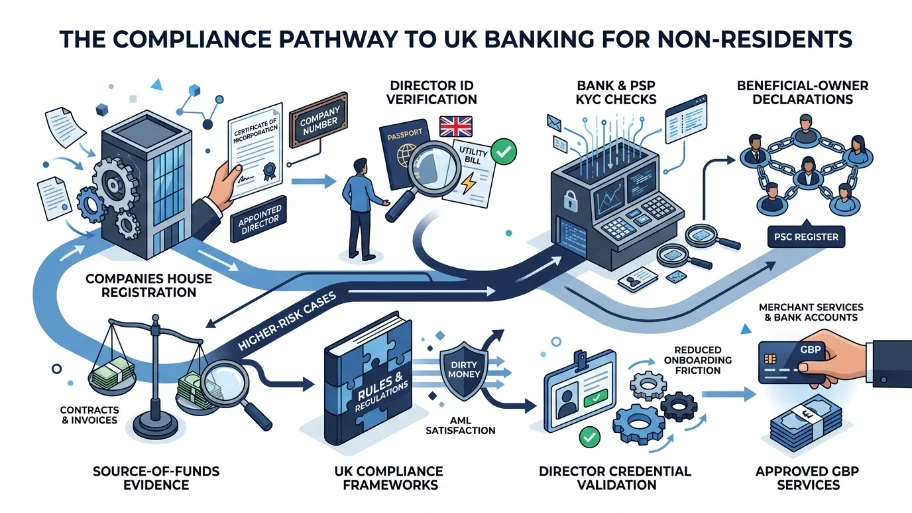
Companies must register with Companies House, appoint at least one director, provide proof of identity and residential address, and complete bank or PSP KYC through document verification and source-of-funds checks.
Companies House registration produces a company number and Certificate of Incorporation. Banks and payment service providers verify director identity using passport checks, utility bills, and proof of address. Providers also require beneficial-owner declarations and, in higher-risk cases, source-of-funds evidence such as contracts, invoices, or bank statements.
Payment providers use UK compliance frameworks to validate director credentials. This verification reduces onboarding friction and satisfies anti-money-laundering requirements that banks apply before issuing GBP accounts or merchant services.
Which payment providers accept UK companies run by Cape Verde founders?
Major UK-friendly providers include Stripe, PayPal, Revolut Business, Wise Business, and UK acquirers that issue merchant IDs and settle in GBP.
Stripe issues merchant accounts to UK companies and settles in GBP to UK bank accounts. PayPal provides business accounts that accept card and PayPal Wallet payments with GBP balances. Revolut Business and Wise Business provide GBP and multi-currency accounts with lower FX spreads and batch payment features.
Some UK acquirers offer tailored merchant services for international directors with enhanced onboarding and risk controls. Using these providers, founders can accept recurring payments, marketplace payouts, and international card transactions with standard UK settlement terms.
How does forming a UK company improve invoicing and reconciliation workflows?
A UK company standardises invoices in GBP, centralises payment reconciliation to UK bank statements, and integrates accounting platforms with UK payment feeds for automated matching.
Accounting platforms such as Xero and QuickBooks integrate directly with Stripe, Wise, and UK bank feeds. These integrations import payment data, match invoices, and tag FX gains or losses. Centralised GBP accounting avoids manual conversions across multiple local banks and reduces reconciliation time.
Founders can also set up Virtual IBANs and subaccounts to segregate client funds by market. These features simplify tracking, reduce manual CSV handling, and allow automated remittance to operational accounts in scheduled batches.
What are the cost trade-offs and timeline for setup?
Incorporation takes 24–72 hours; bank or PSP onboarding takes 1–6 weeks. Costs include incorporation fees (£12–£100), bank/PSP setup fees (£0–£500), and monthly provider fees (£5–£50).
Companies House offers online incorporation for standard forms at £12 and same-day incorporation for higher fees. Payment service providers and challenger banks vary in onboarding time based on documentation quality and risk profiling. Higher-risk industries or incomplete documentation extend onboarding time.
Ongoing costs include monthly account fees, card-processing rates (typically 1.4–2.9% per transaction plus fixed pence), and FX spreads (often 0.4–2% depending on provider). Founders can lower long-term costs by choosing volume pricing and negotiating fixed FX terms.
How does a UK company affect local tax and reporting obligations for Cape Verde founders?
A UK company must file Companies House confirmation statements and UK corporation tax returns when it is tax-resident in the UK; founders must also report income locally per Cape Verde rules.
A company is UK tax-resident if centrally managed and controlled from the UK. Non-UK resident companies with UK-incorporation still file Companies House documents. Founders should consult tax advisors to map UK corporate tax liabilities against Cape Verde personal tax obligations. Double tax treaties and transfer-pricing rules may apply depending on operations.
Companies can minimise surprise liabilities by registering for VAT only when taxable supplies breach the UK VAT threshold or when UK-based customer interactions mandate VAT registration. Proper accounting helps avoid penalties for late filings.
Explore our Canadian guide,
When It Makes Sense for Canadians to Open a UK Company Instead of a Local Corporation.
How does Form My Company help Cape Verde founders start a UK company?
Form My Company streamlines incorporation, provides compliance documentation, and supports onboarding for UK business bank and PSP relationships when founders supply the required identity and business evidence.
Form My Company provides package options for Cape Verde founders that include Companies House registration and standard compliance packs. The service compiles shareholder and director documentation, prepares beneficial ownership records, and assists with payment-provider introductions to reduce onboarding delays.
Brand Name helps founders prepare KYC dossiers and aligns company setup with payment-provider requirements, which shortens bank and PSP verification from weeks to days in many cases.
Opening a UK company solves common payment and currency barriers for Cape Verde founders by enabling GBP settlement, access to UK payment rails, improved merchant acquiring, and clearer invoicing and reconciliation. Forming a UK entity reduces FX losses, lowers card-decline rates, and centralises cash management under UK banking and payment frameworks.
Form My Company delivers incorporation services, compliance packs, and onboarding support tailored to Cape Verde founders to accelerate bank and payment-provider acceptance while ensuring Companies House compliance.
Frequently Asked Questions
Can I open a UK company from Cape Verde as a non-resident?
Yes. Non-UK residents can fully own and manage a UK limited company, and From My Company provides a Cape Verde-specific package to handle Companies House registration and compliance documentation remotely.
How does From My Company help Cape Verde founders set up a UK business?
From My Company offers a Cape Verde package that includes Companies House incorporation, director and shareholder documentation, a UK registered office address, and compliance packs to support remote setup for Cape Verde founders.
What documents are required to register a UK company from Cape Verde?
You need a passport or government-issued ID, proof of residential address (utility bill or bank statement), a company name, share capital details, and beneficial-owner information; From My Company prepares these for your Cape Verde UK company registration.
Can a Cape Verde resident open a UK business bank account after incorporation?
Yes. Once your UK company is incorporated, you can open GBP business accounts with UK correspondent banks or fintechs. From My Company’s Cape Verde package includes guidance to streamline this onboarding for non-residents.
What are the main benefits of a UK company for founders in Cape Verde?
A UK company enables GBP settlement, access to UK payment rails and card acquirers, lower FX costs, and clearer invoicing and reconciliation; From My Company’s Cape Verde service helps you incorporate quickly and comply with UK requirements.