
Canadians benefit from opening a UK company instead of a local corporation when they target UK or EU markets, seek lower administrative complexity, access favourable tax treaties, or require global credibility. This structure suits digital, consulting, and international trade businesses with cross-border revenue streams.
When does a UK company offer better tax efficiency than a Canadian corporation?
A UK company offers better tax efficiency for Canadians when income is generated internationally, profits remain within the company, and treaty benefits reduce withholding taxes. The UK’s corporate tax structure and Canada–UK tax treaty enable structured profit allocation and compliance optimisation.
Tax efficiency depends on how revenue flows and where value is created. The UK corporate tax rate stands at 25% for profits above £250,000, while small profits may qualify for a 19% rate. Canadian federal corporate tax starts at 15%, but combined federal and provincial rates often exceed 26%.
The difference becomes relevant when income is not sourced in Canada. The Canada–UK tax treaty reduces withholding taxes on dividends, interest, and royalties. This allows structured cross-border payments without excessive tax leakage. Profit retention also matters. UK companies allow retained earnings without immediate personal taxation. In Canada, passive income rules can trigger higher tax burdens within corporations.
Three tax advantages stand out:
- Reduce withholding tax using treaty provisions on cross-border payments
- Retain profits within the company without immediate shareholder taxation
- Allocate income based on operational substance across jurisdictions
These mechanisms rely on compliance with both HMRC and CRA frameworks. Proper structuring ensures tax efficiency remains legal and sustainable.
Why do Canadian entrepreneurs choose UK companies for global expansion?
Canadian entrepreneurs choose UK companies for global expansion because the UK offers access to European markets, strong financial infrastructure, and internationally recognised corporate credibility. A UK entity simplifies cross-border trade and enhances trust with global clients and partners.
The UK remains a central hub for international commerce despite Brexit. Over 5.5 million private sector businesses operate in the UK, with strong links to Europe, the Middle East, and Asia. A UK company provides geographic and reputational advantages. Many global clients prefer contracting with UK entities due to familiar legal systems and regulatory transparency.
Expansion benefits include:
- Access broader markets through UK trade networks and agreements
- Improve credibility with European and international clients
- Operate within a stable legal and financial system
Digital businesses gain the most from this structure. Software companies, marketing agencies, and SaaS providers often sell globally. A UK entity aligns with its revenue model without requiring physical presence in multiple countries. Banking infrastructure also supports growth. UK-based fintech solutions enable multi-currency accounts, faster settlements, and integration with global payment systems.
How does administrative simplicity compare between UK and Canadian companies?
UK companies offer simpler administrative processes compared to Canadian corporations, with faster incorporation, fewer residency restrictions, and streamlined reporting requirements. This makes them easier to manage remotely for Canadian founders operating international businesses.
Incorporating a UK company takes 24 to 48 hours through Companies House. Canadian incorporation timelines vary by province and often involve additional documentation and approvals. UK compliance requirements are structured but predictable. Annual filings include confirmation statements and financial accounts. Canadian corporations must comply with both federal and provincial regulations, increasing complexity.
Key administrative differences include:
- Register a UK company fully online within two days
- Maintain compliance through standardised annual filings
- Avoid provincial-level duplication present in Canada
Director residency rules create another distinction. Canada often requires at least 25% resident directors in certain provinces. The UK imposes no such requirement, allowing full foreign ownership and control. For Canadians managing businesses remotely, this flexibility reduces operational friction. It enables faster scaling without relocating or appointing local directors.
What types of Canadian businesses benefit most from UK incorporation?
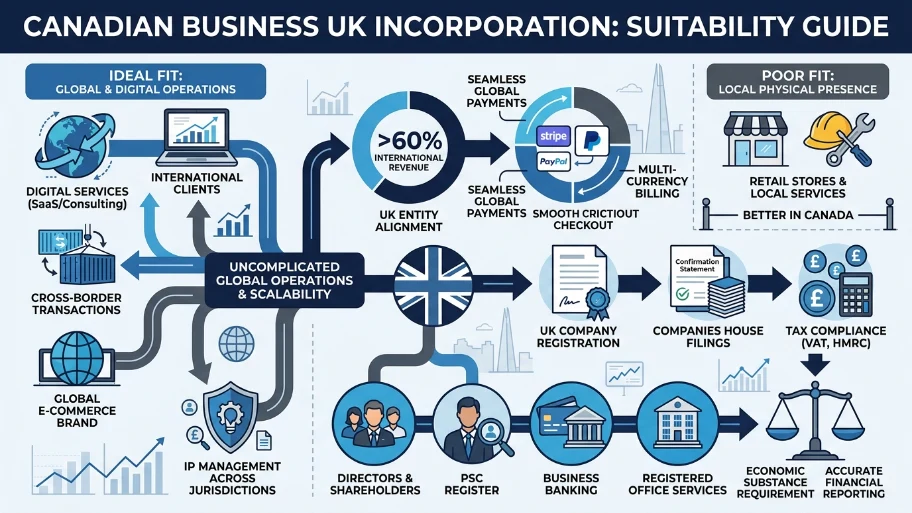
Canadian businesses benefit most from UK incorporation when they operate digitally, serve international clients, or rely on cross-border transactions. Service-based companies, e-commerce brands, and consultants gain efficiency, scalability, and simplified global operations through a UK entity.
Not all businesses require a UK structure. Local service providers, such as construction firms or retail stores, operate more effectively within Canada.
The UK model suits businesses with location-independent operations. These include:
- Deliver digital services such as SaaS, consulting, or marketing
- Sell products internationally through e-commerce platforms
- Manage intellectual property across multiple jurisdictions
Revenue source determines suitability. When over 60% of revenue originates outside Canada, a UK company often aligns better with operational needs. Payment processing also improves. UK entities integrate easily with global payment gateways like Stripe and PayPal. This reduces transaction friction and supports multi-currency billing. Compliance remains critical. Businesses must demonstrate economic substance and maintain accurate financial reporting to avoid regulatory issues.
How does the Canada–UK tax treaty support this structure?
The Canada–UK tax treaty supports UK company structures by preventing double taxation, reducing withholding taxes, and clarifying tax residency rules. It allows Canadian entrepreneurs to operate internationally while maintaining compliance in both jurisdictions.
The treaty defines how income is taxed between the two countries. It ensures that the same income is not taxed twice, which protects profitability. Dividend withholding tax is reduced under treaty provisions. Interest and royalty payments also benefit from lower rates compared to non-treaty jurisdictions.
Three key treaty mechanisms include:
- Allocate taxing rights between Canada and the UK based on income type
- Reduce withholding tax rates on cross-border payments
- Define permanent establishment rules to avoid unintended tax exposure
Permanent establishment rules are especially important. If a Canadian entrepreneur operates a UK company but conducts core activities in Canada, tax obligations may shift back to Canada. Understanding these rules ensures compliance while preserving the intended tax advantages.
What is the process for Canadians to open a UK company?
Canadians open a UK company by registering with Companies House, appointing directors, providing a UK registered address, and completing identity verification. The process is fully remote and typically completed within 48 hours using a structured service provider.
The process follows a defined sequence. Each step must meet UK compliance standards.
Key steps include:
- Register company details with Companies House
- Verify director identity using official documents
- Provide a UK-registered office address
- Issue shares and define ownership structure
A registered address is mandatory. This address receives official correspondence and ensures legal compliance. Identity verification uses government-issued ID and digital validation systems. This step aligns with UK anti-money laundering regulations. For Canadians seeking a streamlined setup, the UK company formation services for Canadian residents are available. These services manage documentation, compliance checks, and registration within a single workflow.
How does this compare to keeping a Canadian corporation?
Keeping a Canadian corporation remains beneficial for domestic operations, local revenue, and access to Canadian tax credits. However, it introduces higher administrative complexity and less flexibility for international expansion compared to a UK company structure.
Canadian corporations provide advantages when operations are local. Tax credits such as the Small Business Deduction reduce effective tax rates for qualifying businesses. However, complexity increases with scale. Multiple filings, residency requirements, and layered taxation create administrative overhead.
Comparison factors include:
- Maintain local benefits such as Canadian tax credits and incentives
- Manage dual compliance across federal and provincial systems
- Handle stricter director residency requirements
International businesses often outgrow this structure. As cross-border revenue increases, limitations in flexibility and efficiency become more visible.
Entrepreneurs evaluating this decision benefit from understanding treaty advantages in detail. The article on UK company formation from Canada and tax treaty benefits provides a deeper breakdown.
Explore our Cambodian guide,
Why a UK Company Helps Cambodian Founders Unlock Stripe, PayPal, and Global Payments
When is the right time to transition to a UK company?
The right time to transition occurs when international revenue exceeds domestic income, administrative complexity slows growth, or global clients require a UK-based entity. These indicators signal that a UK company structure aligns better with operational and financial goals.
Timing depends on measurable business factors. Growth stage, revenue distribution, and client geography all influence the decision.
Clear transition indicators include:
- Generate over 50% of revenue from outside Canada
- Serve clients who prefer UK or EU-based contracts
- Experience delays due to Canadian administrative requirements
Early-stage startups may not require this structure. However, scaling businesses often benefit from transitioning before operational friction increases. A structured transition ensures compliance. It includes closing or restructuring Canadian entities where necessary and aligning accounting practices across jurisdictions. Decision-focused guidance is available in the resource on forming a UK company from Canada with expert support.
A UK company provides Canadian entrepreneurs with a strategic advantage when operating internationally. It improves tax efficiency, reduces administrative complexity, and strengthens global credibility. These benefits depend on proper structuring, compliance, and alignment with business goals.
From My Company supports Canadians through compliant UK company formation, structured onboarding, and regulatory alignment. Their service ensures that incorporation, verification, and documentation meet UK standards while remaining accessible remotely. Businesses with global revenue streams, digital operations, and cross-border clients gain the most from this approach. A clear evaluation of revenue sources, tax exposure, and expansion plans determines whether this structure delivers measurable value.
Frequently Asked Questions
Can Canadians register a UK company without living in the UK?
Yes. Canadians can register a UK company remotely without UK residency, and From My company helps with the incorporation process, registered address requirements, and identity checks for Canada-focused applicants.
Why would a Canadian choose a UK company instead of a Canadian corporation?
A UK company can suit Canadians who sell to UK, EU, or global clients and want simpler cross-border operations. It often fits businesses that value international credibility, remote administration, and treaty-based tax planning.
Is a UK company better for Canadian freelancers and consultants?
A UK company often works well for Canadian freelancers and consultants who invoice overseas clients. It can support multi-currency payments, cleaner international contracting, and a structure that aligns with cross-border service income.
How long does it take to form a UK company from Canada?
UK company formation is usually fast, and many registrations are completed within 24 to 48 hours once documents are verified. From My company supports Canada-based founders through the required setup steps and compliance checks.
Does a Canadian resident pay tax in both Canada and the UK?
Not always. Tax depends on where the company is managed, where income is earned, and how the Canada–UK tax treaty applies to the structure, so proper setup is essential for avoiding double taxation.