Company Name and Structure Changes
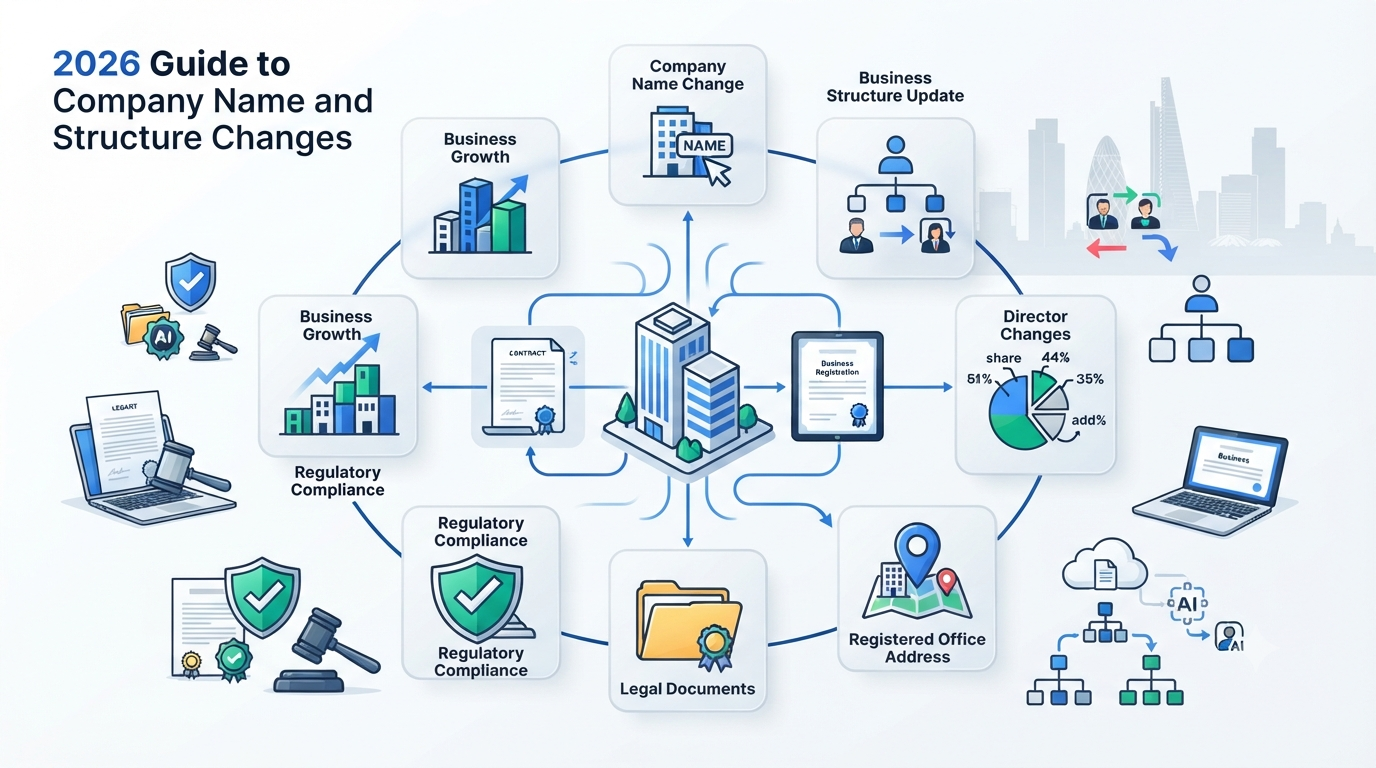
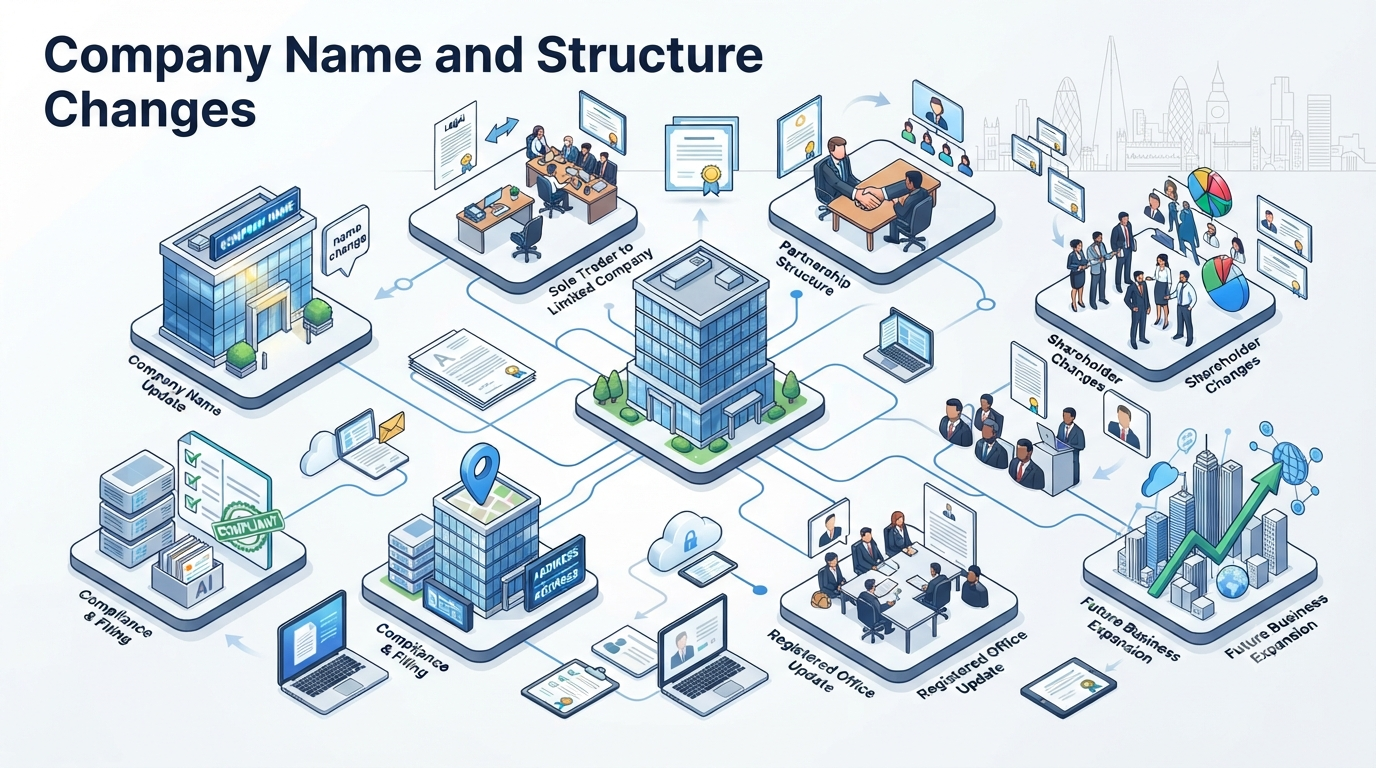
Your UK limited company’s name and structure aren’t fixed at incorporation. As your business evolves, grows, rebrands, or restructures, you may need to change one or both. Common changes include updating your company name after a rebrand, converting from private limited to public limited status, or restructuring for tax or commercial reasons. Each type of change involves specific Companies House filings, board resolutions, and coordination with your other advisers. At Form My Company, we handle company name and structure changes as part of our compliance services. This guide walks you through the main types of changes UK companies make and how to do each one correctly.
The Main Types of Company Name and Structure Changes
UK companies typically go through several types of changes:
Company name changes. Updating the registered name of the company.
Company type changes. Converting between private limited (Ltd) and public limited (PLC), or other structural changes.
Article changes. Updates to the company’s Articles of Association.
Share capital restructures. Changing share classes, values, or structure.
Structural reorganisations. Broader corporate structure changes.
Registration jurisdiction. Rarely, moving between UK jurisdictions.
Group restructures. Reorganising parent-subsidiary relationships.
Each involves its own process and requirements.
Company Name Changes: When and Why
Companies change their name for many reasons:
Rebrand. Refreshing the business identity for market positioning.
Business direction change. Reflecting a shift in business focus.
Merger or acquisition. Aligning with new ownership.
Trademark issues. Where the current name conflicts with existing trademarks.
Domain availability. Aligning company and domain names.
Legal issues. Where the name causes problems.
Founder or family reasons. Personal reasons for renaming.
Compliance issues. Where the current name has been challenged.
Correction of errors. Fixing incorrect information from formation.
Marketing strategy. Better name for the target audience.
Whatever the reason, the Companies Act 2006 provides the framework for legitimate name changes.
How to Change Your Company Name
Step 1: Choose the New Name
Ensure the new name meets requirements:
Available. Not already used by another UK company.
Distinctive. Sufficiently different from existing names.
Not misleading. Doesn’t imply features you don’t have.
Complies with sensitive word restrictions. Certain words require permission (like “royal,” “national,” “authority”).
No offensive content. Companies House can reject inappropriate names.
Ends in Ltd, Limited, PLC, or equivalent. Depending on your company type.
Companies House check. Verify availability through the Companies House name checker.
Step 2: Confirm Trademark Position
Consider trademark implications:
Existing marks. Check whether the new name conflicts with existing UK trademarks.
Your own marks. Whether the new name is protected.
Domain names. Availability of matching domains.
Marketplace considerations. For online sellers, marketplace availability matters.
International considerations. For non-resident businesses, home country trademark position.
Working with a qualified UK trademark attorney is often worth it before finalising a name change.
Step 3: Pass the Right Resolution
Different resolutions may be needed:
Special resolution. Most common for changing a company name. Requires 75% shareholder approval.
Ordinary resolution. Sometimes sufficient depending on your Articles.
Written resolution. Where directors have authority under the Articles.
Board resolution. In addition to shareholder resolution.
Check your Articles of Association for the specific procedure required.
Step 4: File Form NM01
Companies House Form NM01 is used for name changes:
Access WebFiling. Through Companies House online service, or through an ACSP.
Enter new name. With confirmation of availability check.
Attach special resolution. As part of the filing.
Provide effective date. When the change takes effect.
Board and shareholder signatures. As per Articles requirements.
Filing fee. £8 currently applies to name changes.
Certificate of Incorporation. New certificate issued with the new name.
Step 5: Update All Related Records
The Companies House filing is one step. Update:
Business bank account. Under the new name.
HMRC records. For Corporation Tax, VAT, PAYE.
Business insurance. Under the new name.
Client and supplier contracts. Where the name is referenced.
Marketing materials. Website, letterhead, business cards, all needing updating.
Domain names. Register the new name in relevant domains.
Marketplaces. For online sellers.
Company registers. Internal statutory records.
Professional advisers. Your accountant, solicitor, auditor.
Employees and stakeholders. Communication of the change.
Regulatory bodies. For any specific regulated activities.
Coordinating these updates prevents mismatches and confusion.
Company Type Changes: Ltd to PLC
Converting from private limited (Ltd) to public limited (PLC) is a significant structural change:
Why convert to PLC.
- Preparing for IPO or public listing
- Meeting investor requirements
- Enhanced corporate credibility
- Access to public markets
- Preparation for larger transactions
Key requirements.
- Minimum £50,000 share capital (with at least £12,500 paid up)
- Companies Act 2006 requirements for PLCs
- Appointment of Company Secretary (required for PLCs)
- Auditor appointment
- Enhanced disclosure requirements
- Bank confirmation of share capital
Process.
- Board resolution
- Shareholder special resolution
- Companies House Form NM01 (with additional PLC-specific requirements)
- Companies House Form RR01 for re-registration
- Filing fee (higher for re-registration)
- New Certificate of Incorporation issued
Timing.
- Typically 3-6 weeks from filing
- Requires careful coordination with your professional advisers
Converting to PLC is a significant step. Most companies don’t do this without substantial professional advice.
Converting from PLC to Ltd
The reverse conversion is also possible:
Reasons.
- Simplified compliance
- Reduced disclosure requirements
- Private ownership again
- Cost efficiency
- Post-IPO delisting or restructuring
Process similar to Ltd to PLC but simpler.
Requirements less demanding.
Timing typically 2-4 weeks.
Requires special resolution and coordination with Companies House.
Articles of Association Changes
Your Articles govern how the company operates. Changes may include:
Share structure changes. Adding new share classes.
Voting rights modifications. Changing how decisions are made.
Director requirements. Adjusting director powers or appointment rules.
Distribution provisions. How dividends are handled.
Winding-up procedures. Company closure rules.
Corporate governance updates. Board composition, meetings, etc.
Investor requirements. Reflecting new investment terms.
Family or ownership structure changes.
Regulatory compliance updates.
Process for Articles Changes
Board consideration. Draft the changes.
Legal review. Ensuring compliance with UK law.
Shareholder special resolution. 75% approval typically required.
Companies House filing. Form(s) depending on specific changes.
Filing deadline. Usually within 15 days of the resolution.
Filing fee. Varies by specific change.
For substantive Articles changes, working with a qualified UK solicitor is usually essential.
Share Capital Restructures
Companies commonly need to restructure their share capital:
Share allotment. Issuing new shares.
Share transfers. Between existing shareholders.
Share consolidation. Reducing share numbers by combining.
Share subdivision. Increasing share numbers by dividing.
Share buybacks. Company buying back its own shares.
Reduction of share capital. Reducing total capital.
Multi-class share structures. Creating different share classes.
Convertible shares. Convertible into other securities.
Preference shares. Priority for dividends or capital.
Each has its own process and Companies House filings.
Broader Structural Reorganisations
Larger structural changes might involve:
Company mergers. Combining two companies.
Group restructures. Reorganising parent-subsidiary relationships.
Demergers. Splitting company into separate entities.
Cross-border restructures. For international groups.
Asset transfers. Between related companies.
Corporate simplification. Removing unnecessary corporate entities.
Tax-driven restructures. For efficiency or optimisation.
Investment-driven restructures. For new capital or shareholders.
Pre-acquisition or pre-sale restructures. Preparing for transactions.
These typically require qualified legal advice from a solicitor experienced in corporate law.
Common Mistakes to Avoid
A few issues come up regularly:
Not checking name availability first. Wasting time on a name that can’t be used.
Missing filing deadlines. Companies House expects timely filings.
Not obtaining proper resolutions. Companies Act 2006 requires specific approvals.
Not updating related records. Bank, HMRC, insurance, and other records need updates.
Not coordinating with your accountant. For tax implications.
Not consulting a solicitor for complex changes. For substantive structural changes.
Missing trademark implications. Especially for name changes.
Not communicating with stakeholders. Employees, clients, and partners need advance notice.
Ignoring regulatory considerations. For specific business sectors.
Rushing the process. Adequate planning matters.
Not documenting properly. For future reference.
Professional support significantly reduces these risks.
When to Get Professional Support
Consider professional help when:
Complex structural changes. Anything beyond straightforward name changes.
Ltd to PLC conversion. Or vice versa.
Substantial Articles changes. Especially those affecting shareholder rights.
Share capital restructures. Multiple share classes, buybacks, or reductions.
Corporate mergers or reorganisations. Requiring legal expertise.
International considerations. Cross-border restructuring.
Tax planning implications. For structural changes.
Regulated sectors. Where specific compliance applies.
Litigation or dispute considerations. Where changes could affect legal position.
Investor requirements. Where investors mandate specific structural changes.
For material changes, working with a qualified UK solicitor and accountant is usually essential.
Non-Resident Considerations
For non-resident owners planning structural changes:
Coordinating from abroad. Time zones and communication add friction.
UK tax implications. For restructures.
Home country tax implications. Your country of residence may tax differently.
Companies House coordination. Requires UK-based service provider or professional adviser.
Board resolution logistics. Meetings from abroad.
Documentation. Board resolutions and statutory records.
Ongoing compliance. During and after changes.
Professional advice. UK-based legal and tax advisers essential.
ACSP coordination. For efficient Companies House filings.
For non-resident owners, coordinating structural changes with UK-based professional support is essentially standard practice.
The ECCTA Impact on Company Changes
Under the Economic Crime and Corporate Transparency Act:
Enhanced Companies House scrutiny. Of company name and structural changes.
Identity verification requirements. For directors and PSCs during changes.
Confirmation statement coordination. Reflecting changes.
PSC register updates. For structural changes affecting ownership.
Statutory register maintenance. For all changes.
Failure to Prevent Fraud considerations. For service providers handling changes.
Enhanced enforcement. Where changes don’t meet requirements.
Public register visibility. All changes visible on Companies House record.
Getting changes right under the current ECCTA framework matters more than ever.
How Form My Company Handles Company Changes
We provide comprehensive support for UK company name and structure changes as an Authorised Corporate Service Provider (ACSP). We can:
File company name changes. Form NM01 and related documentation.
Update Companies House records. For all changes.
Handle Articles updates. Where straightforward.
Coordinate with your solicitor. For complex legal changes.
Coordinate with your accountant. For tax implications.
Update statutory registers. For internal records.
Provide UK correspondence address. For post-change compliance.
Support identity verification. For directors and PSCs during changes.
Point you toward specialists. For substantive legal or tax-driven changes (solicitors, accountants).
Non-resident support. Coordinating changes from abroad.
Bundle with wider compliance. As part of ongoing service.
For straightforward name changes and basic Companies House filings, we handle the paperwork professionally. For substantive legal changes, we coordinate with qualified UK solicitors.
Make Your Company Changes Correctly Today
Company name and structure changes are significant statutory events with real compliance implications. Getting them right, whether it’s a simple name change or a substantive corporate restructure, sets your business up for smooth ongoing operation. With Form My Company, name and structural changes are straightforward and fully supported for the compliance aspects. For complex legal or tax-driven restructuring, we point you toward qualified specialists. Get in touch today to discuss your specific changes.
Frequently Asked Questions
How do I change my UK company name?
Pass a special resolution (typically 75% shareholder approval), file Form NM01 with Companies House, pay the £8 filing fee, and update all related records (bank, HMRC, insurance, contracts). The change takes effect once Companies House accepts the filing.
What’s the fee to change a company name?
£8 for Form NM01 filing at Companies House. Additional costs may apply for related work (bank updates, insurance changes, professional support).
Can I change from Ltd to PLC?
Yes, through re-registration. Requires minimum £50,000 share capital (with £12,500 paid up), Company Secretary appointment, auditor appointment, and various other requirements. Typically takes 3-6 weeks.
Can I change from PLC to Ltd?
Yes, through re-registration. Generally simpler than the Ltd to PLC conversion but still requires proper resolutions and Companies House filings.
Do I need a Company Secretary for a PLC?
Yes, legally required. PLCs must appoint a Company Secretary with specific qualifications. Private limited companies don’t have this requirement.
Can I change my Articles of Association?
Yes, through special resolution and Companies House filing. Some changes are straightforward; others (like affecting shareholder rights) benefit from legal review. Professional support is often essential.
How do share capital restructures work?
Depend on the specific type. Share allotments, transfers, consolidations, subdivisions, and buybacks each have specific Companies House filings and Companies Act 2006 requirements. Professional support is often essential.
Can Form My Company handle my company name change?
Yes. As an ACSP, we handle NM01 filings, update statutory records, coordinate with HMRC updates, and support related compliance. For complex structural changes (Ltd to PLC, substantive Articles updates, mergers), we coordinate with qualified UK solicitors.