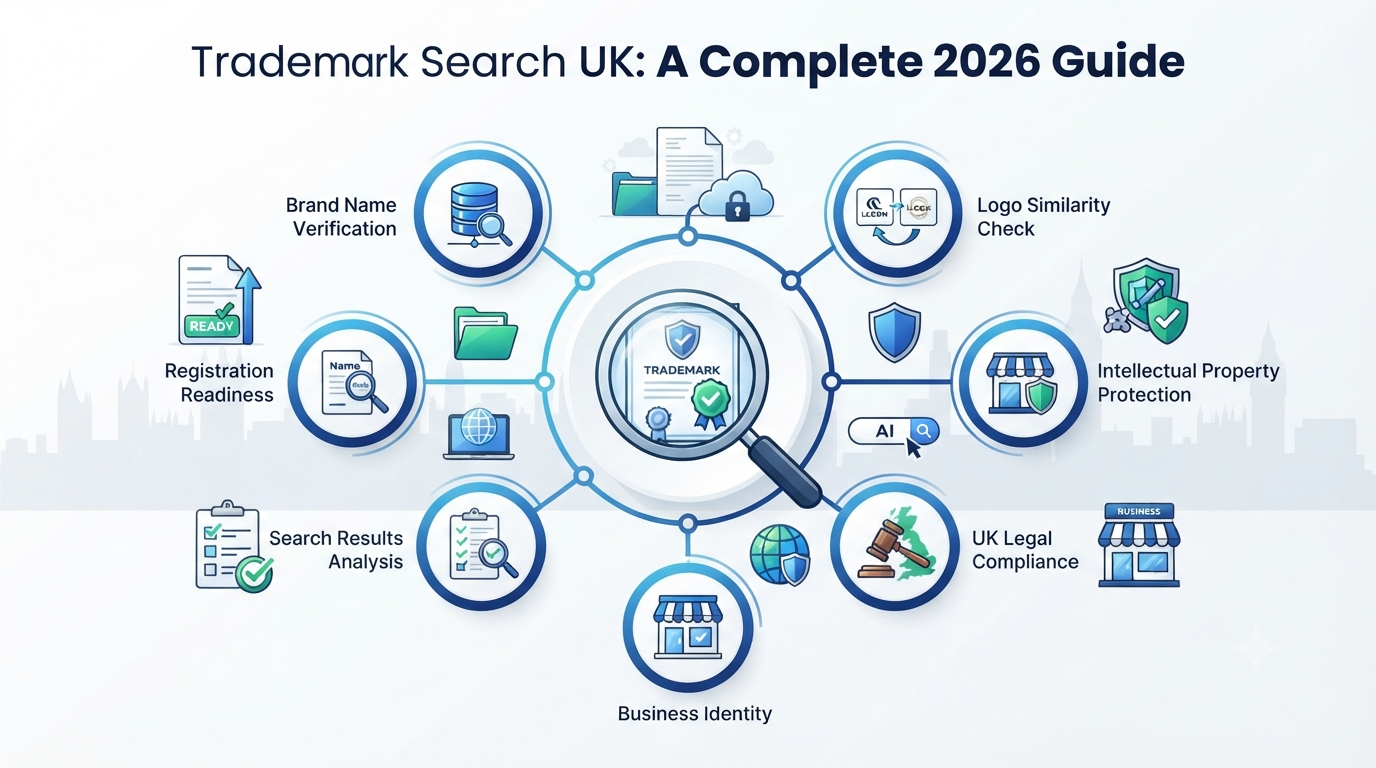
Trademark Search UK
Before you register a UK trademark, invest in marketing, or launch your brand into the UK market, doing a thorough trademark search is one of the most valuable steps you can take. A proper search identifies existing trademarks that could conflict with yours, prevents costly rejections at the UK Intellectual Property Office (UK IPO), and helps you make informed decisions about your brand strategy. At Form My Company, we help UK company owners build strong foundations for their businesses. For trademark work specifically, we point you toward qualified UK trademark attorneys who conduct specialist searches. This guide explains everything you need to know about UK trademark searches in 2026.
What Is a UK Trademark Search?
A UK trademark search is a check to see whether your proposed trademark (or similar marks) is already registered or being used in the UK. Searches can be:
Basic searches. Looking for identical or very similar marks on the register.
Comprehensive searches. Including similar marks, phonetically similar variations, and marks in adjacent classes.
Common law searches. Checking for unregistered marks that could still create legal rights.
International searches. Extending to trademarks registered in other territories that might affect UK use.
Trade name searches. Checking for existing company names, trading names, and domain names.
Google and web searches. Identifying any existing use of similar marks online.
Marketplace searches. For sellers on Amazon, eBay, or Etsy who need to check marketplace usage.
The depth of search depends on your situation and how much risk you can tolerate.
Why Trademark Searches Matter
A proper trademark search is valuable for several reasons:
Preventing rejection. UK IPO can reject applications where existing marks are similar, wasting your £170 filing fee.
Avoiding legal disputes. Discovering conflicting marks early prevents expensive legal action later.
Making informed decisions. Understanding the trademark landscape helps you make strategic choices.
Protecting investment. Confirming your mark is available before spending on branding, marketing, and marketplace listings.
Enabling adjustments. If your intended mark has issues, you can modify it before launching.
Preventing opposition. Third parties can challenge similar marks during the opposition period.
Building brand strategy. Understanding the competitive landscape supports better brand decisions.
Avoiding infringement. Preventing accidental infringement of others’ marks.
Supporting registration success. Well-researched marks have significantly higher success rates.
Reducing costs long-term. Preventing disputes is cheaper than resolving them.
For most businesses, a proper search is one of the best investments in trademark strategy.
When to Conduct a UK Trademark Search
Timing matters. Search when:
Choosing a brand or business name. Before committing to it.
Before UK IPO application. To improve success rates.
Before significant marketing investment. Protect your marketing spend.
Before licensing or selling. Understanding what you actually own.
Before international expansion. Ensuring the mark is available in target markets.
When rebranding. Verify new brand elements are clear.
Before marketplace launches. Amazon, eBay, and Etsy check trademark existence.
Ongoing monitoring. Regular checks to detect potential infringement.
Before enforcement action. Confirm your position before challenging others.
Periodically. As your business grows and evolves.
Searching early prevents late-stage problems that are much more expensive to resolve.
Free UK IPO Search
The UK IPO offers free trademark search services:
Basic Trademark Search. Search the trademark register by mark, applicant, or classification.
IPO Search Tool. Available at gov.uk/search-for-trademark.
Registered Marks Only. Doesn’t include pending applications until published.
Basic Filtering. By classification, status, and other criteria.
Free of Charge. No cost for basic searches.
Immediate Results. Instant search response.
Good for Initial Screening. Rules out obvious conflicts.
Not Comprehensive. Doesn’t catch phonetically similar marks, adjacent classes, or subtle variations.
No Legal Advice. Just results, without professional interpretation.
For an initial check on whether your intended mark is available, the free UK IPO search is valuable. For comprehensive protection, professional searches typically add significant value.
Professional Trademark Search Services
For material trademark decisions, professional searches offer:
Comprehensive search coverage. Beyond exact matches, including phonetically similar marks, adjacent classes, and stylised variations.
Professional interpretation. Assessment of what search results mean for your specific brand.
Risk assessment. Understanding the risk of oppositions, objections, or conflicts.
Search strategy advice. Where to concentrate search efforts based on your business.
International search coordination. Beyond just UK, for global brand strategy.
Common law search. For unregistered but potentially conflicting marks.
Domain name research. Aligning trademark and domain strategy.
Marketplace searches. For online sellers.
Ongoing monitoring. Regular checks to detect new potential conflicts.
Documentation. Professional records of search performed.
Professional searches are typically conducted by qualified UK trademark attorneys.
Types of Trademark Searches
Different search types serve different purposes:
Identical Mark Search
Looking for. Exact matches on the UK IPO register.
Purpose. Ruling out identical existing marks.
Depth. Basic, quick.
Cost. Free through UK IPO, or minimal via professional services.
Best for. Initial screening.
Similar Mark Search
Looking for. Marks that are similar in appearance, sound, or meaning.
Purpose. Identifying marks likely to cause consumer confusion.
Depth. More comprehensive.
Cost. Usually charged by professionals.
Best for. Genuine registration decisions.
Phonetic Similarity Search
Looking for. Marks that sound similar even if spelled differently.
Purpose. Catching marks that consumers might confuse when spoken.
Depth. Requires professional interpretation.
Cost. Usually included in comprehensive searches.
Best for. Marks that will be spoken (radio ads, verbal marketing).
Classification Search
Looking for. Existing marks in specific classifications (goods or services).
Purpose. Understanding the landscape in your commercial space.
Depth. Comprehensive within specified classes.
Cost. Varies by scope.
Best for. Choosing classifications and understanding competition.
Common Law Search
Looking for. Unregistered but potentially conflicting marks (used in commerce even without registration).
Purpose. Identifying non-registered use that could still create legal rights.
Depth. Genuine research effort.
Cost. Typically £200 to £1,000 for professional common law searches.
Best for. Comprehensive protection before significant investment.
International Search
Looking for. Similar marks registered in key international markets.
Purpose. Supporting international brand strategy.
Depth. Varies by market.
Cost. Significant for comprehensive international coverage.
Best for. Businesses planning multi-territory brand protection.
Trademark Watch
Looking for. Ongoing monitoring for new applications similar to yours.
Purpose. Detecting potential opposition targets before your mark is registered.
Depth. Automatic ongoing monitoring.
Cost. Annual subscription typically £100 to £500.
Best for. After you’ve registered your own mark.
What Search Results Mean
Understanding search results requires interpretation:
No conflicts found. Doesn’t guarantee application success, but is favourable.
Similar marks in different classes. Usually not a conflict for your specific goods/services.
Similar marks in your class. Requires careful evaluation of the specific similarity.
Recently filed applications. May not yet be visible to the public.
Marks under opposition. Can create risk if the opposition succeeds.
Expired marks. Can be re-registered by others, so aren’t necessarily “free.”
Cancelled marks. Available but check the reason for cancellation.
Well-known marks. Have extra protection beyond just registered classes.
Common law rights. Even unregistered marks can create legal rights through commercial use.
International marks in your territory. Foreign registered marks can affect UK use.
Interpretation of results is where professional expertise really matters.
Common Search Mistakes
A few issues come up regularly:
Only searching for exact matches. Missing similar variations.
Not searching phonetically similar marks. Where consumer confusion is likely.
Ignoring adjacent classes. Where similar goods/services overlap.
Not considering common law rights. Unregistered marks can still be relevant.
Missing international considerations. Foreign marks can affect UK use.
Assuming Companies House registration means trademark protection. They’re different.
Not checking domain names. Domain and trademark strategy should align.
Overlooking pending applications. Not yet published but relevant.
Ignoring cancelled or expired marks. May be re-registered.
Not documenting search efforts. Important for future reference.
Believing “no conflicts” means guaranteed registration. Search results are a starting point, not a guarantee.
Not consulting a professional. For anything beyond preliminary screening.
Professional support significantly improves search quality and interpretation.
Non-Resident Considerations
For non-residents planning UK trademark searches:
English-language searches. UK IPO operates in English.
UK-specific classifications. Following UK IPO classification standards.
Time zone considerations. For coordinating with professional advisors.
International considerations. Where UK is one of multiple markets.
Local counsel coordination. Working across borders.
Trademark strategy across territories. UK often connects to broader strategy.
Home country priorities. Existing home country registrations may support UK applications.
Cultural and linguistic factors. For international brands, considering how the mark works in UK English.
For non-residents especially, working with a qualified UK trademark attorney significantly smooths the process.
Search Strategy for Non-Residents
A practical approach for non-residents:
Start with free UK IPO search. For initial screening.
Identify potential red flags. Any close matches or concerns.
If red flags found. Consult a qualified UK trademark attorney before proceeding.
If preliminary check is clean. Consider professional comprehensive search before filing.
For material brand investment. Full professional search including common law is often worth it.
Monitor ongoing. After registration, watch for new potentially conflicting applications.
Coordinate with international strategy. UK searches integrate with broader IP planning.
Document everything. For future reference and dispute resolution.
For non-resident businesses building genuine UK brand presence, professional trademark search support is usually a valuable investment.
Trademark Search vs Business Name Check
Understanding the distinction:
Companies House business name check. Confirms whether a company name is available for registration. Doesn’t confirm trademark availability.
Trademark search. Confirms whether a mark is available for trademark registration. Considers broader factors than just identical name conflicts.
Domain name check. Separate from both, checking availability of web domains.
Marketplace name check. For Amazon, eBay, or similar platforms.
A comprehensive brand strategy considers all four types of check, not just one.
Costs of UK Trademark Searches
Costs vary significantly by depth:
Free UK IPO search. No cost for basic identical mark searches.
Basic professional search. Typically £150 to £400.
Comprehensive professional search. Typically £400 to £1,500.
Comprehensive with common law. Typically £800 to £2,500.
International coverage. Adds significantly.
Ongoing trademark watch. £100 to £500 per year.
For most businesses, initial free searches plus professional comprehensive search before filing is a sensible approach.
After the Search: Making Decisions
Search results guide next steps:
Proceed with confidence. If searches show clear path.
Adjust the mark. Modify to avoid conflicts.
Choose different classifications. If specific classes are problematic.
Consider licensing arrangements. If existing marks are relevant.
Enter opposition proceedings. If needed against similar applications.
Delay filing. To resolve issues first.
Seek clearance from existing rights holders. Where relevant.
Redesign brand strategy. If fundamental issues emerge.
Consult specialist advice. For complex situations.
Search results are the input to informed decisions rather than the end of the process.
How Form My Company Fits with UK Trademark Search
Form My Company is an Authorised Corporate Service Provider (ACSP) focused on UK company formation, ongoing compliance, VAT registration, and Companies House work. UK trademark searches are a specialist IP area that we don’t handle directly:
We don’t conduct trademark searches ourselves. UK trademark work requires specialist qualification and experience.
We point you toward qualified UK trademark attorneys. For search and registration work.
We support the broader UK business foundation. Registered office, identity verification, and Companies House compliance.
We coordinate with your trademark attorney. For alignment between compliance and IP work.
We’re transparent about our expertise. Compliance work is our strength; IP work is specialist territory.
We help establish the foundation. For UK companies that then invest in trademarks and IP.
We support ongoing coordination. So compliance and IP work integrate.
For trademark searches and registration itself, work with a qualified UK trademark attorney. Form My Company handles the compliance foundation on which your UK IP strategy can build.
Get Professional UK Trademark Search Support
A proper UK trademark search is one of the best investments you can make before registering a mark, launching a brand, or making significant marketing commitments. Working with a qualified UK trademark attorney typically delivers the depth of search and interpretation that DIY searches can’t match. Form My Company can help you establish the UK company foundation while you work with a specialist trademark attorney for the IP work itself. Get in touch today about your UK company formation and compliance needs.
Frequently Asked Questions
How do I do a UK trademark search?
Start with the free UK IPO search tool at gov.uk/search-for-trademark for initial screening. For material trademark decisions, engage a qualified UK trademark attorney for comprehensive searches including similar marks, phonetically similar variations, and adjacent classes.
Is the free UK IPO search enough?
For initial screening, yes. It identifies obvious conflicts with existing registered marks. For material trademark decisions (registration, branding investment, or business planning), professional comprehensive searches typically add significant value.
What’s the difference between identical and similar mark searches?
Identical searches only look for exact matches on the register. Similar mark searches look for marks that could cause consumer confusion, including phonetically similar variations, adjacent classes, and stylised differences. Similar mark searches require professional interpretation.
How much does a professional UK trademark search cost?
Basic professional searches typically £150 to £400. Comprehensive searches with expert interpretation typically £400 to £1,500. Full common law searches and international coverage can be higher.
Does Companies House registration check trademark availability?
No. Companies House only checks whether a company name is available for company registration. It doesn’t check trademarks. Trademark registration is separate and requires its own search.
Should I search before I register my UK trademark?
Yes. Proper search significantly improves your success rate at UK IPO and reduces the risk of expensive disputes later. It’s usually the best investment you can make before applying.
Does Form My Company conduct UK trademark searches?
No. UK trademark search is a specialist area we don’t handle directly. We work with qualified UK trademark attorneys as your specialist IP partner. Form My Company focuses on UK company formation, Companies House compliance, VAT registration, and ongoing statutory work.
How do I find a UK trademark attorney?
The Intellectual Property Regulation Board (IPReg) maintains a register. The Chartered Institute of Trade Mark Attorneys is a professional body. Referrals from business advisors, other IP professionals, or corporate services providers can also help.