
Forming a UK company from Canada delivers treaty-based tax relief and global trading advantages. The UK–Canada tax treaty allocates taxing rights, prevents double taxation, and applies reduced withholding rates. Canadians gain direct access to UK corporate structures, clear compliance rules, and efficient cross‑border operations.
What tax treaty benefits apply when Canadians form a UK company in 2026?
The UK–Canada tax treaty applies reduced withholding rates, prevents double taxation, and allocates taxing rights between Canada and the UK. Directors report profits under entity residence rules. Canadian residents apply foreign tax credits against UK taxes under treaty articles.
The UK–Canada tax treaty defines how authorities tax cross-border income. The treaty allocates taxing rights across corporate profits, dividends, interest, and royalties. These rules provide predictable treatment for owners living in Canada while operating an incorporated entity in the United Kingdom.
The treaty prevents double taxation through credit-based relief. Canadian residents declare overseas income and then apply foreign tax credits equal to UK taxes paid. Revenue agencies validate credit claims using article-based references. This creates a single layer of taxation on the final reported profit figure.
The treaty applies specific withholding reductions. Dividends fall under defined rates when paid to foreign owners. Article-based exemptions apply when the UK company holds business substance and meets beneficiary rules. These rates support efficient repatriation of profits into Canada.
The treaty includes permanent establishment definitions. These rules confirm that a UK‑registered company remains taxed in the UK when its strategic management stays outside Canada. Canadian authorities recognise these definitions when assessing corporate residency questions. This reduces residency disputes and provides operational clarity.
Read our articles, When it makes sense for Canadians to open a UK company instead of a local corporation and Form Your UK Company from Canada with Form My Company.
How does a UK company help Canadians manage global operations?
A UK company provides recognised corporate status, stable regulatory frameworks, and strong access to international markets. Canadian entrepreneurs use UK entities to register suppliers, validate cross‑border payments, and structure partnerships with European and Asian distributors.
UK limited companies support expansion into European and global markets. International suppliers often request UK corporate credentials during onboarding checks. These entities pass verification through Companies House records. The records authenticate directors, addresses, and share structures.
A UK entity streamlines currency operations. British banks process multi‑currency payments using defined compliance frameworks. This stabilises payments for companies selling into Europe, the Middle East, and Asia. Many platforms prioritise UK companies during risk scoring because of clear reporting obligations.
A UK limited company supports transparent governance. Directors file annual confirmation statements and accounts. These filings create a permanent compliance record. International clients often review these filings before signing high‑value contracts. Clear compliance builds commercial trust.
Canadian founders use the UK structure to negotiate with global logistics providers. Carriers recognise UK entities during onboarding because the entities pass standardised risk checks. This accelerates account activation timelines. The UK corporate environment delivers predictable processes. Registrars publish processing times and verification steps. Investors review these details when evaluating cross‑border holdings. This transparency supports operational planning for Canadian entrepreneurs entering new markets.
What compliance responsibilities apply to Canadians forming a UK company?
A UK company must file annual accounts, confirm director information, maintain statutory registers, and validate identity checks. Canadian‑based directors complete digital verification using passport scans and address documents under UK anti‑money‑laundering rules.
Directors submit identity information through regulated verification systems. These systems authenticate passport details, match biometric data, and validate address records. Companies House links each verification to the director’s profile. This process confirms the legitimacy of Canadian‑based ownership.
The company files annual accounts. Micro-entity accounts summarise financial activity using balance sheet statements and supporting notes. Accountants prepare these filings using UK GAAP rules. Companies House publishes the records, and the public can review them.
The entity files a confirmation statement every twelve months. This statement verifies shareholder details, addresses, and control structures. The filing maintains transparent ownership data for global regulators and partners. UK companies maintain statutory registers. These registers track shares, directors, and persons with significant control. Officers update these records during structural changes. Regulators review register accuracy during compliance audits.
The company maintains a registered office in the United Kingdom. Service providers receive official letters from regulators and forward them to Canadian directors. This address ensures timely compliance communication.
How can Canadians reduce cross‑border administrative burdens with a UK company?
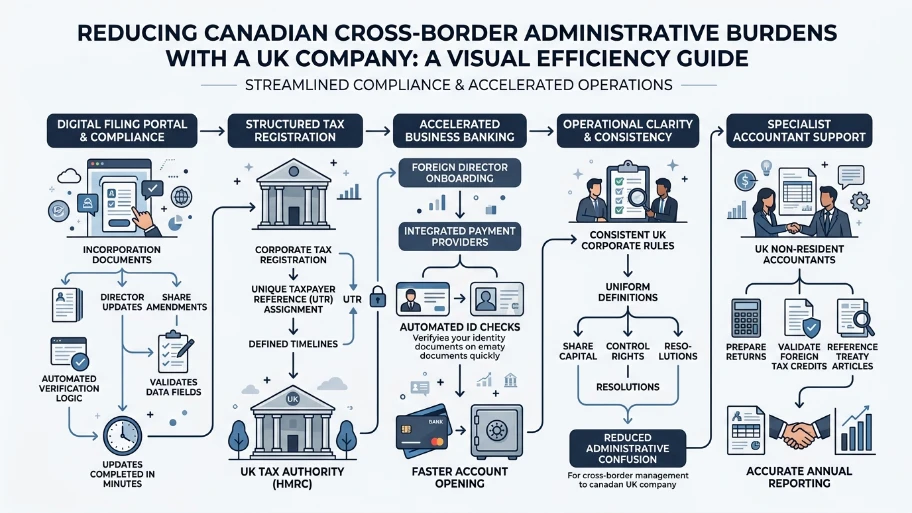
Canadians reduce administrative burdens by using UK digital filing systems, streamlined compliance portals, and centralised banking frameworks. UK systems manage identity checks, corporate changes, and tax registrations through structured, predictable processes.
Digital filing portals manage incorporation, director updates, and share amendments. These systems validate data fields and check compliance requirements before submission. Directors complete updates in minutes because the system automates verification logic.
The UK tax authority provides structured corporate tax registration processes. Registration assigns a Unique Taxpayer Reference within defined timelines. Entities use this reference for accounting, filings, and business account activation. Many UK payment providers offer integrated onboarding for foreign directors. The platforms verify identity documents through automated checks. This reduces manual review times and accelerates account opening.
The UK maintains consistent corporate rules across all entities. Directors operate under uniform definitions for share capital, control rights, and resolutions. This clarity reduces administrative confusion for Canadian founders managing cross-border activities.
Canadian founders rely on UK accountants who specialise in non-resident filings. These professionals prepare returns, validate foreign tax credit information, and reference treaty articles. This support reduces operational strain and ensures accurate annual reporting.
When does setting up a UK company offer strategic advantages over Canadian incorporation?
A UK company offers advantages when the business trades internationally, targets European clients, or requires multi‑currency operations. The UK provides stronger global access, simpler onboarding with international suppliers, and predictable corporate governance frameworks.
Canadian founders with global customer bases often prioritise UK incorporation. International marketplaces onboard UK entities faster because they recognise UK regulatory structures. This speeds up listing, verification, and payout activation. Businesses requiring European distribution gain operational advantages in the UK. The country provides efficient logistic routes, predictable commercial laws, and transparent dispute processes. These features support structured expansion strategies.
Service providers in technology, consulting, and digital trades often select UK companies when clients operate across several jurisdictions. UK contracts pass legal scrutiny because they follow well-defined statutes and case law. This reduces negotiation time and increases client confidence.
Entities trading in multiple currencies benefit from the UK banking system. British financial institutions process USD, EUR, and GBP transactions under centralised frameworks. This creates stable transaction records for tax reporting and audit trails. Entrepreneurs seeking simpler corporate maintenance often choose the UK. Incorporation requires fewer administrative steps than many jurisdictions. Annual obligations follow fixed templates, which reduces compliance complexity.
What formation process do Canadians follow when registering a UK company in 2026?
The process includes identity verification, document submission, share issuance, registered office setup, and Companies House registration. Canadian directors complete digital verification, appoint officers, and receive incorporation documents once the registrar validates all records.
The process starts with identity authentication. Directors verify passports, match biometric scans, and validate addresses. The system sends encrypted results to Companies House. Next, directors choose a company name. The registrar checks the name for restricted terms and duplication. Approval ensures the company meets naming regulations.
Share structures follow defined issuance rules. Directors set share quantities, nominal values, and distribution between shareholders. These figures appear on incorporation documents. A registered office is established in the UK. Service providers host the address and receive statutory mail. This address also appears on public records.
Companies House processes the final submission. The registrar validates identity links, officer roles, and shares information. Once approved, the entity receives incorporation certificates and authentication codes. The company registers for corporation tax. The system issues a Unique Taxpayer Reference. Accounting professionals use this reference to prepare annual returns and financial statements.
Explore our Cambodia guides,
How Cambodian Entrepreneurs Use UK Companies for Global Trade
How does Form My Company support Canadians forming UK companies?
Form My Company supports Canadians through identity verification, document handling, and compliance management. The service delivers structured processes for non‑resident founders and streamlines the formation of UK entities for cross‑border operations.
Form My Company validates director identities using regulated verification systems. The service confirms documents under UK anti‑money‑laundering frameworks. This ensures direct compliance during the formation stage. The platform manages incorporation documents. It prepares shareholder information, director roles, and statutory records. This reduces errors during registrar checks. The service ensures all entries follow UK format rules.
Form My Company handles registered office hosting. The service receives regulatory letters, tax notices, and official documents. Canadian directors access scanned copies through secure portals. The service links users to the dedicated formation package for Canada. The package supports non‑resident filings, compliance oversight, and verification management. You can review the package through the Canada service page.
The company also offers guidance for founders evaluating when UK incorporation offers strategic advantages. The internal resources include an evaluation article that helps compare UK structures with local options. Founders preparing for final incorporation review the decision-focused article. This article explains the full formation process, post‑setup requirements, and operational considerations.
The UK–Canada tax treaty ensures predictable taxation for Canadians forming UK companies. UK structures provide strong international access, streamlined compliance, and clear governance. Canadians operating global businesses benefit from these frameworks. Form My Company delivers verified formation processes aligned with non‑resident requirements and supports ongoing compliance needs.
Frequently Asked Questions
Can Canadians form a UK company from Canada?
Yes. Canadians can form a UK company from Canada by completing identity checks, submitting incorporation details, and registering with Companies House. From My company supports Canada-focused formation workflows for non-resident founders and cross-border compliance.
What tax benefits apply to a Canadian-owned UK company?
A Canadian-owned UK company may access the UK–Canada tax treaty relief, which helps reduce double taxation and can lower withholding tax on certain payments. The exact tax outcome depends on residency, profit location, and how the company is managed.
Do Canadians pay tax twice on UK company profits?
No, not usually. The UK–Canada tax treaty and foreign tax credit rules are designed to prevent the same profit from being taxed twice, provided the company and shareholder reporting is completed correctly.
How long does it take to register a UK company from Canada?
UK company registration can often be completed quickly once identity checks and filing details are ready. The main delay usually comes from verification, document accuracy, and bank or compliance checks after incorporation.
What documents do Canadians need to open a UK company?
Canadians usually need a passport, proof of address, director details, share structure information, and a UK-registered office address. From My company uses these details to complete Canada service setup and UK incorporation filings.