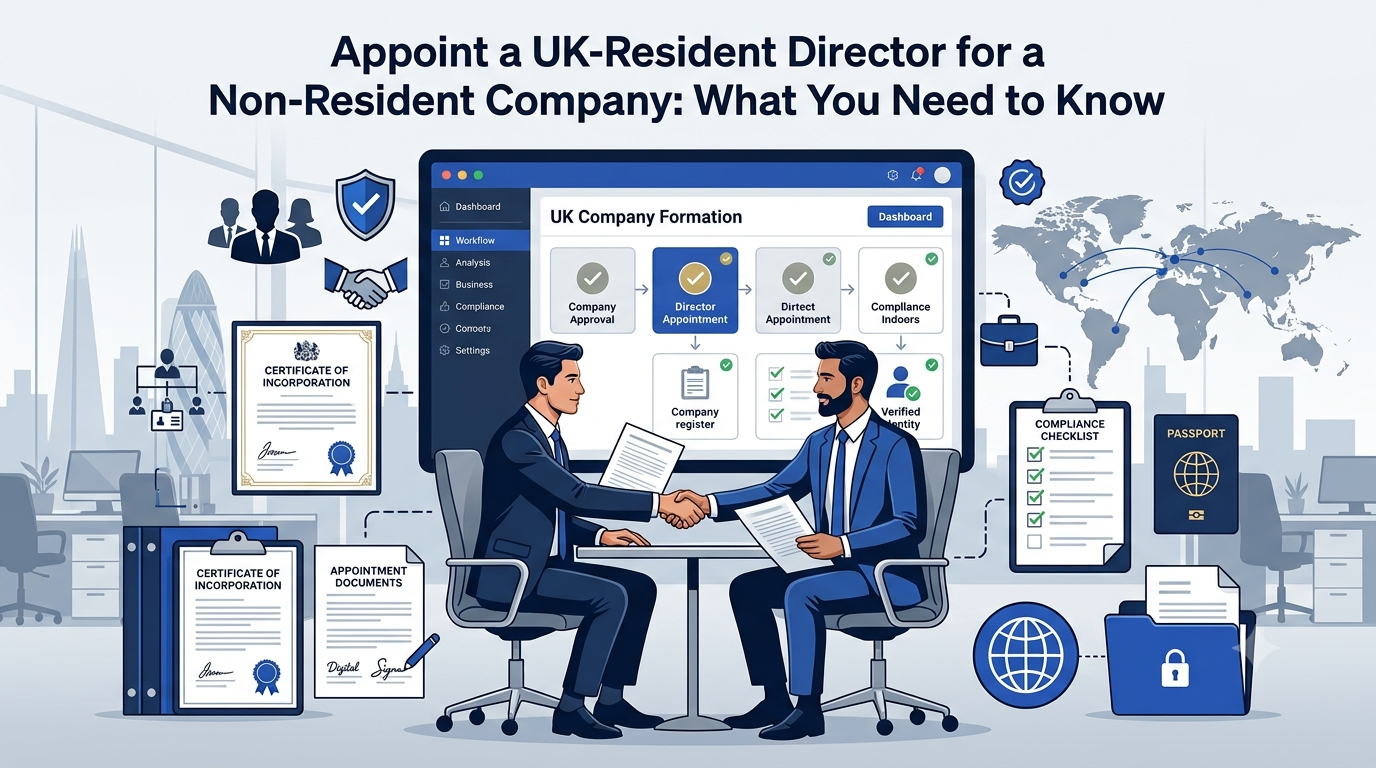
Appoint a UK Resident Director
If you’re a non-resident owner of a UK limited company, you may have wondered whether you need to appoint a UK-resident director, or whether doing so would help with banking, credibility, or compliance. The honest answer, under UK law in 2026, is that you almost certainly don’t need one, and the situations where a UK-resident director genuinely helps are narrower than online marketing often suggests. At Form My Company, we help non-resident founders run compliant UK companies without unnecessary complications. This guide explains what UK law actually requires, when a UK-resident director might legitimately fit, and what most non-resident owners should do instead.
Does UK Law Require a UK-Resident Director?
No. This is the single most important point to be clear about. UK law places no residency, nationality, or visa requirement on the directors of a UK limited company. You can be:
- The sole director of your UK company from anywhere in the world. No UK-based co-director is needed.
- A director of any nationality. No British citizen or UK national is required on the board.
- Fully remote. You never need to visit the UK to act as director.
The only genuine requirements are that at least one director is a natural person (an actual individual, not a corporate entity), that directors are at least 16 years old, and that they aren’t disqualified. Residency isn’t part of the list.
This means the framing of “needing” to appoint a UK-resident director is usually based on a misunderstanding of the rules.
Why Non-Resident Owners Sometimes Consider Appointing a UK-Resident Director
Despite the law being clear, non-resident owners often reach the idea of a UK-resident director through one of these routes:
- Bank rejections. Their business bank account application was rejected because the high street bank required a UK-resident director, and they hope appointing one will unlock banking.
- Perceived credibility. They think a UK-resident director alongside a foreign owner will look more legitimate to clients or investors.
- Misleading advice. They’ve been told (often by intermediaries) that a UK-resident director is a legal necessity or a smart privacy move for overseas founders.
- Tax planning theories. Some tax structures theoretically hinge on where directors are resident and where board meetings take place, though the reality is more complex than online summaries suggest.
Let’s take each of these honestly, because none of them lead to “appoint a UK-resident director” being the right answer for the vast majority of non-resident owners.
The Banking Question
If your UK business bank account application was rejected due to a lack of UK-resident director, the answer isn’t to appoint one. Here’s why:
- Fintech providers accept non-resident directors. Wise Business, Revolut Business, Tide, and Airwallex all accept applications from UK companies with non-resident directors, and they’re designed for remote onboarding. These providers are used by tens of thousands of non-resident founders successfully.
- High street banks look through to beneficial owners. Even if you appointed a UK-resident director, banks apply strict anti-money-laundering rules that verify all Persons with Significant Control (PSCs). A UK-resident director on your register doesn’t hide the non-resident beneficial owner, and banks are actively cautious about arrangements that appear designed to work around residency requirements.
- Nominee-style arrangements can hurt applications. Where a UK-resident director on the register is there primarily to satisfy banking requirements rather than to genuinely direct the company, this can trigger enhanced due diligence, longer waits, or outright rejection.
- The honest fix is to apply to non-resident-friendly providers. This is what most non-resident founders do, and it works.
If banking is your primary reason for considering a UK-resident director, the practical answer is to choose a provider that welcomes non-residents, not to reshape your company structure.
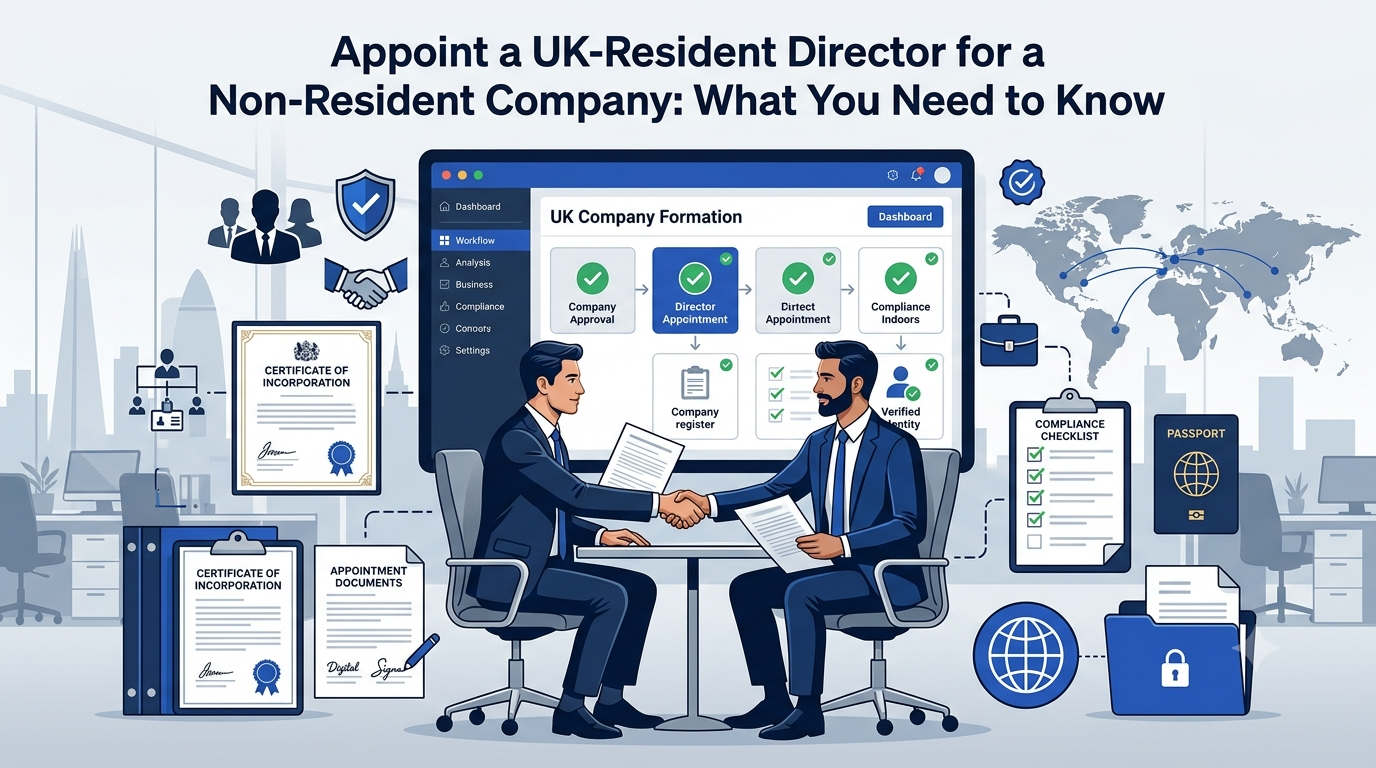
The Credibility Question
Some non-resident owners believe a UK-resident director makes their company look more legitimate to clients, suppliers, or investors. In practice:
- A UK registered office and director’s service address deliver the “UK presence” perception. Clients seeing a Bolton BL1 address on your Companies House record and correspondence understand your company operates from the UK, without needing a UK-resident director on the board.
- Modern due diligence looks at ownership, not just directorship. Serious clients, suppliers, and investors verify beneficial owners as part of KYC. A UK-resident director doesn’t change the underlying reality of who owns and runs the company.
- Credibility comes from consistency and clean records. A transparent structure with proper filings, accurate PSC declaration, and clean identity verification signals a legitimate operation. Adding a UK-resident director to look “more UK” doesn’t outweigh good governance basics.
If credibility is your concern, the direct route is a professional UK presence (registered office, service address) alongside your own consistent, transparent directorship, which is what Form My Company’s Non-Residents package provides.
The Tax Question
This is the one area where the residency of a company’s directors genuinely can matter, though the reality is much more nuanced than online tax-planning content often suggests.
- UK corporate tax residence. A UK-incorporated company is generally treated as UK tax resident by default. Its tax position doesn’t primarily hinge on where directors are resident.
- Central management and control. In some cross-border tax situations, where a company is actually “centrally managed and controlled” matters (for example, when applying double taxation treaties). This can involve where directors meet and make decisions, but it’s a highly specific area.
- Personal tax consequences. The residency of directors can affect the director’s own personal tax position in their home country, not just the company’s.
If you’re considering a UK-resident director for tax planning reasons, this is not a formation-agent question. It’s a matter for a qualified UK tax adviser working in coordination with a tax adviser in your country of residence. Both are essential. General online content, including this page, cannot substitute for personalised professional advice on cross-border tax structuring.
Please don’t act on tax planning theories without proper professional advice. This is one of the areas where mistakes are most expensive to fix later.
When Appointing a UK-Resident Director Genuinely Might Fit
There are specific situations where a UK-resident director on the board of an overseas-owned UK company makes genuine sense. These are narrower than online marketing suggests, and they all involve real, transparent roles, not front-of-house arrangements:
- A genuine non-executive director (NED) appointment. A UK-resident NED with real industry experience joins your board for governance oversight, strategic input, and independent judgement. This is a real professional role, usually paid, with proper terms of engagement and full transparency on the register.
- A UK-resident co-founder or business partner. Where a UK-resident individual is genuinely part of your business, sharing ownership or operational responsibilities, appointing them as a director reflects their real role.
- A UK-resident senior manager being promoted to director. As part of the growth of your UK operations, promoting a UK-resident senior manager to a directorship formalises their leadership.
- Institutional trustee appointments. In specific trust structures (usually set up with legal advice), a UK-resident professional trustee may act as director as part of a transparently documented trust.
In each case, the UK-resident director is a real person doing a real job, not a front for the owner. They complete identity verification like any director, are personally liable under the Companies Act 2006, and receive proper compensation for their role.
Why This Isn’t Something a Formation Agent Should Provide
If you have a legitimate reason to appoint a UK-resident director (like a genuine NED role or a real business partner), this is not something a formation agent like Form My Company should handle as a service. Here’s why:
- It’s a personal appointment, not a corporate service. A director acts personally, with personal liability and duties. That’s fundamentally different from providing a registered office address or filing paperwork.
- It requires proper professional context. A legitimate NED comes with a formal letter of appointment, a proper role definition, appropriate remuneration, and often insurance arrangements. A qualified UK solicitor or governance adviser should set this up.
- It requires vetting. The right UK-resident director for your board is someone with relevant experience, references, and genuine willingness to take on the role. Formation agents aren’t in a position to source or vet this.
- It has ongoing implications. The director will owe duties to the company, sign documents, and appear on the register indefinitely. This isn’t a subscription service.
If you have a genuine need for a UK-resident director, we’d point you toward a qualified UK solicitor, a corporate governance adviser, or a director search firm, rather than trying to fit this into a formation-agent offering.
What Most Non-Resident Owners Should Do Instead
For the vast majority of non-resident owners of UK companies, none of the situations above apply. What you actually need is:
- Direct ownership and directorship. You appear on the register as the actual named director and shareholder, transparently.
- A compliant UK registered office address. For your company’s official correspondence, keeping your overseas address off the register.
- A UK director’s service address. For your personal correspondence, keeping your home address off the register.
- Identity verification. Completed as required under the ECCTA, either directly with Companies House or through an Authorised Corporate Service Provider (ACSP) like Form My Company.
- Access to non-resident-friendly banking. Through providers like Wise Business, Revolut Business, Tide, or Airwallex, which don’t require a UK-resident director.
- Ongoing compliance support. For your annual confirmation statement, PSC updates, and other statutory filings.
This combination gives you a transparent, credible, fully compliant UK company. It’s what our Non-Residents package delivers, and it’s what almost every non-resident founder actually needs.
How Form My Company Helps
We help non-resident founders form and run UK companies directly, without needing to appoint UK-resident directors to solve problems that don’t actually exist. As an Authorised Corporate Service Provider (ACSP), we handle:
- Fast UK company formation with you as the actual named director
- Compliant UK registered office address in Bolton BL1
- UK director’s service address to keep your home address off the public register
- Identity verification (IDV) for directors and PSCs under the ECCTA
- Ongoing compliance help including confirmation statements
- Banking partner introductions for non-resident-friendly providers
For situations where a legitimate UK-resident director appointment genuinely fits (like a real NED or a UK-based business partner), we’d always recommend involving a qualified UK solicitor or governance adviser to set this up properly.
Form Your UK Company Directly Today
For most non-resident owners, appointing a UK-resident director doesn’t solve any real problem, and the honest answer is that your own directorship, combined with the right supporting services, is what UK law and modern banking actually accommodate. With Form My Company, forming and running your UK company as a non-resident is quick, transparent, and fully supported. Get started today.
Frequently Asked Questions
Does UK law require a UK-resident director for a non-resident-owned company?
No. UK law places no residency requirement on directors. A non-resident can be the sole director of their UK limited company from anywhere in the world, without needing a UK-based co-director.
Will appointing a UK-resident director help me open a UK business bank account?
Generally not. High street banks that require UK-resident directors will look through to beneficial owners regardless, and nominee-style arrangements can trigger enhanced due diligence. The practical fix is to apply to non-resident-friendly providers like Wise, Revolut, Tide, or Airwallex.
Would a UK-resident director make my company look more credible?
Modern due diligence focuses on beneficial ownership, transparent records, and consistent governance, not on where directors are personally resident. A compliant UK registered office and director’s service address deliver the “UK presence” perception without needing a UK-resident director.
Are there tax reasons to appoint a UK-resident director?
Cross-border tax structuring can occasionally involve the residency of directors, particularly around central management and control tests in double taxation treaties. This is complex and personalised, and should always involve a qualified UK tax adviser and a tax adviser in your country of residence, not a formation agent.
When is appointing a UK-resident director genuinely appropriate?
When there’s a real role, such as a legitimate non-executive director (NED) appointment for governance, a UK-resident co-founder or business partner, or a UK-resident senior manager being promoted. In each case, the UK-resident director has real duties and real accountability.
Can Form My Company appoint a UK-resident director for me?
No, and honestly this is something we recommend against as a formation-agent service. If you have a legitimate need for a UK-resident director (like a real NED appointment), a qualified UK solicitor or a corporate governance adviser is the right route.
What should most non-resident owners do instead?
Form the company directly as your own director and shareholder, use a UK registered office and director’s service address for privacy and professionalism, complete ECCTA identity verification, and choose a non-resident-friendly banking provider. This is what most non-resident founders actually need, and it’s what our Non-Residents package delivers.