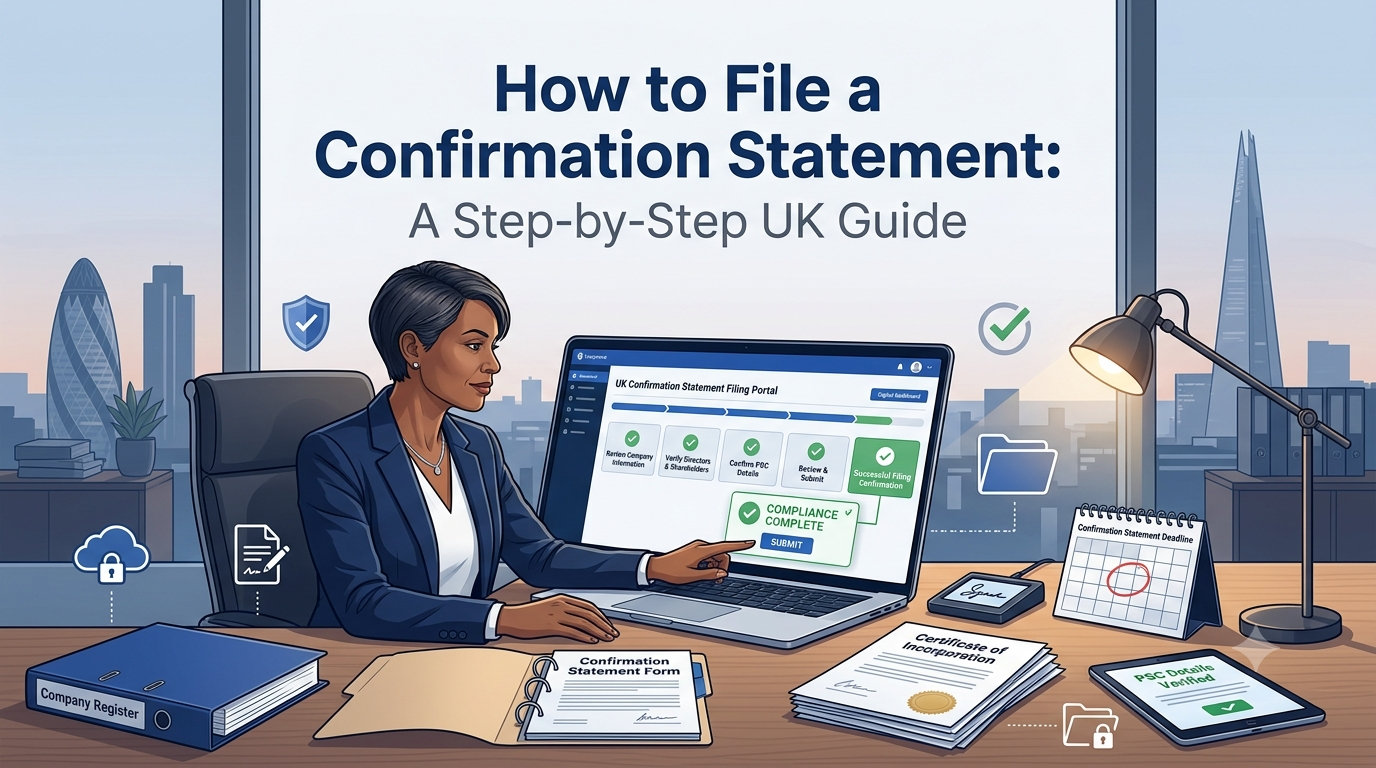
How to File a Confirmation Statement
Filing your confirmation statement is one of the most important annual responsibilities for any UK limited company. It’s how you confirm to Companies House that the information they hold about your company is still accurate. The process is straightforward once you know what to do, but there are a few details that catch people out. At Form My Company, we file confirmation statements for UK companies as part of our ongoing compliance support. This guide walks through exactly how to file a confirmation statement, from checking your details to submitting online.
What You Need Before You Start
Before you begin, make sure you have:
- Your company’s authentication code. This is a unique code Companies House issues for online filings. If you’ve never filed online before, you may need to request one (usually posted to your registered office within about five working days).
- Your Companies House account credentials. If you’ve already set up a WebFiling account, use those. If not, you’ll need to register.
- Your company’s current details. A clear picture of your directors, shareholders, PSCs, registered office, and SIC codes as they stand today.
- Your review period end date. The 12-month period after which your confirmation statement is due.
- Your card details for the £50 filing fee. The digital filing fee is £50 as of February 2026.
If you don’t have your authentication code, request it early. The confirmation statement can’t be filed online without it, and waiting for it in the post can cost you days.
Step 1: Confirm Your Review Period and Filing Deadline
Every company has its own confirmation statement “review period.” This is a 12-month window that runs from either:
- Your incorporation date. For your first confirmation statement.
- Your last confirmation statement date. For subsequent filings.
You have 14 days after the review period ends to submit your confirmation statement. Missing this window puts your company at risk of enforcement action, so getting the date right matters.
To find your review period, log into your Companies House WebFiling account and check your company’s details, or look up your company on the public register at gov.uk/get-information-about-a-company.
Step 2: Review Your Company’s Current Companies House Record
Before filing, check what Companies House currently holds against what should be there. The confirmation statement checks:
- Registered office address. Your company’s official legal address.
- Directors and (if applicable) company secretary. The people responsible for running the company.
- Shareholders and share capital. Who owns the company and how the shares are structured.
- Persons with Significant Control (PSCs). Individuals owning or controlling more than 25% of shares or voting rights.
- SIC codes. The codes describing your main business activities.
Compare each of these with the reality of your company today. If anything is out of date, you’ll need to address it before or during the filing.
Step 3: Handle Any Changes That Need Separate Filings
Some changes can be reported within the confirmation statement itself. Others need to be filed separately, either before you submit or alongside it. Here’s how they split:
Can be reported in the confirmation statement:
- Changes to shareholders and share capital
- Confirmation of SIC codes
- Changes to PSC information
Need separate filings before the confirmation statement:
- Appointing a new director (Form AP01)
- Removing or accepting a director’s resignation (Form TM01)
- Updating a director’s details (Form CH01)
- Changing your registered office (Form AD01)
If you have separate filings pending, submit those first. Then check they’ve been processed on the register before filing the confirmation statement, so everything is consistent.
Step 4: Check Identity Verification Status
Under the Economic Crime and Corporate Transparency Act (ECCTA), identity verification became mandatory for all UK company directors and PSCs at Companies House from 18 November 2025.
For existing directors and PSCs, verification is being phased in during a transition period, often aligned with the annual confirmation statement or a birth-month deadline. If your directors and PSCs haven’t yet completed identity verification, doing so before your confirmation statement is a good idea, because unverified directors can face restrictions on filings.
Verification can be done two ways:
- Directly with Companies House. Using the GOV.UK One Login service.
- Through an Authorised Corporate Service Provider (ACSP). Providers like Form My Company can handle verification remotely.
Once done, verification is generally a one-off exercise and stays in place across future filings.
Step 5: Log in to Companies House WebFiling
The filing itself is done through Companies House WebFiling. Go to the WebFiling service and:
- Log in with your account credentials. If you don’t have an account, register one (it takes a few minutes).
- Enter your company’s authentication code. Required for security.
- Select “File a confirmation statement.” You’ll be guided through the filing screens.
The interface is straightforward, but it does require your authentication code, so don’t try to start the process without it.
Step 6: Complete the Confirmation Statement Filing
The filing walks you through your company’s key information:
- Confirm each section is accurate. Registered office, directors, shareholders, PSCs, SIC codes.
- Update anything that’s changed. For example, adding or removing shareholders, or confirming updated PSC information.
- Confirm the statement. You’re formally stating that the information at Companies House is now accurate.
Take this step carefully. You’re making a legal declaration, so double-check each screen before proceeding.
Step 7: Pay the £50 Filing Fee
The digital confirmation statement fee is £50 as of February 2026. You pay this by card at the end of the filing process.
One useful detail: the £50 fee is payable once in each 12-month “payment period,” regardless of how many confirmation statements you file within that period. So if you need to file multiple statements in one year (for example, to update shareholder details mid-year), you don’t pay £50 each time. The single annual fee covers all filings within the payment period.
Step 8: Confirm the Filing Has Been Accepted
Digital confirmation statement filings are usually processed within one working day. Once accepted:
- You’ll receive an email confirmation. Keep this for your records.
- Your company’s Companies House record will update. The confirmation statement date will show the new filing.
- You have another 12 months on the clock. Your next review period runs from this filing date.
Check the public register a day or two after filing to confirm everything looks right. If there’s any issue with the filing (like a rejection), Companies House will let you know so you can correct and resubmit.
Common Mistakes to Avoid
A few issues come up regularly with confirmation statement filings:
- Missing the 14-day deadline. Set a calendar reminder well before your deadline each year. Late filings can put your company at risk.
- Not having your authentication code. Request it early if you don’t have one, since it can take a few working days to arrive.
- Filing without checking the current record. Assumptions about what’s on the register cause errors. Always check first.
- Forgetting separate filings. If you have director changes or other updates to make, file those separately before the confirmation statement.
- Overlooking identity verification. Unverified directors can face filing restrictions under the ECCTA. Verify first if you haven’t already.
- Assuming “nothing changed” means no filing. The confirmation statement is required annually regardless. Nothing changing is fine, but not filing is not.
- Paying twice within a payment period. Remember, the £50 fee covers all filings within your 12-month payment period, not per filing.
- Not confirming the filing was accepted. Check the public register a day or two after submitting to make sure everything is live.
Working through the process methodically avoids all of these.
What Happens If You Miss the Deadline
Failing to file a confirmation statement is a serious matter:
- It’s a criminal offence. Both the company and its directors can face prosecution.
- Companies House can begin strike-off proceedings. Meaning your company can eventually be removed from the register.
- Directors can be held personally responsible. For failing to comply with statutory duties.
- Financial penalties can apply. Alongside possible disqualification for directors who repeatedly fail to comply.
If you realise you’ve missed a deadline, file as soon as possible. Late filing is better than not filing at all, and quick action reduces the risk of formal enforcement action.
When You Might Want Professional Support
For a simple company with no changes, filing the confirmation statement yourself through WebFiling is manageable. Professional support is worth considering when:
- You have multiple changes to report. Coordinating separate filings (like AP01, TM01, or CH01) alongside the confirmation statement can be fiddly.
- You’ve missed a deadline. Professional support helps you get back on track quickly and correctly.
- You have a complex ownership structure. Multiple PSCs, corporate shareholders, or unusual share structures benefit from experienced eyes.
- You’re a non-resident owner. Managing UK filings from abroad, alongside identity verification and other obligations, is smoother with an ACSP.
- Compliance is falling behind. If you’re behind on confirmation statements or other filings, professional help catches things up efficiently.
Beyond the confirmation statement itself, a good ongoing compliance service can track your deadlines, handle related filings, and give you peace of mind that nothing is being missed.
How Form My Company Helps
We file confirmation statements as part of our ongoing compliance support for UK companies. As an Authorised Corporate Service Provider (ACSP), we handle:
- Tracking your confirmation statement review period and deadlines
- Reviewing your Companies House record before filing
- Filing the confirmation statement and paying the £50 fee on your behalf
- Coordinating separate filings (like director appointments) alongside
- Identity verification (IDV) for directors and PSCs under the ECCTA
- Compliant UK registered office address in Bolton BL1 with mail handling
- Ongoing support for non-resident owners running UK companies from abroad
This means you can run your UK company without worrying about missing an annual filing, and you have a compliant record year after year.
File Your Confirmation Statement Correctly Today
Filing your confirmation statement on time and accurately is one of the most important things you can do for your UK company. With Form My Company, the whole process is quick, accurate, and fully supported. Get in touch today and let us keep your company compliant, without you needing to manage the paperwork yourself.
Frequently Asked Questions
How do I file a confirmation statement?
You file through Companies House WebFiling online. You need your Companies House account credentials, your company’s authentication code, current information on your company’s details, and the £50 filing fee. The process takes you through each section to confirm or update your company’s record.
How much does it cost to file a confirmation statement?
The digital filing fee is £50 as of February 2026. This is payable once per 12-month payment period, so you’re not charged separately for multiple filings within that period.
When is my confirmation statement due?
Every company has a 12-month “review period” running from either incorporation or the last confirmation statement date. You have 14 days after the review period ends to file. Log into WebFiling or check the public register to find your specific dates.
Do I need to file if nothing has changed?
Yes. The confirmation statement is a required annual filing regardless of whether your company’s details have changed. Nothing changing is fine, but not filing is not.
What if I’ve missed the deadline?
File as soon as possible. Missing the deadline is a criminal offence and can lead to Companies House strike-off proceedings, so quick action reduces the risk of formal enforcement. Professional support helps get things back on track efficiently.
Can I update details in the confirmation statement, or do I need separate filings?
Some updates (like shareholders, PSCs, and SIC codes) can be reported in the confirmation statement itself. Others (like appointing or removing directors, or changing your registered office) need separate filings before or alongside the confirmation statement.
Do I need identity verification to file a confirmation statement?
Under the ECCTA, directors and PSCs must complete identity verification with Companies House. Existing directors have transition deadlines often aligned with the confirmation statement. Unverified directors can face restrictions on filings, so completing verification is recommended before your next confirmation statement.