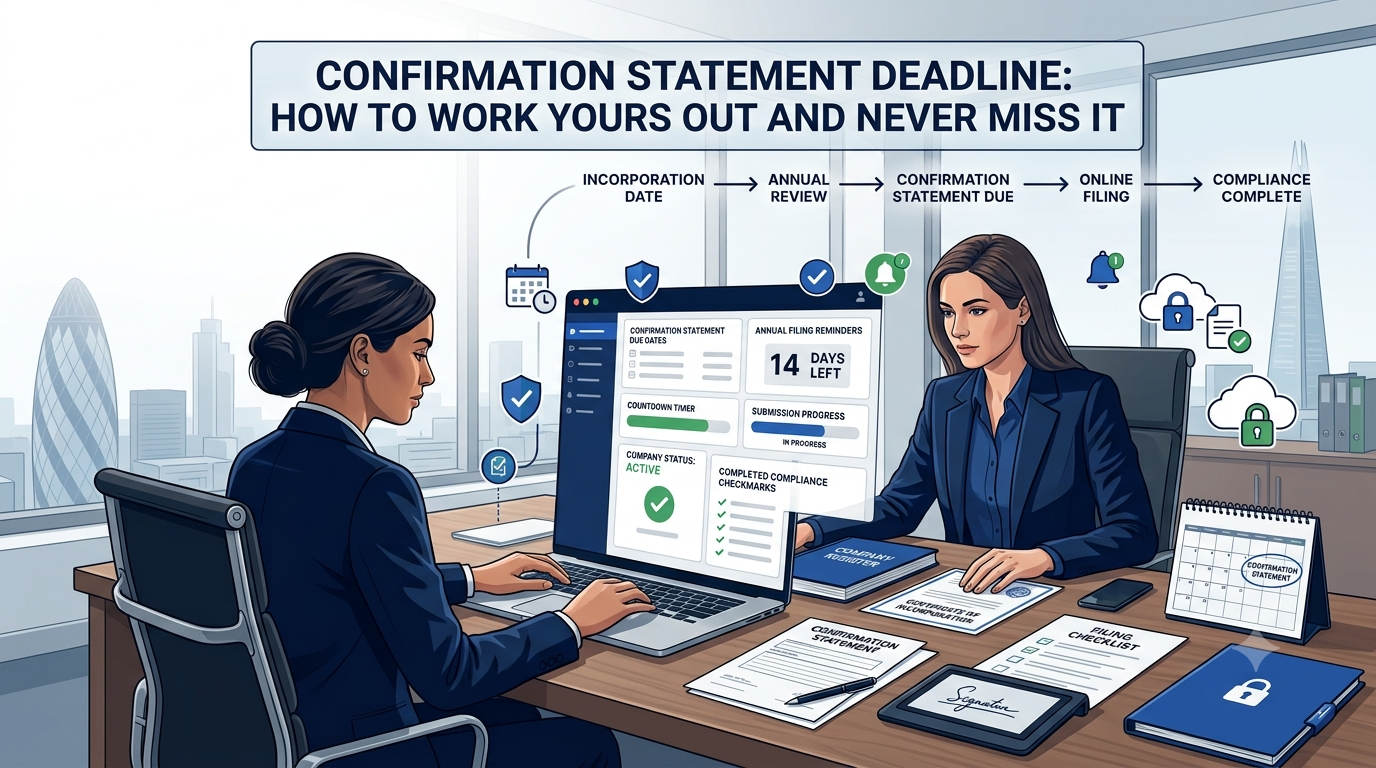
Confirmation Statement Deadline
The confirmation statement deadline is one of the most important dates in the calendar for any UK limited company. Miss it, and you can face criminal penalties, strike-off proceedings, and personal responsibility as a director. Meet it every year without fail, and it becomes a background formality. Yet many company owners struggle to work out exactly when their deadline actually is, and even more get caught out by not tracking it properly. At Form My Company, we track confirmation statement deadlines for the UK companies we support. This guide explains how to work out your specific deadline, what the filing window actually means, and how to build a system that keeps you compliant every year.
How the Confirmation Statement Deadline Works
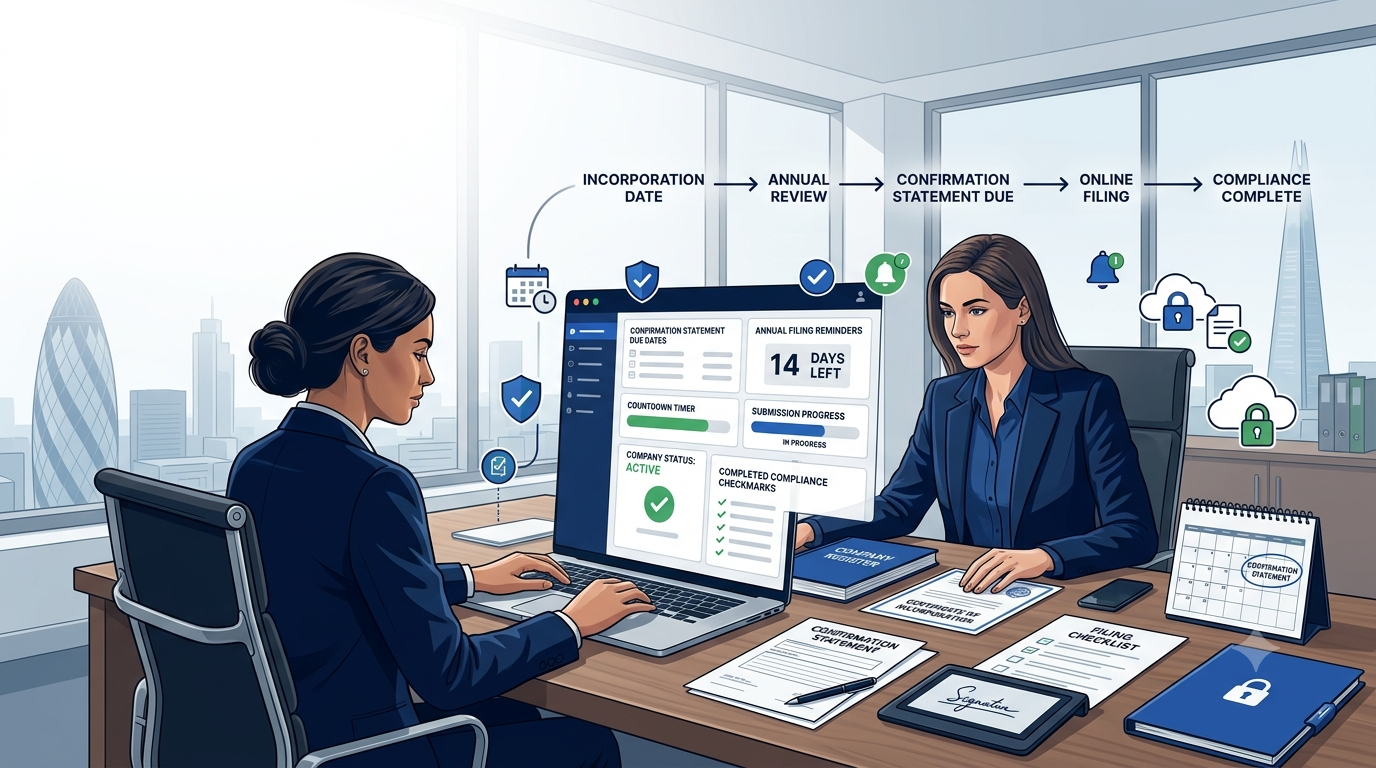
Every UK company has its own individual deadline based on two things: a 12-month “review period” and a 14-day filing window at the end of that period.
- The review period. This is a 12-month window that runs from either your company’s incorporation date (for your first confirmation statement) or the date of your last confirmation statement (for subsequent filings).
- The filing window. You have 14 days after the review period ends to submit your confirmation statement to Companies House.
So if your review period ends on 30 June, your confirmation statement must be filed by 14 July. Missing this window puts your company at risk.
The important thing to understand is that these dates are specific to your company. They aren’t tied to the calendar year, a tax year, or any external date. They’re based on your company’s own history at Companies House.
Working Out Your Specific Deadline
To find your confirmation statement deadline:
- For your first confirmation statement. Your review period runs from the day your company was incorporated (as shown on your Certificate of Incorporation) to 12 months later. Your filing window is the 14 days after that.
- For subsequent confirmation statements. Your review period runs from the date of your last confirmation statement (as shown on the Companies House public register) to 12 months later. Your filing window is the 14 days after that.
- You can find both the incorporation date and the last confirmation statement date by:
- Checking the Companies House public register. Search for your company at gov.uk/get-information-about-a-company. Your filing history shows the last confirmation statement date, and your company overview shows the incorporation date.
- Logging into Companies House WebFiling. Your account shows your company’s confirmation statement due date directly.
- Looking at your last acceptance email. If you filed a previous confirmation statement, the acceptance confirmation from Companies House shows the date.
- Asking your compliance service provider. If you use a service to handle your filings, they should be tracking your deadline for you.
Once you know your review period end date, add 14 days to work out your absolute latest filing date.
Can You File Early?
Yes, and many companies do. You don’t have to wait until the end of your review period to file. You can submit your confirmation statement any time within the review period.
However, filing early has a specific effect on your future dates:
- Filing early resets your review period. Once you file, the 12-month clock starts again from that filing date. So if you file 3 months into your review period, your next review period will end 12 months after that earlier filing.
- You still only pay the £50 fee once per payment period. If you need to file multiple times within a 12-month “payment period” (for example, to update shareholder details mid-year), you don’t pay £50 for each filing.
Most companies file toward the end of their review period, which keeps the annual filing date consistent year over year. But if you want to standardise all your compliance to a single date (like your fiscal year end), filing early to reset the clock is a valid option.
What Happens if You Miss the Deadline
Missing your confirmation statement deadline is a serious matter. The consequences include:
- It’s a criminal offence. Failing to file a confirmation statement is a criminal offence under UK company law. Both the company and its directors can face prosecution.
- Companies House strike-off proceedings. After a period of non-compliance, Companies House can begin proceedings to strike your company off the register, meaning it ceases to exist legally.
- Personal director liability. Directors can be held personally responsible for the company’s failure to comply with statutory duties.
- Fines and potential disqualification. Financial penalties can apply, and directors who repeatedly fail to comply can face disqualification for up to 15 years.
- Damage to your company’s compliance history. Late or missed filings appear on the Companies House record and can affect banking applications, due diligence, contracts, and investor confidence.
- Practical business disruption. A struck-off company can’t trade, hold a bank account, or enforce contracts. Restoring a struck-off company is expensive and time-consuming.
These consequences aren’t theoretical. Companies House does enforce them, and the enhanced Companies House powers under the Economic Crime and Corporate Transparency Act (ECCTA) make enforcement more likely, not less.
What to Do if You’ve Already Missed It
If you realise you’ve missed your confirmation statement deadline, don’t panic, but do act immediately:
- File the overdue confirmation statement as soon as possible. Even late, it’s better than not at all, and it restarts the compliance clock.
- Check for any Companies House correspondence. They may have already issued warnings or begun strike-off proceedings. Respond promptly to anything they’ve sent.
- Bring other filings up to date if needed. If you’ve missed the confirmation statement, check whether your annual accounts, PSC updates, or other filings are also overdue.
- Consider professional help. If your compliance is significantly behind, a company services provider can help you catch up efficiently and avoid further issues.
- Complete identity verification. Under the ECCTA, unverified directors face restrictions on filings. If verification is outstanding, complete it as part of catching up.
Quick action after a missed deadline typically resolves the situation without escalating consequences. Ignoring it makes everything worse.
The ECCTA and Your Deadline
The Economic Crime and Corporate Transparency Act introduced mandatory identity verification for directors and PSCs from November 2025. This affects your confirmation statement deadline in a specific way.
For existing directors and PSCs who haven’t yet completed identity verification, the transition period includes verification deadlines aligned with:
- The next confirmation statement. In some cases, verification needs to be completed by the time the next confirmation statement is filed.
- The director or PSC’s birth month. For existing individual PSCs who aren’t directors of the same company, the deadline is the 14th of their birth month.
The practical effect is that if your directors and PSCs aren’t yet verified, doing this before your next confirmation statement is important. Unverified directors can face restrictions on filings, including potentially the confirmation statement itself.
As an Authorised Corporate Service Provider (ACSP), Form My Company can handle identity verification for directors and PSCs, including for non-residents, alongside your confirmation statement filing.
Common Deadline Mistakes
A few issues come up regularly:
- Assuming the deadline is tied to a calendar or tax year. It isn’t. Your confirmation statement deadline is based on your company’s specific dates, not any external calendar.
- Not tracking the 14-day filing window separately from the review period. The review period ends on one date, but you have 14 days after that to file. Both matter.
- Filing based on a rough memory of “sometime in June.” Companies House deadlines are precise. Rough memory leads to missed filings.
- Not updating your calendar after filing early. If you filed early and reset your review period, your next deadline moves. Update your reminders.
- Missing the deadline because reminders went to an old email. If you’ve changed contact details, make sure Companies House and any service provider have the current ones.
- Forgetting the deadline is different from the £50 payment period. The confirmation statement deadline is about filing. The £50 fee is paid once per 12-month payment period.
- Losing track after a company change. Adding a director, changing your registered office, or other events don’t change your confirmation statement deadline (unless you file a new confirmation statement as part of the process).
Building a reliable system around your specific deadline avoids all of these.
Building a System to Never Miss the Deadline
Some practical steps for staying compliant year after year:
- Put your review period end date and filing deadline in your calendar. Set reminders for 60 days out, 30 days out, and 7 days out.
- Store your Companies House login credentials somewhere you can find them. Nothing wastes time like scrambling for a forgotten password on deadline day.
- Keep your authentication code accessible. You need it for online filings, and reissuing it takes several working days.
- Track any changes to your company throughout the year. Note them somewhere so you can address them at (or before) your next confirmation statement.
- Consider ongoing compliance support. For non-resident owners especially, an ACSP that tracks your deadline and files on your behalf removes the ongoing burden.
- Do a mid-year check. Six months in, log into WebFiling or check the public register to make sure everything is on track and there are no surprises coming.
The confirmation statement is one of those obligations where small habits prevent big problems.
Practical Considerations for Non-Resident Owners
If you’re a non-resident owner, the deadline works exactly the same way, but the practical challenges of staying on top of it are greater. Postal reminders to your UK registered office don’t reach you, time zones can affect any last-minute filings, and it’s easy to let UK compliance drift when you’re focused on business in your home country.
For non-resident owners, an ongoing confirmation statement service (particularly one integrated with your UK registered office, service address, and identity verification) turns the deadline from an ongoing worry into a background formality.
How Form My Company Helps
We handle confirmation statement deadline tracking and filing as part of our ongoing support. As an Authorised Corporate Service Provider (ACSP), we can:
- Track your review period and filing window
- Send you reminders well in advance of the deadline
- Review your Companies House record before filing
- File the confirmation statement and pay the £50 fee on your behalf
- Coordinate related filings (like director changes) alongside
- Handle identity verification for directors and PSCs under the ECCTA
- Support non-resident owners running UK companies from abroad
- Get you back on track if you’ve missed a deadline
For non-resident owners especially, this means the confirmation statement deadline stops being something you have to remember, because we’re remembering it for you.
Stay on Top of Your Deadline Today
The confirmation statement deadline is one of the most important dates in your UK company’s calendar, and missing it can lead to real consequences. With Form My Company, tracking and meeting the deadline every year is quick, straightforward, and fully supported. Get in touch today and let us keep your company compliant, year after year, without you needing to worry about the calendar.
Frequently Asked Questions
What is the confirmation statement deadline?
Every UK company has an individual deadline based on a 12-month “review period” (from incorporation or the last confirmation statement) plus a 14-day filing window after that. So if your review period ends on 30 June, your filing deadline is 14 July.
How do I find my confirmation statement deadline?
Check the Companies House public register at gov.uk/get-information-about-a-company (your filing history shows the last confirmation statement date), log into Companies House WebFiling, or ask your compliance service provider. Add 14 days to the end of the review period to get the absolute latest filing date.
Can I file my confirmation statement early?
Yes. You can file any time within your review period. However, filing early resets your 12-month review period, so your next deadline will be 12 months from your early filing date.
What happens if I miss the deadline?
Missing the confirmation statement deadline is a criminal offence and can lead to Companies House strike-off proceedings, personal director liability, fines, and potential director disqualification. Enhanced Companies House powers under the ECCTA mean enforcement is more likely.
How much does the confirmation statement cost?
The digital filing fee is £50 as of February 2026. This is paid to Companies House and is payable once per 12-month payment period, so multiple filings within that period don’t incur additional fees.
Do I need identity verification before the deadline?
Under the ECCTA, existing directors and PSCs must complete identity verification during a transition period, often aligned with the next confirmation statement or a birth-month deadline. Unverified directors can face restrictions on filings, so completing verification is recommended before the deadline.
How do I make sure I never miss the deadline?
Put the review period end date and filing deadline in your calendar with 60-day, 30-day, and 7-day reminders. Keep your Companies House credentials and authentication code accessible. For non-resident owners, an ongoing service that tracks your deadline can turn this into a background task.