
VAT Number
Getting a UK VAT number is a specific outcome of the VAT registration process, and for many businesses it’s a significant milestone. Once you have a VAT number, you can charge VAT on your sales, reclaim VAT on your business expenses, and present your business as VAT registered on invoices and your website. The process itself is done through HMRC, and while it’s straightforward for most businesses, knowing what to expect helps you plan around it. At Form My Company, we help UK businesses get their VAT numbers as part of our compliance services. This guide walks you through exactly how to get a UK VAT number in 2026, step by step.
What Is a VAT Number?
A VAT number (also called a VAT registration number, or VRN) is a unique identifier HMRC issues to businesses when they register for Value Added Tax. UK VAT numbers are formatted with the prefix “GB” followed by 9 digits (or more for certain groups), and they identify your business for VAT purposes.
Once you have a VAT number, you must:
- Include it on your invoices. Along with your VAT charged, so customers can identify you as VAT registered.
- Show it on your website and business documents. For transparency and business credibility.
- Use it on VAT returns. When filing with HMRC.
- Provide it when asked. By suppliers, customers, or partners who need to verify your VAT status.
A VAT number is essentially your business’s identity in the UK VAT system.
Do You Need a VAT Number?
Getting a VAT number requires you to register for VAT with HMRC. There are two main paths:
- Mandatory registration. You must register for VAT (and therefore get a VAT number) if your VAT taxable turnover exceeds the current threshold. As of April 2024, the threshold is £90,000 over any rolling 12-month period. If you cross this, or expect to in the next 30 days, you must register within 30 days.
- Voluntary registration. You can register (and get a VAT number) before you hit the threshold. Many businesses do this to reclaim VAT on expenses, appear more established, or prepare for growth.
- Specific circumstances. Some businesses must register regardless of turnover, particularly non-resident businesses selling goods to UK consumers or holding stock in the UK.
If you’re not sure whether you need to register, the first step is checking your position rather than applying blindly. A VAT registration service or accountant can help clarify.
What You Need Before You Apply
Before starting the application, gather:
- Business details. Legal name of the business, trading name (if different), company registration number if a limited company, and Unique Taxpayer Reference (UTR) if you have one.
- Business address. Your registered office address for limited companies, or business address for other structures.
- Bank account details. Your business bank account for receiving any VAT refunds. HMRC pays refunds by bank transfer.
- Business activity information. A clear description of what your business does, and the SIC codes that describe your activities.
- Turnover information. Actual turnover for the last 12 months and expected turnover for the next 12 months.
- Effective date preference. The date from which you want to be VAT registered. This can be a current date or, in some cases, backdated.
- Identity details. For the primary business contact, including National Insurance number and date of birth for UK residents.
- Government Gateway credentials. You’ll apply through HMRC’s online service, which requires Government Gateway login. If you don’t have one, you’ll create it during the application.
Having all of this ready before starting means the application goes smoothly.
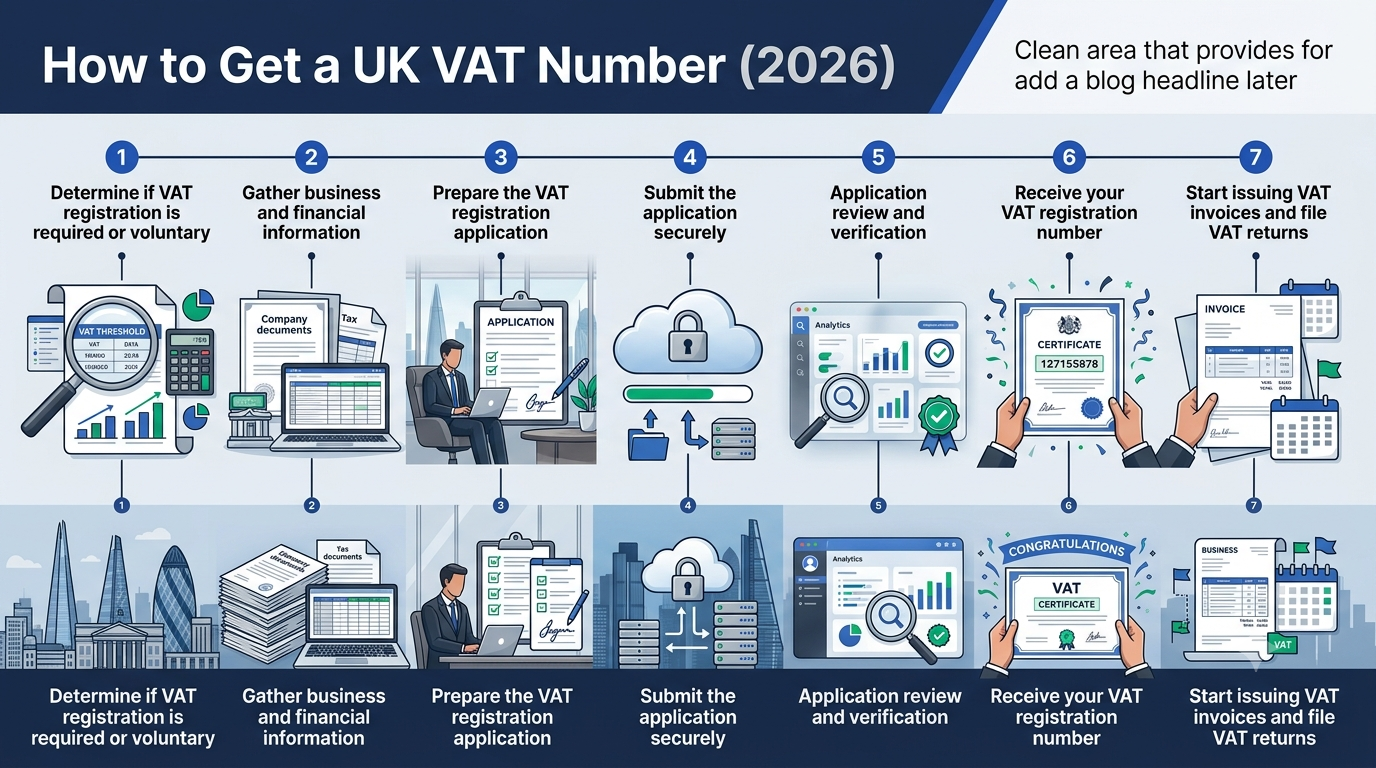
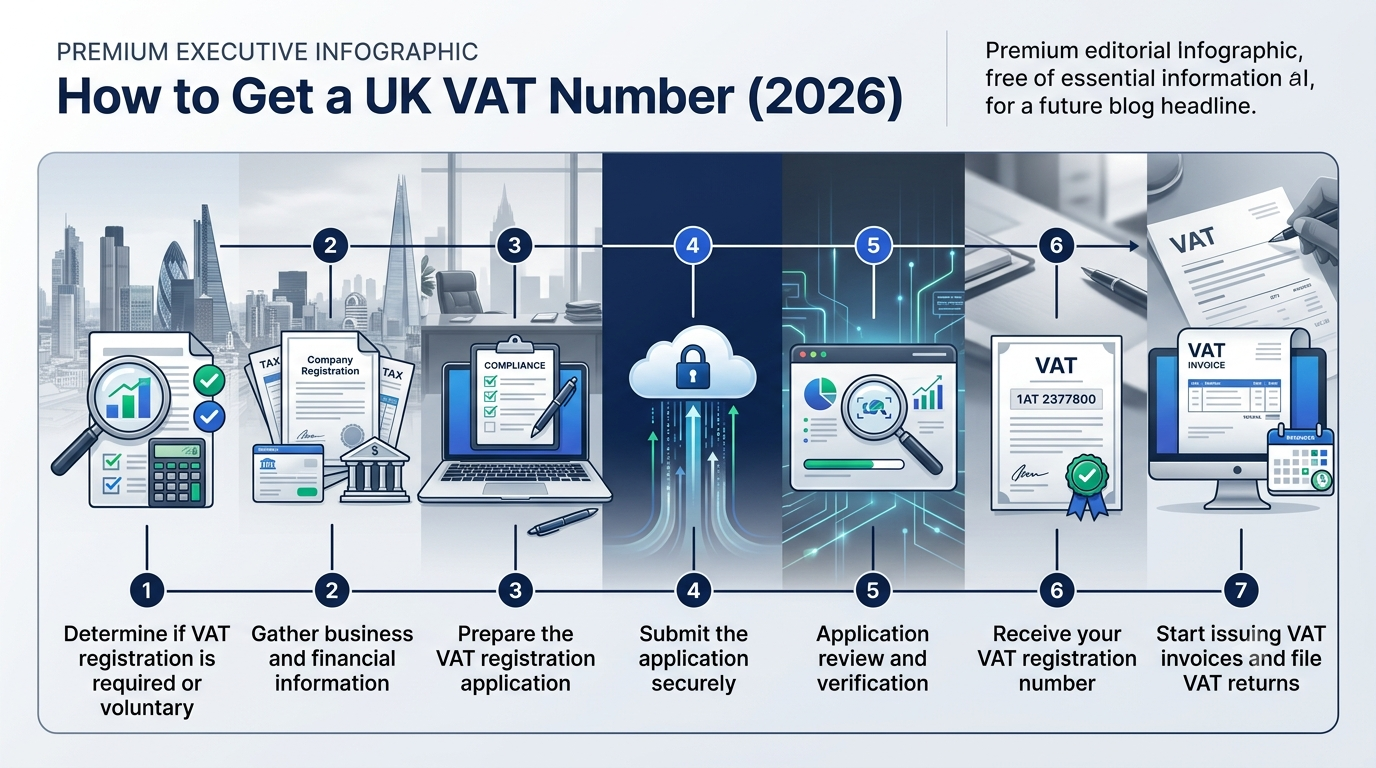
Step 1: Check You Actually Need to Register
Before applying, confirm your situation:
- Check your turnover. If it’s exceeded £90,000 in the last 12 months, or you expect it to in the next 30 days, registration is mandatory.
- Consider voluntary registration. If turnover is below the threshold, weigh whether registration makes sense strategically. Reclaiming VAT on expenses, business credibility, and preparing for growth are common reasons.
- Check for specific circumstances. Non-resident sellers, businesses in specific sectors, and those distance selling into the UK may have different rules.
- Confirm your legal structure. VAT registration works differently for limited companies, sole traders, partnerships, and other structures.
If registration is right for your situation, proceed with the application. If you’re unsure, get professional advice.
Step 2: Access HMRC’s Online Service
VAT registration is done through HMRC’s online VAT service:
- Sign in with your Government Gateway credentials. If you don’t have one, you’ll be prompted to create it.
- Add VAT to your services. From within your Government Gateway account, add VAT registration.
- Start the VAT registration application. The online service walks you through the required information.
If you’re using a service provider (like Form My Company), we handle this through our access, so you don’t need to interact with the HMRC portal directly.
Step 3: Complete the Application
The application asks for:
- Business details. Legal name, trading name, structure, and registration details.
- Business address. Where you’re based.
- Business activity. Description of what you do, along with SIC codes.
- Turnover information. Actual and expected.
- Effective date of registration. When you want VAT registration to take effect.
- Bank account details. For any VAT refunds.
- Contact information. For the primary contact person.
- VAT scheme preferences. If you want to use a specific scheme (like Flat Rate or Cash Accounting).
- Additional information. Depending on your circumstances, HMRC may ask about specific details like whether you buy goods from EU countries, or whether your business involves certain regulated activities.
- Take time to complete this accurately. Errors or omissions can delay processing.
Step 4: Submit the Application
Once complete, submit the application through HMRC’s online service. You’ll receive a confirmation that the application has been received.
Save any confirmation numbers or references HMRC provides. You’ll need these to check on the application status.
Step 5: Wait for HMRC to Process the Application
HMRC typically processes VAT registration applications in 2 to 4 weeks, though this can vary:
- Straightforward cases are often processed within a few weeks.
- Complex cases may take longer, particularly if HMRC needs additional information.
- Non-resident applications can take longer due to additional checks.
- Applications with issues may require correspondence with HMRC to resolve.
- During processing, HMRC may:
- Approve the application and issue your VAT number.
- Ask for additional information. By email or letter, requiring a response before proceeding.
- Reject the application if there are issues (though this is rare for legitimate registrations).
Keep an eye on your inbox and any postal correspondence during this period. Delays in responding to HMRC queries extend the process.
Step 6: Receive Your VAT Number
Once approved, HMRC issues your VAT number. This is confirmed by:
- Email or letter from HMRC. Confirming the VAT number and your effective registration date.
- VAT4 certificate. The formal registration certificate showing your VAT number, effective date, and other details.
Save these carefully. You’ll need your VAT number for invoicing, filing returns, and providing to customers and suppliers who need to verify your VAT status.
Step 7: Update Your Business for VAT
Once you have your VAT number:
- Update your invoices. Include your VAT number, charge VAT correctly, and follow VAT invoice requirements.
- Update your website. Show your VAT number, particularly if you sell online.
- Update your business documents. Letterheads, quotes, business cards, and other business materials.
- Set up Making Tax Digital-compatible software. All VAT-registered businesses must use MTD software for record-keeping and filing.
- Register for HMRC VAT online services. To manage your VAT account, file returns, and check your status.
- Understand your first return timing. Your first VAT period may not be a full quarter. Check your dates and prepare for your first return.
- Consider ongoing accounting support. VAT compliance is an ongoing workload. Many businesses use an accountant for VAT return filing.
Getting your business set up correctly from the day you receive your VAT number sets you up for smooth ongoing compliance.
How Long Does It Actually Take?
The realistic timeline:
- Preparation. 1 to 2 days to gather information and complete the application.
- HMRC processing. 2 to 4 weeks for most cases.
- Follow-up queries. Additional 1 to 2 weeks if HMRC needs more information.
- Total from start to VAT number. Typically 3 to 6 weeks, though straightforward cases can be faster.
If you’re planning around a specific date (like a threshold crossing or product launch), starting the process early gives you buffer.
Common Issues That Cause Delays
A few problems come up regularly:
- Incomplete or inaccurate application. Missing details or errors delay processing.
- Mismatched business details. If your Companies House record and VAT application details differ, HMRC may query.
- Missing supporting documents. For non-residents or specific business types, additional documentation may be needed.
- Address discrepancies. If your registered office and business activity address don’t align, questions may arise.
- Complex ownership structures. Multiple shareholders, PSCs, or corporate parents can slow verification.
- HMRC follow-up questions. Not responding promptly to HMRC emails extends the process significantly.
- Peak periods. HMRC processing can slow at busy times of year.
Preparation, accuracy, and responsiveness are the biggest predictors of a smooth process.
VAT Number for Non-Residents
Non-resident businesses can get UK VAT numbers, but the process has specific considerations:
- Mandatory registration is more common. Overseas sellers holding stock in the UK, or selling goods £135 or less to UK consumers, may need to register regardless of turnover.
- Additional documentation. Non-residents may need to provide additional business documents and identity verification.
- UK bank account preferences. HMRC prefers a UK bank account for VAT refunds, though non-UK accounts can be used.
- Fiscal representative in some cases. Certain non-resident businesses may need a UK-based fiscal representative for VAT purposes.
- Longer processing. Non-resident applications can take longer as HMRC completes additional checks.
For non-residents especially, professional support with VAT registration significantly smooths the process.
What Happens After You Have Your VAT Number
Ongoing obligations include:
- Submitting VAT returns. Usually quarterly, through Making Tax Digital-compatible software.
- Paying VAT owed. By the return deadline, typically one month plus 7 days after the period ends.
- Keeping digital records. Under Making Tax Digital.
- Following VAT invoicing rules. For all sales.
- Managing scheme changes. If your circumstances change, you may need to change VAT scheme.
- Filing changes with HMRC. If your business details change.
- Deregistering if needed. If your turnover falls below the threshold or you stop trading, deregistration is possible.
VAT compliance is a real ongoing workload, which is why many businesses use accounting and VAT support alongside registration.
How Form My Company Helps
We help UK businesses get their VAT numbers as part of our compliance services. We can:
- Assess your VAT position. Whether registration is mandatory, voluntary, or for a specific reason.
- Prepare and submit your VAT registration application to HMRC on your behalf.
- Advise on the right VAT scheme. For your business type, turnover, and cash flow.
- Track the application through HMRC processing. Following up on any queries.
- Coordinate VAT registration with formation. For new UK companies, so everything’s set up together.
- Support non-resident sellers. With the specific rules that apply to overseas businesses.
- Coordinate with Companies House compliance. So VAT registration fits with your wider UK compliance picture.
- Point you toward specialist support for ongoing VAT return filing where needed.
For businesses that want their VAT number quickly and correctly, a service takes the complexity off your plate.
Get Your VAT Number Correctly Today
Getting a UK VAT number is a milestone for many businesses, and doing it correctly matters for smooth ongoing compliance. Whether you’re mandatorily required to register or choosing to do so strategically, professional support can save time, reduce errors, and get you set up for success. With Form My Company, getting your VAT number is straightforward and fully supported. Get in touch today and let us handle the process while you focus on your business.
Frequently Asked Questions
How do I get a UK VAT number?
You get a VAT number by registering for VAT with HMRC. Applications are submitted through HMRC’s online service, requiring information about your business, turnover, and activities. Once approved, HMRC issues your VAT number, typically within 2 to 4 weeks.
How long does it take to get a VAT number?
Most applications are processed in 2 to 4 weeks from submission. Simple cases can be faster; complex cases or those with follow-up queries can take longer. The full timeline from starting to receiving your number is typically 3 to 6 weeks.
Do I need to be VAT registered to get a VAT number?
Yes. A VAT number is issued only to businesses that are VAT registered. Registration is mandatory if your turnover exceeds £90,000, but you can also register voluntarily to get a VAT number below the threshold.
Can I check if a UK VAT number is valid?
Yes. HMRC provides a free online VAT number checker where you can verify UK VAT numbers. This is useful for confirming supplier VAT numbers or checking your own is correct.
What format is a UK VAT number in?
UK VAT numbers start with “GB” followed by 9 digits. Group VAT numbers can have additional digits. The exact format varies slightly by circumstance.
What if I make a mistake on my VAT application?
Contact HMRC as soon as possible to correct any errors. Depending on the nature of the mistake, you may be able to update through the online service or need to submit corrections separately.
Can Form My Company get a VAT number for me?
Yes. We handle VAT registration applications on your behalf, prepare the application, submit it to HMRC, track processing, and coordinate with your wider UK compliance. We support both UK-based and non-resident businesses.