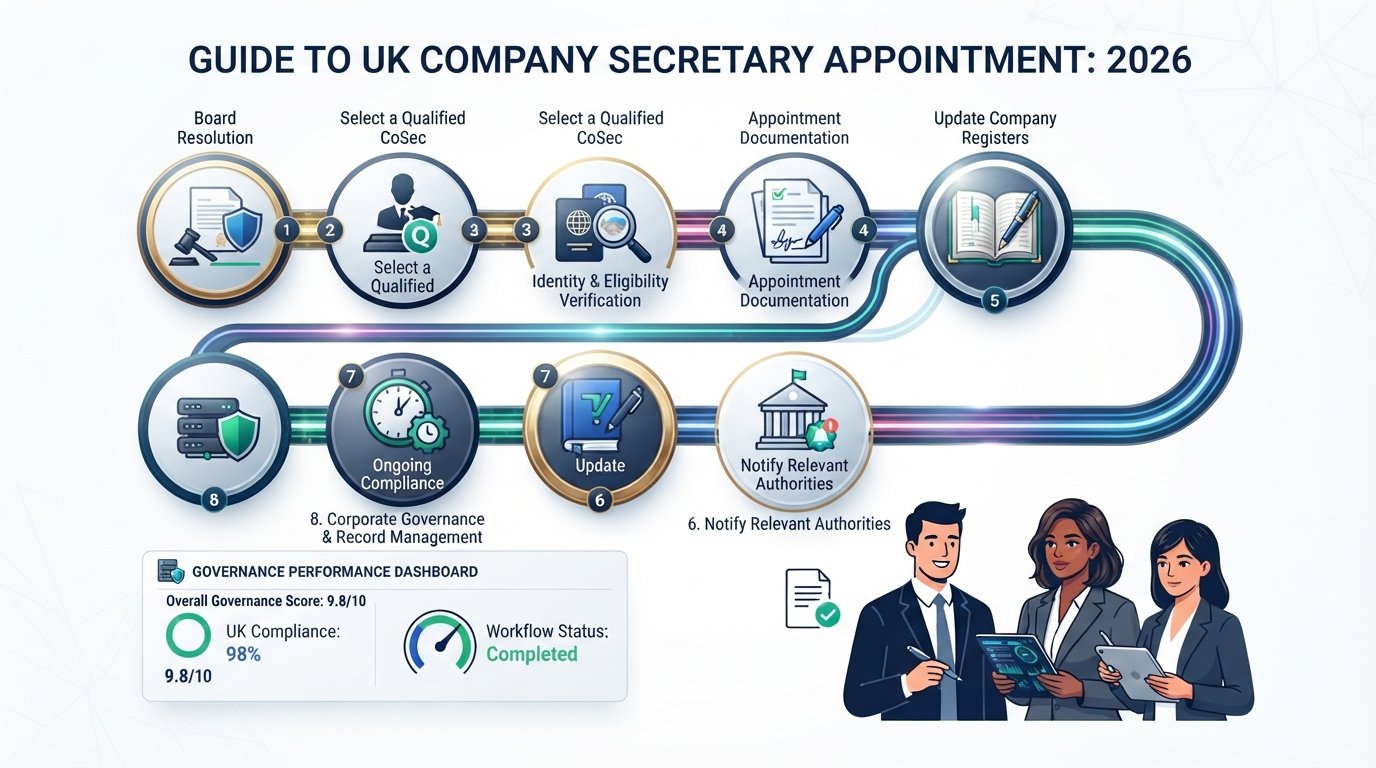
Appoint a Company Secretary
Appointing a Company Secretary is one of the corporate governance steps that’s often misunderstood by UK company owners. For public limited companies (PLCs), a Company Secretary is legally required with specific qualifications. For private limited companies, the role has been optional since April 2008. Whether you actually need to appoint one depends on your company type, corporate governance preferences, and specific situation. At Form My Company, we help UK companies with all their statutory appointments and filings. This guide walks you through exactly how to appoint a Company Secretary in the UK, step by step.
Do You Actually Need to Appoint a Company Secretary?
Before jumping into the process, confirm whether you actually need one. The legal position varies by company type:
Private limited companies (Ltd). Since April 2008, private limited companies have NOT been legally required to appoint a Company Secretary. This applies to the vast majority of UK small and medium businesses. Appointment is optional.
Public limited companies (PLCs). ARE legally required to appoint a Company Secretary. There are also specific qualification requirements for PLC secretaries.
Community Interest Companies (CICs). Follow the underlying rules for their company type (typically private limited).
LLPs and other structures. Have their own separate rules that don’t typically require a Company Secretary.
Some regulated sectors. May have industry-specific requirements.
For most UK small businesses considering this question, the honest answer is that you don’t need to legally appoint a Company Secretary. Many businesses that once had them have removed them. Modern secretarial work is often handled through outsourced compliance services rather than a named officer.
When Appointing a Company Secretary Makes Sense
Voluntary appointment can still be worth considering when:
Corporate governance formality is valued. For businesses that prefer traditional structures.
Sharing responsibility. Where founders want to formalise who handles statutory matters.
External expertise. Bringing in a qualified Chartered Secretary as an officer.
Family business succession. As part of preparing family members for corporate governance roles.
Investor or contractual requirements. Where investors, lenders, or clients expect a named Company Secretary.
Regulatory or sector requirements. For certain regulated industries.
Public perception. For companies wanting the additional layer of formal corporate governance visibility.
Board expansion. Where the Company Secretary adds an independent voice at board level.
Company transitions. When becoming a PLC or preparing for IPO.
For most private limited companies, though, none of these apply, and the pragmatic choice is to use a company secretarial service rather than appoint a named officer.
Legal Requirements for Company Secretaries
If you do appoint a Company Secretary, certain requirements apply:
For Private Limited Companies
Any person can be appointed. No formal qualifications required.
Must be at least 16 years old. Same as directors.
Must not be an undischarged bankrupt (unless with court permission).
Must not be disqualified. From acting as a director.
Can be an existing director. A director and Company Secretary can be the same person, though this isn’t ideal for governance separation.
Corporate secretaries allowed. A company can be appointed as Company Secretary, though corporate secretaries have specific rules.
No residency requirement. Company Secretary can be a non-resident, though there are practical considerations.
For Public Limited Companies
Formal qualifications required. Under the Companies Act 2006, PLC Company Secretaries must be either:
- A member of the Institute of Chartered Secretaries and Administrators (ICSA / The Chartered Governance Institute)
- A qualified accountant (ACA, ACCA, CIMA, or CPFA)
- A qualified solicitor or barrister
- A member of the Association of International Accountants
- Someone with at least 3 years’ experience as Company Secretary of a UK PLC
- Someone the directors reasonably consider capable of the role
Board approval required. For the specific person appointed.
Higher governance expectations. Given the additional regulatory scrutiny of PLCs.
For most private limited companies appointing voluntarily, no formal qualifications are required. Common sense and reliability are more important than credentials.
The Company Secretary’s Legal Duties
Once appointed, a Company Secretary has specific legal duties:
Statutory compliance. Ensuring the company meets Companies House and other statutory obligations.
Maintaining statutory registers. Register of members, directors, PSCs, and other required records.
Filing statutory documents. Confirmation statements, director changes, and other filings.
Ensuring compliance with Articles. Making sure company decisions follow the Articles of Association.
Board and committee support. Documenting board meetings, resolutions, and decisions.
Signing statutory documents. Alongside directors where required.
Communicating with regulators. As appropriate for the company’s activities.
Corporate governance. Advising on best practices and compliance.
Shareholder communications. For matters like AGMs and shareholder resolutions.
Data compliance. For statutory records and confidential company information.
AML compliance. For regulated companies or professional services businesses.
These duties fall on the Company Secretary personally as an officer of the company. This is why the role has real legal weight, unlike outsourced services where the company and directors remain responsible.
The Actual Steps to Appoint a Company Secretary
If you’ve decided to appoint a Company Secretary, here’s the process:
Step 1: Choose Your Candidate
Consider:
Their suitability. Do they understand corporate compliance? Are they organised and reliable?
Their availability. Can they respond to statutory demands promptly?
Any conflicts. Do they have other commitments that could conflict?
Their location. Non-resident secretaries create practical challenges.
Whether they’re a director already. Combining roles simplifies things but reduces governance separation.
Alternative: corporate secretary. A company (like a company services firm) can be appointed rather than an individual, though there are specific rules.
Discuss the role and its responsibilities with the potential secretary before proceeding.
Step 2: Get Their Consent
The person being appointed as Company Secretary must consent to act. This can be done through:
A written consent form. Simple confirmation from the person accepting the appointment.
A signed acceptance letter. More formal document confirming the appointment terms.
Direct signature on appointment documents. Common in more formal appointments.
Board minute references. The board meeting appointing them documented with their acceptance.
The consent is essential. Someone cannot be appointed against their will.
Step 3: Pass a Board Resolution
The appointment must be authorised by the existing board of directors (or shareholders, depending on your Articles). This typically involves:
Board meeting or written resolution. Documenting the appointment decision.
Recording the decision. In board minutes or a written resolution.
Confirming the effective date. When the appointment takes effect.
Setting terms if applicable. Compensation (if any), duties, and other terms.
Adopting related documents. Any supporting documentation.
The board resolution is what officially appoints them as an officer of the company. Companies House filing follows this.
Step 4: Update Your Statutory Register
Immediately after appointment:
Update the register of Company Secretaries. Adding the new appointee’s details.
Include required information. Full name, address, date of appointment, and other statutory details.
Sign the update. As required by your company’s procedures.
Store safely. The register is a legal document and must be maintained.
This internal registration is separate from Companies House filing but equally important.
Step 5: File with Companies House
The appointment must be notified to Companies House within specific timeframes.
Form to Use
Form AP03 for appointing an individual as Company Secretary.
Form AP04 for appointing a corporate entity as Company Secretary.
Information Required
For an individual (AP03):
- Full legal name (including any middle names)
- Any former names in the last 20 years
- Date of birth
- Nationality
- Business occupation
- Country of residence
- Service address (which appears publicly)
- Residential address (held privately by Companies House)
- Date of appointment
- Consent confirmation
For a corporate secretary (AP04):
- Full name of the company
- Company registration number
- Registered office of the corporate secretary
- Country of registration
- Date of appointment
- Corporate details
Filing Method
Companies House WebFiling. Fastest and free for standard filings. Requires your Companies House authentication code.
Through an ACSP. As an Authorised Corporate Service Provider, we can file on your behalf, coordinated with other Companies House work.
Postal filing. Available but slower.
Filing Deadline
14 days from appointment. The AP03 or AP04 must be filed within 14 days of the appointment taking effect. Missing this deadline can attract penalties.
Filing Fee
No filing fee. Companies House currently doesn’t charge a fee for AP03 or AP04 filings.
Once accepted, the new Company Secretary appears on your company’s public Companies House record.
Step 6: Update Related Records
Beyond the Companies House filing:
Business bank account. Notify your bank of the appointment for signatory arrangements.
Company letterhead and website. If your Company Secretary is named on these.
Insurance policies. If professional indemnity or director’s insurance is affected.
Client and supplier contracts. If specific persons are named in contracts.
Auditor and accountant. So they know about the new appointment.
Wider compliance records. Any statutory or regulatory records affected.
Coordinating these updates ensures the appointment is reflected consistently across your business.
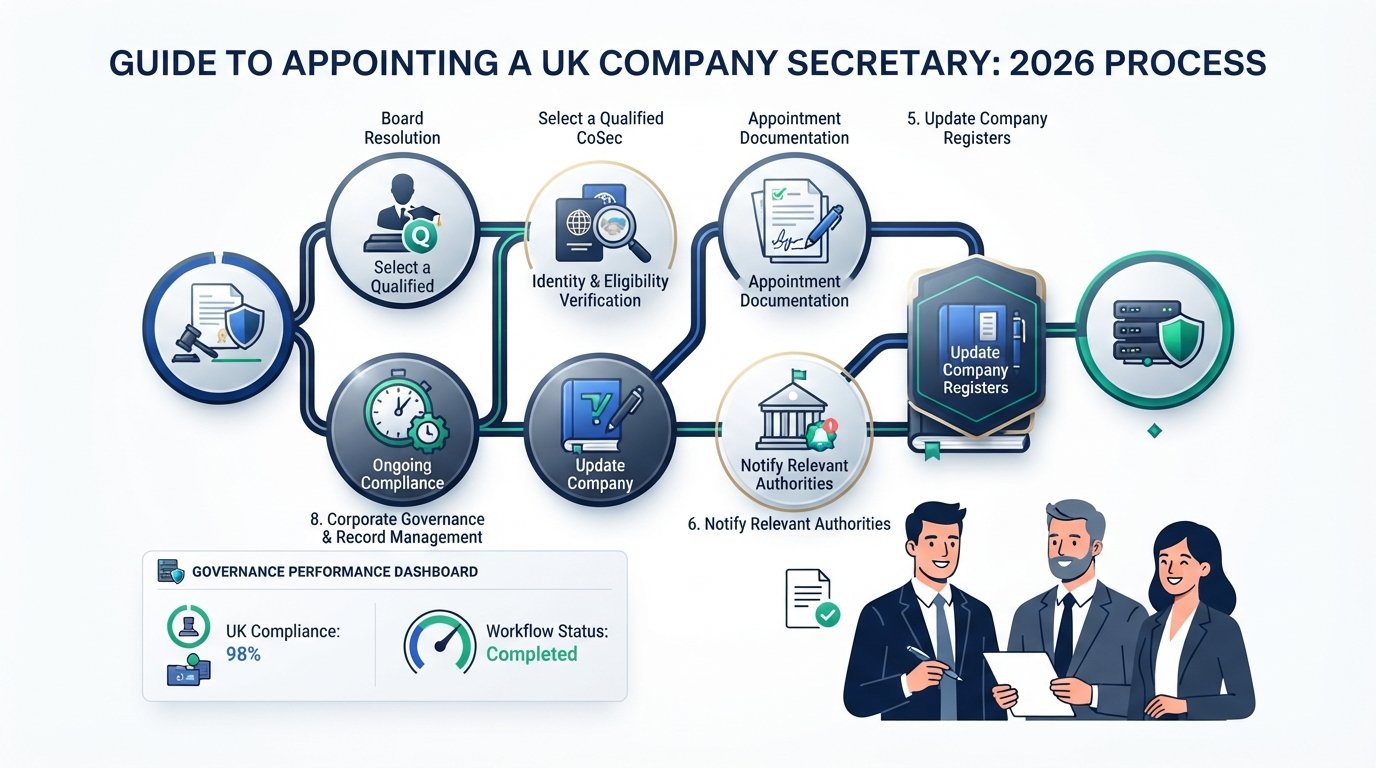
Common Mistakes to Avoid
A few issues come up regularly:
Appointing without consent. Someone must agree to be Company Secretary. Trying to appoint someone unilaterally is legally invalid.
Missing the 14-day filing deadline. Companies House penalties can apply.
Filing the wrong form. AP03 for individuals, AP04 for corporate secretaries. Different rules apply.
Not updating statutory registers. Internal records must match Companies House.
Appointing an unsuitable person. Someone who won’t or can’t perform the duties creates ongoing problems.
Missing PLC qualification requirements. For PLCs, the appointee must meet the qualification requirements.
Combining director and secretary in a small company. Legally permitted, but reduces governance separation.
Not documenting the board resolution. The appointment isn’t valid without proper board or shareholder authorisation.
Overlooking service address requirements. The secretary’s service address must be a real address capable of receiving statutory correspondence.
Not planning for succession. If the Company Secretary resigns or becomes unable to act, having a plan for replacement matters.
Getting the process right at the start avoids these issues.
Removing or Replacing a Company Secretary
The reverse process also matters:
Voluntary resignation. The Company Secretary gives written notice according to your Articles.
Removal by shareholders. Under section 168 of the Companies Act 2006, shareholders can remove a Company Secretary by ordinary resolution.
Removal per Articles. Your Articles may set specific circumstances.
Automatic removal. If the secretary becomes disqualified, bankrupt, or otherwise ineligible.
Filing requirements. Form TM02 (individual) or Form TM03 (corporate) is filed with Companies House within 14 days.
No filing fee. Companies House currently doesn’t charge for termination filings.
Statutory register update. Remove from the internal register of Company Secretaries.
Related communications. Notify banks, business partners, and others as appropriate.
If replacing the Company Secretary, appoint the new one before or immediately after the departure to avoid a gap.
What If You Decide Not to Appoint (Or to Remove) a Company Secretary?
For private limited companies, having no Company Secretary is perfectly legal:
No Companies House filing needed. For companies that never had one.
File TM02 to remove. If you’re removing an existing Company Secretary.
Update statutory registers. Reflecting the absence.
Continue meeting all statutory obligations. The company and its directors remain responsible.
Consider outsourced services. Modern company secretarial services provide the compliance support without the officer role.
Many UK small and medium businesses find that a good outsourced service delivers the same compliance benefits with less overhead and easier flexibility.
Non-Resident Company Secretary Appointments
Non-resident individuals can serve as Company Secretary of a UK company:
No legal restriction on residency. For private limited companies.
Practical challenges. Remote administration of statutory matters can be difficult.
Communication considerations. Time zones affect responsiveness.
Correspondence issues. Postal Companies House correspondence to overseas addresses is slower.
Service address. Can be an overseas address, though a UK service address is often preferable for practical reasons.
Identity verification. Under the ECCTA, some verification requirements may apply (though the specific position for Company Secretaries who aren’t also directors or PSCs varies).
For non-resident businesses, appointing a UK-based Company Secretary or using a UK-based company secretarial service is usually more practical than appointing a non-resident individual.
How Form My Company Helps
We provide comprehensive support for UK company secretarial matters. As an Authorised Corporate Service Provider (ACSP), we can:
File AP03 or AP04. For your Company Secretary appointment.
File TM02 or TM03. For Company Secretary removals.
Update statutory registers. For your internal records.
Provide UK service addresses. For Company Secretaries needing a UK address.
Coordinate with wider compliance. Confirmation statements, director changes, and other statutory work.
Support outsourced secretarial services. As an alternative to appointing a named officer.
Advise on the practical choice. Between named appointment and outsourced services.
Handle ongoing compliance. As your ongoing compliance partner.
Bundle services in packages. For UK-based and non-resident owners.
Whether you’re appointing a formal Company Secretary or preferring outsourced compliance support, we can help you make the right choice for your business.
Get Your Company Secretary Appointed Correctly Today
Appointing a Company Secretary is a formal corporate governance step with real legal implications. Getting it right, whether you’re a PLC required to appoint one or a private limited company voluntarily doing so, matters for compliance. With Form My Company, filing and record-keeping for Company Secretary appointments is straightforward and fully supported. Get in touch today and let us handle the paperwork while you focus on your business.
Frequently Asked Questions
Does my UK limited company need a Company Secretary?
Not for private limited companies. Since April 2008, private limited companies have not been legally required to appoint a Company Secretary. Public limited companies (PLCs) ARE required to appoint one, with specific qualification requirements.
How do I appoint a Company Secretary?
Get the person’s consent, pass a board resolution (or shareholder resolution per your Articles), update your statutory register, and file Form AP03 (for individual) or AP04 (for corporate secretary) with Companies House within 14 days.
Do I need to file with Companies House?
Yes. The appointment must be notified to Companies House using Form AP03 (individual) or Form AP04 (corporate) within 14 days. Filing is free, and can be done online through WebFiling or through an ACSP.
What are the qualifications for a Company Secretary?
For private limited companies, no formal qualifications are required. For PLCs, the appointee must be a Chartered Secretary, qualified accountant, solicitor, barrister, or someone with 3+ years’ relevant experience.
Can a director also be Company Secretary?
Yes, legally. In a private limited company, one person can hold both roles. This is common for small companies but reduces governance separation.
Can I appoint a company as Company Secretary?
Yes. A corporate secretary is possible, though specific rules apply. Form AP04 is used to file a corporate secretary appointment.
What if I decide I don’t want a Company Secretary?
For private limited companies, having no Company Secretary is perfectly legal. Just don’t file an appointment. If you have an existing Company Secretary, they can resign or be removed. Modern company secretarial services provide compliance support without needing a named officer.
Can Form My Company help with Company Secretary appointments?
Yes. As an ACSP, we handle AP03, AP04, TM02, and TM03 filings, coordinate with other Companies House work, and can also provide outsourced secretarial services as an alternative to appointing a named officer.