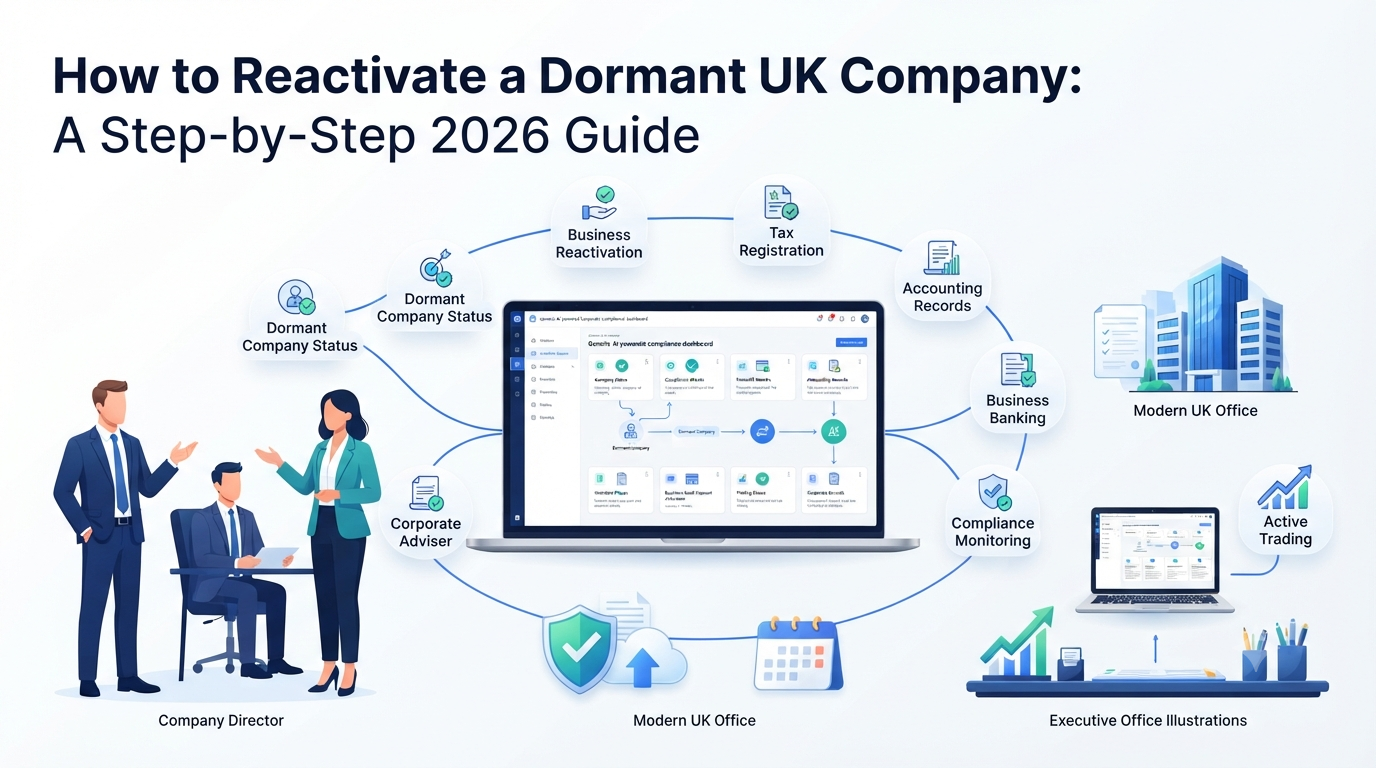
Reactivate a Dormant UK Company
Many UK company owners incorporate a limited company and hold it dormant for a period, waiting for the right moment to launch. When that moment arrives, reactivating a dormant company involves specific steps to move from dormant compliance to active trading status. Get the transition right, and you’re set up for smooth ongoing operations. Get it wrong, and you can face HMRC penalties, Companies House complications, and confusion in your first year of trading. At Form My Company, we help UK company owners transition from dormant to active as part of our compliance support. This guide walks you through exactly how to reactivate a dormant UK company in 2026.
Understanding What “Reactivating” Actually Means
Before jumping into the steps, it helps to be clear about what reactivating a dormant company involves.
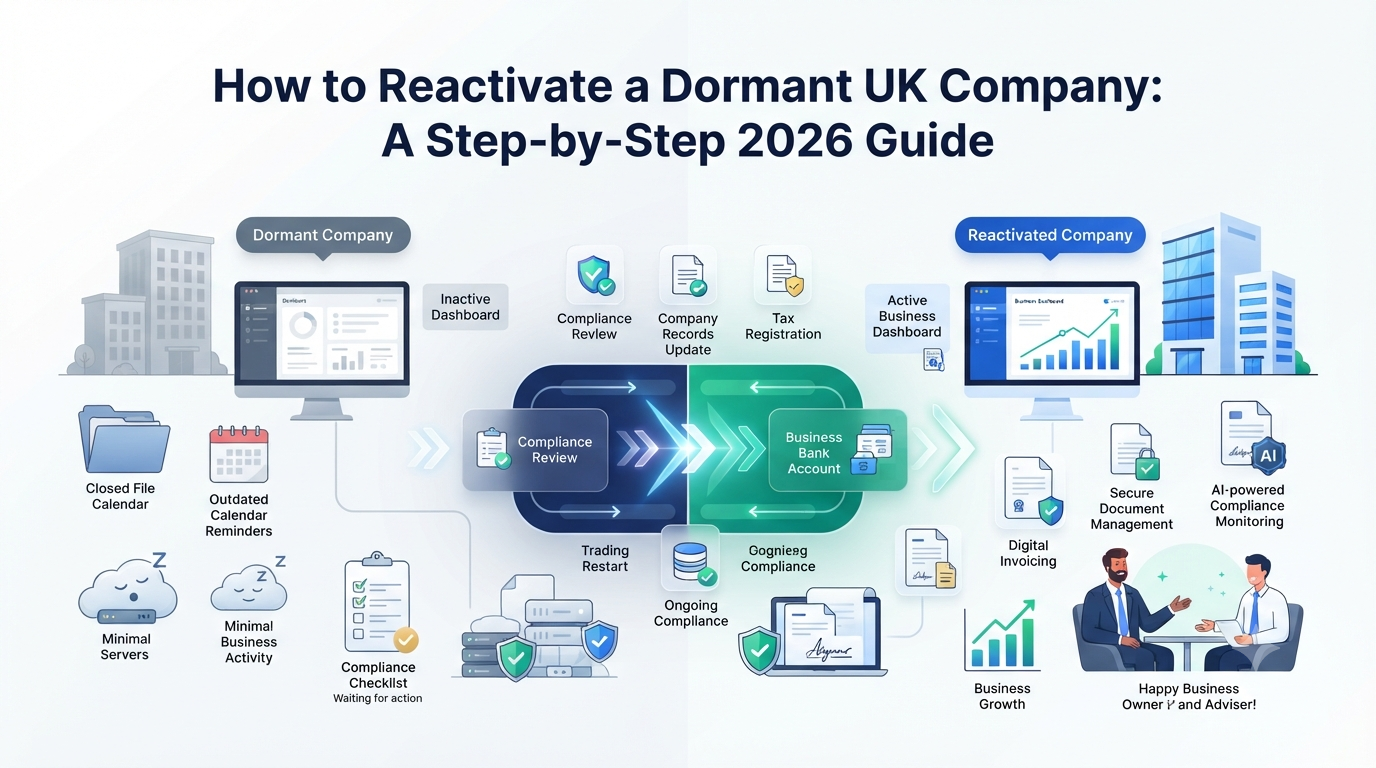
A dormant company is one that has had no “significant accounting transactions” during the financial year. When you reactivate, you’re moving the company from that dormant status to active trading, which means:
Trading activity begins. You start selling goods or providing services, generating income and expenses.
Full accounts required. Rather than dormant accounts (Form AA02), you’ll file full accounts for the financial year in which trading starts.
HMRC notification needed. HMRC needs to know your company has begun trading so they can update your Corporation Tax status.
Ongoing accounting starts. You need proper bookkeeping from the day trading begins.
Wider tax obligations kick in. Depending on your business, this can include VAT, PAYE, and other tax registrations.
Business banking setup. If not already in place.
Continued Companies House compliance. The confirmation statement, PSC updates, and other statutory obligations continue.
Reactivation isn’t a single event. It’s a coordinated transition affecting multiple aspects of your company’s compliance and operations.
When Do You Need to Reactivate?
You need to reactivate your dormant company when:
You start trading. Any commercial activity beyond the dormant exceptions triggers reactivation.
You take on any significant accounting transaction. Even before formal trading, transactions like paying an accountant, receiving interest, or purchasing stock can disqualify dormant status.
You start invoicing. Any invoicing to customers (even before receiving payment) typically triggers reactivation.
You register for VAT. VAT registration typically indicates trading and requires active company status.
You register for PAYE. If you start paying salaries (including to yourself), you’re active.
You open a business bank account. In many cases, this triggers the “active” status if you’re not already.
You take on employees. Starting payroll indicates active trading.
You start receiving customer payments. Whether directly or through a marketplace.
The specific trigger varies, but the underlying principle is any significant activity beyond the strictly limited dormant exceptions.
Step 1: Confirm You Actually Need to Reactivate
Before any formal steps, confirm:
Are you actually starting to trade? Or is this a transitional period where you’re preparing but not yet trading?
What’s the specific trigger? Understanding when trading effectively started matters for HMRC and Companies House timing.
When did trading begin? The specific date matters for tax purposes.
What’s the scope of activity? Full trading, occasional sales, or something in between?
Are you crossing any thresholds? VAT threshold, employer status, or other regulatory tests.
What are your projections? Turnover, expenses, and business scale.
Getting clarity on these questions helps you plan the reactivation properly rather than reacting in a rush.
Step 2: Notify HMRC of Active Trading
This is one of the most important immediate steps. HMRC needs to know your company has started trading:
Notify HMRC within 3 months of trading starting. Failure to notify can lead to HMRC penalties.
Use the HMRC online service. Or notify through your accountant or company services provider.
Provide details of the trading start date. So HMRC can update your Corporation Tax status accurately.
Confirm your business activities. Description of what your company is now doing.
Update your Corporation Tax registration. From dormant to active status.
Prepare for a Corporation Tax return. Which you’ll file at your next accounting reference date after the first period of active trading.
HMRC’s records need to reflect your active status, not just Companies House. This is separate.
Step 3: Set Up Proper Bookkeeping from Day One
The moment you start trading, bookkeeping must begin:
Choose accounting software. Xero, QuickBooks, FreeAgent, or Sage are common choices.
Ensure Making Tax Digital compatibility. If you’re VAT registered or will be, MTD-compatible software is essential.
Set up your chart of accounts. Reflecting your business’s specific income and expense categories.
Establish transaction recording processes. So every transaction is captured accurately.
Set up bank feeds. For automated transaction imports where possible.
Establish invoice numbering. Sequential, unique invoice numbers.
Establish expense tracking. For legitimate business expenses.
Store receipts and documents. Physically or digitally, but organised.
Set up ongoing accountant relationship. For most companies, working with a UK accountant from active trading onwards is essential.
Getting bookkeeping right from the start is much easier than retrospectively reconstructing it later.
Step 4: Assess VAT Registration Needs
Once trading, consider whether VAT registration applies:
Standard threshold. £90,000 rolling 12-month turnover for UK-based businesses.
Voluntary registration. Below the threshold for various strategic reasons.
Mandatory registration. For specific business types (non-resident sellers with UK stock, distance sellers to UK consumers, certain sectors).
Non-resident considerations. Different rules apply to overseas-owned companies.
E-commerce and marketplace sellers. Specific rules for Amazon, eBay, and other marketplaces.
Timing. VAT registration typically takes 2-4 weeks for UK-based, 4-8 weeks for non-residents. Plan ahead of when you actually need the VAT number.
Scheme choice. Standard accounting, Flat Rate, Cash Accounting, or Annual Accounting.
For most active companies, understanding VAT positioning is one of the first strategic decisions after reactivation. Our VAT registration service can help with this.
Step 5: Set Up Employer Obligations if Applicable
If your company will pay salaries (including to you as director):
Register for PAYE. With HMRC before you first pay salaries.
Set up payroll software. MTD-compatible, capable of Real Time Information (RTI) filing to HMRC.
Understand Auto-Enrolment obligations. For workplace pensions.
Set up National Insurance handling. Both employer and employee.
Consider employment law compliance. For any employees.
Coordinate with your accountant. Payroll interacts with Corporation Tax and personal tax.
Get expert help if needed. Payroll can be genuinely complex.
For sole director companies, PAYE setup is often relatively straightforward. For businesses with multiple employees, professional help is usually essential.
Step 6: Update Your Companies House Records
Some Companies House updates may be needed:
Director details. If any director details have changed.
PSC information. If PSC status or details have changed.
Registered office and service addresses. If needed.
Confirmation statement timing. Reactivation doesn’t change your existing schedule, but your annual confirmation statement should reflect the active status.
Statutory register updates. For internal records.
SIC code updates. If your business activity has evolved from what was originally registered.
Companies House records should reflect your active trading status accurately.
Step 7: File Full Accounts for the Financial Year
When your accounting period ends, you file full accounts (not dormant accounts):
Full accounts required. For the financial year in which trading began.
Filing deadline. 9 months after your accounting reference period ends.
Comprehensive accounts. Including profit and loss, balance sheet, and notes.
Accountant help typically needed. Full accounts are more complex than dormant AA02 filings.
Coordination with Corporation Tax return. Which is filed with HMRC separately.
Directors’ report. Where required based on company size.
Reflect the transition. From dormant to active in the financial reporting.
For most companies, this is the first substantive interaction with the full compliance requirements of an active UK company.
Step 8: Corporation Tax Return
For your first accounting period as an active company:
CT600 return required. Filed with HMRC.
Deadline. 12 months after the end of your accounting period for the return, 9 months after for payment.
Comprehensive tax calculation. Including Corporation Tax at the current rate (25% for most companies, 19% small profits rate).
Coordination with your accountant. For most companies, an accountant handles the Corporation Tax return.
Payments on account. May need to be set up.
HMRC agent authorization. If your accountant is submitting on your behalf.
Ongoing quarterly compliance. For VAT if applicable.
The transition from dormant to active is typically the first substantial Corporation Tax interaction.
Step 9: Set Up Business Banking
If you don’t already have a UK business bank account:
Open a business account. Options include high street banks, digital banks (Starling, Tide), or specialist fintechs (Wise Business, Revolut Business).
Non-resident considerations. Fintech providers typically welcome non-resident applicants better than high street banks.
Set up payment gateways. For e-commerce or service businesses.
Establish accounting integrations. With your accounting software.
Handle multi-currency if needed. For international businesses.
Consider expense management. For team expenses.
Set up direct debits. For regular payments.
Establish invoicing systems. With your accounting software.
Business banking is essential from the moment you start trading. Our banking partner introductions can help non-resident owners.
Step 10: Ongoing Active Company Compliance
Once fully reactivated, ongoing compliance becomes:
Annual accounts. Full accounts each year, not dormant.
Corporation Tax returns. Each year at your accounting reference date.
VAT returns. If VAT registered, quarterly (or annually depending on scheme).
PAYE and RTI. If employing anyone.
Confirmation statement. Annual, unchanged in requirement.
PSC updates. As ownership changes.
Companies House filings. For any statutory events (director changes, share transfers, name changes).
Statutory register maintenance. For internal records.
Ongoing bookkeeping. For accurate records.
Making Tax Digital compliance. For VAT-registered businesses.
The compliance burden is significantly higher than during dormancy, which is why most active companies work with a qualified UK accountant.
Common Mistakes When Reactivating
A few issues come up regularly:
Not notifying HMRC. Failing to inform HMRC of active trading can lead to penalties.
Missing the 3-month HMRC deadline. For notification of trading start.
Filing dormant accounts by mistake. For a period when the company was actually active.
Not setting up bookkeeping from day one. Retrospective reconstruction is expensive.
Missing VAT registration triggers. Non-resident sellers especially often miss when registration becomes mandatory.
Not setting up PAYE before paying salaries. Late PAYE registration causes issues.
Not coordinating with an accountant. Full accounts and Corporation Tax are typically beyond DIY capability.
Overlooking Making Tax Digital requirements. For VAT-registered businesses.
Not opening business banking. Trying to operate without proper business accounts.
Missing Companies House filings. Even active companies have specific timings.
Not updating statutory registers. Internal records must match reality.
Assuming the transition is automatic. Reactivation requires active steps, not just becoming active in fact.
Professional support significantly reduces these risks.
Non-Resident Owners Reactivating a UK Company
For non-resident owners, reactivation has specific considerations:
Coordination from abroad. Time zones, communication, and remote setup add friction.
UK banking setup. Fintech options (Wise, Revolut, Tide) work well for non-residents.
Accountant selection. A UK accountant experienced with non-resident-owned businesses is valuable.
HMRC notification. Coordinating from abroad, potentially through a service provider.
Cross-border tax planning. Your home country tax situation matters.
VAT registration if applicable. Non-residents often face specific rules.
Coordination with existing UK compliance. Registered office, service address, and identity verification.
Ongoing compliance workload. Higher than dormant status, requiring UK-based partners.
For non-resident owners, reactivation is a natural moment to bring in UK-based compliance support, whether that’s Form My Company’s ongoing services or a UK accountant, or both.
Timing Considerations for Reactivation
Timing matters:
Plan ahead. Reactivation involves multiple steps (VAT registration, PAYE setup, banking) that take time.
Consider your accounting period. Starting trading part-way through can affect first-year reporting.
Coordinate with tax planning. VAT registration and Corporation Tax positioning matter.
Align with your business plan. Reactivation should follow business readiness, not force it.
Prepare team and systems. Bookkeeping, banking, and admin infrastructure need to be ready.
Consider seasonal factors. For seasonal businesses, timing matters for tax and operational reasons.
Plan for HMRC notification. The 3-month window matters.
Rushing reactivation often causes complications.
How Form My Company Helps with Reactivation
We support UK company owners transitioning from dormant to active as part of our compliance services. As an Authorised Corporate Service Provider (ACSP), we can:
Coordinate the HMRC notification. Ensuring you meet the 3-month deadline.
Handle VAT registration. If applicable to your business.
Update Companies House records. For any statutory events during reactivation.
Coordinate with your accountant. For full accounts and Corporation Tax setup.
Support identity verification. For directors and PSCs under the ECCTA.
Continue registered office and service address. As you reactivate.
Point you toward specialist support. For ongoing accounting, VAT return filing, and payroll.
Non-resident support. With the specific challenges of reactivation from abroad.
Bundled with wider compliance. Registered office, confirmation statement, identity verification, and reactivation coordinated.
Multi-year continuity. As your active company grows.
For UK company owners moving from dormant to active, we handle the transition professionally and coordinate with your other advisers.
Reactivate Your Dormant Company Correctly Today
Reactivating a dormant UK company is a coordinated transition affecting HMRC, Companies House, banking, and ongoing compliance. Getting it right sets your active business up for success. Getting it wrong creates months of complications. With Form My Company, reactivation support is straightforward and fully supported. Get in touch today and let us handle the transition while you focus on your business.
Frequently Asked Questions
How do I reactivate a dormant UK company?
Notify HMRC of active trading within 3 months, set up proper bookkeeping, register for VAT if applicable, set up PAYE if paying salaries, open business banking, update Companies House records, file full accounts (not dormant), and start ongoing active company compliance.
What triggers the need to reactivate my dormant company?
Any significant accounting transaction, including trading, invoicing, receiving customer payments, taking on employees, registering for VAT, or generally starting business operations beyond the dormant exceptions.
Do I need to notify HMRC when reactivating?
Yes. HMRC must be notified within 3 months of trading starting. Failure to notify can lead to penalties. This is separate from Companies House updates.
What accounts do I file after reactivating?
Full accounts, not dormant company accounts (Form AA02). Full accounts include profit and loss, balance sheet, notes, and are more comprehensive than dormant accounts. A qualified UK accountant typically prepares them.
Do I need to register for VAT when reactivating?
Only if you exceed the £90,000 threshold, or if specific rules apply (non-resident sellers with UK stock, distance sellers to UK consumers, or specific sectors). Voluntary registration is also possible.
When should I set up bookkeeping?
Immediately when trading starts. Bookkeeping software (MTD-compatible where relevant) should be in place from day one to capture all transactions accurately.
Do I need a UK accountant when reactivating?
Almost always yes. Full accounts and Corporation Tax returns are typically beyond DIY capability for most business owners. A qualified UK accountant handles ongoing tax compliance and often provides broader financial advice.
Can Form My Company help me reactivate my dormant company?
Yes. We coordinate the HMRC notification, VAT registration, Companies House updates, and identity verification. We also point you toward accountants for ongoing full accounts and Corporation Tax work. We support both UK-based and non-resident owners.