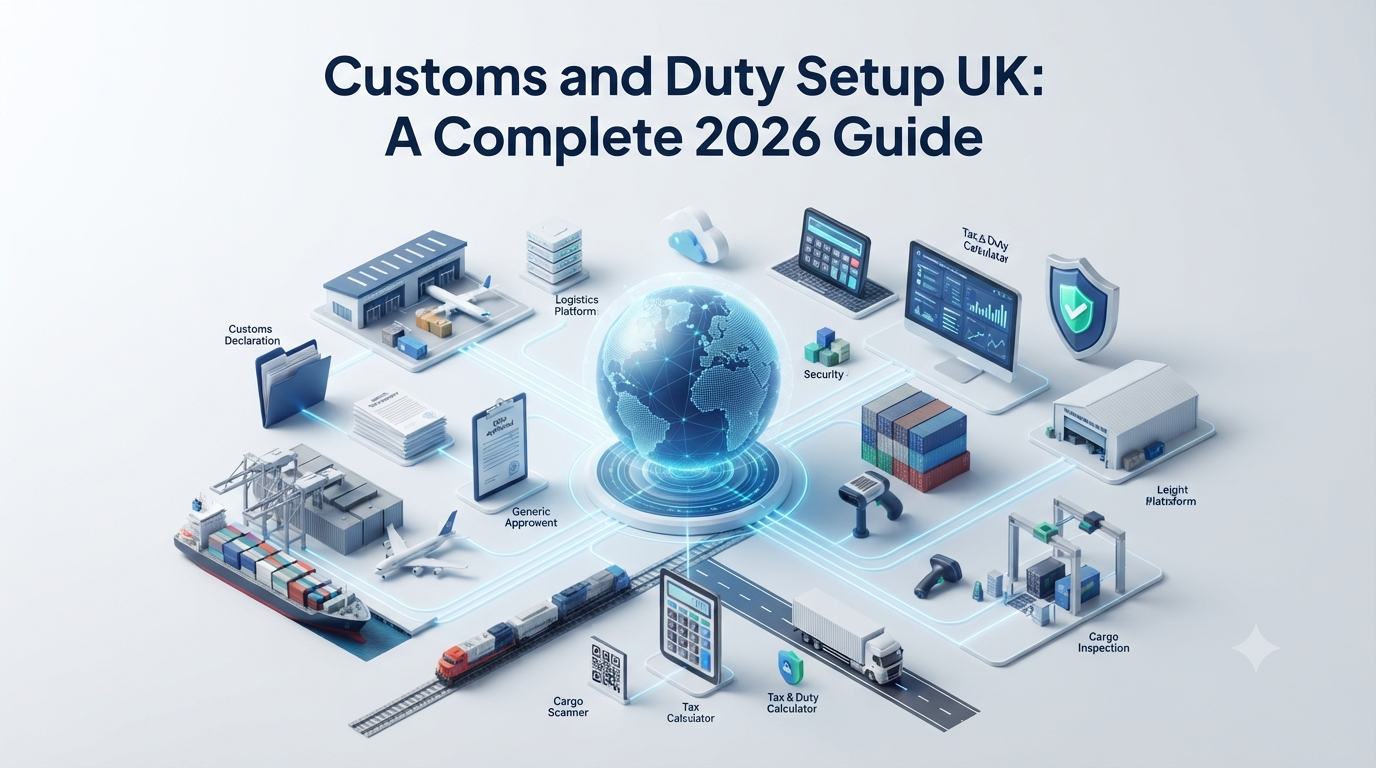
Customs and Duty Setup UK
If you’re importing goods into the UK or exporting from the UK, customs and duty setup is one of the most important operational areas to get right. Post-Brexit, UK customs procedures apply to trade with the EU just as they do with the rest of the world, and the specifics (commodity codes, duty rates, VAT handling, customs special procedures) directly affect your costs and delivery times. Getting the setup right can save significant duties, avoid border delays, and enable smooth ongoing trade. At Form My Company, we help UK businesses establish the corporate foundation for international trade. For customs and duty specifically, we point you toward qualified UK customs agents, freight forwarders, and customs consultants who specialise in this area. This guide explains everything you need to know about UK customs and duty setup in 2026.
What Does Customs and Duty Setup Involve?
UK customs and duty setup covers several distinct operational elements:
Commodity code classification. Correctly identifying each product under the UK Global Tariff for customs and duty purposes.
Customs duty determination. Calculating what duties apply to your specific imports.
Rules of origin. Determining whether goods qualify for preferential duty treatment.
VAT handling. How import VAT is paid and reclaimed.
Customs declaration procedures. Submitting the required documentation for each shipment.
Customs special procedures. Warehousing, inward/outward processing, and other schemes that can reduce costs.
Deferment accounts. For deferring duty payments to improve cash flow.
Postponed VAT Accounting (PVA). For handling import VAT through your VAT return.
Trader authorisations. Special status like Authorised Economic Operator (AEO) or Simplified Import VAT Accounting (SIVA).
Customs agents and brokers. Professional relationships for ongoing customs work.
Compliance systems. For record-keeping and audit.
Getting all of this coordinated properly is what distinguishes efficient from inefficient international trade operations.
Post-Brexit UK Customs: What Changed
Since Brexit, UK customs procedures apply to EU trade as they do to trade with the rest of the world:
Customs declarations required. For nearly all goods moving between UK and non-UK countries (including EU).
UK-EU Trade and Cooperation Agreement. Provides tariff-free trade for qualifying goods under specific rules of origin.
UK Global Tariff. Replaced the EU Common External Tariff for imports from non-EU countries.
Windsor Framework. Simplified arrangements for Northern Ireland trade.
Customs Declaration Service (CDS). UK’s digital customs platform (replacing CHIEF).
Border checks. Physical inspections at UK ports for some goods.
Product regulations. UK product safety, marking, and standards may differ from EU.
Trader Support Service. Free HMRC service for Northern Ireland trade.
Simplified procedures. For approved businesses.
Understanding these changes is essential for anyone starting or reviewing UK international trade operations.
Commodity Codes: The Foundation
Commodity codes (also called tariff codes, harmonized codes, or HS codes) are the foundation of customs work:
Purpose. Classify each product for customs, duty, and statistical purposes.
Structure. Based on the international Harmonized System (HS), extended for UK-specific requirements.
Length. 10 digits for UK imports, 8 digits for UK exports.
Impact. Determines duty rates, VAT treatment, import restrictions, and licensing requirements.
Look up. Through the UK Global Tariff online tool.
Complexity. Some products fall clearly into one code; others require expert analysis.
Consequences of errors. Wrong codes can result in incorrect duties (over or under payment), customs delays, and penalties.
Regular updates. Codes and classifications change periodically.
Product-specific requirements. Some products need additional certifications or licences.
Getting commodity codes right is where much of the value in professional customs advice comes from.
Customs Duty Rates
Duty rates vary significantly:
MFN (Most Favoured Nation) rates. Standard rates applying to imports from countries without preferential agreements.
Preferential rates. For goods from countries with UK trade agreements (including EU under UK-EU TCA), subject to rules of origin.
Zero rates. Some goods have zero duty regardless of origin.
Ad valorem. Percentage of the customs value (most common).
Specific rates. Fixed amount per unit (weight, quantity, etc.).
Compound rates. Combination of ad valorem and specific.
Anti-dumping duties. Additional duties on certain goods from specific countries.
Countervailing duties. Anti-subsidy measures.
Safeguard duties. Temporary protection measures.
Suspension arrangements. For certain goods where UK production is limited.
Duty rates directly affect your import costs. Small percentage differences can be material for regular importers.
Rules of Origin
For preferential duty treatment, goods must meet rules of origin requirements:
UK-EU TCA rules. Determining whether goods qualify as UK or EU origin.
Wholly obtained goods. Grown or produced entirely in one territory.
Substantial transformation. Where processing changes the goods’ character enough to change origin.
Value-added requirements. Percentage of value added in the origin country.
Regional cumulation. Where components from multiple countries in a region count together.
Self-certification. Common under UK-EU TCA for goods under specific values.
Origin certificates. For higher-value goods or non-EU trade.
REX system. Registered Exporter system for EU trade.
Ongoing compliance. Rules of origin claims must be genuine and provable.
For businesses importing from countries with UK trade agreements, understanding and correctly claiming rules of origin can save substantial duties.
Import VAT and PVA
Import VAT interacts closely with customs setup:
Import VAT. Charged on imports over £135 consignment value.
Rate. Same as UK standard VAT (currently 20%) for most goods.
Reduced rate. For qualifying goods (currently 5%).
Zero rate. For some goods.
Payment at import. Historically, VAT paid at the border.
Postponed VAT Accounting (PVA). Since January 2021, allows VAT-registered businesses to account for import VAT on their VAT return rather than paying at import.
PVA benefit. Improves cash flow significantly.
PVA statement. Available from HMRC monthly.
VAT reclaim. For business inputs, import VAT is reclaimable.
Making Tax Digital. For all VAT-registered businesses.
Non-resident considerations. Different rules for overseas sellers.
For VAT-registered businesses, PVA is essentially standard practice for imports.
Deferment Accounts
For customs duty payments:
What they are. Accounts allowing you to defer customs duty (and previously VAT) payments to the middle of the following month.
Benefit. Cash flow improvement, no need to pay at each shipment.
Requirements. Guarantee (typically bank guarantee), regular monthly settlements.
Guarantee amounts. Vary by trader profile and volume.
Setup process. Application to HMRC with financial guarantees.
Ongoing management. Monthly statements, reconciliation, payment.
Costs. Guarantee costs plus HMRC fees.
When useful. For regular importers with material duty amounts.
For occasional importers, deferment often isn’t worth the setup complexity. For regular importers, it’s essentially standard.
Customs Special Procedures
Special procedures can significantly reduce customs costs:
Customs Warehousing. Store goods without paying duty or import VAT until they enter free circulation. Useful for bulk imports.
Inward Processing. Import goods for processing or manufacturing then re-export, avoiding duty on materials.
Outward Processing. Export goods for processing abroad then reimport, paying duty only on added value.
Temporary Admission. For goods imported temporarily (samples, exhibition goods, etc.).
End Use. Reduced duty rates for goods used for specific approved purposes.
Authorized Economic Operator (AEO). Trusted trader status providing simplified procedures.
Simplified Import VAT Accounting (SIVA). For approved traders on VAT.
Common Transit Convention (CTC). For goods transiting the UK to other territories.
Bonded warehousing. For excise goods.
Each has specific requirements, costs, and administrative overhead. Whether they benefit your business depends on volume, product type, and business model.
The Customs Declaration Service (CDS)
CDS is the UK’s digital customs platform:
Replaced CHIEF. Since 2022, all UK customs declarations go through CDS.
Digital submission. All declarations submitted digitally.
Real-time processing. Faster than paper-based systems.
Comprehensive requirements. Detailed data on each shipment.
Direct submission. Traders can submit directly if trained and authorised.
Agent submission. Most traders use customs agents to submit on their behalf.
Integration with software. With freight forwarders’ systems.
Documentation. Commercial invoices, packing lists, certificates of origin.
Trader Support Service. For Northern Ireland trade specifically.
Ongoing evolution. CDS continues to develop.
For most businesses, working with a customs agent or freight forwarder for CDS submissions is standard practice.
Customs Agents and Freight Forwarders
Most traders work with specialist providers:
Customs Agents. Specialise in customs declarations and clearance.
Freight Forwarders. Handle physical logistics and often customs work together.
Customs Brokers. Similar to agents.
Combined Service Providers. Handle end-to-end supply chain.
AEO Status. Some providers hold AEO status, providing efficiency benefits.
Software Integration. With trader systems.
Costs. Vary by shipment complexity.
Volume Discounts. For regular importers.
Sector Specialisation. Some providers focus on specific industries (electronics, textiles, etc.).
Regulatory Expertise. Beyond basic customs work.
Choosing the right customs partner significantly affects operational efficiency.
Product Regulations Beyond Customs
Customs is one aspect; product regulations are another:
UK product safety. UKCA marking (replacing CE for most products from January 2028) and product safety compliance.
Sector-specific regulations. Electronics, cosmetics, food, medical devices, etc.
Product testing. For safety certifications.
Documentation. For regulatory purposes.
Labelling. UK-specific requirements.
Language requirements. English documentation.
Recall obligations. For unsafe products.
Certification bodies. For specific product types.
Ongoing compliance. As product regulations evolve.
Import restrictions. For certain products (weapons, chemicals, etc.).
Beyond customs work, product-specific regulatory compliance matters for legal UK trade.
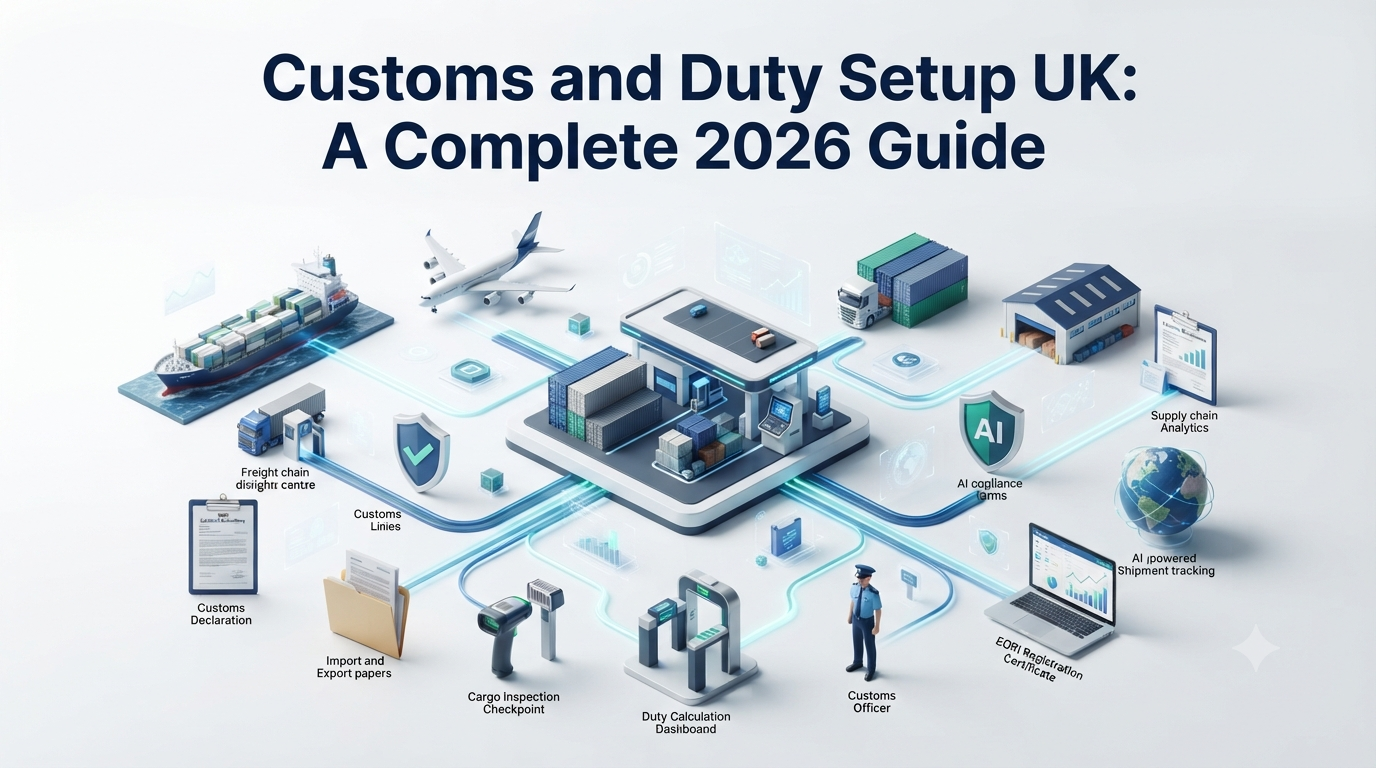
Customs and Duty Setup for Non-Residents
Non-resident traders have specific considerations:
UK company or non-resident business. Different customs setup for each.
GB EORI required. For non-residents with UK trade.
VAT registration. Typically mandatory before customs work.
UK-based customs partners. Working with UK customs agents and freight forwarders.
Documentation from abroad. Coordination on commercial documentation.
Product classification. May be more challenging for exotic products.
Rules of origin from home country. Where preferential treatment applies.
Ongoing compliance from abroad. Coordination through UK partners.
Cross-border VAT considerations. For multi-jurisdictional trade.
Home country tax implications. Beyond just UK.
For non-resident businesses, working with UK-based customs partners is essentially essential.
Common Customs Setup Mistakes
A few issues come up regularly:
Wrong commodity codes. Leading to incorrect duties or delays.
Missing rules of origin proofs. Where preferential treatment could apply.
Ignoring VAT setup. Not registering for VAT when needed.
Not using PVA. Missing cash flow benefits.
Missing deferment account setup. For regular importers.
Not considering customs special procedures. That could save costs.
Poor customs partner selection. Choosing on price alone.
Underestimating documentation requirements. Missing required paperwork.
Product regulation gaps. Beyond customs.
Not planning for post-Brexit complexity. For EU trade especially.
Not integrating systems. Manual processes creating errors.
Missing AEO consideration. For high-volume traders.
Professional customs advice significantly reduces these risks.
Customs Costs
Understanding customs costs:
Import duties. As applicable per commodity code and origin.
Import VAT. 20% for most goods (reclaimable if VAT-registered).
Customs clearance fees. Typically £30 to £150 per declaration.
Freight forwarder charges. Various.
Handling fees. For physical clearance work.
Storage fees. If goods are held pending clearance.
Documentation fees. For certificates, permits.
Deferment account costs. Guarantee and admin.
PVA setup. No cost (free scheme).
Ongoing compliance. Accountant fees for VAT return coordination.
Special procedures setup. For customs warehousing, IP, etc.
Product regulatory costs. Testing, certification.
Software subscriptions. For customs management.
Budget realistically for both setup and ongoing operations.
Coordinating Customs With Broader UK Setup
Customs works best when integrated with broader UK operations:
UK company formation. Provides legal basis for UK trade.
VAT registration. Essential for imports.
EORI number. Required for customs declarations.
Banking arrangements. For payments to freight forwarders, customs agents, HMRC.
Insurance. For goods in transit.
Warehousing. For UK stock.
Marketplace integrations. For Amazon, eBay, etc.
Accounting systems. For financial coordination.
Ongoing compliance. With HMRC and Companies House.
Professional relationships. With accountant, ACSP, customs agent, freight forwarder.
For non-resident traders especially, coordinated professional support ensures all pieces work together.
How Form My Company Fits with Customs and Duty Work
Form My Company is an Authorised Corporate Service Provider (ACSP) focused on UK company formation, Companies House compliance, VAT registration, and ongoing statutory work. Customs and duty is a specialist operational area we don’t handle directly:
We handle the UK compliance foundation. Formation, addresses, VAT registration, Companies House work.
We don’t handle customs declarations. That’s specialist customs agent territory.
We don’t handle freight logistics. That’s freight forwarder territory.
We don’t handle deferment accounts. That’s HMRC directly, sometimes through customs agents.
We don’t handle customs special procedures. That’s specialist customs consultant work.
We point you toward customs specialists. For declarations, deferment, and complex customs work.
We coordinate with your accountant. For VAT compliance and international tax.
We’re transparent about our expertise. Compliance work is our strength; customs work is specialist territory.
We support the foundation on which customs work builds. UK company, VAT, EORI coordination.
For customs and duty work itself, we recommend working with qualified UK customs agents, freight forwarders, or customs consultants. Form My Company handles the compliance foundation that supports your customs operations.
Get Professional UK Customs Support Today
UK customs and duty setup is a specialist operational area that directly affects your international trade costs and efficiency. Working with qualified UK customs agents, freight forwarders, and customs consultants is essential for material import/export operations. Form My Company can help establish the UK company and compliance foundation on which customs work builds. Get in touch today about your UK company formation and compliance needs.
Frequently Asked Questions
What are commodity codes?
Codes classifying each product for customs, duty, and statistical purposes. UK imports use 10-digit codes; UK exports use 8-digit codes. Based on the international Harmonized System (HS). Correct classification is essential to determine duty rates, VAT treatment, and licensing requirements.
What is PVA?
Postponed VAT Accounting. Allows VAT-registered businesses to account for import VAT on their VAT return rather than paying at import. Available since January 2021 as standard practice. Significantly improves cash flow for regular importers.
What is a deferment account?
An HMRC-approved account allowing you to defer customs duty payments to the middle of the following month rather than paying at each shipment. Requires a guarantee. Beneficial for regular importers with material duty amounts.
What are rules of origin?
Requirements determining whether goods qualify for preferential duty treatment under trade agreements. Under UK-EU TCA, goods meeting rules of origin qualify for tariff-free trade. Getting rules of origin right saves substantial duties.
What is the UK-EU TCA?
UK-EU Trade and Cooperation Agreement. The framework governing UK-EU trade post-Brexit. Provides tariff-free trade for qualifying goods under specific rules of origin, plus other cooperation areas.
Do I need a customs agent?
Most traders yes. UK customs declarations through the Customs Declaration Service (CDS) require detailed data and expertise. Customs agents specialise in this. DIY declarations are possible but often not efficient.
Does Form My Company handle customs and duty work?
No. UK customs work (declarations, deferment, special procedures, classification) is specialist territory. We handle the compliance foundation (formation, VAT registration, EORI coordination) but point you toward qualified customs agents, freight forwarders, or customs consultants for actual customs operations.
How much does UK customs work cost?
Customs clearance fees typically £30 to £150 per declaration. Import duties and VAT are separate. Freight forwarder fees vary. Deferment account setup has guarantee and admin costs. Regular importers often have material ongoing customs and freight costs; occasional importers pay per shipment.