
Professional PSC compliance services identify, maintain, and report Persons with Significant Control data to Companies House. These services ensure UK corporate entities meet legal register obligations, verify beneficial ownership records, prevent statutory penalties, and safeguard company directors from personal liability under federal filing regulations.
Understanding Persons with Significant Control (PSC) requirements is crucial for every active company board. UK corporate law mandates that every private limited company, limited liability partnership, and registered entity maintain an accurate PSC register.
Professional compliance support manages these administrative burdens entirely. Specialist corporate secretaries track ownership threshold changes, prepare official notices, verify director information, and file statutory updates seamlessly. Managing PSC records systematically protects corporate integrity and mitigates regulatory risk.
Why Is PSC Compliance Mandatory for UK Company Directors?
PSC compliance is mandatory for UK company directors under the Small Business, Enterprise and Employment Act 2015. Section 790ZA obligates boards to identify, register, and report individuals possessing over 25 percent voting rights or significant managerial control to Companies House.
Companies House demands absolute transparency regarding ultimate beneficial owners. Directors bear individual statutory responsibility for submitting accurate control details. Failing to update PSC registers within 14 days constitutes a criminal offence.
Regulatory enforcement has intensified significantly following recent corporate transparency reforms. Statutory compliance safeguards your operational standing across commercial banking and legal environments.
Failure to maintain public records risks severe prosecution. Non-compliant officers face unlimited financial penalties, civil disqualification orders, or potential custodial sentences up to 2 years.
What Triggers a Persons with Significant Control Filing Obligation?
A PSC filing obligation triggers when an individual or relevant legal entity acquires more than 25 percent of company shares, controls over 25 percent of voting rights, or holds the statutory right to appoint or remove majority board members.
Corporate structural alterations require immediate statutory notification. Share transfers, equity issuance, board restructuring, and trust beneficiary changes immediately alter control percentages.
Three primary criteria determine individual PSC status: direct equity ownership, voting power allocation, and contractual governance authority. Boards must evaluate indirect ownership chains involving parent entities, offshore structures, or holding companies.
When corporate restructures alter control dynamics, directors must issue formal confirmation notices immediately. Professional PSC Compliance Services for UK Business Directors resolve complex ownership calculations quickly, ensuring statutory accuracy before submitting formal filings to Companies House.
How Do Fraud Protection Services Prevent Unauthorized PSC Alterations?
Fraud protection services prevent unauthorized PSC alterations by monitoring public registers continuously, locking corporate filing access, and deploying electronic authentication protocols that block fraudulent submissions made to Companies House by bad actors.
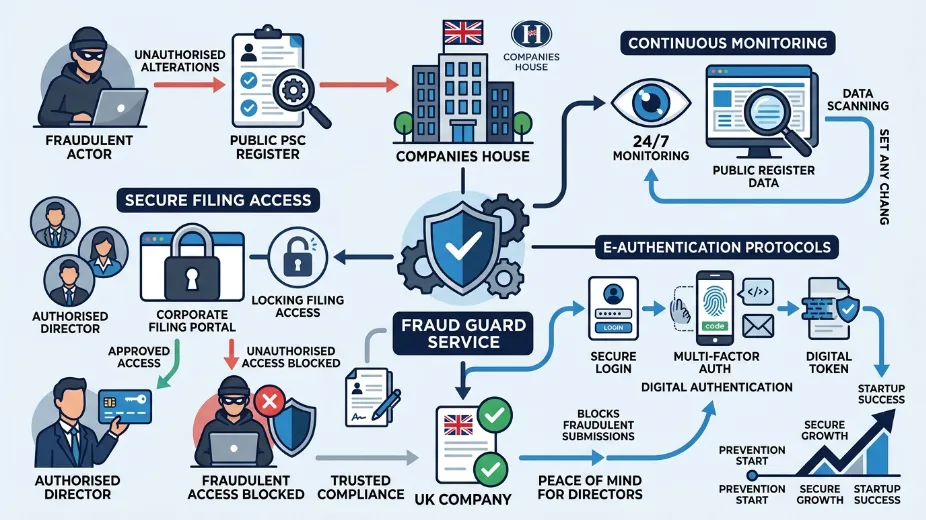
Corporate identity theft presents a critical danger to modern commercial entities. Fraudulent actors submit unauthorized PSC04 or AP01 forms to hijack corporate ownership online. Hijacked registers allow criminals to secure fraudulent commercial loans, liquidate corporate assets, or damage institutional credit ratings overnight.
Protecting corporate records requires proactive defenses. Establishing active statutory protections like Fraud Protection blocks unverified register amendments. Corporate security frameworks validate every administrative change before public registration occurs.
Modern protection platforms monitor Companies House registers 24 hours daily. Real-time filing alerts notify directors immediately whenever administrative changes trigger, enabling instant legal remedies before physical financial damage manifests.
What Steps Are Required to Maintain an Accurate PSC Register?
Maintaining an accurate PSC register requires identifying eligible individuals, issuing formal information notices, recording verified personal data internally within 14 days, and filing official updates with Companies House within a subsequent 14-day window.
Static registers fail compliance standards because corporate dynamics change continuously. Company secretaries must audit ownership structures periodically to detect untracked share movements or altered voting arrangements.
Five mandatory steps govern ongoing PSC management:
Identify all individuals meeting statutory control metrics
Issue formal Section 790D information requests to suspected beneficial owners
Verify personal details including full name, birth date, nationality, and service address
Update internal statutory books within 14 days of confirmation
Submit appropriate statutory notices (PSC01 through PSC09) to Companies House within 14 days
Maintaining complete standardization across company records simplifies regulatory audits. Reviewing your internal corporate documentation ensures every statutory document matches statutory filings seamlessly. For guidance on maintaining uniform statutory documentation across your business, read Document Standardisation: Why Your Company Pack Should be Consistent.
How Does Failure to Report PSC Data Impact Commercial Business Banking?
Failure to report PSC data impacts commercial business banking by triggering mandatory AML suspensions, blocking credit lines, freezing institutional bank accounts, and preventing financial institutions from completing legally required customer due diligence checks.
UK financial institutions must cross-reference customer account details against the public Companies House register under strict Anti-Money Laundering regulations. Discrepancies between bank records and statutory PSC entries trigger automated fraud flags.
When financial institutions detect unverified ownership records, compliance departments freeze active commercial accounts immediately. Account freezes disrupt merchant processing, payroll operations, supplier payments, and working capital lines.
Preventing corporate records from falling out of sync ensures uninterrupted financial operations. Unprotected corporate filings leave entities vulnerable to malicious administrative alterations. Learn more about securing your corporate assets in our detailed guide, Why You Should Never Leave Your Company Documents Unprotected.
What Information Must Be Recorded on the Public PSC Register?
The public PSC register must record full legal names, service addresses, country of residence, nationality, month and year of birth, the exact date control commenced, and specific control tier metrics.
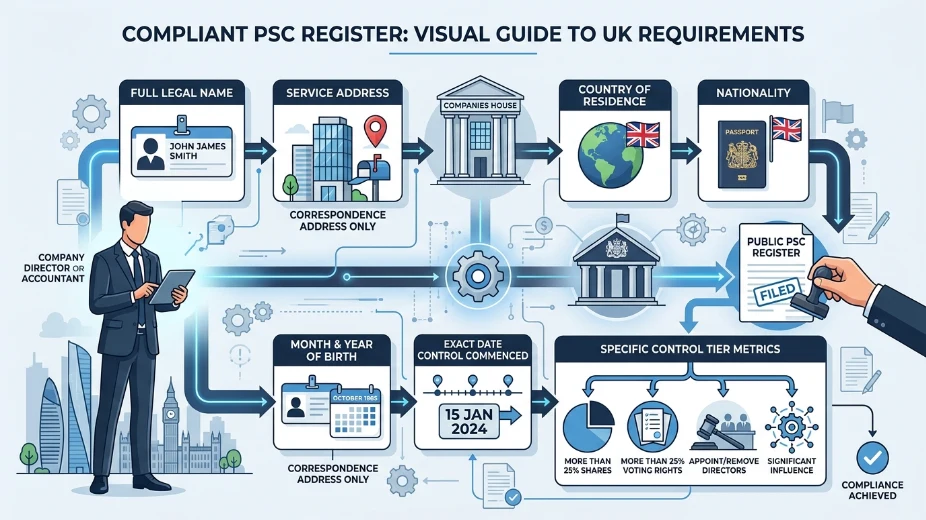
Privacy regulations balance public corporate transparency with personal identity protection. Public registers display professional service addresses while keeping private residential locations secured from standard public searches.
Two restricted data points remain strictly confidential: day of birth and usual residential address. Statutory authorities and law enforcement agencies maintain sole access to restricted personal metrics under official regulatory powers.
When submitting PSC registrations, corporate officers must verify every entry rigorously. Submitting false or misleading information to Companies House constitutes a statutory offence under section 1112 of the Companies Act 2006.
How Do Professional PSC Compliance Services Safeguard Company Boards?
Professional PSC compliance services safeguard company boards by automating statutory filings, tracking regulatory deadliness, managing complex corporate structures, verifying beneficial ownership data, and eliminating personal liability risks for company directors.
Managing internal statutory obligations demands considerable time and corporate administrative resources. Complex ownership arrangements involving corporate entities, trusts, or foreign investors require specialized legal analysis to accurately identify reportable controllers.
Professional compliance management eliminates administrative friction entirely. Dedicated corporate secretaries monitor statutory deadlines, draft formal notices, and file accurate electronic returns directly to Companies House gateways.
Form My Company provides comprehensive compliance infrastructure for expanding UK enterprises. Engaging dedicated statutory management ensures corporate registers remain complete, accurate, and completely aligned with evolving legislative frameworks.
Summary of Statutory Compliance
Maintaining accurate Persons with Significant Control records is a vital legal obligation for UK company directors. Evolving corporate legislation requires continuous transparency, precise reporting, and immediate notification of ownership modifications. Engaging professional compliance support mitigates administrative burdens, safeguards corporate registers against fraud, and protects directors from personal regulatory liability. Form My Company delivers complete compliance management, ensuring your enterprise remains fully protected and legally compliant.
Explore our Fraud Protection guide,
Reliable Company Secretarial Services for Growing UK Firms
Secure a Prestigious UK Business Address with Form My Company
Frequently Asked Questions
What is a PSC Fraud Protection service for UK companies?
A PSC Fraud Protection service monitors Companies House filings to prevent unauthorized alterations to your company’s Persons with Significant Control (PSC) register. By restricting electronic filing access and alerting directors to unverified submission attempts, Form My Company protects corporate entities from identity theft and corporate hijacking.
How does Companies House fraud protection prevent corporate identity theft?
Companies House fraud protection locks a company’s electronic administrative access so that official filings can only be processed through secure, authenticated pathways. Services like the Form My Company Fraud Protection service ensure that fraudulent changes to directors, registered office addresses, or PSC details are rejected before public registration occurs.
Why do business directors need fraud protection for corporate registers?
Business directors carry statutory responsibility for the accuracy of their company registers and face personal liability if corporate details are compromised. Implementing proactive fraud protection prevents bad actors from using hijacked corporate credentials to secure fraudulent lines of credit, alter beneficial ownership, or damage corporate credit ratings.
What happens if an unauthorized person changes your PSC details at Companies House?
If an unauthorized person submits a fraudulent PSC filing, your commercial banking access, credit standing, and legal standing can be restricted immediately during Anti-Money Laundering (AML) reviews. Utilizing a corporate fraud protection service enables immediate detection and containment, allowing directors to initiate legal and statutory corrections before physical financial damage occurs.
Can individuals or third parties change company documents without director permission?
Without administrative filing locks in place, bad actors can exploit vulnerable filing processes to submit unauthorized documents such as PSC updates or director appointments. Enrolling in a protected filing framework through Form My Company ensures all statutory document updates undergo strict identity and authorization checks prior to official registration.