
You manage your PSC register during business changes by recording beneficial ownership updates in your internal register within 14 days and notifying Companies House within a further 14 days. You must verify identity details, confirm percentage changes, and submit official statutory forms to prevent corporate compliance penalties.
What Is a PSC Register and Why Must UK Companies Maintain It?
A PSC register is an official statutory record that details every individual or legal entity exercising ultimate beneficial ownership or control over a UK company. Maintaining this register remains a strict legal requirement under the Companies Act 2006 to ensure corporate transparency.
The Persons with Significant Control (PSC) regime prevents illicit financial activities across the UK business sector. The law requires private limited companies, limited liability partnerships, and public limited companies to identify ultimate beneficial owners. A person qualifies as a PSC if they hold more than 25% of company shares or voting rights. Individuals who hold the right to appoint or remove the majority of the board of directors also meet the threshold.
Corporate compliance rules demand that PSC registers reflect accurate ownership structures at all times. The Economic Crime and Corporate Transparency Act 2023 grants statutory powers to Companies House to verify submitted ownership records. Failing to record beneficial ownership details compromises corporate transparency across official databases. UK directors carry a statutory duty to investigate, request, and verify PSC information continuously.
Official registers mandate recording specific details for every individual beneficial owner. Required data fields include full name, service address, date of birth, nationality, and exact date of control acquisition. Company officers must store residential addresses securely away from public view. Maintaining comprehensive registers protects company legal standing during regulatory audits.
What Triggers an Update to Your PSC Register?
An update to your PSC register is triggered whenever share transfers, voting right realignments, board restructures, or personal detail modifications change beneficial control thresholds. Any internal dynamic shifting operational control above the 25% legal limit demands immediate statutory action.
Corporate transactions regularly alter internal ownership hierarchies and trigger filing obligations. Equity funding rounds that dilute existing investors modify ownership percentages past legal reporting boundaries. Company share buybacks redistribute voting shares among remaining investors, creating new reportable PSCs.
Execute share transfers using Form J30 stock transfer instruments.
Issue new share allotments to external venture capital investors.
Reclassify share classes to alter voting control parameters.
Restructuring executive management triggers updating requirements under board appointment provisions. Appointing officers with dominant operational veto rights creates a reportable control relationship. Company directors must identify indirect control channels exercised through intermediate holding entities or family trusts.
Personal detail modifications for existing registered persons require prompt administrative tracking. A individual changing their legal name, nationality, or correspondence address must notify company officers. Restructuring corporate parent entities requires tracing ultimate individual beneficiaries to maintain register accuracy.
How Long Do You Have to Report Business Changes to Companies House?
You have 14 days to enter updated beneficial ownership details into your internal PSC register, followed by 14 days to notify Companies House. This strict 28-day total timeline ensures statutory public registers reflect ongoing ownership modifications.
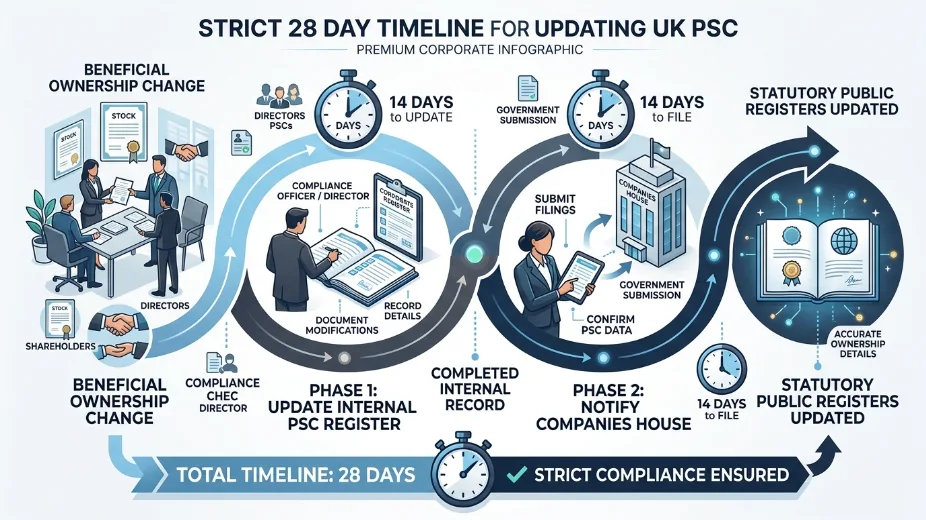
The dual-stage compliance timeline mandates fast administrative processing from company officers. Stage one begins immediately when a company becomes aware of an ownership shift. Directors have 14 calendar days to confirm all personal details with the beneficial owner.
Stage two governs public disclosure through central government databases. Filing updates with Companies House requires submitting official statutory forms within 14 days of internal register entry. Missing these statutory windows exposes company officers to regulatory enforcement actions.
Three primary statutory filing forms handle specific register updates:
File Form PSC01 to register new individual persons with significant control.
Submit Form PSC04 to update changed personal details for active PSCs.
Submit Form PSC07 to notification of a person ceasing to exert significant control.
What Are the Steps to Update Your PSC Register Correctly?
To update your PSC register correctly, you must confirm ownership changes, verify individual identity details, log updates internally, and file electronically. Completing these statutory validation steps guarantees legal accuracy across public company records.
What Are the Risks of Non-Compliance and Incorrect PSC Reporting?
The risks of non-compliance include uncapped corporate fines, director disqualifications, criminal prosecution, and severe commercial disruptions. Companies House enforces strict statutory penalties against businesses failing to maintain accurate beneficial ownership records.
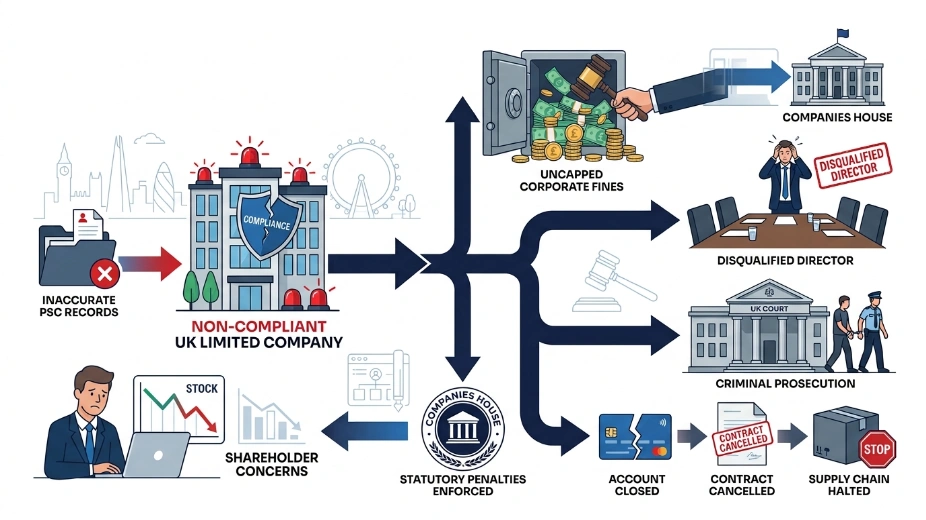
Directors who fail to track ultimate ownership face personal legal liabilities under criminal statutory provisions. Magistrates courts issue unlimited financial fines against non-compliant corporate entities and officers. Severe cases involving deliberate falsification carry potential prison sentences reaching two years.
Companies House actively issues formal restriction notices against non-responsive beneficial owners. Placing restriction notices on delinquent shares freezes underlying shareholder rights completely:
Nullify share transfer rights to prevent asset sales.
Suspend dividend payments and capital distributions.
Block voting capabilities during corporate general meetings.
Operational fallout extends into everyday business operations and funding activities. Financial institutions review public register accuracy before approving commercial lending facilities or business accounts. Errors on public records halt institutional investment deals during due diligence checks.
Preventing administrative compliance errors requires rigorous corporate governance structures. Businesses implementing robust identity verification protocols protect themselves against regulatory sanctions. Early risk identification prevents costly legal disputes during high-value commercial transactions.
For comprehensive regulatory risk mitigation, professional solutions streamline complex corporate filings. Establishing proactive oversight protocols ensures every share movement translates into accurate regulatory disclosures. Maintaining verified registers preserves complete legal standing across government databases.
Companies seeking guidance on regulatory accuracy can review common reporting mistakes to identify systemic record gaps. Businesses can secure comprehensive compliance support using specialized business verification tools. Protecting commercial assets requires adopting specialized enterprise fraud protection services to safeguard corporate identity data.
Explore our Fraud Protection guide,
Can Brunei Residents Open UK Companies? 2026 Breakdown
UK Company Formation from Burkina Faso: Challenges Explained
Frequently Asked Questions
How does the Form My Company fraud protection service prevent corporate identity theft?
The Form My Company fraud protection service prevents corporate identity theft by establishing continuous automated monitoring over your official Companies House records. The system detects unauthorized filings regarding director appointments, officer resignations, registered office changes, or share capital modifications. Real-time alerts notify business owners immediately if unexpected changes occur, enabling swift intervention to stop illegal account openings or contract obligations.
Who can enroll in the Form My Company fraud protection service?
Any active UK Limited Company or Limited Liability Partnership (LLP) can enroll in the Form My Company fraud protection service. The monitoring service applies to both newly incorporated businesses and existing UK companies regardless of where or when they were formed. Directors simply connect their registered Company Registration Number to activate automated corporate surveillance.
How does Form My Company fraud protection differ from the Companies House PROOF scheme?
The Companies House Protected Online Filing (PROOF) scheme restricts paper-based filings by requiring electronic submission codes. Form My Company fraud protection enhances security by delivering real-time digital monitoring and immediate notifications for all electronic filings submitted against a company. Combining automated watchdogs with statutory filing restrictions provides comprehensive corporate security against unauthorized alterations.
What notifications do directors receive with Form My Company fraud protection?
Directors receive instant electronic alerts whenever any statutory document or corporate update is lodged with the registrar under their company registration details. Alerts cover critical corporate administrative events, including shifts in registered office addresses, director changes, and updates to Persons with Significant Control (PSC) registers. Immediate notification gives management the exact timeline and filing details required to notify law enforcement and reverse fraudulent modifications.
Why is corporate fraud protection essential for UK businesses?
Companies House operates primarily on a good-faith filing policy, which means official documents are often processed online before deep manual verification occurs. Fraudsters can exploit this window to hijack corporate identities, change registered details, and fraudulently acquire credit, loans, or supply chain inventory. Active fraud protection from Form My Company safeguards business credit scores, legal standings, and corporate reputations from unauthorized hijacking.