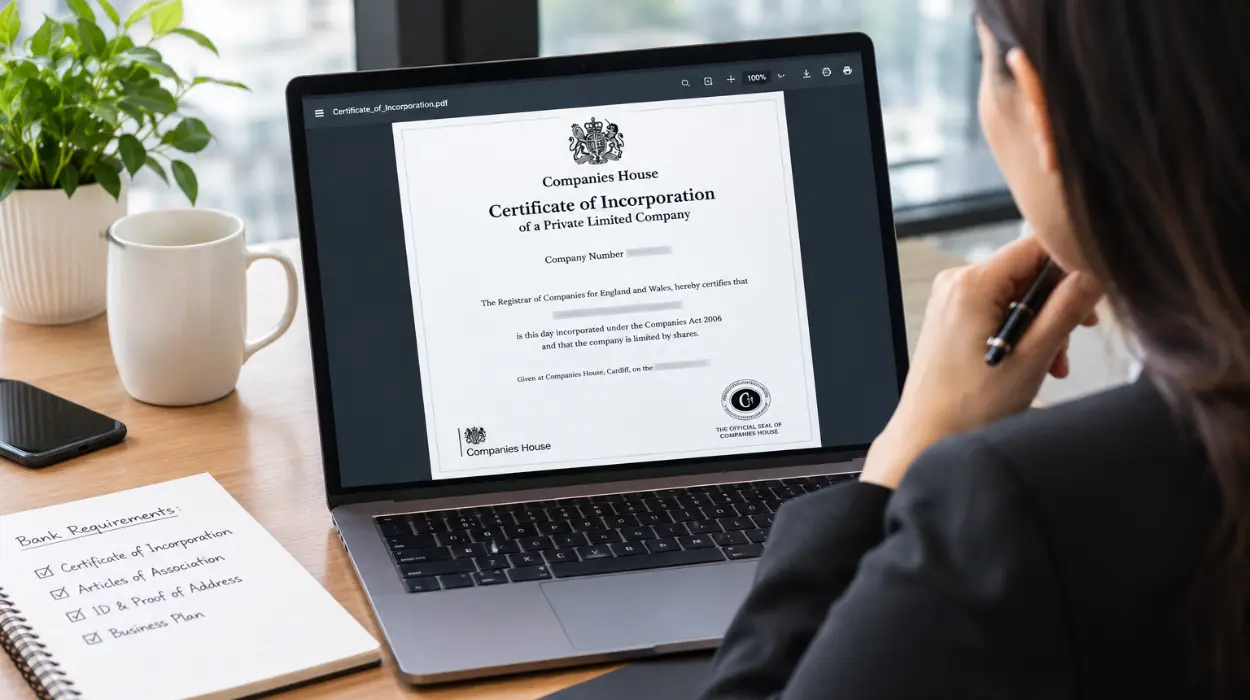
UK companies avoid PSC reporting mistakes by maintaining accurate registers, updating Companies House within 14 days of changes, and implementing proper identity validation protocols. Compliance failure risks unlimited fines, director disqualifications, and severe operational restrictions for non-compliant corporate entities.
What Are the Most Frequent PSC Reporting Mistakes UK Businesses Make?
The most frequent PSC reporting mistakes include failing to register changes within required statutory deadlines, submitting incorrect personal details, failing to identify indirect control structures, and ignoring initial notification requirements. These errors directly trigger compliance reviews by Companies House authorities.
Many UK businesses fail to understand the strict timeline requirements enforced by the Economic Crime and Corporate Transparency Act. Directors must update their internal register within 14 days of a change occurring. The company then has an additional 14 days to file this updated information with Companies House. Missing this total 28-day window creates a criminal offense for both the company and its individual officers.
Filing inaccurate personal details represents another massive vulnerability in corporate compliance. Common mistakes involve misspelling legal names, providing wrong service addresses, or recording incorrect residential details. Because identity verification rules require exact matches against official government databases, minor typographical errors cause immediate filings rejections.
Complex corporate structures frequently cause misidentification of ultimate beneficial owners. When a business operates under parent entities or corporate shareholders, directors often incorrectly list the corporate entity instead of tracing control up to a registrable individual. Companies must identify individuals holding more than 25% of shares, holding more than 25% of voting rights, or exercising significant influence over management.
Ignoring confirmation statement deadlines also creates severe administrative problems. Even when no corporate ownership changes occur during the accounting year, directors must explicitly confirm that PSC details remain accurate. Treating the PSC register as a static document leads to accidental reporting lapses and administrative dissolution notices from the registrar.
Why Is PSC Information Accuracy Critical for Corporate Standing?
PSC accuracy is critical because inaccurate records undermine legal transparency, delay corporate banking approvals, and trigger statutory enforcement penalties. Verified ownership registers protect business credibility and ensure seamless commercial operations across UK markets.
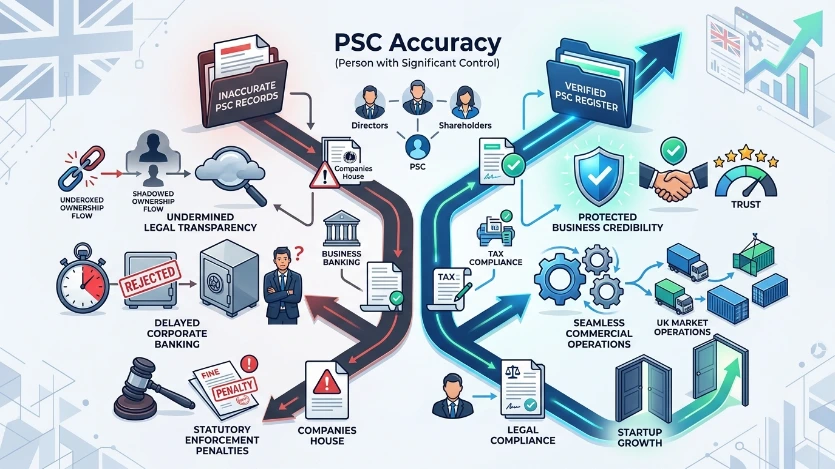
Public access to the Companies House register allows financial institutions, credit agencies, and business partners to verify corporate ownership instantly. When bank compliance teams discover discrepancies between submitted loan documentation and public PSC records, they freeze corporate accounts immediately. These verification delays disrupt daily cash flow and cause unnecessary operational downtime.
Inaccurate registers also expose companies to severe statutory penalties. Under UK law, directors who knowingly or recklessly supply false PSC information face unlimited financial fines and custodial sentences up to two years. Furthermore, Companies House actively places formal restrictions on company shares when beneficial owners fail to respond to official information notices.
Corporate transactions require impeccable ownership records during due diligence phases. Investors and buyers analyze the PSC history to confirm legal title to company assets. Discrepancies in historical filings complicate acquisitions, lower business valuations, and force sellers to fund expensive legal remediations before closing deals.
Accurate filings directly protect corporate identity integrity. Fraudulent filings by third parties often alter PSC details to hijack corporate assets or secure illegal credit lines. Companies must monitor their filings regularly to ensure unauthorized individuals do not register control over the business entity.
How Do You Correct Historical Errors on Your PSC Register?
Correct historical errors on your PSC register by conducting an internal record audit, issuing formal confirmation notices to beneficial owners, and submitting corrective RP04 forms to Companies House. Immediate remediation prevents legal escalation and restores corporate standing.
Rectifying mistakes begins with a comprehensive compliance audit of all existing PSC records. Directors must compare public filings on the Companies House register against actual company share registers, board minutes, and voting agreements. Identifying discrepancies early allows the business to establish an accurate timeline of ownership changes.
When information requires updating or clarification, directors must issue statutory information notices to suspected beneficial owners. The legal framework requires recipients to respond within one month of receiving notice. These formal notices create a verifiable paper trail showing that company officers exercised reasonable diligence to maintain accurate corporate records.
Once you establish correct details, submit the appropriate amendment forms to Companies House. Use form RP04 to correct historical errors in previously filed statutory documents. When removing an incorrectly listed individual, file the necessary cessation notices alongside updated registration details for the true person with significant control.
Proactively managing register changes requires clear internal communication processes. Reviewing guidelines like Transparency Rules: Managing Your PSC Register During Business Changes helps directors establish structured protocols during corporate reorganizations. Clear internal workflows ensure ownership adjustments trigger timely statutory filings every time.
How Does Identity Verification Prevent PSC Filing Errors?
Identity verification prevents PSC filing errors by authenticating individual credentials against government databases before statutory submission. Validating identity details ensures filing data matches official records and eliminates registration rejections.
Mandatory identity verification changes how UK companies process PSC data. Directors and beneficial owners must prove their identity using official identity verification services before submitting official forms. Three primary verification methods: passport checks, biometric facial scans, and physical address validation confirm individual identities.
Automated verification tools eliminate human error during information intake. Manual entry of names, birth dates, and nationalities frequently introduces typos that invalidate corporate filings. Digital validation systems extract data directly from verified identity documents, guaranteeing absolute precision across all Companies House submissions.
Verifying beneficial owners deters fraudulent corporate registrations effectively. Fraudsters regularly attempt to register dummy PSCs or use stolen identities to obscure illicit financial activities. Implementing rigorous verification checks stops unauthorized individuals from appearing on public records.
Businesses protecting their corporate identity should consider comprehensive defense mechanisms. Applying robust fraud protection for UK companies secures official corporate records against unauthorized filings and identity theft attempts. Active security monitoring ensures only verified corporate officers alter statutory company registers.
What Steps Ensure Ongoing PSC Compliance for UK Businesses?
Ensure ongoing PSC compliance by assigning specific compliance responsibilities, setting automated review reminders, conducting quarterly audits, and partnering with verified corporate service providers. Systematic oversight guarantees compliance across all business changes.
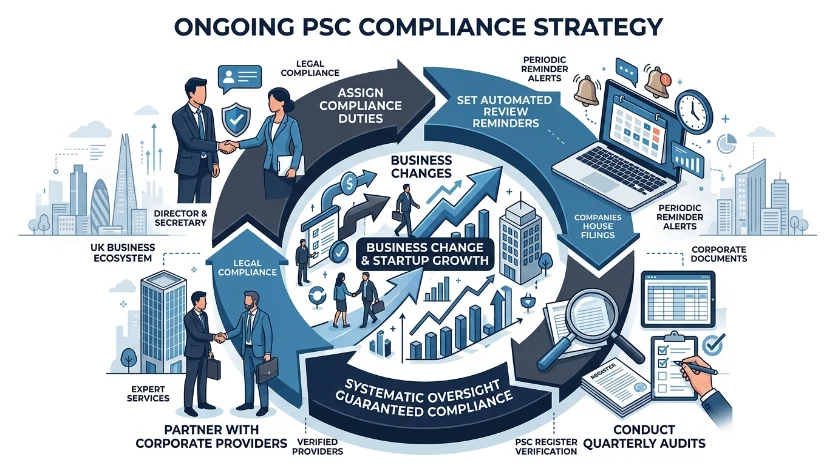
Maintaining continuous compliance requires dedicated internal oversight. Assign specific administrative responsibilities to qualified company secretaries or compliance officers. When a single professional monitors statutory obligations, company updates proceed without administrative delays or overlooked filing deadlines.
Implement automated calendar reminders tied to company anniversary dates and statutory deadlines. Set alerts 30 days prior to annual confirmation statement due dates. These automated systems give management adequate time to confirm beneficial ownership details before filing official documents with Companies House.
Conduct quarterly corporate record reviews to identify unrecorded ownership shifts. Minor equity transfers, changes in voting rights, or altered board structures frequently impact PSC status without immediate executive awareness. Regular reviews ensure company registers reflect real-time operational structures accurately.
Professional support simplifies ongoing regulatory compliance significantly. You can Ensure Your Business Standing is Verified by Form My Company to maintain total statutory compliance and secure official corporate records. Expert management eliminates regulatory guesswork and protects officers from enforcement actions.
Maintaining an accurate PSC register is a strict statutory requirement for all UK companies. Businesses must systematically record beneficial ownership, submit timely updates to Companies House, and validate individual credentials. Avoiding common reporting mistakes protects company officers from legal penalties, prevents commercial disruptions, and preserves corporate reputation. Form My Company delivers comprehensive corporate compliance solutions that keep your business fully verified, secure, and compliant with evolving UK business legislation.
Explore our Fraud Protection guide,
How East Timor Residents Can Set Up a UK Company and Operate Internationally
How Ecuador Residents Can Register a UK Company and Handle Cross-Border Sales
Frequently Asked Questions
How does company fraud protection prevent unauthorized changes at Companies House?
Company fraud protection monitors official corporate registers in real time to alert directors of any unauthorized attempts to alter company details, directors, or registered addresses. By intercepting illegal submissions immediately, services like the Fraud Protection package from Form My Company prevent identity hijackers from accessing corporate credit or transferring company assets.
Why do UK businesses need specialized corporate identity theft protection?
UK businesses require corporate identity theft protection because public filings on Companies House can be targeted by fraudsters seeking to exploit corporate standing for fraudulent loans or illegal trading. Implementing targeted security controls, such as the Fraud Protection service offered by Form My Company, ensures that only verified corporate officers can execute official statutory filings and structural updates.
Can fraudsters register false Persons with Significant Control (PSC) details?
Yes, unauthorized third parties can attempt to submit fraudulent PSC filings to misrepresent ownership control or obscure illicit corporate activities. Enrolling in the Fraud Protection program from Form My Company establishes strict record validation and continuous monitoring to detect and block unauthorized PSC amendments before they compromise legal compliance.
What happens if an unauthorized person files a change of registered office address?
An unauthorized address change allows fraudsters to intercept official government mail, legal notices, and corporate financial documents without the business owners’ knowledge. Using the Fraud Protection service from Form My Company ensures immediate notification upon any filing attempt, allowing legal officers to reverse fraudulent address changes with Companies House right away.
How do I protect my UK company from corporate identity theft?
You can protect your business by restricting paper filings, enforcing digital authentication protocols, and setting up real-time registry alerts. Utilizing the Fraud Protection solution provided by Form My Company secures statutory registers, mitigates unauthorized corporate filings, and maintains absolute transparency across all public records.